

Background music for events is audio played to create atmosphere and influence mood without demanding your guests’ active attention. Done right, it fills silence, eases social tension, and shapes how people feel without anyone consciously noticing it. Here is what you need to act on right away:
- Choose instrumental or acoustic styles for most event phases — they support conversation instead of competing with it.
- Set volume so guests can talk comfortably without raising their voices. That is your baseline.
- Decide live vs. recorded early. Live performers adapt in real time; recorded playlists are predictable and lower cost.
- Success check: conversations flow naturally, phase transitions feel smooth, and guests leave remembering the mood.
Table of Contents
- Why background music matters for your event
- Music styles that work best as background music
- When and how to use music through your event timeline
- Live performers vs. recorded playlists: which fits your event?
- Practical logistics for hiring a sitarist
- Budget and pricing for background music in the U.S.
- U.S. public performance licensing: what planners must know
- How to select and vet a live sitarist or music provider
- Sample sitar repertoire for common event types
- Key Takeaways
- Why sitar works as background music, from the artist’s perspective
- Book Sitarrajib for your next event
- Useful sources and resources
Why background music matters for your event
Music is the element guests remember most emotionally, yet planners routinely spend more on florals than on sound. That is a real budget misalignment. Music shapes memory and emotional response more than decor or lighting, and a live performer can adjust volume, tone, and tempo in real time as the room changes.
Music at corporate events is not decoration. It is an emotional signal that shapes trust, connection, and how attendees remember your brand long after they leave the room.
The practical upside for planners: music used strategically can ease networking, extend guest dwell time when you want it, and smooth the energy between program segments. That makes it planning infrastructure, not a nice-to-have line item.
Music styles that work best as background music
Instrumental and acoustic styles are the safest choices for formal and professional events because they minimize distraction and let conversation happen naturally. Here is a quick style map:
- Instrumental/acoustic: Works across nearly every event type. Guitar, piano, and chamber strings are reliable defaults.
- Light jazz: Ideal for cocktail hours and corporate receptions. Familiar enough to feel warm, unobtrusive enough to disappear.
- Ambient/world fusion: Good for lounge areas, pre-event arrivals, and multicultural gatherings.
- Sitar and raga-based pieces: Strong fit for ceremonies, cultural celebrations, South Asian weddings, fusion cocktail hours, and any event where a distinctive sonic identity matters. Sitar music suits ceremonies particularly well because its meditative quality holds attention without demanding it.
- Styles to avoid for background: Lyric-heavy pop, aggressive electronica, and driving sub-bass all compete with speech and shift focus away from guests.
Pro Tip: When programming culturally specific music for a mixed audience, blend sitar-led instrumental sets with lighter neutral accompaniment. Keep individual pieces shorter (3–5 minutes) during cocktail hours so the music stays present without becoming a focal point.
When and how to use music through your event timeline
Mapping music to event phases is the most reliable way to control atmosphere. Assign each segment a target energy level and build a short playlist for it.
- Arrival and check-in. Warm, low-tempo, lyric-free music. Guests are orienting themselves; the music should reduce social anxiety, not add stimulation.
- Cocktail and networking. Conversational volume, mid-tempo instrumental or sitar lounge sets. Sitar music benefits for cocktail hours include a natural meditative quality that keeps energy relaxed and social.
- Dinner and seated program. Lower volume, sparser arrangements. Avoid anything lyrical that conflicts with speakers or toasts.
- Speeches and presentations. Music off or nearly silent. Bring it back softly during applause transitions.
- Phase transitions. Use tempo as an invisible cue: a brief up-tempo motif signals movement; a slower passage encourages guests to settle. No announcement needed.
- Wrap-up and send-off. A purposeful finale or signature track creates an emotional echo guests carry home.
Live performers vs. recorded playlists: which fits your event?
Both have a place. The decision comes down to budget, event type, and how much responsiveness you need.

| Factor | Live performer | Recorded playlist |
|---|---|---|
| Adaptability | Reads the room, adjusts in real time | Static; cannot respond to mood shifts |
| Cost | Higher; includes rider and travel | Lower; streaming or licensed files |
| Technical needs | Stage, mic/DI, monitor, sound check | PA system and playlist management |
| Guest impact | Higher emotional engagement | Consistent and predictable |
| Best fit | Premium receptions, weddings, cultural events | Trade floors, large networking halls |
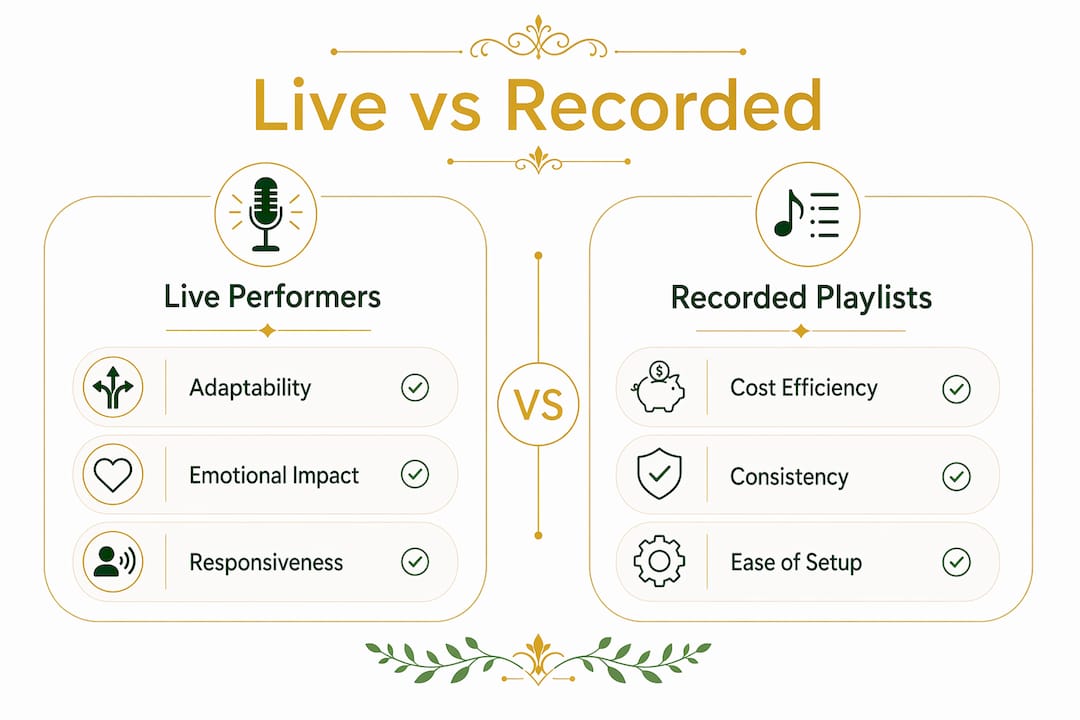
Live performers function as an emotional engine precisely because they can change tempo, dynamics, and repertoire as the room shifts. A recorded playlist cannot do that. For corporate sitar performances, the live advantage is especially clear: a sitarist who reads the room can hold a quiet cocktail energy for 45 minutes and then lift the tempo naturally as dinner service begins, with no DJ cue needed.
The impact of live music at events consistently outperforms recorded options on guest recall and emotional connection, which matters most at premium corporate receptions and weddings.
Practical logistics for hiring a sitarist
Book early and communicate the technical requirements clearly. Here is what you need to know.
Booking timeline:
- Solo sitar at private events: book several weeks in advance
- Corporate receptions: plan well ahead, ideally a few months before
- Festivals or commissioned compositions: allow ample lead time, often several months
Essential rider items:
- Stage footprint: minimum 8 ft × 8 ft clear floor space
- Microphone/DI: one condenser mic on a low boom stand plus one DI line for pickup output
- Monitor: one floor wedge or in-ear feed for low-latency foldback
- Seating: one armless chair or low performance seat (no stool with a back)
- Power: one standard 120V outlet within 10 ft of the performance area
- Break schedule: 45–50 minutes on, 10–15 minutes off for sets longer than 90 minutes
| Technical input | Specification | Notes |
|---|---|---|
| Microphone | Condenser, low boom stand | Positioned 12 inches from resonator |
| DI line | Passive or active DI box | For piezo pickup output |
| Monitor send | Pre-fader aux send | Low latency preferred |
| Stage power | 120V/15A outlet | Within 10 ft of performance position |
| Stage size | 8 ft × 8 ft minimum | Clear of cables and foot traffic |
Pro Tip: Brief your house sound engineer to keep sitar in the mid-range and pull back low-end EQ slightly. Sitar resonance can build in reflective rooms; a gentle high-pass filter around 80 Hz keeps the mix clean without thinning the sound.
For full sitar performance logistics guidance, including load-in checklists and on-site contact protocols, the Sitarrajib site has a dedicated planner resource.
Budget and pricing for background music in the U.S.
Prices vary by format, market, and rider complexity. Use these ranges as planning benchmarks.
| Format | Base fee range | Common add-ons |
|---|---|---|
| Curated recorded playlist service | $200–$500 | Licensing fees, PA rental |
| Solo sitarist (2–3 hour event) | $800–$2,000 | Travel, extended sets |
| Duo or trio ensemble | $1,500–$4,000 | Rehearsal time, extra equipment |
| Festival or commissioned booking | $3,000 and up | Accommodation, production fees |
Factors that move price up: travel beyond 50 miles, union or festival venue fees, amplified outdoor setups, and rehearsal time for custom repertoire. Always clarify:
- Deposit amount and schedule (typically 25–50% to hold the date)
- Cancellation and rescheduling terms
- Overtime rates per 30-minute increment
- Whether travel and accommodation are included or billed separately
U.S. public performance licensing: what planners must know
In the U.S., public performance of copyrighted music requires a license. Three performing rights organizations handle this: ASCAP, BMI, and SESAC. Most venues that regularly host events hold blanket licenses from one or more of these organizations. Your job as a planner is to confirm that coverage applies to your specific event.
Playing a Spotify playlist at a public event without a venue blanket license is not covered by your personal streaming subscription. Licensing responsibility falls on whoever controls the music at the event.
Action checklist:
- Confirm with the venue whether their blanket license (ASCAP, BMI, and/or SESAC) covers your event type and date.
- If you are bringing in an outside AV company or DJ, ask them to document their licensing coverage.
- For recorded playlists you control, verify that the venue license extends to your use or secure a separate license.
- Live renditions of copyrighted songs may still require performance reporting to the relevant PRO.
- Original compositions and public-domain repertoire (traditional ragas, classical Indian pieces) reduce licensing complexity considerably.
How to select and vet a live sitarist or music provider
A short, structured vetting process saves you from last-minute surprises.
- Confirm musical fit. Ask for a sample recording or video from a comparable event type.
- Review technical capacity. Does the performer have a written rider? Can they work with your venue’s PA system?
- Check references. Request two or three contacts from recent events of similar scale.
- Verify insurance. Ask for a certificate of liability insurance, especially for corporate and festival bookings.
- Read the contract. Confirm cancellation terms, overtime rates, and what happens if the performer is ill.
Sample questions to ask:
- What ragas or styles do you recommend for a 90-minute cocktail hour with a mixed audience?
- Can you adjust tempo and volume in real time based on room energy?
- What is your backup plan if you cannot perform?
- Do you handle your own sound setup or do you need a dedicated engineer?
Red flags: evasive answers on licensing, no written rider, inability to provide references, or vague availability claims without a signed hold.
A simple 1–5 scorecard across musical fit, technical readiness, references, contract clarity, and communication speed gives you a fast comparison when evaluating multiple performers.
Sample sitar repertoire for common event types
Cocktail hour (30–45 minutes)
- Yaman-based instrumental: Bright, evening raga with an open, welcoming feel. Good opener as guests arrive and settle.
- Light fusion set: Sitar melody over soft percussion and ambient pads. Familiar enough for non-classical audiences.
- Bhairavi-inspired piece: Gentle, slightly melancholic tone. Works well as the cocktail hour winds down toward dinner.
Dinner set (45–60 minutes)
- Slow Kafi or Bhimpalasi arrangement: Sparse, meditative. Sits quietly under conversation without disappearing.
- Interstitial cues between courses: 60–90 second motifs that signal a pause without stopping the music entirely.
- Closing passage: A gradual tempo reduction over the final 10 minutes cues guests that the dinner program is ending.
For mixed audiences, favor culturally respectful programming by keeping pieces shorter and avoiding extended complex ragas that require prior familiarity to appreciate fully.
Key Takeaways
Background music for events works when it supports conversation, maps to each event phase, and stays compliant with U.S. licensing requirements.
| Point | Details |
|---|---|
| Define the volume rule | Guests should converse comfortably without raising their voices — that is your volume ceiling. |
| Map music to event phases | Assign a target energy level to each phase (arrival, cocktail, dinner, send-off) and build a short playlist per segment. |
| Live vs. recorded decision | Choose live performers for premium receptions and weddings; use curated recordings for large trade floors or tight budgets. |
| Confirm licensing before the event | Check whether the venue holds ASCAP, BMI, or SESAC blanket coverage; original or public-domain repertoire reduces complexity. |
| Sitarrajib for live cultural music | Rajib Karmakar offers solo sitar sets, ensembles, and workshops tailored to corporate events, weddings, and festivals across the U.S. |
Why sitar works as background music, from the artist’s perspective
Most planners ask me what kind of music to play. The better question is what you want guests to feel at each moment. Sitar has a natural quality that sits in a room without dominating it. Its resonance fills silence without demanding attention, which is exactly what background music is supposed to do.
What planners rarely hear from vendors: you do not need musical knowledge to brief a sitarist well. Tell me the guest demographics, the event tone (formal, celebratory, contemplative), and the program flow. That is enough. A good sitarist translates that into raga selection and tempo choices in real time. If the room gets louder and more energetic, the playing lifts with it. If a speaker is about to take the stage, the music tapers naturally.
The one thing I would ask every planner to do: share the run-of-show at least a week before the event. Knowing when speeches start, when dinner service begins, and when the finale happens lets the music serve the program instead of working against it.
Book Sitarrajib for your next event
Sitarrajib brings live sitar performance to corporate receptions, weddings, festivals, and cultural events across the U.S. Rajib Karmakar performs solo sets, leads duo and trio ensembles, and offers workshops and cultural music experiences that go beyond a standard entertainment booking.
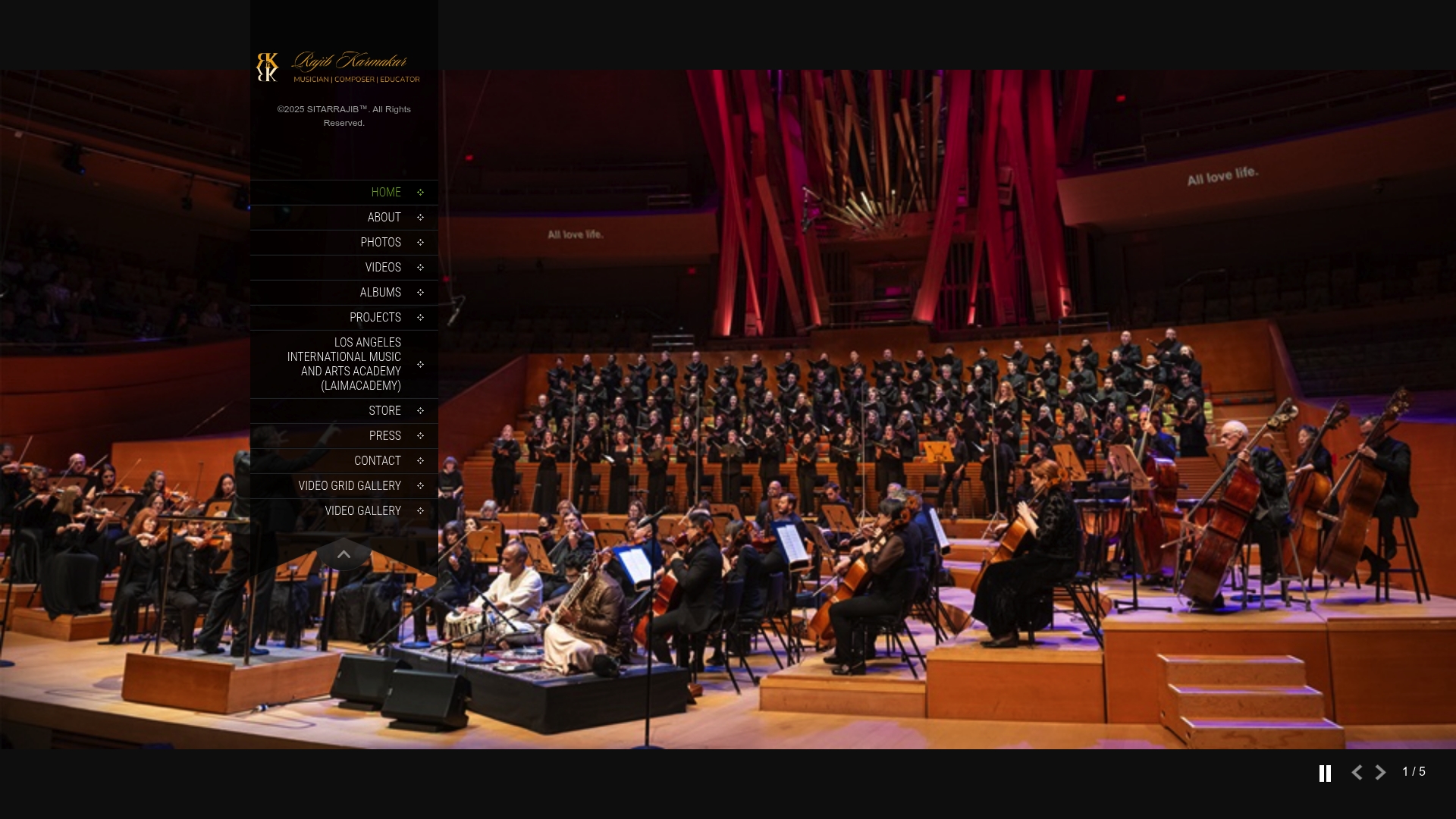
What you get when you book: a written technical rider, a sample setlist tailored to your event type, and direct communication with Rajib on program flow and guest demographics. Lead time starts at 4–8 weeks for private events and 8–12 weeks for corporate bookings. A 25–50% deposit holds your date.
Ready to add live sitar to your program? Review the corporate event performance details or check the full technical requirements to share with your production team. Contact Sitarrajib directly at sitarrajib.com to check availability.
Useful sources and resources
- Background music (Wikipedia) — Comprehensive overview of background music history, research, and use in commercial and event settings.
- Event Background Music: 4 Things Planners Should Know (Social Tables) — Practical guidance on style selection and volume for professional events.
- How Music Shapes the Mood of an Event (The Rhythm Story) — Research-backed case for prioritizing music over visual elements in event planning.
- How Music Shapes Trust, Connection and Memory at Live Events (The Drum) — Editorial perspective on music as strategic infrastructure at corporate events.
- 3 Steps for Choosing Background Music (Eventective) — Step-by-step guide covering mood, playlist creation, and U.S. licensing basics.
- ASCAP, BMI, SESAC — The three U.S. performing rights organizations where planners can verify licensing coverage or apply for a public performance license.
- Sitarrajib — technical rider and booking — Full technical rider, sample setlists, and booking contact for Rajib Karmakar’s live sitar performances.