
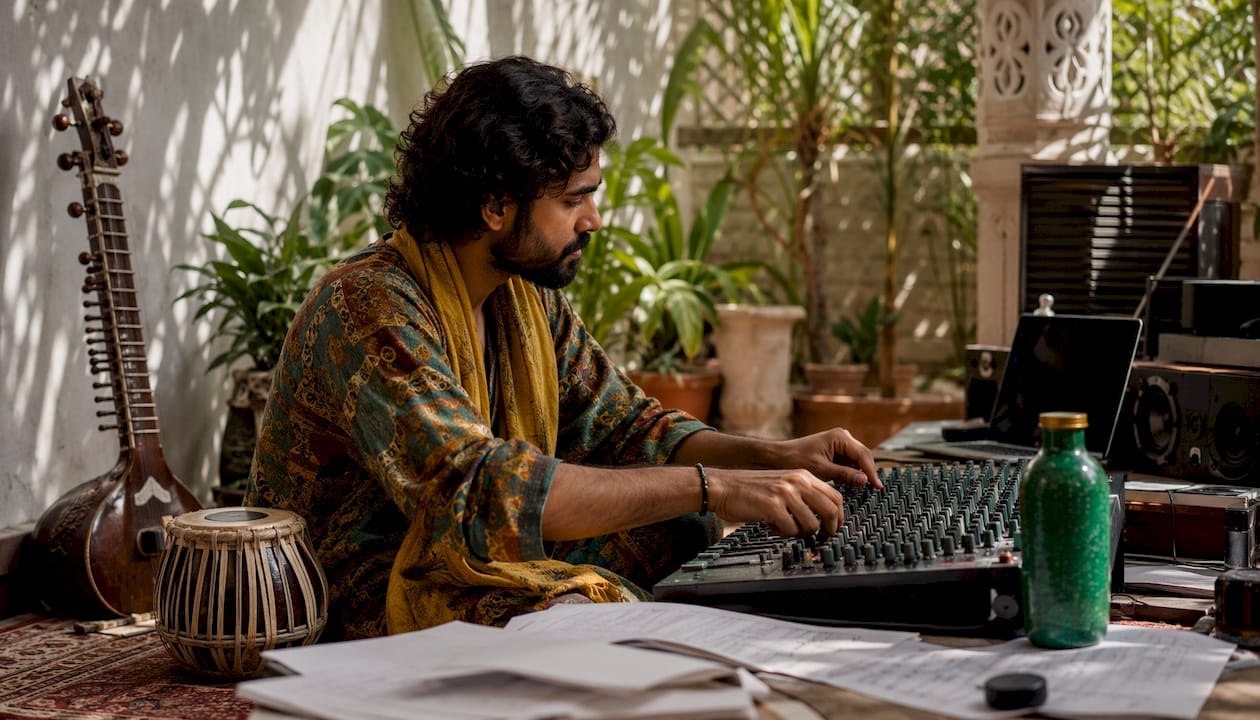
Three films show you exactly what fusion soundscapes in Hollywood can do: The Guru (2002) layers sitar textures over orchestral strings to build cultural identity; Blade Runner 2049 (2017) fuses acoustic sources with synthesized processing for psychological disorientation; and Salaam Bombay! (1988) weaves raw acoustic Indian motifs into ambient jazz to ground characters in place. Each one treats the non-Western instrument as a narrative tool, not decoration.
- The Guru — sitar + orchestral strings; function: cultural world-building and character identity
- Blade Runner 2049 — acoustic instruments + synthesized textures; function: psychological tension and alien familiarity
- Salaam Bombay! — acoustic Indian motifs + jazz-ambient; function: emotional memory and place
Sitarrajib’s Rajib Karmakar, a Los Angeles-based sitarist and composer, works in exactly this tradition. Scholars like Professor Helen Hanson and sound designers like Mark Mangini have each described the same core principle: music in these films acts as a character, not a backdrop.
Table of Contents
- What do the best Hollywood fusion soundscapes actually combine?
- How Sitarrajib’s work maps to these Hollywood examples
- How Hollywood fusion soundscapes are actually built
- Adapting Hollywood-style fusion for live events
- Creative and ethical considerations for Indian classical fusion
- Hollywood fusion beyond Indian classical: Latin, African, and Middle Eastern examples
- Step-by-step compositional techniques for fusion soundscapes
- How to collaborate well with traditional musicians and sound designers
- Key Takeaways
- Why fusion soundscapes matter for live events
- Sitarrajib brings Hollywood-style fusion to your event
- Further reading and sources
What do the best Hollywood fusion soundscapes actually combine?
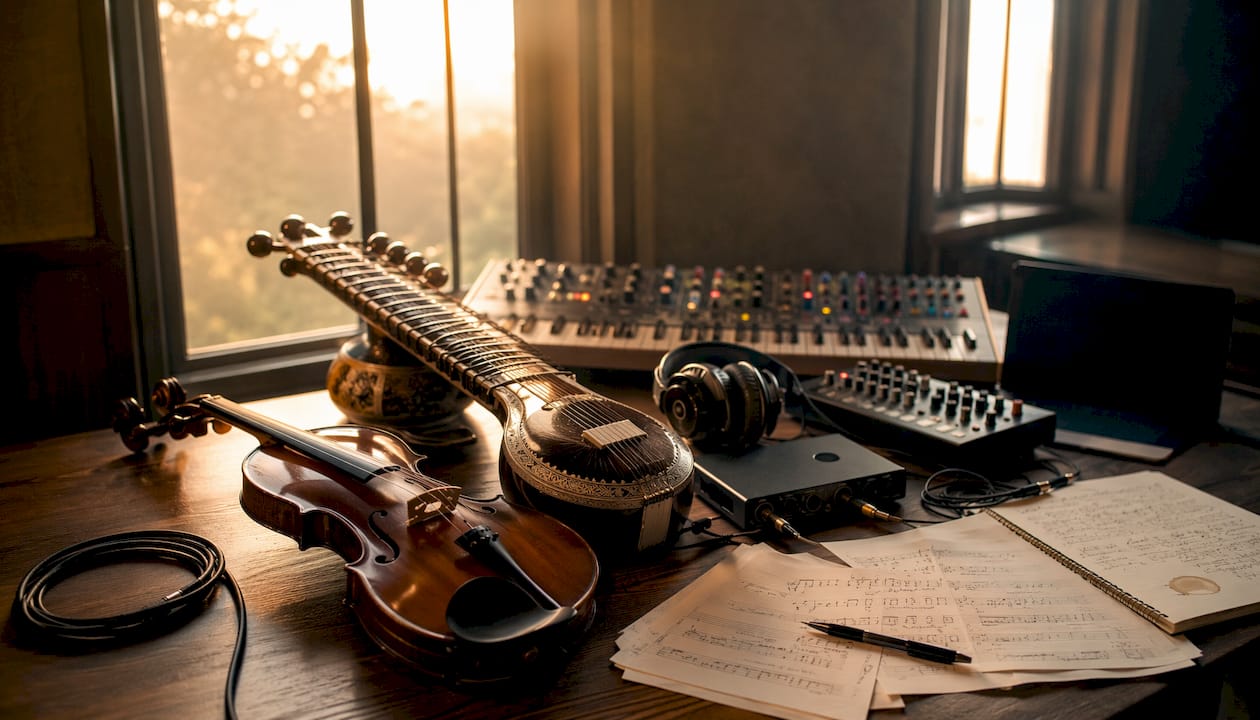
Hollywood’s most cited fusion soundtracks in films don’t just layer world instruments on top of an existing score. They restructure the whole sonic architecture around those instruments.
Blade Runner 2049 (2017)
Composer Hans Zimmer and Benjamin Wallfisch built the score around processed acoustic sources. Mark Mangini, the film’s supervising sound designer, describes world-building in sound design as creating textures that feel “jarringly human” by combining acoustic performers with synthesized manipulation. The result sits between music and sound effect, which is exactly what makes it unsettling.
Salaam Bombay! (1988)
L. Subramaniam’s score keeps acoustic Indian instruments close to their natural timbre. The AllMusic review notes that raw acoustic moments provide more compelling contrast than polished production. The restraint is the technique.
The Guru (2002)
Sitar lines carry the protagonist’s cultural duality. The instrument isn’t ambient texture; it marks specific emotional turning points in the story.
Jazz-ambient hybrids
Films like Blue (1993) and Lost Highway (1997) stretch muted trumpet and acoustic strings into ambient textures. Surveys of jazz-ambient fusion in film show this approach works particularly well for internal psychological states because it resists melodic hand-holding and uses texture instead.
| Film | Fusion elements used | Primary narrative function |
|---|---|---|
| Blade Runner 2049 | Acoustic instruments + synthesized processing | Psychological tension, alien familiarity |
| Salaam Bombay! | Acoustic Indian motifs + jazz-ambient | Emotional memory, place |
| The Guru | Sitar + orchestral strings | Cultural identity, character psychology |
| Lost Highway | Muted trumpet + ambient electronics | Psychological fragmentation |
Professor Helen Hanson frames Hollywood fusion as a world-building strategy: music acts as a character that shapes viewers’ emotional perception of film environments, not merely a tonal layer added in post-production.
Sound designer Mark Mangini emphasizes that frequency balancing between music and environmental effects is where most fusion scores succeed or fail — coexistence without clarity loss is the technical goal.
How Sitarrajib’s work maps to these Hollywood examples
Rajib Karmakar is a sitarist, composer, and educator based in Los Angeles. He performs and records across concert, festival, corporate, and film contexts, blending Indian classical music with orchestral, electronic, and ambient sounds.
Rajib’s live arrangements treat the sitar as a narrative carrier — the same structural role it plays in the Hollywood examples above. The instrument carries emotional weight in each cue rather than serving as surface texture.
Two live formats he regularly adapts for staged events:
Quartet format: Sitar with cello, tabla, and ambient synth. This mirrors the acoustic-plus-electronic hybrid used in Blade Runner 2049 and works well for mid-size concert halls or corporate galas where you want presence without a full orchestra.
Solo with electronic textures: Sitar over backing electronic pads and processed ambient layers. Closer to the Salaam Bombay! model, this format suits intimate venues and ceremonies where a raw acoustic moment needs to land clearly.
You can preview Rajib’s live concert footage and listen to recorded arrangements on his album page before reaching out.
How Hollywood fusion soundscapes are actually built
The most reliable technique is structural integration: assign the traditional instrument a specific narrative job before you write a single note.
Electroacoustic composition tools let composers treat environmental recordings as musical material, expanding the palette well beyond conventional orchestration. Specific methods that transfer directly to live contexts:
- Frequency carving: Cut the low-mid range (roughly 200–400 Hz) on tabla or mridangam so it sits cleanly under cello or bass. Reserve the upper register for sitar’s characteristic sparkle.
- Pitch-bending and meend: Use the sitar’s natural glide technique to carry melodic transitions that Western strings can’t replicate. This is a narrative tool, not an ornament.
- Textural treatment: Run acoustic instruments through light convolution reverb to place them in a shared acoustic space with electronic elements without erasing their natural character.
- Hybrid orchestration: Write the sitar part as a lead voice with its own harmonic function, then build strings and synth pads around it rather than underneath it.
- Improvisation vs. written cues: Leave specific sections open for idiomatic improvisation. Orchestral-jazz fusion scores use friction between structured and improvisational elements deliberately to engage rather than soothe.
Mixing checklist for music + SFX clarity:
- Carve low-mid on percussion to keep kick and tabla from masking each other
- Reserve 8–12 kHz for percussive SFX and sitar harmonics
- Use gentle sidechain compression on ambient pads when dialogue or SFX hit
- Place sitar center-to-slightly-right in the stereo field; ambient pads wide; strings mid-width
Pro Tip: Lock frequency allocations with your sound design team before the final mix session. Decisions made in post about who owns which frequency range are nearly impossible to undo cleanly once stems are printed.
Adapting Hollywood-style fusion for live events
A typical live adaptation runs several weeks from concept to performance night.
- Week 1–2: Define the narrative arc of the set. Which moments are tension, which are release? Assign instrument roles before arranging.
- Week 2–4: Commission or adapt arrangements. Decide which sections are written and which allow improvisation.
- Week 4–6: Recruit personnel: sitarist, percussionist (tabla or cajon), strings (one or two players), synth/FX operator.
- Week 6–8: First full rehearsals with all players. Focus on idiomatic phrasing for traditional musicians.
- Week 8–10: Tech run with full PA. Check monitoring, DI signal from sitar pickup, and ambient pad levels.
- Week 10–12: Final dress rehearsal and soundcheck. Lock the mix.
| Phase | Typical duration | Ballpark cost (U.S. market) |
|---|---|---|
| Concept and arrangement | several weeks | moderate cost |
| Rehearsals | several weeks | moderate cost |
| Tech run and soundcheck | a few days | moderate cost |
| Performance (single event) | 1 day | varies widely |
Figures vary significantly by scope, ensemble size, and market rates.
Pro Tip: Build at least one unprocessed acoustic moment into the set. Critics and audiences consistently respond to raw sitar or tabla passages more strongly than to fully produced fusion sections. Leave space for the instrument to breathe.
See sitar performance logistics for a detailed planning checklist.
Creative and ethical considerations for Indian classical fusion
Fusion must be structural, not decorative. Using a sitar riff as an intro sting and then dropping it entirely is the definition of tokenistic sampling. It signals to audiences and musicians alike that the tradition wasn’t taken seriously.
Do:
- Hire musicians who actually practice the tradition, not just players who can approximate the sound
- Credit the raga, tala, or regional tradition the material draws from in program notes
- Allocate rehearsal time specifically for idiomatic phrasing — Indian classical ornamentation doesn’t transfer from sheet music alone
- Understand world music fusion as a structural approach, not a surface aesthetic
Don’t:
- Sample traditional recordings or chants without securing rights and documenting provenance. See licensing Indian classical music for practical guidance.
- Pitch-shift or time-stretch traditional recordings without the original artist’s consent
- Present a fusion arrangement as “authentic” Indian classical music — be clear about what it is
Pro Tip: When collaborating with a traditional musician for the first time, ask them to demonstrate the raga or tala you’re working with before you write anything. What you hear will change your arrangement.
Hollywood fusion beyond Indian classical: Latin, African, and Middle Eastern examples
Indian classical is the most discussed tradition in Hollywood fusion, but it’s far from the only one. Cultural music exchange across film scoring shows several other traditions doing similar structural work.
Latin percussion + orchestral: Gustavo Santaolalla’s scores for Babel (2006) and Brokeback Mountain (2005) use ronroco and sparse Latin percussion as primary melodic voices. The orchestral elements support rather than lead.
African polyrhythm + electronic: Hans Zimmer’s work on The Lion King (1994) integrates West African percussion cycles into a full orchestral and choral framework. The tala-like rhythmic cycles function as structural anchors, not color.
Middle Eastern maqam + strings: Alexandre Desplat’s score for The Queen of Katwe (2016) and Ennio Morricone’s work on several international co-productions use maqam-based melodic lines over Western string arrangements, creating harmonic tension that neither tradition produces alone.
Each of these works because the non-Western element carries a specific narrative function. You can explore jazz-ambient and lo-fi fusion examples at Hot Mic Radio for additional reference listening.
Step-by-step compositional techniques for fusion soundscapes
These steps apply whether you’re writing for film or adapting for a live event.
- Choose your rhythmic framework first. Indian talas (like Teentaal at 16 beats) and West African 12/8 cycles don’t map neatly onto 4/4. Decide early whether you’re adapting the traditional cycle or writing Western rhythm around it.
- Assign harmonic roles. Pick a raga or maqam and identify which Western scale it most closely resembles. Then write your Western harmonic progressions to highlight the differences, not erase them.
- Write the traditional instrument part first. Let it set the melodic and rhythmic identity of the cue. Add orchestral and electronic layers after.
- Use call-and-response between traditions. A sitar phrase answered by a cello line, or a tabla break answered by a kick and synth hit, creates dialogue rather than layering.
- Leave space. Fusion scores that feel overproduced usually have no silence. A single unaccompanied sitar phrase resets the listener’s ear and gives the next full-ensemble moment more impact.
- Test the arrangement acoustically before adding electronics. If the sitar and strings don’t work together unplugged, processing won’t fix it.
How to collaborate well with traditional musicians and sound designers
The biggest friction point in fusion projects is usually communication, not musicianship. Traditional musicians and Western-trained composers often use completely different vocabulary for the same concepts.
With traditional musicians:
- Share a reference recording, not just a lead sheet. Indian classical notation doesn’t capture ornamentation.
- Discuss the emotional function of each section before rehearsal. A musician who understands why a passage exists will make better decisions than one following instructions.
- Build in extra rehearsal time for the first project together. Idiomatic phrasing takes time to settle.
With sound designers:
- Share stems early. A sound designer who hears the sitar part in isolation can make better frequency decisions than one working from a full mix.
- Agree on which acoustic moments stay raw and which get processed. This decision shapes the whole mix.
- Sitar recording techniques matter at the capture stage. A well-recorded sitar gives the sound designer more to work with.
The sitar crossover collaboration process Rajib uses on cross-genre projects is a good model for how to structure these conversations from day one.
Key Takeaways
Hollywood fusion soundscapes work when the traditional instrument carries narrative weight, not when it’s used as surface texture.
| Point | Details |
|---|---|
| Use film references early | Blade Runner 2049, Salaam Bombay!, and The Guru give organizers and composers a shared vocabulary before a note is written. |
| Structural integration is the rule | Assign the sitar, tabla, or world instrument a specific narrative job — tension, memory, identity — before arranging. |
| Plan for 6–12 weeks | A live fusion adaptation from concept to performance typically needs this window for arrangements, rehearsals, and tech runs. |
| Leave acoustic moments unprocessed | Raw passages consistently land harder with audiences than fully produced fusion sections. |
| Book Sitarrajib for live fusion | Rajib Karmakar performs and commissions fusion arrangements for concerts, festivals, and corporate events from Los Angeles. |
Why fusion soundscapes matter for live events
Fusion makes music a character in the room, not just a soundtrack. When a sitar line carries the emotional arc of a scene or a live set, the audience tracks it the way they track a person. That’s a different kind of engagement than background music, and it’s what separates a memorable event from a forgettable one. If you’re planning a live fusion performance, preview the video archive and ask for a short reference arrangement before you commit to a full program.
Sitarrajib brings Hollywood-style fusion to your event
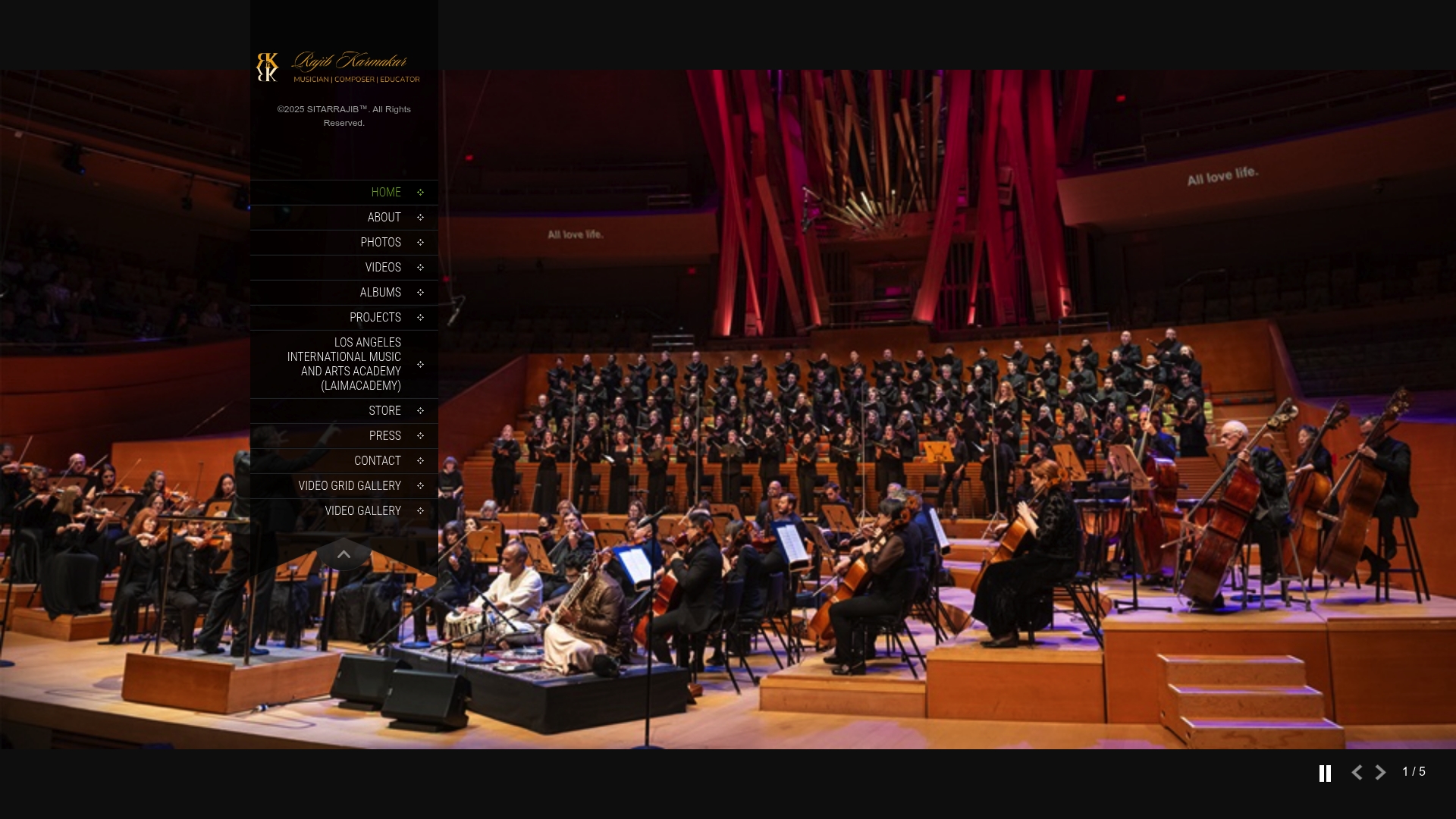
Sitarrajib offers live sitar performances, commissioned fusion arrangements, studio scoring, and workshops for concerts, festivals, weddings, and corporate events across the U.S. Rajib Karmakar brings the same structural approach used in Hollywood fusion scores to every live booking: traditional instruments with a real narrative role, not decorative layering.
Technical rider basics: one DI box, one condenser mic on the sitar body, one monitor wedge, and a standard 20-amp power outlet for the synth/FX rig. Full details are on the sitar performance technical requirements page.
Ready to book or get a quote? Visit sitar performance benefits for corporate events or reach out directly through sitarrajib.com.
Further reading and sources
These sources back the claims in this article and are worth bookmarking for your own research.
- Helen Hanson on Hollywood soundscapes — Best for creative directors who want to understand the narrative theory behind fusion. Hanson’s framing of music as world-building character is the clearest articulation of why fusion works.
- Mark Mangini on Blade Runner 2049 — Essential for technical crew. Covers acoustic-synthetic hybrid design and the intent behind novel textures.
- MixOnline: Score and SFX in Tron: Legacy — Practical frequency balancing reference for anyone mixing a live fusion show.
- Orchestral-jazz fusion scores (CineNoir) — Good for composers and musical directors building a reference playlist.
- Jazz-ambient fusion survey (CineNoir) — Useful for event programmers exploring non-Indian fusion models.
- Electroacoustic composition tools (Academia.edu) — Technical reference for composers and sound designers working with environmental recordings.
- AllMusic: Salaam Bombay! — Short but useful note on the value of restraint and raw acoustic moments in fusion scoring.