
A spotting session is the meeting where the director, composer, and music editor watch the locked cut together and decide exactly where music goes, why it’s there, and when it starts and stops. By the end, you need one document: a spotting sheet with timecoded in/out points and a stated purpose for every cue. Nothing else counts as done.
Before you walk in, know what you’re walking out with:
- A locked picture. No exceptions.
- A spotting sheet template ready to fill in live.
- Temp tracks labeled and cued up.
- A clear answer to “who signs off on this?” — usually the director, sometimes a producer with final cut authority.
If you leave without a signed spotting sheet, you didn’t have a spotting session. You had a meeting.
Key Takeaways
A spotting session succeeds when picture lock comes first, every cue answers “what is the music doing here,” and the music editor’s spotting sheet captures decisions before the room forgets them.
| Point | Details |
|---|---|
| Lock picture first | Never spot against an unlocked cut; edits after spotting force costly cue rewrites. |
| Assign one decision owner | Usually the director, so disputes get resolved instead of left ambiguous. |
| Mute temp music initially | Judge scenes without bias, then play temp tracks only to explain a specific reference. |
| Use a fixed spotting-sheet format | Cue number, TC in/out, purpose, and instrumentation notes prevent rework later. |
| Bring specialist input for world instruments | Sitarrajib helps composers translate spotting notes into authentic sitar recordings. |
Table of Contents
- When Should You Hold a Music Spotting Session?
- Who Needs to Be in the Room for Spotting?
- How Do You Prepare for a Spotting Session?
- How Do You Actually Run a Spotting Session?
- What Goes on a Spotting Sheet?
- What Happens After the Spotting Session Ends?
- What Are the Biggest Spotting Session Mistakes?
- How Long Does a Spotting Session Take, and What Does It Cost?
- Talking Instrumentation and World Instruments in Spotting
- Why In-Person Spotting Still Wins
- How Sitarrajib Supports Your Scoring Process
- Frequently Asked Questions
- Sources
When Should You Hold a Music Spotting Session?
Spotting happens after picture lock), full stop. Lock means the editor has stopped changing cut points, scene order, and shot lengths. Once that’s true, a composer can trust that a cue timed to :23 will still land at :23 next week.
Spot before lock, and you’re scoring a moving target. One editor cuts eight frames from a scene after the composer has already built a swell to hit a specific beat, and now the cue needs a rewrite instead of a trim. That’s lost time and lost money, and it’s avoidable.
A few timing notes worth flagging early:
- Music spotting is usually its own session, separate from sound effects and VFX spotting, even though all three follow the same “after lock” logic.
- Studio features sometimes run a rough spotting pass on a near-final cut, followed by a confirmation pass after true lock. Independent projects rarely have the budget for two passes, so lock discipline matters even more.
Who Needs to Be in the Room for Spotting?
Three people make a spotting session function: the director, the composer, and the music editor (or an assistant taking that role). The picture editor should attend too, since questions about frame-accurate cut points come up constantly.
Beyond that minimal group, bring a producer or supervising sound editor when music decisions might collide with sound design or licensed source cues. A lead arranger can join for projects with heavy demo work, and a licensing representative should be present if any scene depends on cleared source music.
Skip any of these roles and you’ll be scheduling a second meeting to answer questions the first one should have settled.
How Do You Prepare for a Spotting Session?
A spotting session runs on time only when the room is ready before anyone sits down. Technical setup and creative materials both matter, and skipping either one wastes the whole team’s afternoon.
Technical checklist:
- Locked cut on the highest-quality playback available, timecode burned in or synced separately.
- Confirmed frame rate and a written version/cut number, so nobody scores the wrong pass.
- A calibrated sound system loud enough to reveal what a temp track is actually doing.
- Backup media in case the primary playback fails.
Creative and administrative checklist:
- Temp tracks clearly labeled by scene, not buried in a folder called “misc.”
- A blank spotting-sheet template, ready to fill live.
- A script or scene list for quick reference.
- One person designated as the decision owner, and one person (usually the music editor) designated to take notes.
Pro Tip: Push hard for an in-person session if the budget allows it. Watching a film together in a dark room produces the kind of spontaneous creative back-and-forth that video calls tend to flatten out, according to Soundbridge’s spotting session guide.
How Do You Actually Run a Spotting Session?
Follow a sequence, not a free-flowing discussion. A structured pass through the film prevents the session from sprawling into a three-hour tangent about act two.
- Watch the full film once, temp music muted or kept minimal, so the team judges scenes without bias.
- Go scene by scene on a second pass, marking in and out points and stating, out loud, what the music is doing in that moment.
- Assign a decision owner for each contested call, usually the director, and log any disagreement instead of pretending it resolved itself.
- Defer anything unresolved to a short follow-up rather than burning session time debating it.
Temp music handling deserves its own discipline. Experienced editors recommend muting temp tracks during the first viewing so nobody’s judgment gets anchored to someone else’s music choice, but playing a temp cue on the second pass is fair game when the director wants to explain why a specific reference works.
Composer articles on the subject keep returning to one question worth asking about every single cue: what is the music doing here? If nobody in the room can answer that in one sentence, the cue probably doesn’t belong.
Pro Tip: Have the music editor take notes in real time using a fixed set of fields, not free-form prose. Consistency here saves hours later.
What Goes on a Spotting Sheet?
A usable spotting sheet has a fixed column set, filled in live during the session, not reconstructed from memory afterward.
| Column | What It Captures |
|---|---|
| Cue number | Sequential ID (e.g., 1m01) tied to reel or sequence |
| Scene / reel | Which scene or sequence the cue covers |
| TC in / TC out | Exact frame-accurate start and stop |
| Duration | Runtime of the cue, derived from TC in/out |
| Cue purpose | The story function: tension, release, transition, character theme |
| Temp reference | What temp track (if any) informed the discussion |
| Instrumentation notes | Director or composer notes on tone, texture, or instrument family |
| Owner / status | Who’s responsible and whether the cue is approved, pending, or cut |
Cue numbering like 1m01 (reel 1, music cue 1) matters because it keeps tracking consistent all the way through mixing and dubbing. Note the frame rate and picture version at the top of the sheet, and if the picture changes after spotting, log the change against the affected cue rather than starting a new sheet from scratch.
What Happens After the Spotting Session Ends?
The spotting sheet is a starting point, not a finished product. Expect a rhythm of sketches, feedback, and revisions before anything reaches the recording stage.
- The signed spotting sheet, annotated temp references, and a prioritized cue list go out within a day or two.
- The composer delivers rough sketches or digital mock-ups for approval, works through a feedback loop, and locks approved cues before moving toward full production.
- A standard post-spotting workflow uses mock-ups for sign-off specifically to catch frequency clashes with dialogue and sound design before they surface at the dub stage.
- If the picture changes after spotting, the music editor decides whether a cue needs a quick patch or a full re-spot. That call protects the score from cascading rewrites.
What Are the Biggest Spotting Session Mistakes?
Most spotting failures trace back to skipped discipline, not bad taste. A few patterns show up again and again.
- Spotting before lock. The single most expensive mistake on this list. Insist on a locked cut before scheduling the session.
- Nobody writing anything down. A verbal agreement that isn’t logged didn’t happen. Assign note-taking to one person and hold them to it.
- Leaning on unlicensed temp music too long. Log why each temp track was chosen so the reasoning doesn’t disappear once the placeholder gets swapped.
- Unclear cue ownership. If nobody knows who approved a cue, nobody can explain why it changed later.
A short follow-up checkpoint a few days after the session catches most of these before they compound.
How Long Does a Spotting Session Take, and What Does It Cost?
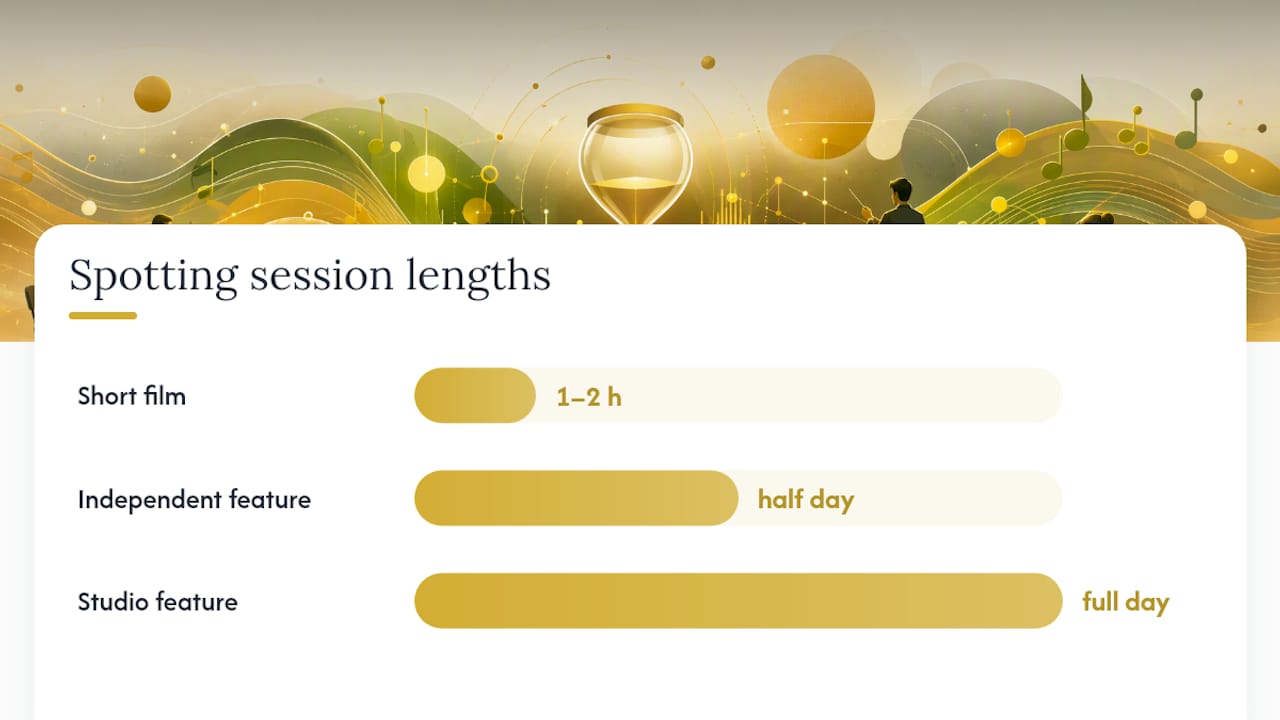
Session length scales with project size. A short film often wraps spotting in an hour or two. An independent feature typically needs half a day. A studio feature can run a full day or spread across two sessions if the runtime or cue count is heavy.
After spotting, composer workload depends on cue volume: mock-ups for a handful of key scenes might land in a week, while a full feature score with forty or more cues can take several weeks of sketching and revision before recording. Cost factors scale the same way, driven by composer rate bands, mock-up hours, and whether the project needs live orchestration or stays in-the-box. Treat all of this as a range to budget against, not a fixed number to quote.
Talking Instrumentation and World Instruments in Spotting
Directors rarely speak in music theory, so composers need a plain-language way to describe tonal direction. Talk in terms of mood, texture, and instrument family: “warm and intimate, low strings and something plucked” lands better than a key signature ever will.
Bringing in a less common instrument, like sitar, raises specific questions worth settling during spotting rather than after recording:
- Mic and arrangement constraints: sitar has a resonant, sustained character that needs room to breathe in a mix; crowding it with dense orchestration flattens what makes it distinctive.
- Cultural authenticity versus cinematic use: decide upfront whether the cue wants an authentic raga-based phrase or a more Western-structured melody voiced on sitar. Those are different creative briefs, and raga-based compositions follow their own internal logic worth understanding before you write for the instrument.
- Licensing notes: if any source material draws on traditional compositions, clear that early, not after the mock-up is approved.
- Leitmotif potential: an instrument with a distinctive voice is a strong candidate for a recurring thematic motif rather than a one-scene color choice.
Pro Tip: When you present a mock-up featuring an unfamiliar timbre, walk stakeholders through what they’re hearing before you play it. “This is a sitar, it’s going to sustain longer than a guitar and sit differently against the dialogue” prevents surprised reactions in the room.
Why In-Person Spotting Still Wins
Some of the best cue decisions I’ve watched happen when nobody’s talking, just reacting to a scene together in the dark. That silence is doing work a video call can’t replicate.
Remote spotting tools have gotten good, and they’re a real option when travel isn’t. But the quick win hasn’t changed: sitting in the same room cuts down on the kind of miscommunication that turns into a rewrite three weeks later.
How Sitarrajib Supports Your Scoring Process
If your spotting session flagged a need for something outside standard orchestral color, that’s where Sitarrajib fits: composer-led sitar recording, mock-up development, and studio sessions built to slot into a post-production timeline instead of disrupting it. Rajib Karmakar works directly with composers and producers to translate spotting-sheet notes on tone and texture into a real recorded part, not a guess at what a world instrument might sound like.
That collaboration runs both directions. You bring the cue purpose and instrumentation notes from your spotting sheet, and the sitar recording process gets built around your delivery deadline, not the other way around. If a scene needs something with genuine cultural depth rather than a synthesized approximation, request a session and bring your spotting notes to the first conversation.
Frequently Asked Questions
What’s the difference between a spotting session and a temp score?
A temp score is placeholder music editors use during the cut to test pacing. A spotting session is the formal meeting where the director and composer decide where the final score goes, replacing that temp with intentional cues.
Can you spot a film before picture lock?
You can, but it’s risky. Any cut change after spotting can invalidate the timecodes on your spotting sheet and force the composer to rework cues that were already scored to specific frames.
How long should a spotting session last?
It scales with runtime and cue count. A short film often takes an hour or two; an independent feature usually needs half a day; a studio feature can run a full day.
Who actually fills out the spotting sheet?
The music editor typically owns this in real time during the session, recording timecodes, cue purpose, and instrumentation notes as decisions get made in the room.
What if the director wants a sitar or another world instrument in a cue?
Raise arrangement and mic constraints during spotting itself, not after a mock-up is built. Confirm whether the cue calls for authentic raga phrasing or a Western melodic structure voiced on the instrument, and clear any licensing questions early.
Sources
- Spotting session (film) — Soundbridge blog
- Film editors and music – spotting session — Film Scoring Tips
- The Spotting Session: Mapping Your Film’s Score — Ken Joseph Music
- Careers: Music Editor — Berklee College of Music