
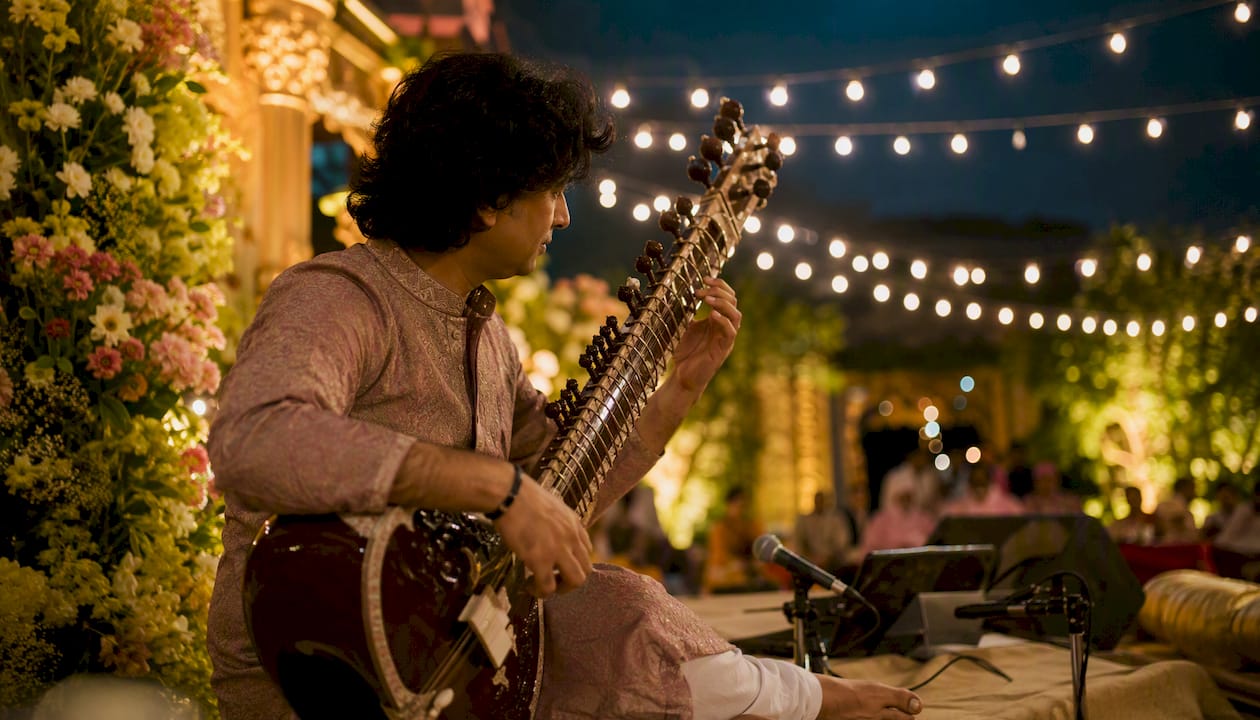
Yes, hire a live sitarist for your sangeet. A sitar at a sangeet adds something no DJ playlist can replicate: real-time musical response to the room’s energy. The two formats that work best are sitar + tabla for dance accompaniment and high-energy medleys, and solo sitar for bridal entry or cocktail-hour ambience. Book well in advance, ideally a few months ahead, especially for the busy wedding season in autumn and winter. The instrument needs amplification, so confirm your venue has a sound system or arrange a rental before you finalize the booking.
- Bridal entry: Solo sitar playing a slow alap in Raga Yaman or Bhupali sets a ceremonial tone without competing with the moment.
- Cocktail hour: A 20–30 minute ambient set works well here. Guests settle in, and the music fills the room naturally.
- Dance accompaniment: Sitar + tabla for a medley set of 3–4 Bollywood instrumentals keeps the energy up and gives choreographed acts a live musical anchor.
Key Takeaways
A live sitar at your sangeet works best when you book 3–6 months ahead, confirm the technical rider early, and match the set format to each moment in your run order.
| Point | Details |
|---|---|
| Book several months ahead | Peak wedding season fills fast; confirm date, format, and rider before the calendar closes. |
| Match format to the moment | Solo sitar for bridal entry; sitar + tabla for dance medleys and high-energy acts. |
| Confirm tech requirements early | Contact mic, stable seating, and a 30–45 minute soundcheck are standard rider items. |
| Send run order 2–3 weeks out | Confirm sound specs 7–10 days before the event to avoid day-of delays. |
| Sitarrajib for U.S. bookings | Rajib Karmakar offers solo, duo, and ensemble formats with full logistics support across the U.S. |
Table of Contents
- What does sitar music actually sound like at a sangeet?
- What set formats and repertoire work best for a sangeet?
- When should you book a sitarist and what does it cost?
- What does a sitarist need from your venue?
- What exactly is a sitar, and how does it differ from a veena?
- How do you choose the right sitarist for your sangeet?
- Why a live sitar changes the feel of a sangeet
- Book Sitarrajib for your sangeet
- Sources
What does sitar music actually sound like at a sangeet?
The sitar’s sound is hard to describe without hearing it. The long neck and gourd resonator produce a warm, buzzing tone, and the sympathetic strings underneath the main strings add a shimmering harmonic trail that lingers after each note. At a sangeet, that quality reads as elegant and alive rather than background noise.
Here are some listening and viewing references to help you plan:
- Raga Yaman (evening alap): A slow, meditative opening that suits bridal entry or the first 10 minutes of a sangeet before dancing begins. Listen for the wide, ascending phrases.
- Raga Bhupali: Pentatonic and immediately warm. Works well for cocktail-hour ambience because it feels welcoming without being busy.
- Bollywood instrumental medley (e.g., “Tum Hi Ho” / “Kal Ho Na Ho”): Up-tempo gat arrangements of familiar film songs. Guests recognize the melodies and respond physically.
- Raga Khamaj (late-evening): Slightly playful and romantic. A good transition from dinner into the dance segment.
- Classical jhala section: Fast, rhythmic strumming on the chikari strings. High energy, crowd-pleasing, and a natural set closer.
- Fusion arrangement (sitar + tabla + electronic beat): Contemporary format that works for sangeets mixing classical and modern aesthetics.
For video, search for live sitar concert footage from artists performing at Indian weddings or check the video highlights from Rajib Karmakar’s sitar concerts to hear how these sets actually sound in event settings.
What set formats and repertoire work best for a sangeet?
Sangeet planning guides recommend keeping the choreographed block under 90 minutes and limiting it to 6–10 acts. A live sitar fits into that structure in three distinct ways.
Common set templates:
- Ambient set (20–30 min): Solo sitar, slow to medium tempo. Ragas Yaman or Bhupali. Ideal for cocktail hour or pre-ceremony seating.
- Bridal entry set (3–6 min): Solo sitar, slow alap. One raga, no percussion. The silence around the notes matters here.
- Medley set (3 × 90-second segments): Three Bollywood instrumentals back to back. Sitar + tabla. Suits choreographed acts or the transition into open dancing.
- Dance accompaniment set (15–20 min): Up-tempo gat and jhala sections. Sitar + tabla. High energy, structured around tala cycles so dancers can lock in.
Ragas Yaman, Bhupali, and Khamaj are standard teaching repertoire%20Semester-%20I%20to%20VI.pdf) and reliable choices for evening programs because they suit the time of day and feel immediately accessible to mixed audiences.
| Format | Stage footprint | Audience energy | Best placement | Typical duration |
|---|---|---|---|---|
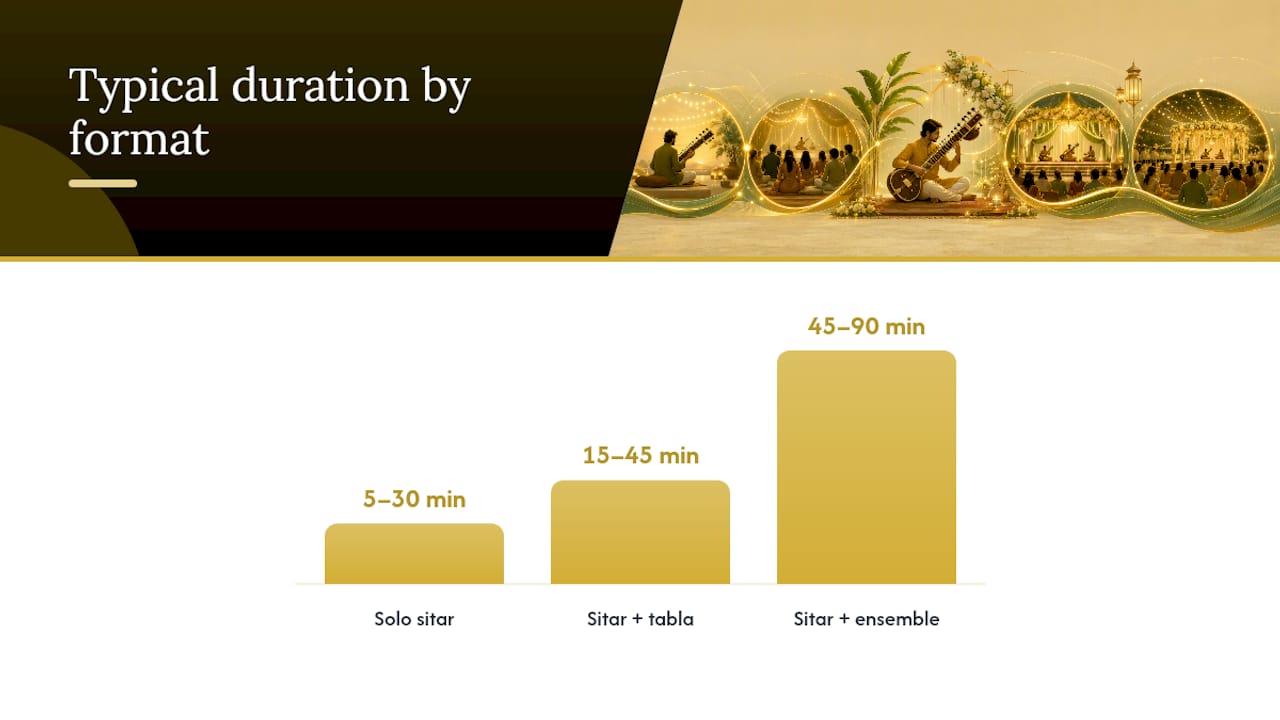
| Solo sitar | Small (1 chair, 1 mic) | Calm, focused | Bridal entry, cocktail hour | 5–30 min |
| Sitar + tabla | Medium (2 chairs, 2 mics) | Moderate to high | Medley sets, dance accompaniment | 15–45 min |
| Sitar + ensemble | Large (4–6 musicians) | High, festive | Grand finale, full sangeet set | 45–90 min |
For sangeet medleys, keep each song segment to roughly 90 seconds so choreographed acts stay tight and the audience doesn’t lose the thread.
When should you book a sitarist and what does it cost?
Booking timeline:
- Ideal window: 3–6 months before the event. This gives you time to discuss repertoire, confirm logistics, and lock in the date before the artist’s calendar fills.
- Minimum lead time: 4–6 weeks for local bookings, longer if travel is involved.
- Peak season (October–February): Book earlier. Many professional sitarists in the U.S. are fully booked by late summer for fall and winter weddings.
What affects the fee:
- Artist experience and reputation
- Solo vs. duo (sitar + tabla adds a second musician’s fee)
- Travel distance and accommodation needs
- Total performance duration
- Whether the artist supplies their own amplification
U.S. pricing for live sitar at events varies based on these factors. Solo sitar sets generally start at a few hundred dollars for short local performances. Experienced professional sitarists with full event packages, travel capability, and sound support typically quote higher. Always request an itemized quote.
Sample quote request template:
Pro Tip: Send your quote request with a short description of the sangeet’s overall vibe — traditional, modern fusion, or mixed. A professional sitarist will tailor the repertoire suggestion to fit, and you’ll get a more accurate quote.
What does a sitarist need from your venue?
Getting the technical setup right makes a real difference. Standard vocal mics don’t capture the sitar’s full range, particularly the sympathetic string resonance, so specific micing matters. Here’s what to confirm with your venue coordinator:
- Seating: A flat, stable surface at floor level or on a low riser. Baithak-style (cross-legged) seating is standard. Provide a cushion or low platform.
- Microphone setup: A contact mic or small-diaphragm condenser mic placed near the main strings, plus a second mic for the gourd resonator. A DI box is useful for direct feed to the board.
- Power: Two standard 120V outlets near the performance area.
- Stage dimensions: Minimum 6 ft × 6 ft for solo sitar; 10 ft × 8 ft for sitar + tabla.
- Soundcheck: Allow 30–45 minutes before guests arrive. This is non-negotiable for a sitar because sympathetic strings need tuning adjustments based on the room’s temperature and humidity.
- Outdoor venues: Confirm wind protection for the instrument and a covered area. Humidity and temperature swings affect tuning stability.
For a full technical checklist, the sitar performance technical requirements guide covers rider specifics in detail.
Pro Tip: Send the artist the final run order 2–3 weeks before the event and confirm sound specs 7–10 days out. Day-of surprises with audio setup are the most common cause of delayed starts.
What exactly is a sitar, and how does it differ from a veena?
The sitar is a plucked string instrument at the center of Hindustani classical music. It has a long neck, a gourd resonator, movable frets, and a set of sympathetic strings running beneath the main playing strings. Those sympathetic strings vibrate in response to the notes played above them, creating the instrument’s characteristic harmonic shimmer.
Sitar vs. veena:
- Sitar: North Indian origin, Hindustani tradition, curved frets, sympathetic strings, brighter and more percussive tone. Common in classical concerts, film scores, and events across North India and the diaspora.
- Veena: South Indian origin, Carnatic tradition, fixed frets, no sympathetic strings, rounder and more sustained tone. Standard in Carnatic music contexts and South Indian ceremonies.
For a sangeet rooted in North Indian or pan-Indian tradition, the sitar is the natural choice. A South Indian sangeet may call for a veena instead, or both. The cultural context of the families involved should guide this decision. Music in Hindu ceremonial gatherings has deep roots in sacred gathering traditions where instrumental music carries specific meaning.
Sitar playing styles:
- Gayaki ang: Vocal-style playing. Smooth, lyrical, focused on melodic expression. Suits bridal entry and ambient sets.
- Tantrakari ang: Instrumental style. More rhythmic, technically complex, with fast jhala passages. Suits dance accompaniment and high-energy finales.
How do you choose the right sitarist for your sangeet?
Ask these questions before you book:
- Have you performed at Indian weddings or sangeet events before?
- Can you share a live recording from a similar event?
- What is your repertoire range — classical only, Bollywood, fusion?
- Do you travel, and what are your travel requirements?
- Do you carry your own amplification, or do you work with the venue’s system?
- Do you have liability insurance, and can you provide a contract?
- Can you coordinate directly with the sound engineer or DJ on the day?
Red flags to watch for:
- No live recordings available, only studio tracks
- Unwillingness to share a rider or tech requirements in advance
- No written contract or vague cancellation terms
- Can’t name specific ragas or songs when asked about repertoire
- No references from event clients
Trust signals to request:
- References from at least two event bookings
- A short demo of a proposed set or a sample medley
- Proof of insurance if your venue requires it
- A clear rider document listing stage, mic, and power needs
Why a live sitar changes the feel of a sangeet
Most sangeet programs are built around choreographed acts and a DJ. A live sitar sits differently in that structure. It gives the room something to listen to, not only to dance to, and that shift in attention creates moments guests actually remember.
When I program a set for a bridal entry, I start with a slow alap in Raga Yaman. No percussion, no accompaniment. The room quiets down on its own. By the time the bride enters, the music has already set the emotional register. For high-energy finales, I move into jhala, which is fast rhythmic strumming on the chikari strings. The tabla locks in, the tempo builds, and the crowd responds without needing any prompting.
One thing planners often underestimate is how much the room’s acoustics shape the performance. In a large hall with hard walls, the sympathetic strings can over-resonate and muddy the sound. I tune the taraf strings specifically for the venue after the soundcheck, and I adjust the mic placement based on how the room responds. That’s not something you can replicate with a recorded track.
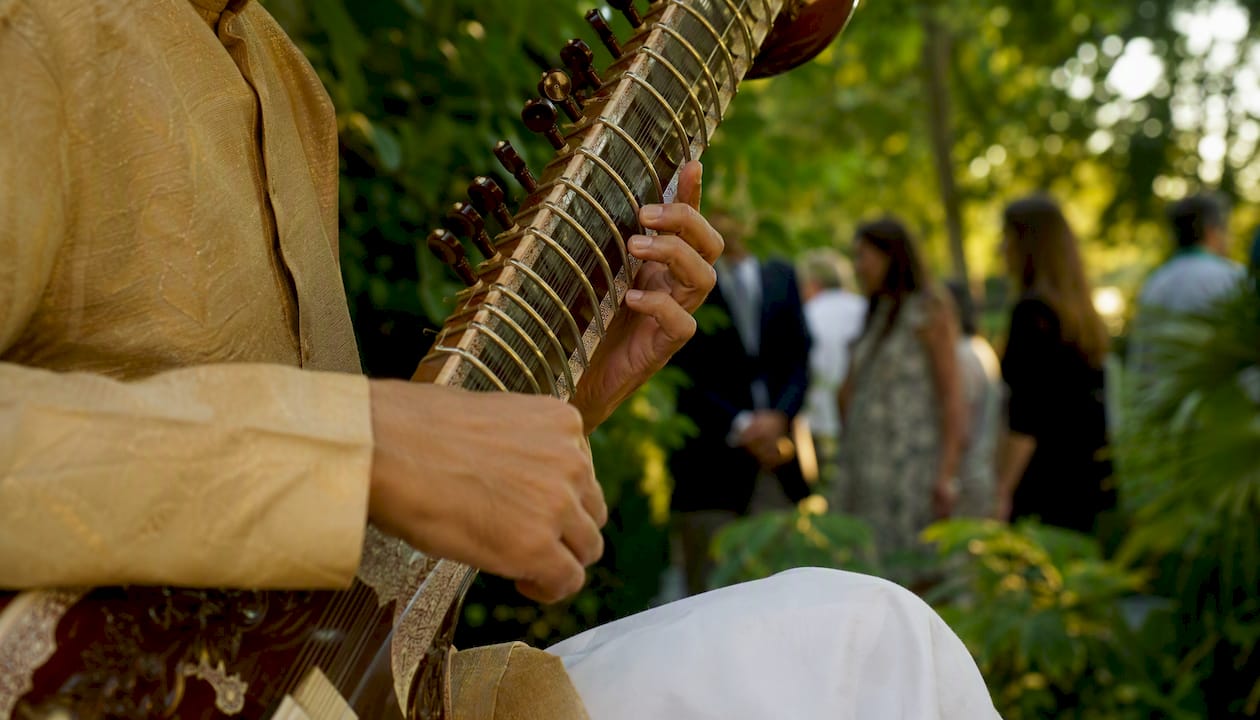
For audience engagement, the most effective move is simple: let guests see the instrument up close during cocktail hour. When people can watch the fingers on the frets and hear the sound coming directly from the gourd, the connection is immediate. It becomes a conversation starter and a memory, not just background music.
Book Sitarrajib for your sangeet
Sitarrajib brings live sitar to sangeet events across the U.S., with formats built specifically for Indian weddings: solo sitar for bridal entry and ambient sets, sitar + tabla for medleys and dance accompaniment, and full ensemble arrangements for larger programs. Every booking includes repertoire consultation, a full technical rider, and direct coordination with your venue’s sound team.
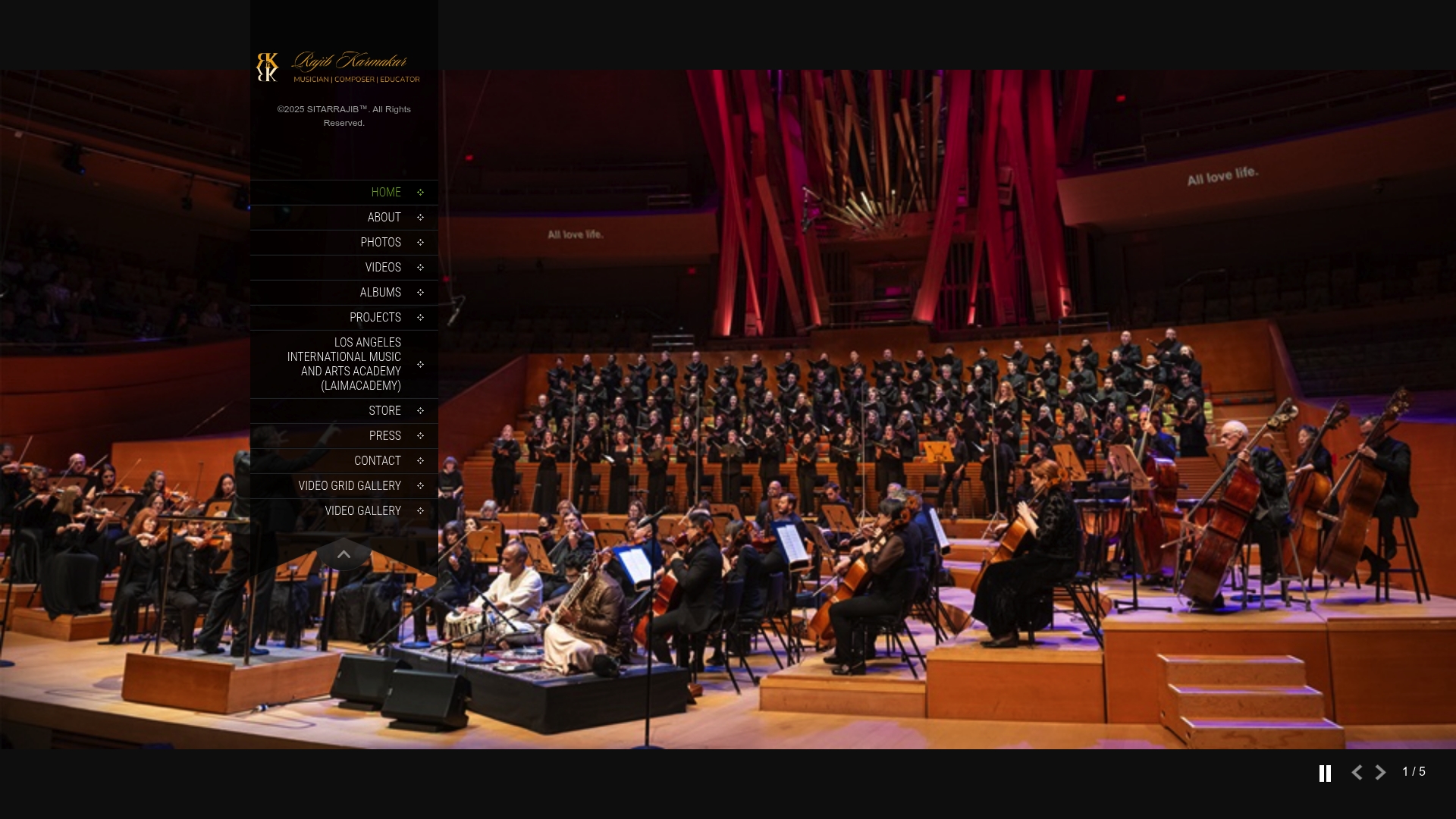
To request a quote, send your event date, venue location, desired set format, approximate duration, and budget range. Rajib responds to booking inquiries within 48 hours. For a full overview of what’s included and how live sitar fits your event program, visit Sitarrajib or review the sitar performance benefits page for details on what a professional booking covers.
Sources
- Sitar – Wikipedia
- Chandrakantha
- The Sitar from different angles (Pt. 1): Instrument basics, past masters – Darbar
- Wedding Sangeet Planning: Theme, Performances, Timeline & Budget