
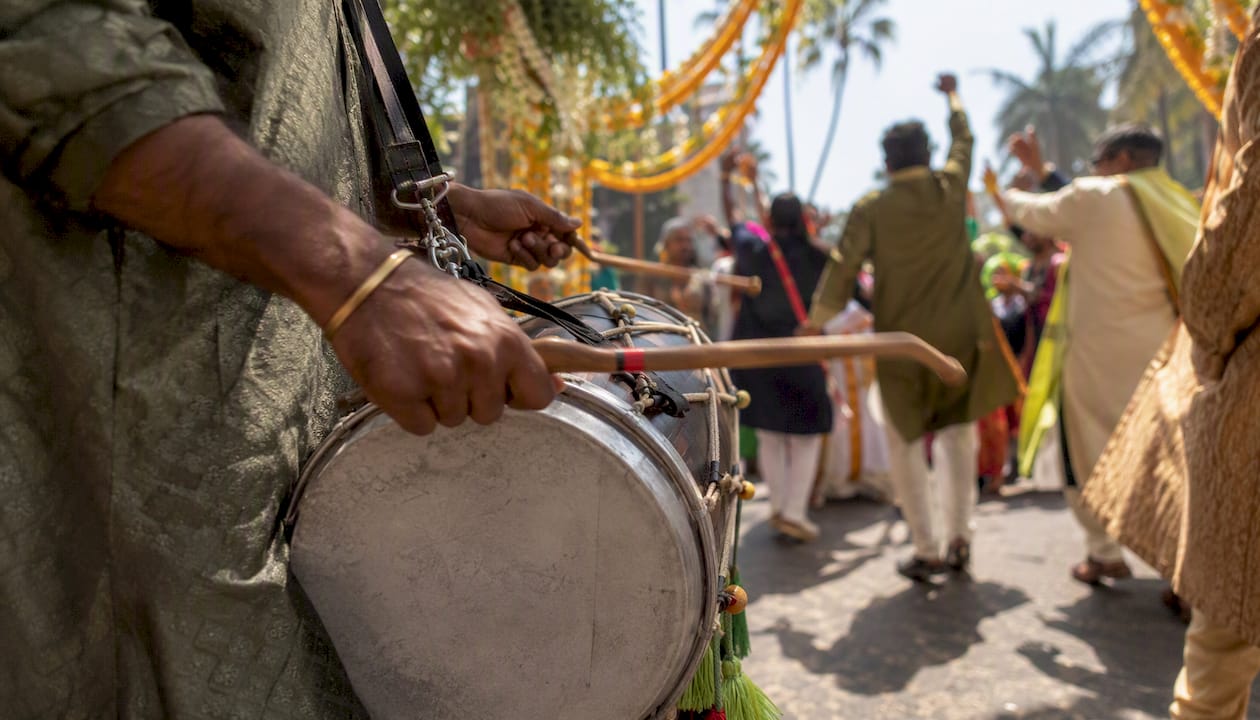
The most effective baraat soundtrack mixes high-energy Punjabi and Bollywood anthems, live or recorded percussion, and one or two instrumental interludes to pace the procession. Get those three elements right and your baraat moves, looks great on camera, and keeps every generation on their feet.
Here is what belongs on every baraat playlist:
- Opening hype track: A high-BPM Punjabi dhol anthem with a fast tempo to kick off the procession with immediate energy
- Bollywood crowd-pleasers: Three to five recognizable dance hits that guests of all ages already know and love
- Live or recorded dhol: Continuous percussion underneath or between tracks to hold momentum during photo stops
- Classical or sitar interlude: One 60–90 second instrumental passage to reset energy and give photographers a clean moment
- Closing anthem: A slower, celebratory track that signals the groom’s arrival at the mandap
Organizing songs by mood rather than by movie or era is one of the most practical baraat playlist suggestions you will find. Sitarrajib’s Rajib Karmakar, a Los Angeles-based sitarist who performs live at US weddings, covers the sitar interlude piece in detail later in this guide.
Key Takeaways
A strong baraat soundtrack combines high-energy anthems, live percussion, and one or two classical interludes timed to photo stops and procession cues.
| Point | Details |
|---|---|
| Build by vibe, not era | Group songs into high-energy, Bollywood, romantic, and instrumental buckets for a coherent playlist. |
| Time the procession first | Walk the route, then match song length to each segment before finalizing your cue sheet. |
| Hybrid setup wins | Pairing a DJ with a dhol player and a sitarist gives you flexibility, live energy, and cultural depth. |
| Sitar interlude timing | A 60–90 second sitar phrase at a photo stop resets crowd energy and gives photographers a clean frame. |
| Sitarrajib for live sitar | Rajib Karmakar performs live sitar at US weddings and collaborates with DJs for seamless baraat integration. |
Table of Contents
- Which music style fits your baraat?
- Ready-to-use baraat playlists organized by vibe
- Live musicians vs DJ: which setup works best?
- How to time your baraat songs to the procession
- How to build baraat mashups and medleys that keep energy up
- How sitar and classical elements fit into a baraat
- What does baraat music cost in the US?
- What I have learned from playing baraats
- Sitarrajib brings live sitar to your baraat
- Sources
Which music style fits your baraat?
Four style buckets cover almost every baraat scenario. Knowing when to use each one saves you from a playlist that starts strong and fades out.
Punjabi bhangra and high-energy tracks are the default opening choice. Fast tempo, call-and-response hooks, and dhol-driven beats get the procession moving and signal to guests that the party has started. These work best for the first third of the walk.
Bollywood dance hits are crowd-pleasers across generations. Songs from the last five to ten years with recognizable hooks pull in younger guests, while a classic from the 1990s or early 2000s brings the aunties and uncles onto the street. Mixing classic hits with modern remixes keeps a mixed-age crowd engaged without alienating anyone.
Regional folk and drum-led tracks fit South Indian, Rajasthani, or Bengali baraats where Punjabi bhangra would feel out of place. Nadaswaram, shehnai, or folk percussion tracks carry ceremonial weight and signal cultural specificity that guests from those communities appreciate.
Classical and fusion instrumental interludes serve a different purpose entirely. They slow the pace, give the procession a breath, and create a cinematic quality that photographs beautifully. A sitar raga phrase or a fusion piece built on a classical melody works here.
- Punjabi bhangra: procession opening, dance sections, high-crowd-energy moments
- Bollywood hits: middle of the procession, photo stops with dancing guests
- Regional folk: full procession for South Indian or regional weddings, ceremonial entry moments
- Classical/fusion: photo-stop interludes, final approach to the mandap
Pro Tip: Reserve your classical or sitar interlude for the moment when energy has peaked and guests are starting to scatter. A 90-second instrumental reset pulls everyone back into focus and gives your photographer a clean, calm frame before the final approach.
Ready-to-use baraat playlists organized by vibe
Grouping baraat entrance songs by mood helps you hand a coherent list to your DJ instead of a random collection. Here are five vibe-based groups with song examples and placement guidance.
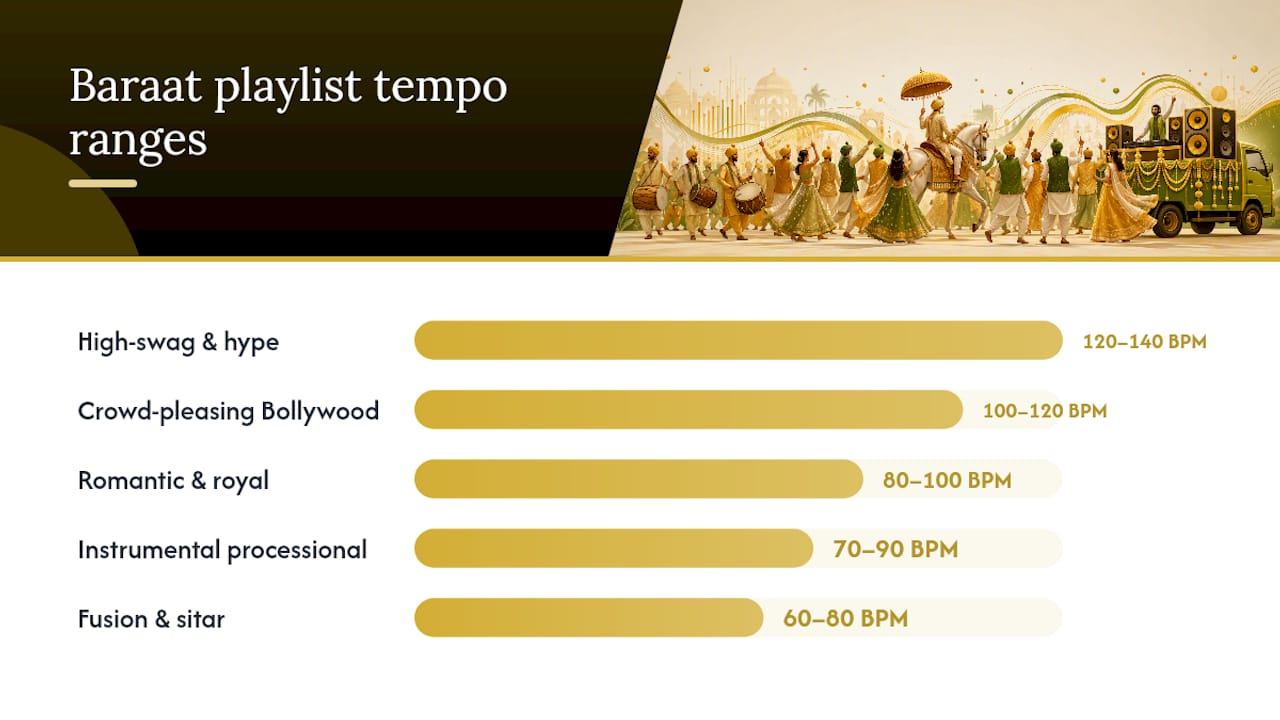
High-swag and hype (opening, 120–140 BPM): “Dildara” (Jab Tak Hai Jaan), “Ainvayi Ainvayi” (Band Baaja Baaraat), “Balam Pichkari,” “Gallan Goodiyaan,” “Desi Beat” (Bodyguard), “Kar Gayi Chull” (Kapoor & Sons), “Tenu Suit Suit Karda”
Crowd-pleasing Bollywood anthems (middle procession, 100–120 BPM): “Nagada Sang Dhol” (Ram-Leela), “Lovely” (Happy New Year), “Ghagra” (Yeh Jawaani Hai Deewani), “Badtameez Dil,” “Senorita” (Zindagi Na Milegi Dobara), “London Thumakda” (Queen)
Romantic and royal entry (final approach, 80–100 BPM): “Tujh Mein Rab Dikhta Hai,” “Teri Meri” (Bodyguard), “Pehla Nasha,” “Tum Hi Ho” (Aashiqui 2), “Kesariya” (Brahmastra)
Fusion and sitar interludes (photo stops, 60–80 BPM): Sitar rendition of “Kal Ho Naa Ho,” raga-based fusion of “Tum Hi Ho,” classical sitar improvisation on Raag Bhairavi, instrumental cover of “Dil Se Re”
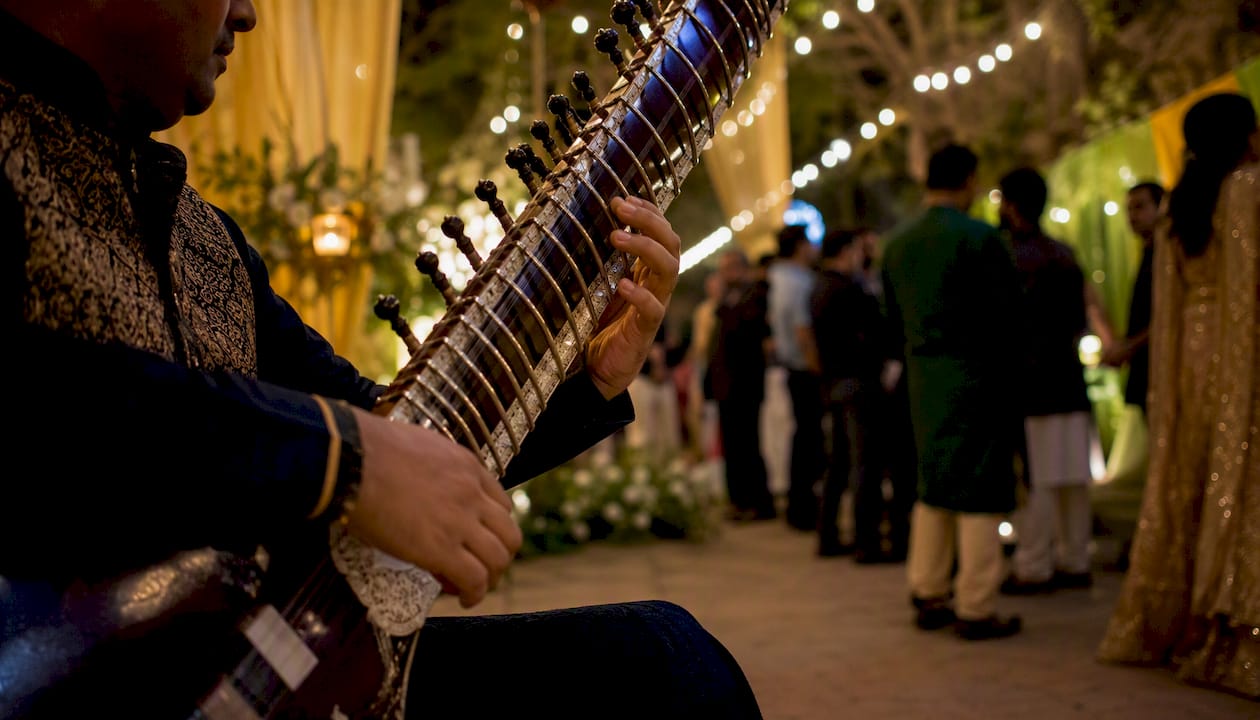
Instrumental and processional (background walk, 70–90 BPM): Shehnai classical pieces, nadaswaram processional tracks, instrumental covers of Bollywood melodies that maintain walking pace without demanding attention
| Song / Track Type | Perceived Pace | Recommended Placement |
|---|---|---|
| “Gallan Goodiyaan” | Fast | Procession opening |
| “Nagada Sang Dhol” | Fast/Medium | Middle dance section |
| “London Thumakda” | Medium | Guest participation moment |
| Sitar raga interlude | Slow | Photo stop or reset |
| “Tujh Mein Rab Dikhta Hai” | Slow/Medium | Final approach to mandap |
Comprehensive baraat song lists confirm that Punjabi party tracks and Bollywood dance numbers dominate crowd-pleasing baraats. Use these as your starting point, then swap two or three songs to reflect your own taste.
Live musicians vs DJ: which setup works best?
Each option has real trade-offs. Here is a plain breakdown.
- DJ: Most flexible, widest song selection, easiest to adjust on the fly. Cost-effective for a full procession. Needs a reliable power source and speaker placement that covers an outdoor route.
- Dhol player or drum ensemble: Adds raw, physical energy that recorded tracks cannot replicate. Works best alongside a DJ, not as a solo act for a long procession. One dhol player typically costs $300–$600 for a two-hour block in most US markets.
- Live band with vocalists: Highest production value, most expensive, and requires the most coordination. Best for shorter, contained baraats where the band can stay in one spot.
- Solo sitarist: Ideal for interludes, the final approach, or a fusion medley. Low logistics footprint. Sitarrajib performs live at US weddings and can collaborate directly with your DJ or band.
The hybrid setup, a DJ handling recorded tracks while a dhol player and sitarist handle live moments, gives you the best of all three. Groom entries are increasingly choreographed, so pairing a DJ’s precision with live percussion energy matches what guests now expect.
This overlap prevents dead air and makes the shift feel intentional.
Technical notes: dhol players outdoors rarely need amplification, but a sitarist does. Plan for a DI box or a small monitor, a 20-amp power outlet nearby, and a sound check at least 30 minutes before the procession starts. See the sitar performance technical requirements guide for a full checklist.
Pro Tip: Cue your dhol player to start a solo fill during the last eight counts of a recorded track. That live fill carries the energy into the next song’s chorus without any gap, and guests feel the shift as a build rather than a break.
How to time your baraat songs to the procession
Start by walking the route at a normal pace and timing it. Most US baraat processions run 8–20 minutes depending on venue layout and the number of participants stopping to dance.
- Measure the route from the groom’s starting point to the mandap entrance. Walk it once at a relaxed pace, once at a dance pace.
- Build a prelude playlist of 15–30 minutes for guests gathering before the procession starts. Ceremony prelude playlists should run long enough to cover late arrivals and pre-ceremony mingling.
- Match song length to procession segments. Use full songs (3–4 minutes) for open stretches where guests can dance freely. Use 30–60 second loops or edits for tight corridors or slow-moving sections.
- Mark three cue points in your song list: start cue (procession begins), photo-stop cue (interlude begins), and final-approach cue (last song before mandap).
- Rehearse with your walking party. Walk through the route with the actual procession group at least once before the wedding day. This confirms song length and reveals any timing gaps.
- Brief your DJ or band in writing. Give them a one-page cue sheet: song name, start time, cue type (fade, hard cut, live handoff), and any special instructions.
Timing callout: Hand your DJ this script the week before. “Song 1 starts when the groom steps out. Photo stop begins at the 2:30 mark of Song 3. Final approach starts when I give a thumbs-up. Hold the last song until the groom reaches the mandap steps.”
How to build baraat mashups and medleys that keep energy up
A well-built mashup does two things: it keeps the procession moving and it gives guests a moment to react. Here is how to put one together.
- Match tempos within 10 BPM for clean segues. “Gallan Goodiyaan” (128 BPM) flows naturally into “Kar Gayi Chull” (124 BPM). A jump from 90 BPM to 130 BPM mid-phrase kills momentum.
- Use key-compatible phrases. Songs in the same key or relative key blend without jarring pitch clashes. Most DJ software like Serato or rekordbox shows key automatically.
- Loop the anthemic hook of a crowd-favorite for 16 counts before dropping into the next track. That repetition gives guests time to react and join in.
- Plan dhol drop points. Mark one or two moments in your medley where the recorded track drops to half volume and the dhol player takes over for 8–16 counts before the next song kicks in.
- Build in a 60-second classical or sitar bridge between your high-energy opening block and your Bollywood mid-section. It resets the crowd without stopping the procession.
Pro Tip: For mixed-age crowds, open your medley with a classic from the 1980s or 1990s (something the parents recognize instantly), then transition into a current hit. Elders lean in for the familiar hook; younger guests take over when the new track drops. Both groups feel included.
How sitar and classical elements fit into a baraat
Rajib Karmakar, the sitarist behind Sitarrajib, is based in Los Angeles and performs live sitar at weddings across the United States. His approach to baraat integration focuses on placement and contrast rather than volume.
Concrete ways to use sitar in your baraat:
- Entrance interlude: A 60–90 second raga-based phrase as the groom steps out, before the first full track drops
- Photo-stop texture: Sitar playing softly under a recorded track during a planned pause, giving the moment a cinematic quality
- Melodic bridge in a medley: A sitar line carrying the melody of a Bollywood song between two high-energy tracks
Technical needs are straightforward. A sitarist needs a DI box or a small condenser mic, a monitor or in-ear feed, and a 20-amp outlet. Sitar music for wedding moments works well both indoors and outdoors when the sound setup is planned in advance.
Pro Tip: Choose a sitar interlude over a full classical segment for a baraat. A full raga performance runs 10–20 minutes and breaks procession momentum. A 60–90 second melodic phrase gives you the cultural depth without the pacing cost.
What does baraat music cost in the US?
Prices vary by market, season, and booking lead time. These ranges reflect typical US rates for a two-hour baraat block.
Travel outside Los Angeles adds a flat fee or mileage cost depending on the artist. Booking a sitarist for rehearsal attendance adds roughly $200–$400 to the base rate but pays off in tighter cue timing.
That split gives you a full sound without overloading any single line item.
What I have learned from playing baraats
The most memorable baraat I arranged started with a 90-second sitar improvisation on Raag Yaman. The groom had asked for something “different” before the dhol kicked in. That quiet opening, just sitar and silence, made every guest stop talking. Then the dhol dropped and the whole street erupted. The contrast did the work.
The practical takeaway: time your sitar intro to land exactly at the photo stop. Brief your photographer in advance so they are ready for that calm moment. You get a clean, beautiful frame, and the energy that follows feels earned.
Sitarrajib brings live sitar to your baraat
You have the playlist, the timing plan, and the logistics checklist. If you want a live sitar element that actually fits your procession, Sitarrajib offers exactly that.
Rajib Karmakar performs live sitar interludes for baraat processions, collaborates directly with DJs and dhol players, and can attend one rehearsal to lock in cue timing. He works with couples to choose repertoire that fits the procession length, the cultural mix of the wedding, and the overall mood they want.
Before you reach out, have these details ready: your procession route and estimated duration, your DJ’s contact information, any specific songs you want the sitar to reference, and your venue’s power setup. Watch Rajib’s live performance videos to get a feel for his style, then contact Sitarrajib at Sitarrajib to check availability and get a quote.
Sources
- 30 Groom Entry Songs That Still Own the Baraat in 2026 – Mosaic Moments
- Top 40 Baraat Entry Songs for Grooms
- Wedding processional songs – Minted
- 50+ Best Groom Entry Songs for Baraat 2026
- Unique processional songs we love | Junebug Weddings
- Top Best 25+ Indian Baraat Songs