
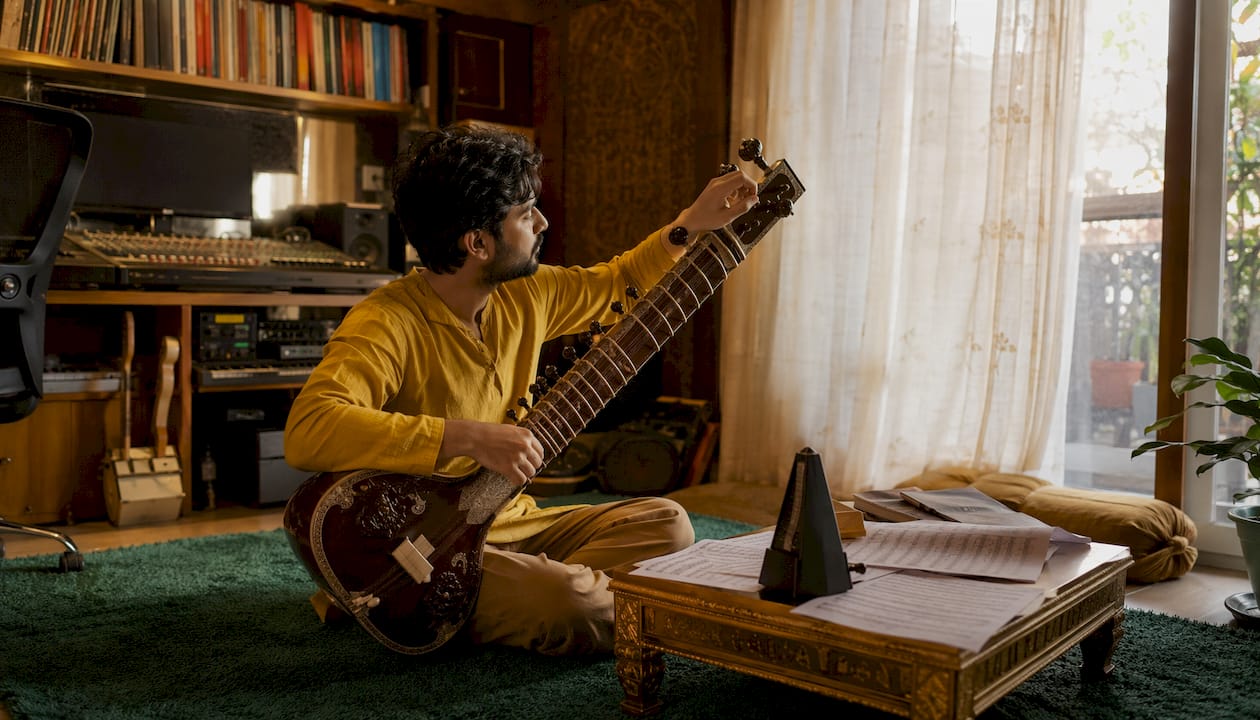
Composing sitar music for commercial applications means blending traditional Raga and Tala frameworks with modern production techniques to create tracks that feel both authentic and accessible. The core elements you need to get right are: selecting a Raga that suits the emotional tone of your project, understanding how the sitar’s sympathetic strings and microtonal bends shape its sound, notating idiomatic techniques clearly so performers can execute them faithfully, and integrating the instrument with modern production elements without flattening its personality. Arrangements need to respect the sitar’s expressive timing and microtonal nuances. Plan for recording, mixing, and licensing from the start, not as afterthoughts. Cultural sensitivity is not optional. Treating the sitar as a generic “exotic texture” is the fastest way to produce something that sounds hollow and disrespects the tradition behind it.
Key elements for a solid commercial sitar composition:
- Ground melodies in a specific Raga rather than a generic pentatonic or chromatic scale
- Preserve the sitar’s natural tonal qualities: sympathetic string resonance, microtonal bends, and dynamic phrasing
- Use idiomatic technique labels in your notation so performers know exactly what you want
- Plan microphone placement and mixing approach before the session, not during it
- Secure licensing agreements early, whether you are using live sessions, pre-recorded loops, or licensed samples
- Stay aware of cultural context throughout the creative process
What are the most practical techniques for composing sitar parts in commercial music?
The biggest mistake composers make is treating sitar as a looped texture without grounding it in Raga and Tala. When you strip away those frameworks, you lose the melodic personality that makes the instrument compelling in the first place. Successful commercial sitar compositions root their melodies in traditional Indian modes and rhythmic cycles, even when the surrounding production is entirely modern.
Start with Raga selection. Each Raga carries a specific set of ascending and descending note patterns, characteristic phrases, and an emotional quality called rasa. Raga Yaman works well for romantic or cinematic contexts. Raga Bhairavi suits melancholic or introspective moods. Choosing the right Raga before you write a single note gives your melody a built-in emotional logic that western chromatic writing cannot replicate.
Ornamentation is where the sitar’s character lives. Three techniques you need to understand and write for:
- Meend: A glide between two notes, executed by pulling the string sideways across the fret. This is the sitar’s most expressive device and cannot be approximated by a simple pitch bend in MIDI without careful velocity and pitch automation.
- Gamak: A rapid oscillation between two notes, creating a shimmering, intense effect. Think of it as a specialized trill with a distinctly Indian character.
- Bols: Right-hand stroke patterns (Da and Ra) that define rhythm and accent. Da is the accented downstroke; Ra is the lighter upstroke. These strokes shape the rhythmic feel of a phrase as much as the notes themselves.
Quantizing sitar MIDI to a rigid grid destroys the emotional timing and expressiveness that define the instrument. Apply pitch bend and velocity automation manually to simulate human nuance. Bollywood cinematic templates often use a slow tempo around 65 BPM to give phrases room to breathe and allow for expressive, unhurried melodic development.
When integrating tabla or percussive layers, let the rhythmic cycle (Tala) inform the phrasing of your sitar melody rather than forcing the melody to sit on a western 4/4 grid. Electronic elements like pads and synthesizers work well underneath the sitar when they occupy different frequency ranges and do not compete with the instrument’s midrange fundamentals.
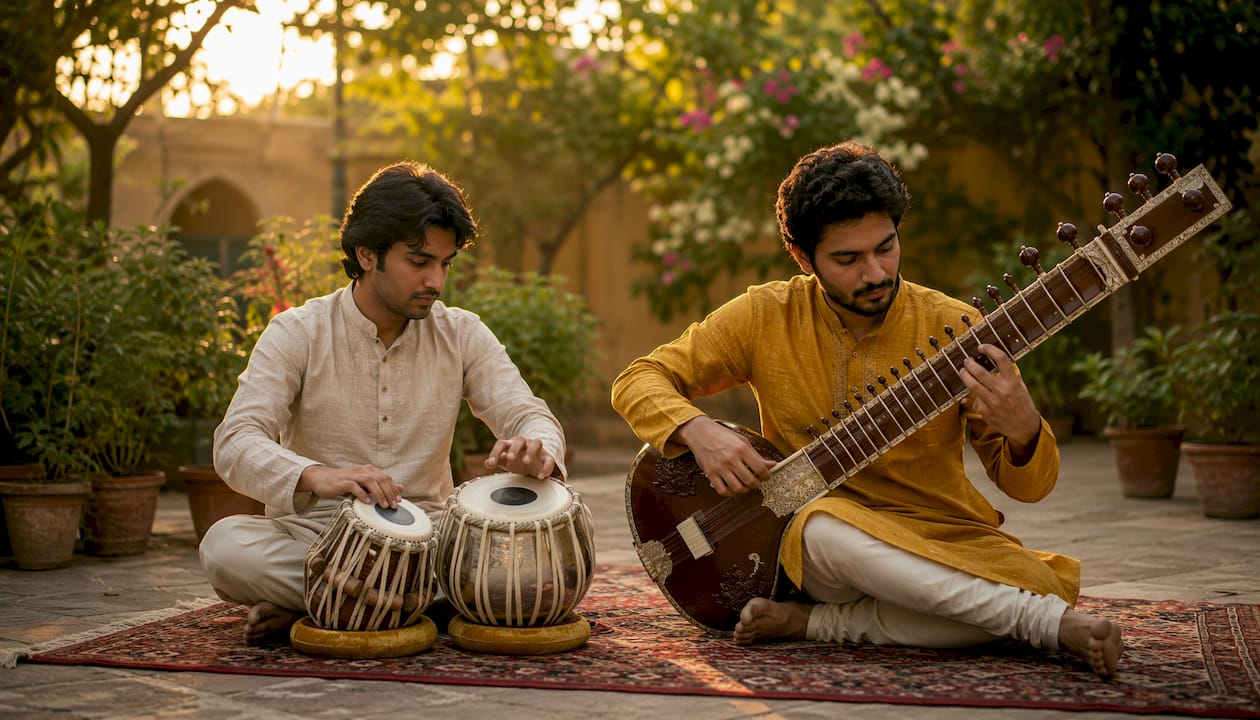
Pro Tip: Write the sitar melody as a full melodic statement with development, not as a repeating two-bar loop. Even in a 30-second commercial cue, a melody that goes somewhere feels more authentic and holds attention better than a texture that cycles.
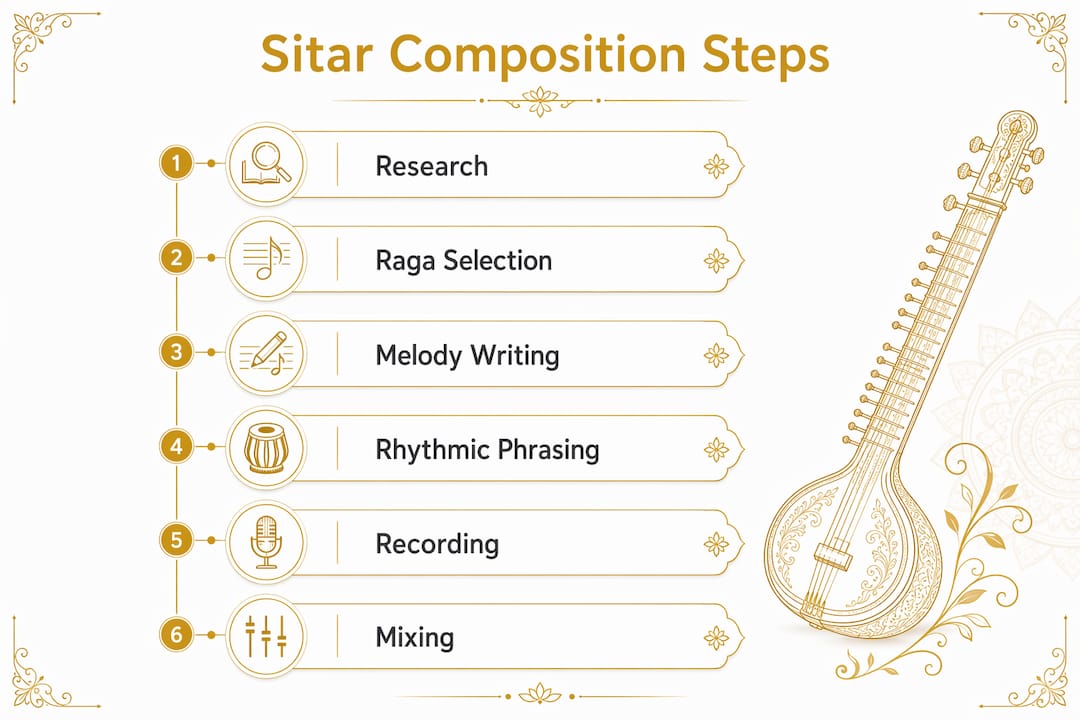
How do you notate sitar compositions accurately?
There is no single universal notation standard for the sitar, which means your job as a composer is to be as clear as possible within standard Western notation. Write in concert pitch and use the treble clef for the vast majority of the instrument’s range. Reserve the bass clef only when notes fall uncomfortably low for treble clef reading.
The Sitar Orchestration Manual by Tim White provides a practical notation framework that many composers working with Indian instruments now reference. It establishes specific symbols for bols, Da and Ra strokes, and dynamic accentuation marks, giving performers enough information to interpret traditional rhythms and articulation precisely.
Practical notation guidelines for sitar scores:
- Label meend explicitly above the staff with the word “meend” and a curved line connecting the start and end pitches, similar to a glissando marking
- Mark gamak passages with a trill-style notation and the word “gamak” written above
- Use the vertical line “|” beneath a note to indicate a Da stroke (accented downstroke) and a horizontal dash “–” for a Ra stroke (unaccented upstroke)
- Add a brief performance note at the top of the score explaining your notation conventions, since not every sitarist reads the same symbols the same way
- Avoid standard Western vibrato markings; the sitar’s pitch inflections are produced differently and need their own labels
The Indian music notation system also uses a solfège-based system called Sargam (Sa, Re, Ga, Ma, Pa, Dha, Ni) that some sitarists prefer alongside Western notation. Including both in your score, especially for melodic passages, helps performers connect your written notes to the Raga they know by ear.
How do you record and mix sitar for commercial productions?
Microphone placement is the single most important decision in a sitar recording session. Position a Small Diaphragm Condenser microphone approximately two feet above and slightly to the left of the sitar bridge and aimed at the gourd (the large resonating cavity). This placement captures both the attack from the strings and the sympathetic string resonance that gives the instrument its characteristic shimmer. Moving the mic closer than 18 inches tends to overload the harmonics and produce a thin, harsh sound. Live session sitar recording in a room with some natural ambience almost always produces better results than a completely dead studio environment.
For mixing, pan the sitar to the center of the stereo field. The instrument occupies a midrange-heavy frequency range, so when vocals are present, cut around 3,000 Hz on the sitar track and boost the same frequency on the vocal to create separation without losing the sitar’s harmonic overtones. Avoid aggressive high-pass filtering below 175 Hz, but do notch out any harsh resonances in the 5–10 kHz range.
Key mixing decisions:
- Use light compression to even out the dynamic range between soft and loud passages, but keep the attack time slow enough to let the transients breathe
, which interfere with the natural resonance of the sympathetic strings and make the instrument sound artificial
- Use a hall reverb with a short pre-delay to add depth without washing out the articulation of individual notes
- For orchestral or cinematic mixes, high-pass string sections below 200 Hz and apply subtle midrange dips around 400–600 Hz on backing elements to give the sitar’s fundamental room to cut through
- Straight delays work well rhythmically; set the delay time to match the tempo of the track
Pro Tip: Solo the sitar track and check that its midrange fundamentals are clearly audible before you start adding other elements. If the core tone sounds right in isolation, it will sit correctly in the full mix with far less corrective EQ.
What do you need to know about licensing sitar music commercially?
Licensing for sitar music follows the same tiered structure used across most royalty-free music platforms, but the details matter a lot depending on how and where you plan to use the track. Standard licenses typically cover web use and downloads up to a set copy limit with no broadcast rights. As your audience reach grows, so does the license tier and its cost. Platforms like AudioJungle structure their sitar music licenses from a basic personal-use tier up through broadcast licenses covering audiences of one million, ten million, and beyond, with the top tier covering theatrical film distribution.
A few things to watch carefully in any sitar music license:
- Redistribution restrictions: Most standard licenses explicitly prohibit redistributing the track through streaming services like Spotify or YouTube Music, even if you purchased the track for commercial use. Check this clause before you submit music to a distribution platform.
- Live session vs. sample-based recordings: If you hire a sitarist for a live session, get a clear written agreement covering who owns the master recording, whether the performer retains any royalties, and what uses are permitted. This is especially relevant for film and advertising work.
- Pre-recorded loops and sample libraries: Using sitar loops from a sample library does not automatically grant you the right to claim composer credit or register the work with a PRO (Performing Rights Organization) like ASCAP. Read the library’s terms carefully.
- Cultural attribution: Some licensing contexts, particularly for documentary or educational media, may require or strongly benefit from crediting the cultural origin of the music. This is good practice regardless of whether it is legally required.
For composers building a licensing catalog, licensing Indian classical music for film involves additional considerations around PRO registration and sync licensing agreements that differ from standard royalty-free terms.
What does Rajib Karmakar of Sitarrajib say about blending tradition with commercial music?
Rajib Karmakar, the sitarist and composer behind Sitarrajib, is based in Los Angeles and has built a career at the intersection of Indian classical music and contemporary global production. His work spans live concert performance, film and media scoring, studio recording, and education, giving him a practical perspective on what actually works when you bring the sitar into a commercial context.
Rajib’s core position is straightforward: the sitar’s soul lives in its expressive timing and melodic development, and both of those qualities are the first things to disappear when producers treat the instrument as a background element. A sitar melody needs space to develop, just as it would in a traditional Raga performance. Even in a two-minute commercial track, the melody should have a beginning, a middle, and a point of arrival.
From his experience working with producers across genres, a few practical points stand out:
- Communicate the Raga framework to your producer before the session. Most western producers have not worked with modal Indian music and will default to western harmonic thinking unless you brief them clearly.
- Record the sitar before you finalize the arrangement. The instrument’s natural resonance and timing will often suggest better arrangement choices than what you planned on paper.
- When collaborating with electronic producers, ask them to leave space in the 500 Hz–2 kHz range for the sitar’s fundamental. Pads and synths that fill this range make it nearly impossible to mix the sitar without heavy EQ that damages its tone.
- Avoid over-processing. The sitar’s complexity comes from its acoustic physics, and heavy plugin chains tend to strip away the very qualities that make it interesting.
Sitarrajib’s approach to sitar crossover collaborations reflects this philosophy directly. Rajib treats each commercial project as a conversation between the tradition and the context, not a compromise of one for the other. The goal is always a track where the sitar sounds like itself, not like a processed approximation of what someone imagined an “Indian sound” should be.
Pro Tip: If you are new to writing for sitar, spend time listening to recordings of Ravi Shankar or Nikhil Banerjee before you write a single note. Understanding what the instrument sounds like in its natural context is the fastest way to avoid the most common compositional mistakes.
Key Takeaways
Effective commercial sitar composition requires grounding melodies in Raga and Tala, notating idiomatic techniques clearly, recording with Small Diaphragm Condensers near the gourd, and securing tiered licenses matched to your actual broadcast reach.
| Point | Details |
|---|---|
| Root melodies in Raga | Choose a specific Raga before composing; generic scales strip the sitar of its melodic identity. |
| Notate techniques explicitly | Label meend, gamak, and bols in your score so performers can execute your intent accurately. |
| Mic placement determines tone | Position a Small Diaphragm Condenser about two feet above and left of the bridge for balanced resonance. |
| Avoid modulation effects | Chorus and modulation damage sympathetic string resonance; use hall reverb with short pre-delay instead. |
| Match license tier to reach | Standard licenses restrict broadcast use; upgrade to the appropriate tier before submitting to distribution platforms. |