
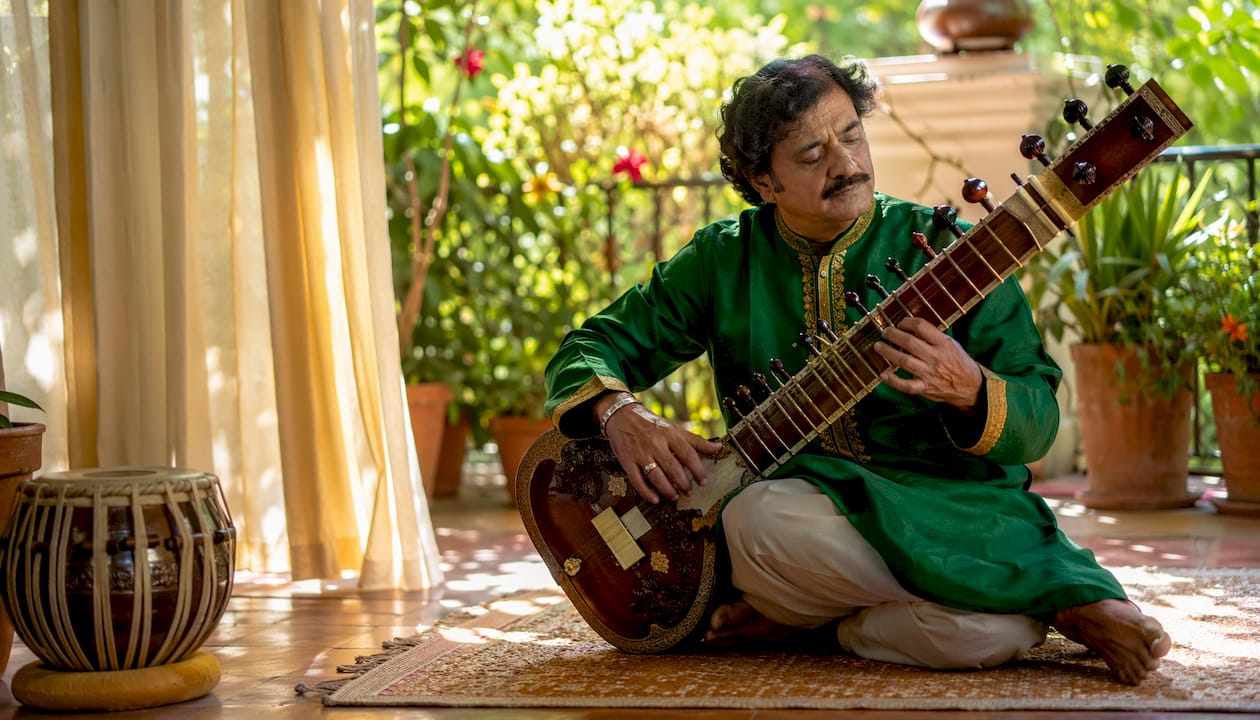
Indian classical music organizes its compositions around ragas, which are melodic frameworks built on specific notes, phrases, and emotional qualities. Every raga-based composition follows the rules of its raga while also fitting into a defined structural form with its own tempo, lyrical style, and performance role. The two main traditions are Hindustani (North Indian) and Carnatic (South Indian), and each has its own set of composition types.
Here is a quick overview of the major forms you will encounter:
Hindustani compositions:
- Khayal (vilambit, madhyalaya, drut, and tarana subtypes)
- Dhrupad and Dhamar
- Thumri and Tappa
- Trivat, Chaturang, and Raagmala
Carnatic compositions:
- Kriti, Varnam, Padam, Javali, and Tillana
- Ragamalika and Ragam-Tanam-Pallavi
Light classical and folk adaptations:
- Bhajan, Ghazal, and Hori
Each form uses a specific lyrical structure and notation approach. Hindustani compositions typically use sthayi and antara stanzas — in the case of Khayal, these are classified by tempo into vilambit (slow), madhyalaya (medium), and drut (fast). Carnatic forms use pallavi, anupallavi, and charanam sections. Understanding these structures helps you recognize and appreciate each form when you hear it.
1. Khayal: The most popular Hindustani raga composition
Khayal is the dominant genre in Hindustani classical music today. The word itself means “imagination,” and the form lives up to that name by giving performers wide room for creative expression within the raga’s rules. A Khayal composition typically has two stanzas: the sthayi, which stays in the lower to middle register, and the antara, which moves into the upper octave.
Tempo is the primary way Khayal compositions are classified:
- Vilambit (slow): A slow, expansive presentation that allows deep melodic exploration. This is where a performer spends the most time developing the raga’s character.
- Madhyalaya (medium-paced): A mid-tempo form that balances melodic development with rhythmic momentum.
- Drut (fast): A fast-paced presentation with quick melodic runs called tans, creating energy and excitement.
- Tarana: A playful, fast composition that uses wordless syllable clusters like “dhim,” “tana,” “nom,” and “tadare” instead of meaningful lyrics. These syllables trace back to the sounds of the mridangam and pakhavaj drums. A tarana is usually performed at the end of a Khayal set.
The bandish, or fixed composition, maps the raga’s melodic range across octaves. The first line starts near the melodic center, the second line covers the lower octave, the antara reaches into the upper octave, and the final line returns to the starting point. This circular structure guides improvisation throughout the performance.
Pro Tip: When listening to a vilambit Khayal, pay attention to how the performer returns to the mukhada (the opening phrase of the sthayi) after each improvised passage. That return is the structural anchor of the entire performance.
2. Dhrupad and Dhamar: The classical pillars of Hindustani music
Dhrupad is the oldest surviving major genre of Hindustani classical music. It was the dominant form until the mid-18th century, and while Khayal eventually took over concert stages, Dhrupad has seen a genuine revival in recent decades. Its character is meditative, serious, and deeply rooted in the Vedic tradition.
Key features of Dhrupad:
- Four-stanza structure: Early Dhrupad compositions had four parts: asthayi (refrain), antara (variation), sanchari (progression), and abhog (culmination). Most modern performances use only the first two.
- Alap as the centerpiece: Dhrupad performances open with an extended, unaccompanied alap that develops the raga slowly and methodically before the bandish begins.
- Solemn lyrical themes: Dhrupad texts are often devotional or philosophical, reflecting their Vedic origins.
- Tempo range: Like Khayal, Dhrupad compositions are classified as vilambit, madhyalaya, or drut.
Dhamar is a related but lighter form within the Dhrupad tradition. It is set to the 14-beat Dhamar-taal rhythm cycle and centers on romantic themes, particularly Krishna and Radha playing Holi. Where Dhrupad is austere, Dhamar has a folk-like warmth. A Dhamar is typically performed at the close of a Dhrupad concert, offering a lighter finish to a weighty program.
The contrast between Dhrupad and Khayal is worth noting. Dhrupad uses a more restrained, syllable-by-syllable approach to melody, while Khayal allows faster runs and more ornamental freedom.
3. Thumri and Tappa: Semi-classical forms with expressive depth
Thumri and Tappa occupy a middle ground between strict classical music and folk. They are treated with genuine artistry and musical care, but they carry more emotional flexibility than Dhrupad or Khayal.
Thumri centers on romantic and devotional themes, often depicting the longing of a devotee for Krishna or the emotions of separated lovers. It favors light ragas like Khamaj, Kafi, Bhairavi, Pilu, and Pahadi, and uses asymmetric rhythm cycles such as Deepchandi, Addha, and Rupak. The defining feature of Thumri is that performers are allowed to stretch the raga’s rules slightly to heighten emotional expression. That flexibility is intentional, not a flaw.
Tappa comes from the folk music of Punjab, specifically songs sung by camel riders. It entered classical music in the 18th century and is known for its fast-paced, intricate melodic ornaments. Tappa compositions are typically built on themes of love and separation, set in light ragas like Kafi, Khamaj, Jhinjhoti, Des, and Bhairavi. The ornamentation in Tappa is dense and rapid, demanding real technical skill from the performer.
Both forms appear regularly in light classical concerts and dance performances. They are not part of a standard Dhrupad or Khayal set, which is one reason they carry the “semi-classical” label. The other reason is their use of folk ornaments that strict classical forms avoid.
4. Trivat, Chaturang, and other specialized Hindustani forms
Beyond the main genres, Hindustani music includes several specialized composition types that combine multiple styles of vocalization into a single piece.
- Trivat: A composition that weaves together three styles of vocalization. These typically include meaningful lyrics, wordless syllables (as in a tarana), and sol-fa syllables called sargam. All three are set to melody within the raga’s rules.
- Chaturang: Similar to Trivat but combining four styles. The fourth element is usually vocal recitation of pakhavaj drum compositions, known as padhant. Chaturang is a demanding form that showcases a performer’s range across multiple musical languages.
- Raagmala (or Raagmala bandish): A composition that strings together multiple ragas, with each stanza or phrase set to a different raga. The mood shifts with each raga change, creating a kind of musical journey through contrasting emotional colors. One well-known example is Bhaja Govindam, the ancient Sanskrit composition by Adi Shankara, where each of the ten stanzas is set to a different raga.
- Hori: Folk songs from the Holi festival tradition of Braj, adapted into the Khayal style. They share thematic ground with Dhamar but sit within the Khayal genre rather than Dhrupad.
- Bamayna bandish: A composition where the lyrics appear to be ordinary words but secretly encode the notation. Each syllable begins with a sound corresponding to a swar (musical note): sa, re, ga, ma, pa, dha, or ni.
These forms do not appear in every concert, but they show up on special occasions and demonstrate the compositional creativity within the Hindustani tradition.
5. Carnatic raga compositions: Kriti, Varnam, Padam, and more
Carnatic music has its own rich set of composition types, each with a defined structure and concert role. The Kriti is the foundational Carnatic composition, built around three sections: pallavi (refrain), anupallavi (second verse), and charanam (final verse). Some Kritis include a chittaswara, a passage of pure notes without lyrics, between the anupallavi and charanam. Others, particularly compositions by Muthuswami Dikshitar, omit the anupallavi entirely and use a samashti charanam instead.
The Kriti is the backbone of any Carnatic concert. Composers like Tyagaraja, Muthuswami Dikshitar, and Syama Sastri, known collectively as the Trinity of Carnatic music, produced thousands of Kritis that remain central to the repertoire today.
Other key Carnatic forms:
- Varnam: The most technically demanding form in the practice repertoire. A Varnam covers all the characteristic phrases and unusual melodic movements of a raga, requiring dexterity and deep raga knowledge. It is also performed in concerts, typically as an opening piece.
- Padam: A slow, lyrical composition with deeply romantic or devotional text. Padams were perfected in the 17th century by the composer Kshetragna and are set in weighty classical ragas. They belong primarily to the dance repertoire but appear in music concerts for their high musical content.
- Javali: A lighter form than the Padam, developed in the 19th century. Javali lyrics deal with human relationships in a direct, sometimes sensuous way. They are set in light ragas like Kapi, Khamas, and Behag, and appear in the second half of concerts or in dance programs.
- Tillana: A short, lively composition that serves as a concert finale. The pallavi and anupallavi consist of swaras and jatis (rhythmic syllables), while the charanam adds lyrics. The name comes from the syllables “ti-la-na.”
- Ragamalika: A composition that moves through multiple ragas, with the performer returning to the original pallavi’s rhythmic theme after each raga section. It often closes the Ragam-Tanam-Pallavi format.
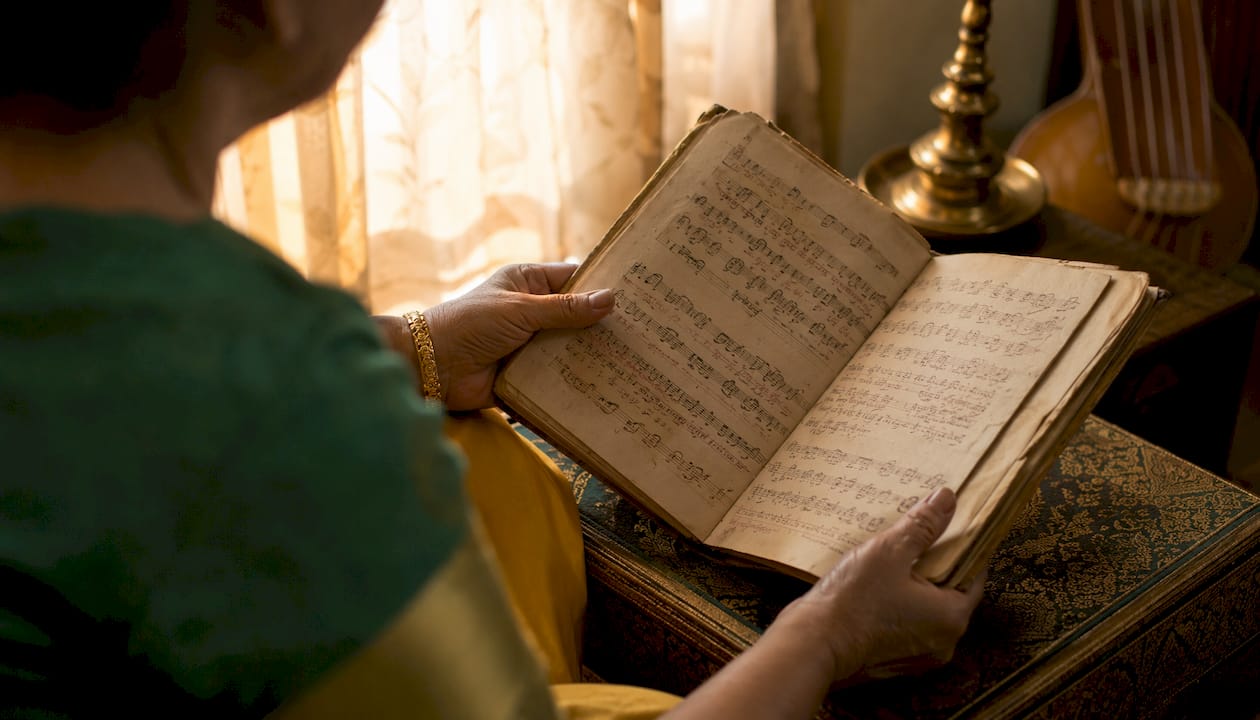
The Indian notation system used in Carnatic music maps these structures precisely, making it possible to transmit compositions across generations with accuracy.
6. How raga compositions support improvisation in performance
Raga compositions are not just fixed pieces to be reproduced. They function as starting points for creative expansion. Pandit Arvind Parikh describes this through the concept of “bindu vistar”: a composition acts as a seed from which the performer grows the full raga structure through improvisation.
“Starting from a Bindu, through the process of badhat or Vistar, he builds up the entire raga structure on a step-by-step basis.” — Pandit Arvind Parikh
In Hindustani music, this balance between fixed composition and spontaneous elaboration is called manodharma. The bandish provides the melodic map, and the performer uses that map to explore the raga’s full range through tans, alap, and rhythmic play with the tabla.
In Carnatic music, the same principle applies through specific techniques:
- Neraval: The performer takes a line from the Kriti and improvises melodic variations on it, staying within the raga’s rules.
- Swara-kalpana: The performer improvises sequences of swaras (sol-fa syllables) that explore the raga before returning to the composition.
- Sangati: Melodic variations on the composition’s phrases, not fixed by the original composer but considered standard in concert performance.
The guru-shishya tradition plays a direct role here. Teachers transmit not just the compositions but the understanding of how far a performer can stretch within a raga before losing its identity. That knowledge is what keeps improvisation authentic rather than arbitrary. You can hear this balance in action by watching live sitar performances where the composition and improvisation feed each other throughout the set.
Pro Tip: If you want to understand how a performer navigates between composition and improvisation, listen for the mukhada in Hindustani music or the pallavi return in Carnatic music. These are the anchors that tell you where the fixed composition ends and the free exploration begins.
7. Alap and Jor: How raga presentations begin before the composition
Before any composed piece begins in a Hindustani performance, the musician presents the raga through alap and jor. These are not compositions in the formal sense, but they are structured presentations that set the raga’s character for everything that follows.
Alap is a slow, unaccompanied exploration of the raga. The performer starts from the tonic (Sa) and builds outward, introducing notes one by one and establishing the raga’s mood, phrase patterns, and emotional character. There is no rhythmic cycle in alap. The pace is entirely in the performer’s hands, and the goal is to make the raga’s identity unmistakable before a single composed line is sung or played.
Jor follows alap and introduces a pulse. The performer begins to play with rhythmic momentum, still without tabla accompaniment, but with a steady internal beat that builds energy. Jor phrases tend to be longer and more flowing than alap phrases, and the tempo gradually increases.
Jhala often follows Jor on string instruments like the sitar. It uses rapid strokes on the drone strings to create a driving rhythmic texture, building toward the entry of the bandish and tabla.
In Carnatic music, the equivalent is the Ragam section of Ragam-Tanam-Pallavi. The performer freely improvises on the raga without rhythmic accompaniment, developing it in stages before the Tanam introduces rhythmic pulses and the Pallavi brings in the composed line. Understanding sitar improvisation helps clarify how alap and jor function as the foundation for everything that follows in a performance.
8. Light classical and folk adaptations: Bhajan, Ghazal, and related forms
Not all raga-based music sits within the strict classical tradition. Several popular forms use ragas as a foundation while allowing more flexibility in structure and presentation.
Bhajan is a devotional song, often performed in a group setting. In casual worship contexts, bhajans use simple melodies that anyone can sing. In classical settings, a trained musician may perform a raga-based bhajan with full melodic elaboration, sometimes including a simple refrain for the audience to join. Bhajans became central to Indian musical culture during the Bhakti movement, roughly from the middle of the first millennium CE onward.
Ghazal originated as a form of Urdu love poetry, introduced to the Indian subcontinent by Sufi mystics in the 12th century. When set to music based on ragas, ghazals fall into the light or semi-classical category. Not all ghazals are raga-based, but those that are carry a distinct melodic depth that separates them from purely pop settings.
Kirtan is a structured, call-and-response devotional form that incorporates ragas associated with specific deities, such as Bhairav for Shiva or Hindola for Krishna. It typically involves multiple instruments and a group of performers.
These forms serve an important social function. They bring raga-based music into everyday life, ceremonies, and community gatherings where a full classical concert would not fit. If you are planning an event and want to understand how Indian classical music suits ceremonies, these lighter forms often provide the most accessible entry point for audiences new to the tradition.
9. Notation and lyrical formats across raga composition types
Every raga-based composition carries a lyrical and notational structure that defines how it is learned, transmitted, and performed. These structures vary significantly across traditions and genres.
In Hindustani music, compositions are traditionally transmitted orally through the guru-shishya system. Written notation, when used, follows the system developed by Vishnu Narayan Bhatkhande in the early 20th century, which uses swaras (sa, re, ga, ma, pa, dha, ni) with markings for octave and duration. The sthayi and antara stanzas of a Khayal bandish are typically written out with both the swar notation and the lyrical text.
In Carnatic music, notation is more standardized and widely used in teaching. The pallavi, anupallavi, and charanam sections of a Kriti are written with swaras, lyrics, and gamaka (ornament) indications. Sangatis, the melodic variations on a Kriti’s phrases, are sometimes notated but are often learned by ear from a teacher.
Lyrical languages vary by form and region. Dhrupad texts are often in Braj Bhasha or Sanskrit. Khayal compositions use Braj Bhasha, Hindi, or Urdu. Carnatic Kritis are composed in Telugu, Sanskrit, Tamil, and Kannada, depending on the composer. Padams are predominantly in Telugu or Tamil. Ghazals are in Urdu.
The notation and lyrical format of a composition tells you a great deal about its tradition, age, and intended performance context. A Sanskrit Dhrupad text signals a very different performance occasion than a colloquial Javali in Kannada.
Key Takeaways
Raga-based compositions span two major classical traditions and dozens of distinct forms, each defined by its structure, tempo, lyrical language, and role in performance.
| Point | Details |
|---|---|
| Two main traditions | Hindustani and Carnatic music each have their own set of composition types with distinct structures. |
| Khayal dominates Hindustani concerts | Khayal compositions are classified by tempo: vilambit, madhyalaya, and drut, with tarana as a related fast form. |
| Kriti is the Carnatic backbone | Kriti consists of pallavi, anupallavi, and charanam sections, supports improvisation through neraval and swara-kalpana, and sometimes includes chittaswara or samashti charanam. |
| Compositions serve as seeds for improvisation | Per Pandit Arvind Parikh, a bandish acts as a bindu from which the performer grows the full raga through badhat. |
| Light forms extend the tradition | Bhajan, Ghazal, and Thumri bring raga-based music into devotional, social, and semi-classical contexts. |
Hear raga compositions performed live
If reading about these forms has made you want to hear them in person, Sitarrajib brings this tradition to life across concerts, festivals, corporate events, and private sessions in Los Angeles and beyond. Rajib Karmakar performs and teaches across the full range of Hindustani raga compositions, from extended Khayal and Dhrupad presentations to lighter semi-classical and fusion sets.
Whether you are a producer looking for live sitar recording for your next project or an event planner building a program around Indian classical music, Sitarrajib offers the depth and versatility to make it work. Reach out at sitarrajib.com to discuss your next event or recording session.