
A leitmotif is a short, recurring musical idea that a composer ties to a specific character, place, object, or idea, then repeats and transforms it to guide your understanding and emotion throughout a film. It is one of the most direct tools a composer has for shaping what you feel and when you feel it.
Three names anchor the canon:
- Richard Wagner built the device in 19th-century opera, using dozens of recurring motifs in Der Ring des Nibelungen to track characters and ideas across four operas.
- John Williams carried it into Hollywood with two of the most recognized motifs ever written: the two-note shark motif in Jaws and The Imperial March for Darth Vader in Star Wars.
- Howard Shore built an entire motif network for The Lord of the Rings, with separate themes for the Shire, Mordor, the Fellowship, and more than a dozen other referents.
- Ennio Morricone took a different path in The Good, the Bad and the Ugly, using whistles, electric guitar, and human voices as motif instruments rather than a traditional orchestra.
The sections below cover how the device works, how to hear it, and how to write it yourself.
Table of Contents
- What is the role of leitmotif in film music?
- How leitmotifs shape narrative, emotion, and subtext
- Famous leitmotif examples you should know
- How composers build and transform leitmotifs
- How to create and apply leitmotifs in your own projects
- Why a distinctive instrument can become a powerful leitmotif
- Common pitfalls to avoid when writing leitmotifs
- Key Takeaways
- Why leitmotifs work differently than most composers expect
- Sitarrajib brings a distinctive voice to your film score
- Useful sources and listening recommendations
What is the role of leitmotif in film music?
Leitmotif comes from the German Leitmotiv, meaning “leading motif.” The standard definition: a short, recurring musical phrase, rhythm, or harmonic progression associated with a character, place, idea, or object. In film, it provides narrative cohesion, psychological insight, and emotional resonance.
That definition covers the basics. What it does not capture is how the device differs from related terms that composers and analysts use interchangeably, often loosely.
A theme is broader. It can be a full melody, 16 bars long, that opens a film and returns at the end. It does not need to transform or carry associative weight across scenes. A motif is shorter, usually two to eight notes, and functions as a building block. A leitmotif is a motif with a specific, consistent referent and the expectation that it will develop alongside the narrative. An idée fixe, coined by Berlioz, is a single recurring melody representing an obsession, used in a single work without the systematic network Wagner built.
Film practice blurs these lines constantly. John Williams calls his cues “themes,” but The Imperial March functions as a leitmotif by any analytical standard. The important distinction is functional: does the musical idea carry a specific meaning, return across the film, and change to reflect narrative or character development? If yes, it is operating as a leitmotif regardless of what the composer calls it.
| Era | Context | Example |
|---|---|---|
| 19th-century opera | Wagner’s Der Ring des Nibelungen | Dozens of motifs for characters, objects, and ideas across four operas |
| Early Hollywood (classic Hollywood era) | Max Steiner, Erich Wolfgang Korngold | Recurring character themes in King Kong, The Adventures of Robin Hood |
| Contemporary film | John Williams, Howard Shore, Ennio Morricone | Star Wars, The Lord of the Rings, The Good, the Bad and the Ugly |
Richard Wagner’s operatic practice gave film composers a ready-made dramaturgical model. Cinema inherited the same structural problem opera had: how do you keep a long, complex narrative coherent across time? The leitmotif solved it by giving the audience a musical memory system.
How leitmotifs shape narrative, emotion, and subtext
The role of music in films goes well beyond background atmosphere. A leitmotif does specific narrative work that dialogue and visuals cannot always do alone. Here are its core functions:
- Character identification: You hear the motif before you see the character, or after they leave the frame. The music tells you who is present or who is being thought about.
- Memory cueing: Repetition builds recognition. By the third or fourth appearance, the motif triggers the emotional associations from every prior scene where it appeared.
- Subtext and irony: A composer can play a villain’s motif under a scene where the villain is not visible, telling you the threat is real even when the hero does not know it yet.
- Foreshadowing: A motif heard in a distorted or minor-key form before a character’s death prepares the audience emotionally without revealing the plot.
- Thematic unity: Across a two-hour film or a multi-film franchise, motifs create a musical architecture that holds the story together.
- Continuity in fragmented narratives: When a film cuts between timelines or locations, a shared motif signals connection without a title card.
Matthew Bribitzer-Stull’s analysis frames this precisely: the leitmotif functions as both a thematic identifier and an associative marker that evolves to reflect a character’s internal changes. It is not merely an audio label.
One underused function is diegetic hinting. A motif can appear in a diegetic source, a radio playing in the background, a character humming a tune, to communicate offscreen influence without visual confirmation. Howard Shore used this technique in The Lord of the Rings films to signal the Ring’s corrupting presence even in scenes where it is not shown. That kind of placement requires close coordination between the composer, sound designer, and editor.
When you are watching a film and want to catch leitmotifs in action, listen for three things: a motif that appears before its referent is visible, a motif that returns in a changed form at a dramatic turning point, and a motif that plays under a character who is thinking about someone else.
Famous leitmotif examples you should know
These four examples cover the range of what the device can do, from a two-note shark cue to a network of more than thirty interlocking themes.
- Jaws (1975, John Williams): The shark motif is two alternating notes, E and F, played on low strings. It starts slowly, accelerates as the shark approaches, and works because it is almost too simple to be music. Williams said he thought Steven Spielberg was joking when he first played it. The motif is never played when the shark is not a threat, so its absence is as meaningful as its presence.
- The Imperial March (1980, John Williams): Darth Vader’s theme is built on a descending minor third and a dotted rhythm that suggests a military march. It appears in full orchestration when Vader is dominant, fragmented when he is offscreen but influential, and in a slower, stripped-back form in Return of the Jedi when his humanity resurfaces. The transformation tracks his arc precisely.
- The Lord of the Rings (2001–2003, Howard Shore): Shore built one of the most extensive leitmotif networks in film history, with distinct motifs for the Shire, Mordor, the One Ring, the Fellowship, Rohan, and more. The Shire theme is diatonic and folk-like; the Ring motif is chromatic and unstable. When Frodo is tempted by the Ring, you hear the Ring motif creep into the Shire theme, a musical representation of corruption that works without a single line of dialogue.
- The Good, the Bad and the Ugly (1966, Ennio Morricone): Morricone assigned each of the three main characters a distinct sound: a whistle for Blondie, an ocarina for Angel Eyes, and a human voice for Tuco. These are not melodies in the traditional sense; they are timbral signatures. The approach shows that a leitmotif does not need to be orchestral or even pitched in a conventional way to function.
| Film | Motif | Instrumentation | Key transformation |
|---|---|---|---|
| Jaws | Two alternating notes (E/F) | Low strings | Tempo accelerates with threat level |
| Star Wars | Descending minor third, dotted rhythm | Full brass | Fragmented when Vader is offscreen; stripped back for redemption |
| The Lord of the Rings | Chromatic Ring motif vs. diatonic Shire theme | Choir, strings, folk instruments | Ring motif infiltrates Shire theme during temptation scenes |
| The Good, the Bad and the Ugly | Timbral signatures per character | Whistle, ocarina, voice | Timbre alone carries identity; no melodic development needed |
It is worth noting that modern composers have pushed the device further into sound design. Hans Zimmer’s work on The Dark Knight uses a two-note metallic motif for the Joker that functions more as a sound-design element than a traditional melody, widening the expressive palette of what a leitmotif can be.
Pro Tip: When studying these scores, listen to the motif in its first appearance, then find its last. The distance between those two versions tells you everything about the character’s arc.
How composers build and transform leitmotifs
A good leitmotif survives reharmonization, orchestral doubling, and rhythmic disguise. That durability is not accidental. Composers design motif fragments with distinctive intervallic shapes and timbres specifically so the motif stays recognizable even when everything around it changes.
Construction basics: Keep the cell short, two to six notes. Give it a distinctive intervallic contour, a leap of a tritone or a minor sixth stands out more than a stepwise scale. Pair it with a specific timbre or instrument so the association is reinforced by sound color as well as pitch. The two-note Jaws motif works partly because it lives in the low strings; the same pitches on a flute would not carry the same dread.
Transformation strategies are where the real craft lives:
- Augmentation slows the rhythm, making a march feel like a funeral.
- Diminution speeds it up, creating urgency or agitation.
- Inversion flips the melodic direction, often used to suggest a character’s reversal or defeat.
- Reharmonization keeps the melody but changes the underlying chords, shifting the emotional color from hopeful to ambiguous.
- Fragmentation uses only two or three notes of the motif, suggesting a presence that is partial or fading.
- Orchestration swap moves the motif from strings to brass to woodwinds, each carrying different emotional weight.
The trap to avoid is what practitioners call “on-the-nose” writing: playing the hero’s triumphant theme every time the hero does something heroic. The more interesting use is ironic or anticipatory. Play the villain’s motif under a scene where the hero feels safe. Play the love theme in a minor key during a reunion that is about to go wrong. The motif adds information the image does not.
Isolating intervallic contour and instrumentation helps you hear these transformations. On a second listen, mute the dialogue in your head and track only the motif’s shape and color. You will catch transformations you missed the first time.
How to create and apply leitmotifs in your own projects
Here is a practical process you can follow from the first spotting session to the final mix.
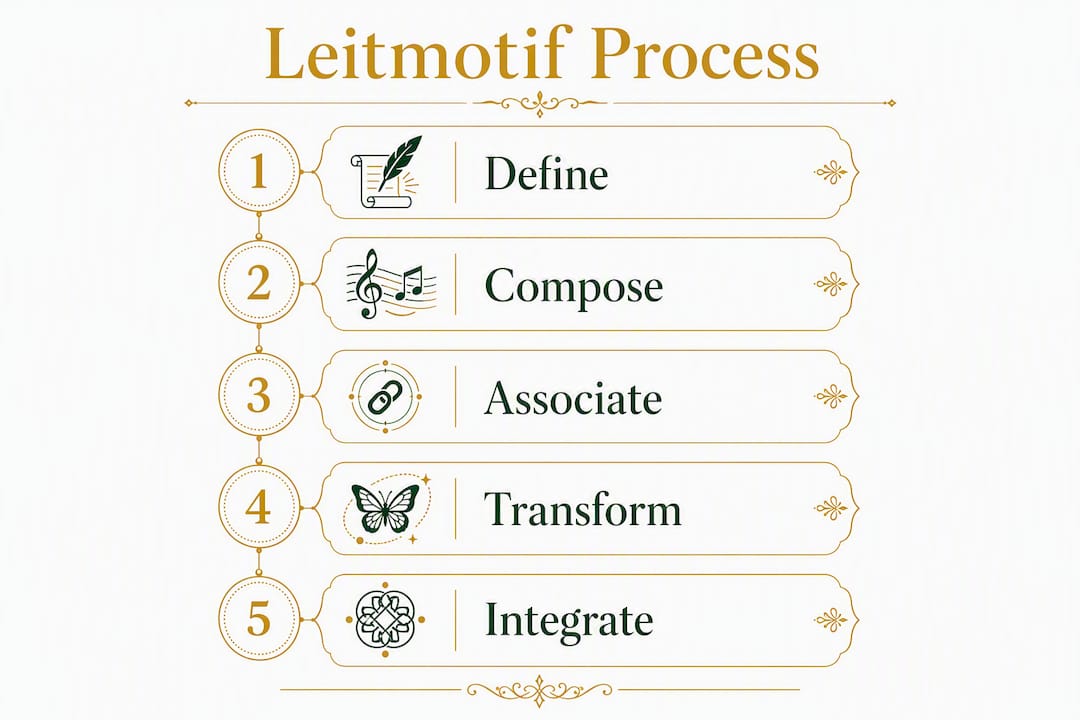
Spot the film with narrative intent. Watch the film with the director and editor. Mark every scene where a character, relationship, or idea needs a musical identity. Note whether the scene calls for the motif to be prominent, subtle, or absent. Absence is a choice too.
Find your cell. Write a two-bar phrase for each major referent. Keep it short enough to fragment later. Test it on a single instrument first, piano or guitar, before you orchestrate. If it does not work acoustically, it will not work in a full arrangement.
Create three variations before you score a single scene. Write a version in a major key, a minor key, and a rhythmically altered form. This forces you to think about the motif’s range before you commit it to a scene. If you cannot vary it, it is probably too simple or too complex.
Map motif placement to the dramatic arc. The first appearance should be clear and unambiguous so the audience registers the association. Middle appearances can be more disguised. The final appearance should carry the full weight of everything that came before.
Balance the motif in the mix. A leitmotif does not always need to be the loudest element. In dialogue-heavy scenes, push it under the conversation at a level where it registers subconsciously. In action sequences, bring it forward. The role of music in promotional video follows the same principle: music supports the message without competing with it.
Test recognition with a fresh listener. Play three scenes containing the motif to someone who has not seen the film. Ask them to identify the recurring musical idea. If they cannot, the motif needs more distinctive shaping or clearer placement.
Coordinate with sound design. If you want to use a motif diegetically, talk to the sound designer early. A motif bleeding from a diegetic source needs to match the acoustic environment of that source, room tone, distance, and reverb included.
Pro Tip: In spotting sessions, come prepared with a one-sentence description of each motif’s referent and its emotional register. Directors respond better to “this is a four-note phrase that represents Mara’s grief, played on solo cello” than to a vague description of the music’s mood.
Why a distinctive instrument can become a powerful leitmotif
Timbre is one of the fastest ways to build recognition. When an audience hears an instrument they associate with a specific character or world, the association forms quickly and holds across transformations. This is exactly why Morricone used a whistle for Blondie and why Shore used folk instruments for the Shire.
The sitar is a strong example of this principle in practice. Its resonant, sustained tone and characteristic sympathetic string buzz are immediately identifiable, even in a dense orchestral mix. A two-bar sitar phrase used consistently for a specific character or setting will register as a leitmotif faster than the same phrase played on violin, because the timbre itself carries distinctiveness.
Cultural sensitivity matters here. Using a culturally specific instrument as a leitmotif requires more than a good melody. The scale choices, the modal context, and the performance style all carry cultural meaning. A sitar motif built on a raga framework communicates something specific to listeners familiar with Indian classical music, and something different to those who are not. Both responses are valid, but the composer needs to be aware of both. Raga-based melodic planning offers a structured approach to modal choices that respects the instrument’s tradition while serving the film’s narrative.
Recording logistics for a sitar motif in a film score require specific attention. Close-mic placement captures the instrument’s detail and sympathetic resonance; a room mic adds space. In the mix, a high-pass filter around 80 Hz cleans up low-end rumble without affecting the instrument’s body. For more technical detail on mic placement and signal chain, sitar recording techniques for film scoring covers the full workflow.
Licensing is a separate consideration. If you are sampling a recorded traditional performance rather than hiring a live player, you need to clear the rights to that recording. Original compositions performed live carry different rights implications than samples. For a clear breakdown of what applies in a U.S. film context, licensing Indian classical music for film is a practical starting point.
Pro Tip: When collaborating with an instrumental specialist on a leitmotif, ask them to improvise around the motif’s core interval in their instrument’s idiomatic style. You will often get a more authentic and recognizable result than if you write out every note yourself.
Common pitfalls to avoid when writing leitmotifs
Most leitmotif problems come down to a few recurring mistakes. Knowing them in advance saves you a lot of revision.
Overuse kills the effect. If the motif plays every time a character appears on screen, it stops being a signal and becomes wallpaper. Reserve it for moments where the association adds information or emotion the image does not already carry.
Too complex to transform. A motif built on a long, elaborate melody is hard to fragment, invert, or reharmonize without losing recognition. Keep the core cell short. You can always add countermelody or orchestration around it.
No distinctive intervallic shape. A motif built entirely on stepwise motion blends into the harmonic background. Give it at least one distinctive leap or rhythmic figure that survives orchestration changes.
Inconsistent association. If you use the same motif for two different characters or ideas, the audience’s associative memory breaks down. Each referent needs its own musical identity, even if the motifs share a harmonic world.
Ignoring the absence. Not playing a motif when the audience expects it is one of the most powerful tools available. If a character’s motif has been consistent throughout the film and then disappears in their final scene, that silence communicates something. Plan absences as deliberately as appearances.
Forcing the motif into every cue. Film music practitioners note that functional purpose matters more than technical completeness. Not every scene needs a leitmotif. Some scenes work better with ambient texture or silence. Let the drama guide placement, not a checklist.
On-the-nose placement. Playing a character’s triumphant theme during their triumph is the least interesting use of the device. The motif adds the most value when it tells the audience something the image does not, a threat that is not yet visible, a feeling the character is suppressing, a connection the story has not yet made explicit.
Key Takeaways
A leitmotif’s power comes from consistent association, deliberate transformation, and strategic placement, not from how often it repeats.
| Point | Details |
|---|---|
| Core definition | A leitmotif is a short, recurring musical idea tied to a character, place, or idea that develops alongside the narrative. |
| Primary functions | Identification, memory cueing, foreshadowing, subtext, and thematic unity across a film or franchise. |
| Canonical examples | Jaws’ two-note motif, The Imperial March, Shore’s LOTR network, and Morricone’s timbral signatures each demonstrate a different approach. |
| Transformation techniques | Augmentation, diminution, inversion, reharmonization, fragmentation, and orchestration swaps keep a motif recognizable while reflecting character change. |
| Cultural instrument note | Using a distinctive instrument like sitar as a leitmotif increases recognition but requires cultural sensitivity, appropriate modal choices, and rights clearance. |
| Sitarrajib | Rajib Karmakar offers commissioned leitmotif composition, live sitar recording sessions, and film music production for projects that need a distinctive instrumental voice. |
Why leitmotifs work differently than most composers expect
Most discussions of leitmotifs focus on the famous examples, Williams, Shore, Wagner, and treat the device as something that belongs to large-scale orchestral scores. That framing misses the point.
The leitmotif works because human memory is associative. You hear a sound, you connect it to an experience, and the next time you hear that sound, the experience comes back. Composers do not create that response; they use a response that already exists in how the brain processes music. The craft is in choosing the right musical cell, placing it at the right moment, and then trusting the audience to carry the association forward without being told.
What I find most interesting, working across Indian classical and Western film contexts, is how differently the two traditions approach recurring musical ideas. In Indian classical music, a raga is not a leitmotif, but it functions associatively in a similar way. Certain ragas carry emotional and temporal associations that an informed listener brings to every performance. When you use a raga-derived motif in a film score, you are working with two layers of association simultaneously: the one you build through the film and the one the raga already carries. That layering can be a strength, but it requires you to know which layer your audience is hearing.
The practical lesson: before you write a motif, decide what association you are building and for whom. A motif that works for a Western audience may carry unintended meaning for a South Asian audience, and vice versa. That is not a reason to avoid culturally specific instruments or scales. It is a reason to be deliberate about them.
Working with directors and editors on motif placement has taught me that the most effective leitmotifs are the ones the audience does not consciously notice until a late scene makes the pattern clear. That retroactive recognition, the moment a viewer realizes the music has been telling them something all along, is what separates a leitmotif from a theme song.
Sitarrajib brings a distinctive voice to your film score
If you are working on a film, media project, or commissioned score and want a leitmotif with a genuinely distinctive timbre, a live sitar session delivers something no sample library can replicate. The sympathetic string resonance, the microtonal inflections, and the dynamic range of a live performance give a motif an identity that holds up across transformations and mixing contexts.
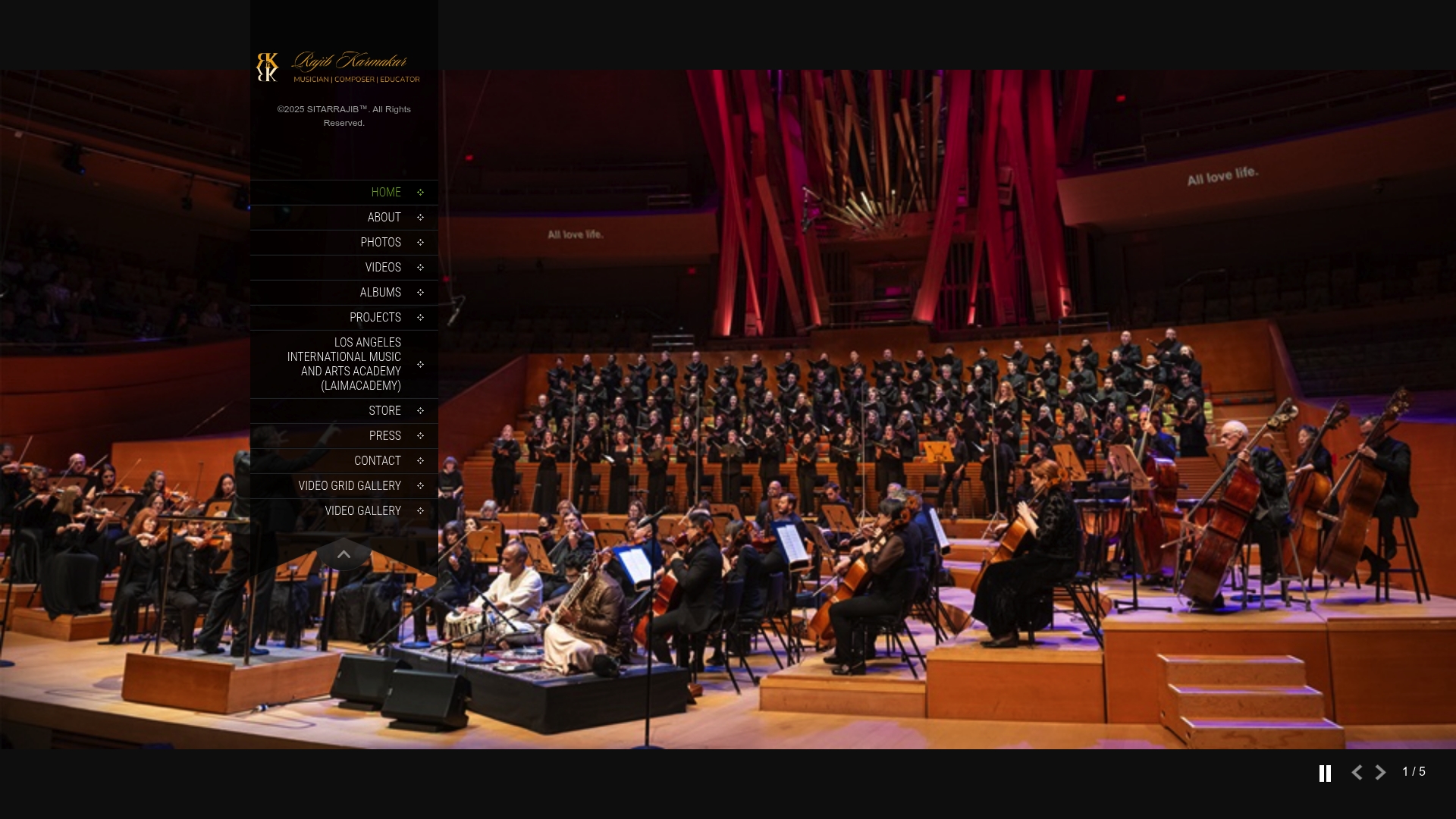
Sitarrajib offers live session sitar recording for producers and composers, along with commissioned film music, workshops on Indian classical music for media, and cultural music experiences. Rajib Karmakar works directly with directors and editors to develop motifs that fit the narrative, not just the aesthetic. If you have a project in development and want to discuss how a sitar motif could work in your score, reach out through sitarrajib.com to start the conversation.
Useful sources and listening recommendations
The sources below are organized by use: academic study, score analysis, and production guidance.
For academic study:
- Understanding the Leitmotif by Matthew Bribitzer-Stull: The most thorough musicological treatment of the device, tracing it from Wagner through Harry Potter and The Lord of the Rings. Start here if you want a scholarly foundation.
- Leitmotif definition and history, Britannica: A reliable short reference for the technical definition and historical context.
- MTO 22.1: Film Music Themes, Richards: A peer-reviewed analysis of how film themes function associatively and emotionally; useful for understanding the relationship between leitmotif and broader film music theory.
For score analysis:
- Leitmotif, Wikipedia: A solid overview with examples across opera and film; useful as a quick reference for canonical examples.
- Howard Shore’s LOTR score, LibreTexts: A course-level breakdown of Shore’s motif network; good for understanding how a large-scale system works in practice.
- Leitmotif revisited, FilmSound: An essay on how Wagner’s model transferred to film scoring and why it solved specific dramaturgical problems.
- LOTR leitmotif practitioner notes, Woodzie: A detailed fan-scholar breakdown of Shore’s themes; one of the most thorough public analyses of the LOTR score.
For production and composing guidance:
- Essay on motif flexibility, Brent Yorgason: Practical analysis of how composers design motifs to survive transformation; directly useful for the composing techniques section.
- The use of leitmotifs in film scores, FilmMusicTheory: Listening strategies and compositional guidance for practitioners.
- Visual storytelling techniques in film: Useful context for understanding how musical motifs interact with visual storytelling choices.
Recommended listening:
| Track | Film | What to listen for |
|---|---|---|
| “Main Title / Theme from Jaws” | Jaws (1975) | Two-note motif, tempo acceleration, absence during safe scenes |
| “The Imperial March” | The Empire Strikes Back (1980) | Dotted rhythm, brass orchestration, fragmentation in later films |
| “The Fellowship of the Ring” | The Lord of the Rings (2001) | Motif layering, Ring motif vs. Shire theme contrast |
| “The Ecstasy of Gold” | The Good, the Bad and the Ugly (1966) | Timbral identity, voice as motif instrument |