

To blend sitar into a pop production, treat the sitar as a hybrid textural lead. Record or source a high-quality take, build the arrangement around its tonal center (raga or key), and use targeted EQ, dynamic control, and modern effects to place it above the mix without competing with drums and bass.
TL;DR: Choose your sitar source, lock the tonal center to your key, record dry and wet stems at 48kHz/24-bit, then carve midrange space with subtractive EQ and automate expression.
- Source: Pick live acoustic sitar for authentic fusion, a Coral-style electric for easy tracking, or a multisampled library for fast demos.
- Arrangement: Assign sitar one role per section (lead hook, texture, or counter-melody) and keep it out of the chorus unless it IS the hook.
- Mix move: High-pass below 200Hz, reduce competing midrange frequencies that clash with vocals and pads, and use a short plate reverb to glue it to the track.
Pro Tip: Before you open a session, decide whether sitar is the lead or the color. That single decision shapes every EQ, arrangement, and automation choice you make.
Table of Contents
- Where does sitar actually fit in a pop arrangement?
- Which sitar source is right for your session?
- How do you record sitar for a pop mix?
- What is the step-by-step mixing recipe for sitar in pop?
- How do you write sitar parts that actually fit pop song forms?
- What should your pre-session checklist look like?
- How does Sitarrajib’s crossover collaboration process work?
- Key Takeaways
- The part most producers get wrong about sitar in pop
- Work with Sitarrajib on your next sitar session
- Useful sources and publisher assets
Where does sitar actually fit in a pop arrangement?
Sitar works best when it has a clear, defined role. The instrument has a wide frequency spread, a naturally long sustain, and microtonal ornaments that draw attention. Give it too much space and it pulls focus from the vocal. Give it too little and it disappears.
Here are the roles that work consistently in pop production:
- Lead melodic hook: Sitar carries the main motif in a verse or pre-chorus, often doubling or answering the vocal line.
- Atmospheric texture: Short, looped phrases or sustained drones sit under synth pads in a bridge or intro.
- Counter-melody: Sitar plays a response phrase against the vocal, especially effective in mid-tempo tracks.
- Intro or bridge ornament: A short sitar phrase opens the track or marks a section transition.
- Interlude solo: A full sitar passage replaces the guitar solo, common in fusion pop and Bollywood-influenced tracks.
Pairing sitar with synth pads or clean guitar tends to yield strong results because neither instrument fights for the same harmonic space. Sitar and a heavily distorted guitar, on the other hand, create frequency chaos in the 1–4kHz range. For sitar as ambient texture, sparse verses and dramatic interludes are the natural home.
What to avoid: Letting sitar run continuously through a chorus that already has a lead vocal, bass, and drums. The instrument’s overtones will mask the vocal and muddy the low-mids. Also avoid forcing a long raga improvisation into a 16-bar section that needs a tight, repeatable hook.
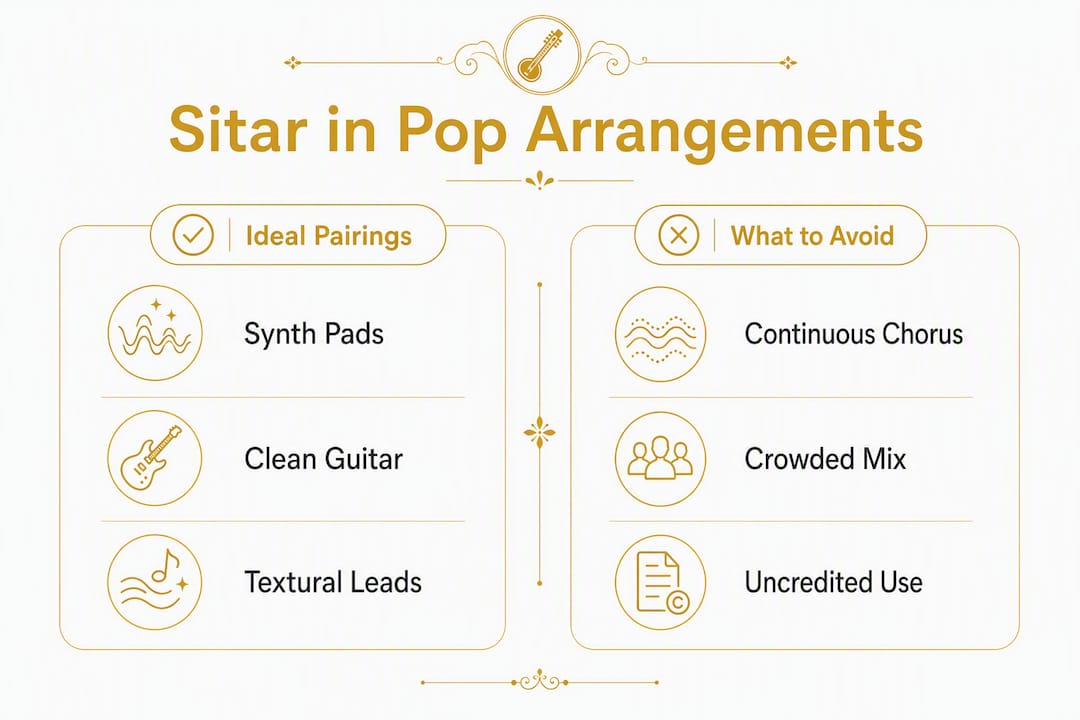
Cultural sensitivity note: When you use sitar in pop, credit the instrument and its tradition in your liner notes or release metadata. If you worked with a live sitarist, name them. If you used a sample library, check the license and credit the source. This is not a legal requirement in every context, but it is standard practice in the fusion community and it matters to the artists whose tradition you are drawing from.
Which sitar source is right for your session?
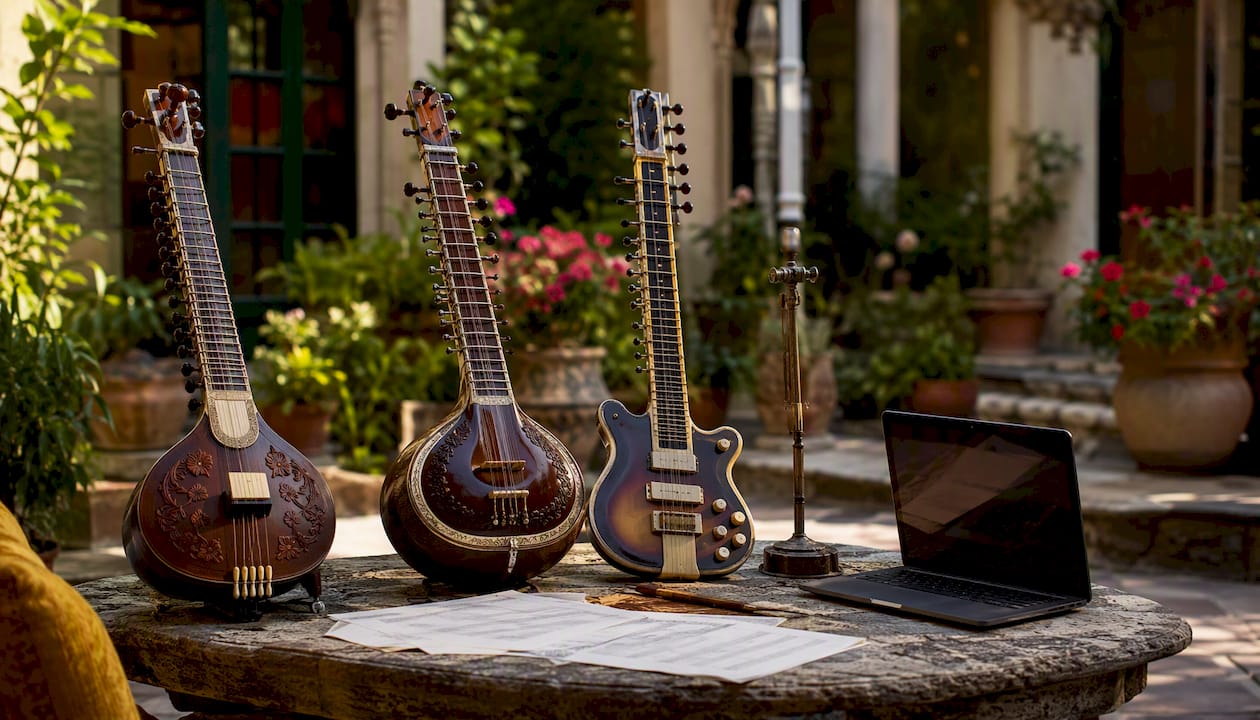
You have three practical options: a live acoustic sitar, a Coral-style electric sitar, or a multisampled virtual instrument. Each one involves real trade-offs in tone, workflow, and cost.
Acoustic sitar
A live acoustic sitar gives you the full picture: microtonal ornaments (meend, kan swar), sympathetic string resonance, jawari buzz, and the natural dynamic range that no sample library fully replicates. It requires a skilled player, a decent room, and at least one quality condenser microphone. Sessions take longer, tuning is more involved, and the player needs time to warm up. For authentic fusion, this is the right call.
Coral Electric Sitar (Danelectro lineage)
The Coral Electric Sitar, introduced by Danelectro in 1967, was designed as an electric guitar configured to emulate sitar timbre. It made sitar-like sounds accessible to Western studio guitarists and drove a wave of sitar-influenced pop in the late 1960s. The tone is brighter and more guitar-like than an acoustic sitar, with less sympathetic resonance and fewer microtonal possibilities. It tracks cleanly through a DI or amp, fits easily into a standard guitar session, and requires no specialist mic setup. For a pop hook that needs a sitar flavor without full classical authenticity, it is a practical and historically grounded choice.
Multisampled virtual instruments
Sample libraries give you tempo-locked, pitch-corrected sitar phrases you can drop into any DAW. They are fast, consistent, and require no session booking. The trade-off is that they lack the dynamic expression and microtonal nuance of a live player. In Ableton Live, you can use Warp modes and Instrument Racks to layer sampled Indian instruments with electronic elements, syncing sitar loops to your tempo grid. For demos and modern pop hooks where the sitar is a texture rather than a featured lead, this is the fastest path.
| Source | Tone | Tuning flexibility | Mic needs | Session control | Best for |
|---|---|---|---|---|---|
| Acoustic sitar | Rich, full, authentic | High (microtones, ragas) | Yes (stereo pair) | Lower | Authentic fusion, film, featured lead |
| Coral Electric Sitar | Bright, guitar-like | Moderate | DI or amp mic | High | Pop hooks, fast sessions, retro flavor |
| Multisampled library | Consistent, processed | Limited | None | Highest | Demos, textures, tempo-locked loops |
Pro Tip: For a modern pop hook, layer a multisampled sitar riff with a live electric sitar overdub. The sample gives you rhythmic precision; the live take adds the human feel and slight pitch variation that makes the part sound real.
How do you record sitar for a pop mix?
The single most important decision you make at the recording stage is file format. Deliver separate stems at 48kHz/24-bit: at minimum a dry close-mic take, a room ambience take, and a separate capture of the sympathetic string resonance. That separation gives the mix engineer full control over how much natural buzz and reverb ends up in the final track.
Microphone choices and placement
Two microphones cover most sitar recording scenarios well.
The Neumann U87 is the standard choice for close-miking. Its large diaphragm captures the full frequency range of the sitar, including the low-mid body resonance and the high-frequency shimmer of the jawari. Position it roughly a foot or so from the bridge, angled slightly toward the main playing strings rather than the sympathetic strings. This gives you a clean, detailed close sound with controlled low-end.
The AKG C414 works well as a second mic or as the primary mic when you want a slightly brighter, more open capture. Its switchable polar patterns let you use cardioid for close work or figure-8 for a mid-side setup. Place it at an appropriate distance and angle to capture body resonance and room ambiance to capture the full body resonance and some room air.
For a simple two-mic setup: U87 near the bridge (close, detailed), C414 at room distance (body and air). Pan them slightly apart in the mix for a natural stereo image.
Room considerations: A live but not overly reverberant room works best. Hard-walled rooms add unwanted flutter echo that competes with the sitar’s natural sustain. If you are recording in a treated studio, add a small amount of room ambience with a short plate reverb at the mix stage rather than baking it in at tracking.
Gain staging: Set input gain to avoid clipping while capturing the sitar’s full dynamic range. The sitar’s dynamic range is wide. If you push gain too high to capture quiet ornamental passages, you will clip on the loud strokes. Use a slow-attack preamp or a gentle optical limiter on the way in.
Sympathetic string resonance: The sympathetic strings (taraf) create the characteristic hum and shimmer of the acoustic sitar. Capture them by keeping the room quiet and not gating the input. A noise gate will cut the sympathetic resonance before it decays naturally. Record a separate pass with the main strings muted so you have an isolated sympathetic resonance stem if needed.
- Dry close-mic stem (U87, near bridge)
- Room ambience stem (C414, 3–4 feet back)
- Sympathetic resonance stem (separate pass, main strings muted)
- DI stem if using electric sitar
- Multiple performance passes: Foundation (main melodic line), Flavor (ornamental fills), Solo (featured passage)
Pro Tip: Label every file with a consistent naming convention before you send stems to the mix engineer. A format like 01_SIT_FND_dry_48k24b.wav (track number, instrument, pass type, signal path, spec) saves significant time at the mix stage and prevents version confusion.
For more on high-fidelity sitar capture in production contexts, the sitar recording techniques for film scoring guide covers overlapping best practices in detail.
What is the step-by-step mixing recipe for sitar in pop?
The core principle: use subtractive EQ to clear competing midrange, gentle compression to control peaks while preserving microdynamics, and tasteful harmonic saturation to help sitar cut through a dense pop mix. Work in this order.
Static EQ (subtractive first). High-pass the sitar to remove low-end rumble below the key frequency range to remove low-end rumble and free up space for bass and kick. Notch 800Hz–1.2kHz by 2–4dB to reduce the nasal midrange buildup that clashes with synth pads and vocals. Use a linear-phase EQ for this cut to avoid phase smearing on the harmonics above it.
Dynamic control. Use a slow-attack, medium-release compressor with a gentle ratio to preserve articulation. The slow attack lets the initial pluck transient through, which preserves the sitar’s articulation. Apply moderate gain reduction on peaks to control dynamics. Avoid fast-attack compressors here; they kill the jawari attack and make the sitar sound like a synth pad.
Stereo placement. Keep the dry close-mic stem centered or slightly off-center (10–15% left or right). Send the room stem to a stereo bus and widen it. This creates depth without spreading the fundamental tone across the stereo field in a way that weakens it on mono playback.
Harmonic saturation. A tape-style or tube saturation plugin adds odd-order harmonics that help the sitar sit in a dense mix without boosting level. Apply it gently (1–3dB of drive) on the close-mic stem. This is especially useful when the sitar needs to cut through 808 sub-bass and layered synths.
Reverb and delay sends. Use a short plate reverb (pre-delay 15–20ms, decay 1.2–1.8 seconds) as the main reverb send. This keeps the sitar present and forward. Add a tempo-synced dotted-eighth delay at low mix level (10–15%) to create rhythmic movement without cluttering the mix. Keep the delay send mono or narrow stereo so it does not compete with the reverb tail.
Sidechain and ducking. If synth pads or midrange-rich guitars are masking the sitar, use volume automation rather than heavy sidechain compression. Draw in a 2–3dB dip on the competing instrument every time the sitar plays its main phrase. This is more transparent than a fast sidechain and preserves the natural dynamics of both instruments.
Automation for expression. Automate the sitar’s fader and reverb send level through the arrangement. Bring the reverb send up slightly during sustained notes and ornamental slides (meend) to let the natural pitch movement breathe. Pull it back on rhythmic strokes so the attack stays clear. This is the single most effective way to preserve the sitar’s expressive character in a pop context.
Dealing with frequency masking: The sitar’s fundamental range sits roughly between 200Hz and 3kHz, which overlaps directly with synth pads, rhythm guitars, and the upper harmonics of 808 bass. Run a spectrum analyzer on a full mix bus reference and identify where the sitar’s energy clusters. If it is competing with a synth pad in the 600Hz–1kHz range, automate the pad down by 2–4dB during sitar phrases rather than EQing the sitar more aggressively.
Pro Tip: To preserve microtonal slides, use a transient shaper (not a compressor) to control the attack separately from the sustain. Reduce attack by 1–2dB and boost sustain by 1–2dB. This keeps the ornamental slides audible without the initial pluck overpowering the mix.
How do you write sitar parts that actually fit pop song forms?
Choose the tonal center before you write a single note. Whether you are working from a raga (Kirwani, Yaman) or a Western key, the sitar part needs to be built around that center from the start. Trying to retrofit a sitar melody onto a chord progression it was not designed for produces parts that sound out of place regardless of how well they are recorded.
Lo-fi and trap producers commonly choose a raga that matches the emotional quality of the track (Kirwani for a minor, melancholic feel; Yaman for a bright, open feel) and then record Foundation, Flavor, and Solo layers around that choice. This approach, documented by contemporary fusion practitioners, gives the mix engineer maximum flexibility and keeps the sitar part coherent across the arrangement.
Dos:
- Use short motifs (4–8 notes) that repeat and vary, rather than long improvised lines.
- Write call-and-response phrases between sitar and vocal or sitar and synth.
- Use ornamental notes (kan swar) to add Indian flavor to otherwise simple melodic lines.
- Reserve the sitar for verses, pre-choruses, bridges, and interludes where the arrangement has space.
Don’ts:
- Do not force a full raga improvisation into a 16-bar chorus. The sitar will compete with the vocal and the hook will suffer.
- Do not tune the sitar to a key that requires constant retuning mid-session. Choose a key the instrument can hold comfortably.
- Do not layer sitar over a dense chord stack. It needs harmonic space to be heard clearly.
Scale and tuning in practice
The sitar is typically tuned to a specific raga, which means some Western chord progressions will create microtonal clashes. The practical solution: map the raga’s notes to the closest Western scale and write the sitar part using only those notes. Raga Yaman maps closely to the Lydian mode; Raga Kirwani maps to a natural minor with a flat second. Raga-aware arranging tools can help you visualize this mapping quickly.
For producers who want to go deeper on raga-based composition, the types of raga-based musical compositions guide is a useful reference.
Historical and modern references
The Beatles’ “Norwegian Wood (This Bird Has Has Flown)” (1965) is widely cited as the first prominent use of sitar in Western pop, with George Harrison playing the instrument on the track. A year later, “Love You To” from Revolver (1966) went further, featuring a full Indian classical arrangement. Led Zeppelin incorporated sitar textures in their recordings, and Anoushka Shankar’s “Are You a Lipstick Girl?” (2011) demonstrates how sitar can fuse with electronic beats and contemporary pop structures without losing its classical identity.
“Fusion is not about erasing tradition. It’s about letting traditions converse.” — Purbayan Chatterjee, speaking about his approach to blending sitar with electronic music on Feathered Creatures.
This is the right frame for any producer working with sitar in pop. The instrument brings something specific and irreplaceable. The goal is conversation, not replacement.
Credit the tradition in your release. List the sitarist by name in your credits. If the sitar is a central element of the track, consider a brief liner note acknowledging its Indian classical roots. This is standard practice in the fusion community and reflects well on the production.
What should your pre-session checklist look like?
A clear pre-session brief saves time and produces better stems. Send this to your sitarist before the session date.
Pre-session brief (send at least 48 hours before):
- Desired raga or key (specify both if you have a preference).
- Tempo map or click track exported from your DAW.
- Two or three reference tracks that represent the tone and energy you want.
- Arrangement map: which sections need sitar, what role (lead, texture, counter-melody), and approximate bar counts.
- Deliverable list: dry stems, room stems, DI if applicable, Foundation/Flavor/Solo passes.
- File specs: 48kHz/24-bit WAV, labeled by convention (e.g.,
01_SIT_FND_dry_48k24b.wav). - Booking confirmation, session length, and payment terms.
In-session deliverables to request:
- Dry close-mic take (no effects, no reverb)
- Room ambience take (natural decay captured)
- DI or electric take if a Coral-style sitar is used
- Foundation pass: the main melodic line, played clean and steady
- Flavor pass: ornamental fills, counter-phrases, and variations
- Solo pass: featured melodic passage for the interlude or bridge
- Tuned guide vocal or reference playback file for the sitarist to play against
Time budget for a standard session:
- Warm-up and tuning: 20–30 minutes.
- Foundation pass (3–4 takes per section): 45–60 minutes.
- Flavor and Solo passes: 30–45 minutes.
- Quick rough comp and playback review: 15–20 minutes.
- Contingency for retakes or arrangement adjustments: 30 minutes.
Total: plan for a 3-hour session minimum for a single song with multiple passes.
File naming convention:
01_SIT_FND_dry_48k24b.wav(Foundation, dry, 48kHz/24-bit)02_SIT_FLV_room_48k24b.wav(Flavor, room mic)03_SIT_SOL_dry_48k24b.wav(Solo, dry)
Consistent naming prevents version confusion when you hand stems to a mix engineer or revisit the session weeks later.
How does Sitarrajib’s crossover collaboration process work?
Sitarrajib, the artist brand of Rajib Karmakar, uses a repeatable three-stage workflow for pop and fusion collaborations: pre-production briefing, guided sitar session, and deliverable handoff.
Stage 1: Pre-production briefing. Rajib reviews the producer’s reference tracks, arrangement map, and desired raga or key. He advises on which raga fits the emotional tone of the track and flags any tuning or arrangement issues before the session begins. This stage typically happens over email or a short call.
Stage 2: Guided sitar session. The session follows the Foundation/Flavor/Solo structure. Rajib records each pass separately, with the producer or engineer present (in-person in Los Angeles or remotely via session link). Each pass is captured at 48kHz/24-bit with a dry close-mic stem and a room stem.
Stage 3: Deliverable handoff. Producers receive a complete stem package: dry and wet takes for each pass, notation snippets for the main motifs, and suggested comping notes so the mix engineer knows which takes are strongest. The Sitar Crossover Collaboration Process guide documents this workflow in full.
“The goal of every session is to give the producer stems they can actually use. That means clean files, clear labeling, and enough variation in the passes that the mix engineer has real choices.” — Rajib Karmakar, Sitarrajib.
Deliverables template producers receive from Sitarrajib:
- Dry Foundation, Flavor, and Solo stems (48kHz/24-bit WAV)
- Room ambience stems for each pass
- Notation snippets for main motifs (PDF)
- Comping notes with take recommendations
- Session report: raga used, tuning reference, BPM, and key
To request a session brief or get a quote, producers can reach out through the Sitarrajib website. The process is designed to be transparent from the first contact, so you know exactly what you are getting before the session begins.
Key Takeaways
Blending sitar into pop production works best when you treat it as a hybrid textural lead, record at 48kHz/24-bit with separate dry and room stems, and use subtractive EQ plus automation to place it clearly in the mix without competing with vocals or bass.
| Point | Details |
|---|---|
| Choose the tonal center first | Lock the raga or key before composing sitar parts to avoid microtonal clashes with your chord progression. |
| Record separate stems at 48kHz/24-bit | Deliver dry, room, and sympathetic resonance stems so the mix engineer controls how much natural buzz appears in the final mix. |
| Use subtractive EQ and slow-attack compression | High-pass below 200Hz, notch 800Hz–1.2kHz, and use a slow-attack compressor to preserve the sitar’s pluck and ornamental slides. |
| Automate expression, not just level | Draw in reverb send and fader automation on sustained notes and meend slides to keep the sitar’s dynamic character alive in a dense pop mix. |
| Sitarrajib for live session stems | Rajib Karmakar delivers Foundation, Flavor, and Solo stems with notation snippets and comping notes, ready for immediate mix use. |
The part most producers get wrong about sitar in pop
Most producers approach sitar as a seasoning: drop in a sample, add some reverb, done. The tracks that actually work do the opposite. They build the arrangement around the sitar’s tonal center from the start, the same way you would build a track around a vocal key.
The other thing producers consistently underestimate is how much the ornamental notes (kan swar, meend) carry the Indian identity of the sound. You can use a perfectly recorded acoustic sitar and strip all of that expression out with a fast-attack compressor and a tight gate. What you are left with is a plucked string instrument that sounds vaguely exotic but has no real character. The ornaments are the point. Preserve them with slow-attack compression, automation on the reverb send, and a transient shaper that lets the sustain breathe.
There is also a tendency to over-process sitar to make it “fit” the pop mix. Heavy pitch correction, extreme EQ, and thick reverb all work against what makes the instrument interesting. The sitar’s microtonal slides and sympathetic resonance are features, not problems to fix. The mix job is to give them space, not to sand them down.
Sitar in pop has always been cyclical. It peaked in the late 1960s with the Beatles and the Coral Electric Sitar wave, then receded, and it keeps returning because the sound is genuinely distinctive. The producers who use it well treat it as a conversation between traditions, not a shortcut to an exotic texture. Purbayan Chatterjee put it directly: fusion lets traditions converse rather than be erased. That is the right standard for any pop production that includes sitar.
Work with Sitarrajib on your next sitar session
If you are ready to move past samples and get live sitar stems built for your production, Sitarrajib offers studio recording sessions designed specifically for producers and engineers. Rajib Karmakar records Foundation, Flavor, and Solo passes at 48kHz/24-bit, delivers fully labeled dry and room stems, and includes notation snippets and comping notes with every session.
Services available for producers include:
- Live session recording: — Dry and room stems, multiple passes, ready for your mix.
When you are ready to book or want to talk through what your session needs, the live session sitar recording page has full details on what each service delivers and how to get a quote. For producers working on cross-genre tracks, pitching your finished track to playlists is a natural next step once the mix is done.
Useful sources and publisher assets
- Sitar in Western Popular Music — Wikipedia: Primary historical reference for sitar’s entry into pop, the Coral Electric Sitar lineage, and Beatles examples.
- Mixing Traditions: Indian Classical Instruments in Western Music — Raga’s: Background on pairing Indian classical instruments with Western genres.
- Sitar Crossover Collaboration Process: 2026 Guide — Sitarrajib: Publisher’s full collaboration workflow and deliverables template.
- Sitar Recording Techniques for Film Scoring: 2026 Guide — Sitarrajib: Technical capture guide with overlapping best practices for pop studio recording.
- Live Session Sitar Recording: Benefits for Producers — Sitarrajib: Booking and service details for producers seeking live sitar stems.
- Types of Raga-Based Musical Compositions — Sitarrajib: Reference guide for producers needing quick theoretical grounding in raga forms.