
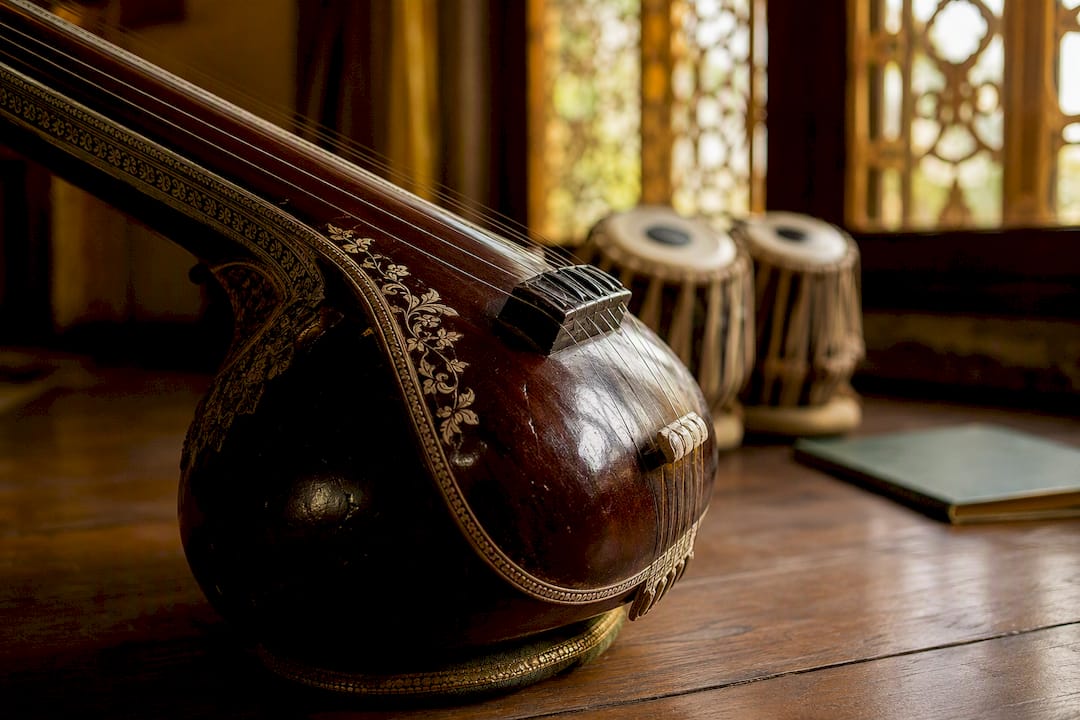
The drone is a sustained reference pitch, usually Sa paired with Pa or Ma, that creates the tonal field on which Indian classical melody unfolds. It never plays a tune. It just sits there, humming underneath everything, and that stillness is exactly what makes it work.
The role of drone in Indian music breaks down into three jobs, and every one of them matters before a single note of melody gets sung or played:
- Pitch anchoring. The drone gives the performer and listener a fixed Sa to measure every other note against.
- Overtone matrix. Its harmonic field shapes how each svara (note) is heard and colored, almost like a lens the melody passes through.
- Meditative field for alap. The unbroken tone helps settle the room into the slow, exploratory opening of a raga.
The tanpura is the traditional source of this sound, though electronic sruti boxes and tanpura apps now fill the same role in practice rooms and smaller venues.
Key Takeaways
The drone functions as a sustained tonic reference that shapes pitch accuracy, harmonic color, and emotional depth throughout an Indian classical performance.
| Point | Details |
|---|---|
| Drone defines the tonal field | It supplies a fixed Sa (often with Pa or Ma) that every melodic note is measured against. |
| Jivari creates the “living” tone | Bridge grazing and thread placement generate a shifting overtone cascade, not a flat hum. |
| Tuning must match the raga | Ragas without Pa, like Malkauns, require retuning to Sa–Ma to avoid destabilizing the mode. |
| Beating patterns aid pitch correction | Performers use interference between their note and the drone to fine-tune intonation in real time. |
| Sitarrajib applies this in practice | Rajib Karmakar’s lessons and recording sessions treat drone tuning and jivari care as core technique, not an afterthought. |
Table of Contents
- What Is the Role of Drone in Indian Music, Technically Speaking?
- How Does the Drone Function During a Performance?
- What Makes the Tanpura Drone Sound Alive, Not Static?
- Why Does a Continuous Drone Feel Meditative to Listeners?
- What Are the Standard Tanpura Tuning Rules for Different Ragas?
- Acoustic Tanpura or Electronic Sruti Box: Which Drone Source Fits Your Setting?
- Practitioner Notes: Tuning Routines and Stage Practice
- Does the Drone Sound Different Across Gharanas and Regional Styles?
- Vocal Performance vs. Instrumental Performance: Does the Drone’s Role Change?
- How Does Drone Production Differ Between Live Concerts and Studio Recordings?
- How Does the Drone Shape Improvisation in Indian Classical Music?
- What the Research and Practice Actually Tell Us About the Drone
- Hear the Drone Done Right, or Learn to Work With It Yourself
- Sources
What Is the Role of Drone in Indian Music, Technically Speaking?
A drone, in strict musical terms, is a continuous tone or set of tones held at a fixed pitch for the duration of a piece, with no rhythmic or melodic movement of its own. That single feature separates it from everything else happening in a performance. Melody moves through time, note to note, building phrases. Harmony, in the Western sense, stacks multiple moving pitches into chords that shift and resolve. The drone does neither. It stays put, and its constancy is precisely what gives the moving parts something to move against.
Three examples make the distinction concrete:
- Single-note drones. An instrument like the ektar, a one-string folk drone often used in devotional and Baul music, holds only the tonic. No harmonic complexity, just a steady Sa.
- Two-note drones. A Sa–Pa combination, the tonic and the fifth, is the most common setup across Hindustani and Carnatic performance. It gives the ear a stable frame with a little more harmonic weight than a single pitch.
- Multi-string drones. The tanpura typically uses four strings tuned to something like Pa, Sa, Sa, Sa (an octave lower on the last), producing a dense wash of overtones rather than a simple hum.
That third example is the one most listeners associate with Indian classical music, and for good reason. The tanpura isn’t a melodic instrument at all. It exists to generate a continuous reference chord that the performer builds everything else on top of, a function documented across historical treatises going back centuries. Once you hear the difference between a drone and a melody side by side, you stop mistaking the tanpura for background noise. It’s the floor the whole performance stands on.
How Does the Drone Function During a Performance?
Three functions matter most once the music starts: pitch reference, intonation correction, and emotional support for the raga being unfolded.
Pitch reference is the obvious one. A vocalist or instrumentalist locks their Sa to the drone before a single phrase begins, and every subsequent note gets judged against that fixed point. But the drone also does something more subtle: it lets performers hear beating patterns, the slight pulsing that happens when two frequencies are almost but not quite in tune. Musicians use those beats as a kind of acoustic measuring tape, narrowing in on a note until the pulsing disappears and the pitch locks in clean. This is one of the most underappreciated skills in Indian classical training, and it’s almost impossible to develop without a drone running constantly during practice.
The drone shapes how svaras are perceived, not just where they sit. A note played against a rich overtone field sounds different from the same note played in silence. The tanpura’s harmonic wash brings out partials that reinforce certain svaras and create tension against others, which is part of why a raga’s mood shifts depending on which notes get emphasized against that backdrop.
The drone’s job also changes across the arc of a performance:
- During alap, the slow unaccompanied opening, the drone is doing almost all the harmonic work, since there’s no rhythm or chordal instrument yet.
- Once tabla and rhythmic cycles (gat, layakari) enter, the drone recedes into the texture but never stops.
- For accompanists and students, a steady drone is often the fastest way to internalize sruti, the fine-grained pitch shading that separates a raga from its near neighbors.
Pro Tip: If you’re learning to sing or play a raga, spend real time just sitting with the drone before you touch the melody. Most students rush past this step, and it shows in their intonation later.
What Makes the Tanpura Drone Sound Alive, Not Static?
The answer is a bridge design called jivari, and it’s the single most important piece of acoustic engineering in the entire instrument. Without it, the tanpura would sound like a plain, flat hum. With it, every string produces a shimmering cascade of overtones that seems to breathe.
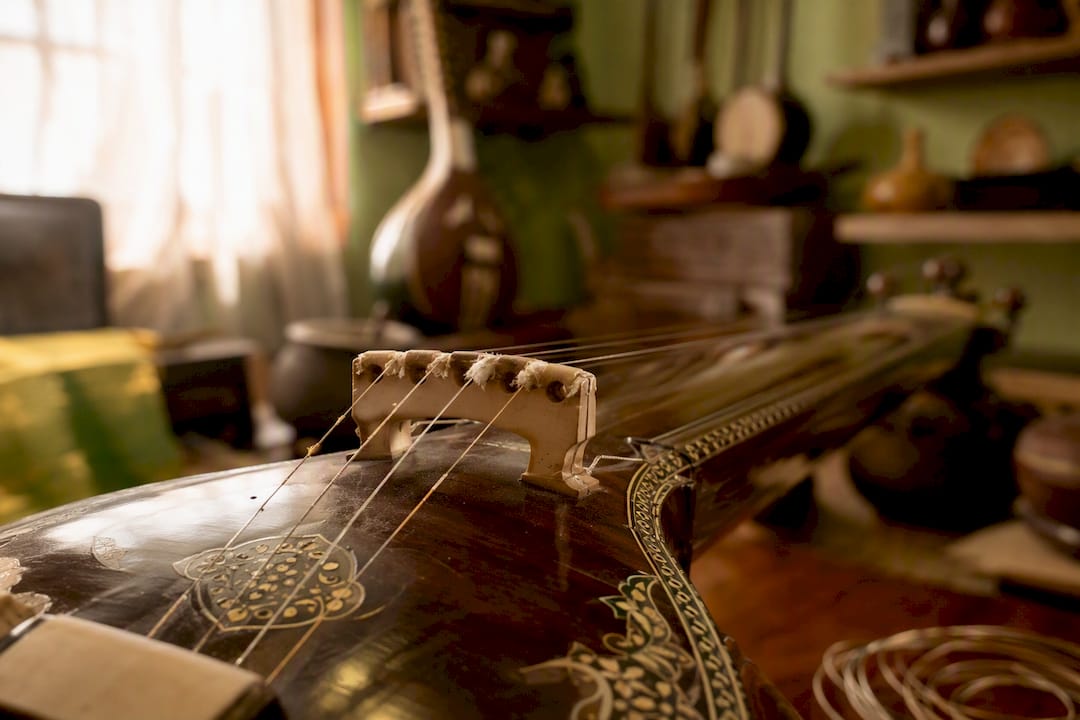
The tanpura’s anatomy is simple on the surface: four (sometimes more) metal strings, a wide curved wooden bridge, and a large resonating gourd or wooden bowl that amplifies the sound. The trick sits at the bridge. Instead of the string leaving the bridge cleanly, as it would on a guitar, the tanpura’s bridge is deliberately curved so the string grazes along its surface for a short distance. A fine cotton thread, called jivari, is slid between string and bridge to fine-tune exactly how much contact happens.
That grazing contact is what generates the drone’s characteristic overtone cascade, and it’s not just folklore. A quantitative acoustic study of tanpura string vibrations measured how shifting the thread’s position changes the harmonic spectrum and how long each overtone sustains. Move the thread a few millimeters, and the entire tonal character of the drone shifts.
The contact point where string meets bridge actually creeps as the string’s vibration decays, which means the harmonic emphasis of a single pluck slowly shifts over several seconds. That’s the acoustic reason a tanpura note never sounds static, even though it’s technically one unchanging pitch.
| Tanpura Part | Function |
|---|---|
| Strings | Produce the fundamental pitches, typically tuned to Pa/Ma, Sa, Sa, Sa |
| Curved bridge | Creates the grazing contact that generates overtones |
| Jivari thread | Fine-tunes contact position, shaping harmonic density and sustain |
| Resonating bowl | Amplifies the string vibration into a full, room-filling tone |
Musicians tune the jivari by ear, adjusting the thread until the sound “opens up” into that shimmering quality rather than a dull thud. It’s a skill passed down largely through practice and demonstration, not written instruction.
Why Does a Continuous Drone Feel Meditative to Listeners?
Sustained tones do something specific to human hearing: the brain treats a constant sound as background and stops actively processing it as a discrete event, freeing attention for whatever moves against it. That’s a big part of why a tanpura drone can run for an hour-long alap without ever feeling tedious. It fades from conscious notice while still doing its structural job, which frees the listener’s attention for the melody floating above it.
That psychoacoustic quality is also a working tool, not just an aesthetic effect. Performers rely on the same beating patterns described earlier as a pitch-correction system in real time. As a note approaches the drone’s fundamental or its fifth, the interference pattern between the two slows down and eventually vanishes at true tuning. Trained musicians can hear and correct microtonal deviations this way that would be nearly invisible on a tuner readout.
The density of the drone’s overtone spectrum changes the emotional weight of a raga, too. A tanpura tuned with heavier jivari contact produces a thicker, more resonant wash of harmonics, which tends to deepen a raga’s gravity, appropriate for something somber like Darbari. A lighter, cleaner drone suits brighter, more restless ragas. This isn’t incidental decoration. The overtone density is doing real emotional work, shaping how a raga’s rasa (aesthetic mood) lands on the listener, a connection musicological commentary has traced directly to the harmonic content of the drone itself.
Pro Tip: Listen to the same raga performed with a thin electronic drone and then with a full acoustic tanpura. The melodic notes are identical. The emotional weight is not, and that gap is entirely the drone’s doing.
Alap depends on this effect more than any other section of a performance. With no rhythm and no fixed melodic material yet, the drone is the only constant, and it’s what keeps a 20 minute unaccompanied exploration from feeling aimless. Our detailed guide to alap covers how performers build phrases against exactly this backdrop.
What Are the Standard Tanpura Tuning Rules for Different Ragas?
Most tanpuras follow a baseline tuning pattern, but the details shift depending on which raga is being performed, and getting this wrong is one of the most common beginner mistakes.
- Standard tuning (5-8-8-1). The numbers refer to scale degrees: the fourth string tuned to Pa (the fifth), the third and second strings to Sa an octave apart, and the first (thinnest) string to a high Sa. This works for the large majority of ragas that include Pa as a stable, consonant note.
- Sa–Ma tuning for ragas without Pa. Ragas like Malkauns omit Pa entirely from their scale. Keeping Pa in the drone actively destabilizes the raga’s modal identity, so performers retune the fourth string to Ma instead, matching the raga’s actual tonal center.
- Sa–Dha tuning for specific ragas. Certain ragas, such as some versions of Marwa, work better with Dha as the secondary drone note rather than Pa or Ma. This is a smaller category but a real one, and experienced accompanists know which ragas call for it before the performer even asks.
The same logic applies to electronic sruti boxes and tanpura apps. Most digital tools let you select the secondary drone note directly from a menu, and matching it to the raga’s actual structure, rather than defaulting to Pa out of habit, makes an audible difference in how settled the performance sounds. Our primer on Indian music notation walks through how sargam relates to these tuning choices in more technical detail. Getting the raga’s raga-composition context right also helps here; our guide to raga-based compositions breaks down how different composition types lean on these tuning decisions.
Acoustic Tanpura or Electronic Sruti Box: Which Drone Source Fits Your Setting?
Every drone source trades something for something else. The right choice depends on whether you’re on a concert stage, in a practice room, or in a recording booth.
- Acoustic tanpura: unmatched harmonic richness thanks to jivari, but it needs regular retuning, is sensitive to humidity and temperature, and takes real skill to keep sounding its best.
- Electronic sruti box: rock-solid pitch stability and total portability, at the cost of a thinner, more static tone that lacks the tanpura’s living overtone shifts.
- Harmonium: historically doubled as both a melodic and drone-supporting instrument in many vocal traditions, and it remains common in devotional and semi-classical settings, though its equal-tempered tuning limits microtonal flexibility.
- Surpeti (surpeti box): a simpler, hand-pumped or electric reed drone box, widely used in practice and teaching for its plain, steady tone.
- Sitar drone strings: the sitar carries its own sympathetic and drone strings (chikari), letting a soloist reinforce the tonic mid-performance without a separate instrument.
The sruti box and tambura remain the two most common concert-ready drone sources, and a lot of professional performers now run a hybrid setup: a real tanpura on stage for its visual and acoustic presence, backed by an electronic unit tucked offstage as insurance against tuning drift during a long set. Recording studios tend to prefer this hybrid approach too, since the electronic layer gives an engineer a clean, stable reference track while the acoustic tanpura supplies the texture listeners actually respond to.
Practitioner Notes: Tuning Routines and Stage Practice
A pre-concert tuning routine isn’t optional, it’s the difference between a drone that supports the raga and one that fights it. Before any performance, the checklist looks roughly like this:
- Tune the main Sa string first, checking it against a fixed reference (a tuning fork, harmonium, or app).
- Set the secondary string (Pa, Ma, or Dha) based on the specific raga being performed that evening.
- Check jivari contact on each string, adjusting the thread until the overtone “opens” rather than sounding dead or buzzy.
- Recheck tuning once the instrument has warmed up under stage lighting, since heat shifts string tension.
In teaching, the drone becomes an exercise tool as much as an accompaniment. Students are often asked to sing or play long, sustained tones against the tanpura for extended stretches, training their ear to lock onto sruti before they’re allowed to move on to faster passages. It’s slow, sometimes tedious work, but it’s how pitch sense actually gets internalized, not through theory but through repeated, patient listening.
Stage logistics matter more than most audiences realize. Keeping drone continuity across a two-hour concert, especially one that shifts between multiple ragas, often means a hybrid setup: an acoustic tanpura for tone, an electronic backup for insurance.
A drone that drifts even slightly mid-performance pulls the entire raga out of focus, no matter how well the melodic lines are played. Continuity is not a small detail. It’s the foundation the rest of the performance depends on.
Does the Drone Sound Different Across Gharanas and Regional Styles?
The core function of the drone stays constant across every gharana (lineage-based stylistic school), but the texture and density performers prefer shifts noticeably from one tradition to another. Some vocal gharanas favor a very dense, richly layered tanpura sound, sometimes using two tanpuras tuned slightly apart to thicken the overtone field even further. Others, particularly styles built around fast, intricate melodic ornamentation, prefer a leaner, quieter drone that doesn’t compete for the listener’s attention.
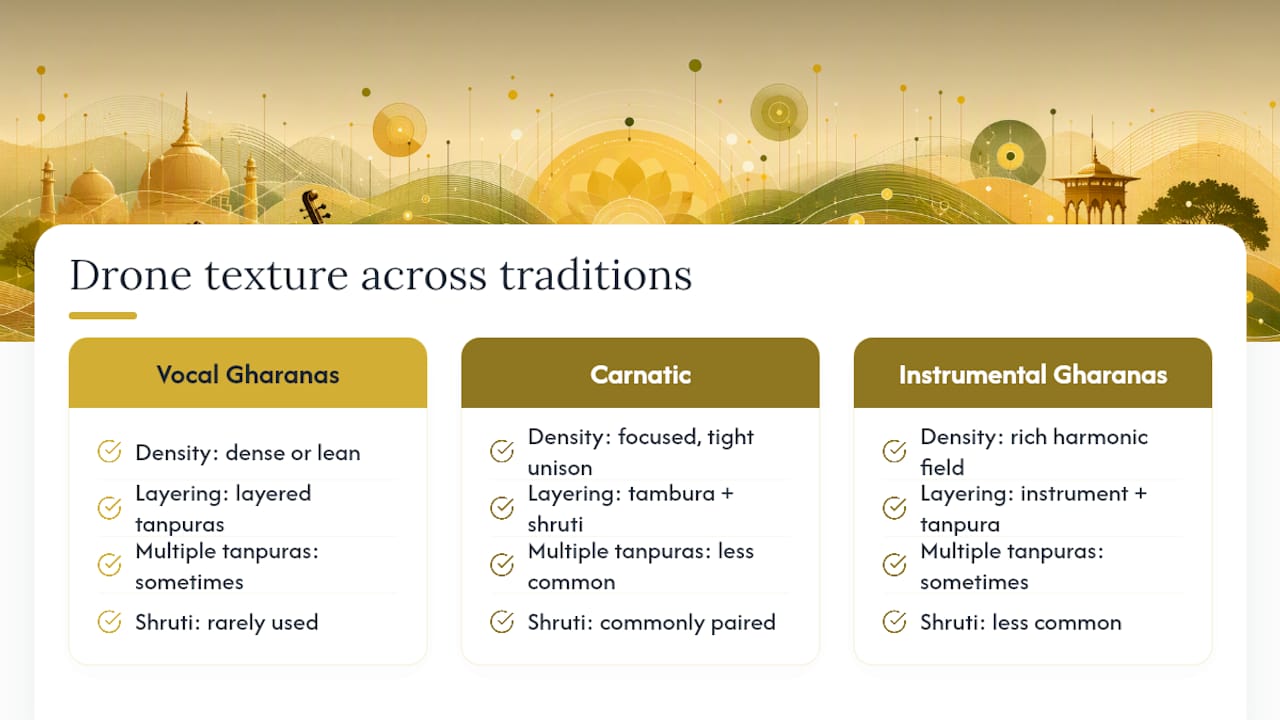
Carnatic music, the classical tradition of South India, handles the drone slightly differently than Hindustani practice does. The tambura (the regional name and construction variant) often runs alongside a separate shruti instrument, and Carnatic vocal concerts frequently favor a drone with strong emphasis on Sa and Pa held in tight unison, reinforcing the tradition’s emphasis on precise, sustained melodic phrasing.
Instrumental gharanas built around the sitar or sarod often lean on the instrument’s own sympathetic and drone strings in addition to a separate tanpura, layering the harmonic field from two sources at once rather than one. None of these regional differences change the drone’s basic job. They just change how thick, how loud, and how textured that harmonic floor sounds from one tradition to the next, a distinction any listener can start to hear once they know to listen for it.
Vocal Performance vs. Instrumental Performance: Does the Drone’s Role Change?
The drone’s fundamental job, tonic reference and harmonic support, stays identical whether a vocalist or an instrumentalist is performing. What changes is how closely the performer’s pitch has to track it.
Vocal music leans on the drone even more heavily than instrumental performance, mainly because the human voice has no frets, keys, or fixed positions to fall back on. Every pitch a vocalist produces is found by ear in real time, which makes the tanpura’s steady reference the only external anchor available. That’s part of why vocal concerts often run a denser, richer tanpura sound than instrumental ones. The singer needs more harmonic material to lean into.
Instrumentalists get a partial substitute built into their instruments. A sitar’s sympathetic strings and chikari, or a sarod’s resonating strings, already reinforce the tonic somewhat on their own, which means the accompanying tanpura’s job shifts slightly from sole pitch anchor to full harmonic enrichment. That doesn’t make the drone less important for instrumentalists. It just means the instrument itself is doing some of the drone’s work before the tanpura even enters the picture. Watching this play out live is genuinely instructive, and our collection of live sitar performance footage shows exactly how a soloist’s own drone strings interact with a separate tanpura on stage.
How Does Drone Production Differ Between Live Concerts and Studio Recordings?
Live concerts and studio sessions demand almost opposite priorities from a drone, and that difference shapes everything from instrument choice to microphone placement.
On stage, consistency under pressure matters most. Temperature, humidity, and hours of continuous playing all pull a tanpura’s tuning around, which is exactly why many professional setups now pair an acoustic tanpura with an electronic sruti box as backup. A drifting drone is far more forgivable to an audience’s ear in the moment than it would be on a permanent recording, but it still pulls focus from the soloist if it happens.
Studio recording flips the priorities. A tanpura’s naturally shifting overtone content, the same quality that makes it feel alive in a concert hall, can create problems for an engineer trying to build a clean, editable mix. Many studio sessions record the tanpura on its own isolated track, sometimes doubling it with a subtle electronic layer underneath purely for pitch stability during editing, while keeping the acoustic instrument’s texture front and center in the final mix. Placement matters more indoors, too. Studio engineers typically mic a tanpura close and slightly off axis from the resonating bowl to capture the jivari’s overtone detail without picking up excess room reflection. If you’re planning a studio session and want that acoustic texture captured properly, booking a live sitar recording session with an engineer who understands tanpura mic technique makes a real difference in the finished product.
How Does the Drone Shape Improvisation in Indian Classical Music?
Improvisation in Indian classical music isn’t free in the way jazz improvisation sometimes is. It’s bounded, and the drone is one of the main things doing the bounding. Every improvised phrase, whether in alap or a fast taan passage, gets built and judged against that fixed tonal reference running underneath it.
This constraint actually opens creative room rather than closing it. Because the tonic and its harmonic field never move, a performer can take real risks with phrasing, rhythm, and note choice, always confident there’s a stable reference to return to and resolve against. Without that anchor, prolonged improvisation would quickly lose its sense of direction, since there’d be nothing fixed to measure tension and release against.
The drone’s overtone field also feeds ideas directly into improvisation. Skilled performers often pick up melodic suggestions from the harmonics ringing inside the tanpura itself, letting an overtone that’s especially present in the room’s acoustics nudge a phrase in one direction over another. It’s a subtle, largely intuitive process, but musicians who’ve spent years playing against a live tanpura describe hearing melodic possibilities in its overtone wash that a flatter electronic drone simply doesn’t offer. That’s a real, if hard to quantify, creative input, not just a technical backdrop.
What the Research and Practice Actually Tell Us About the Drone
Most explanations of the drone treat it as a passive backdrop, something you set and forget before the real music starts. That framing undersells it. The acoustic research on jivari makes clear the drone is a moving, decaying, constantly shifting sound source, and treating it as static is exactly why so many students plateau in their pitch training.
The conventional advice, “just tune your tanpura and move on,” skips the part that actually builds musicianship: sitting with the drone long enough to hear its beating patterns and overtone shifts before attempting to sing or play against it. That patience is unglamorous, and most instructional material rushes past it in favor of teaching phrases and ornamentation.
If there’s one priority worth taking from all this, it’s spending real, unhurried time with the drone alone. Not tuning it and moving on, but listening to how it breathes. Everything else, intonation, rasa, improvisational confidence, builds on that foundation, and skipping it is the single most common shortcut that shows up later as shaky pitch.
— Rajib
Hear the Drone Done Right, or Learn to Work With It Yourself
Reading about jivari and tuning rules only gets you so far. At some point you need to hear a tanpura’s overtones actually breathing in a room, or sit down with someone who can walk you through tuning your own drone by ear rather than by app. Sitarrajib offers both paths: private sitar lessons built around exactly this kind of listening practice, and studio recording sessions where the drone is captured with the care it actually deserves.
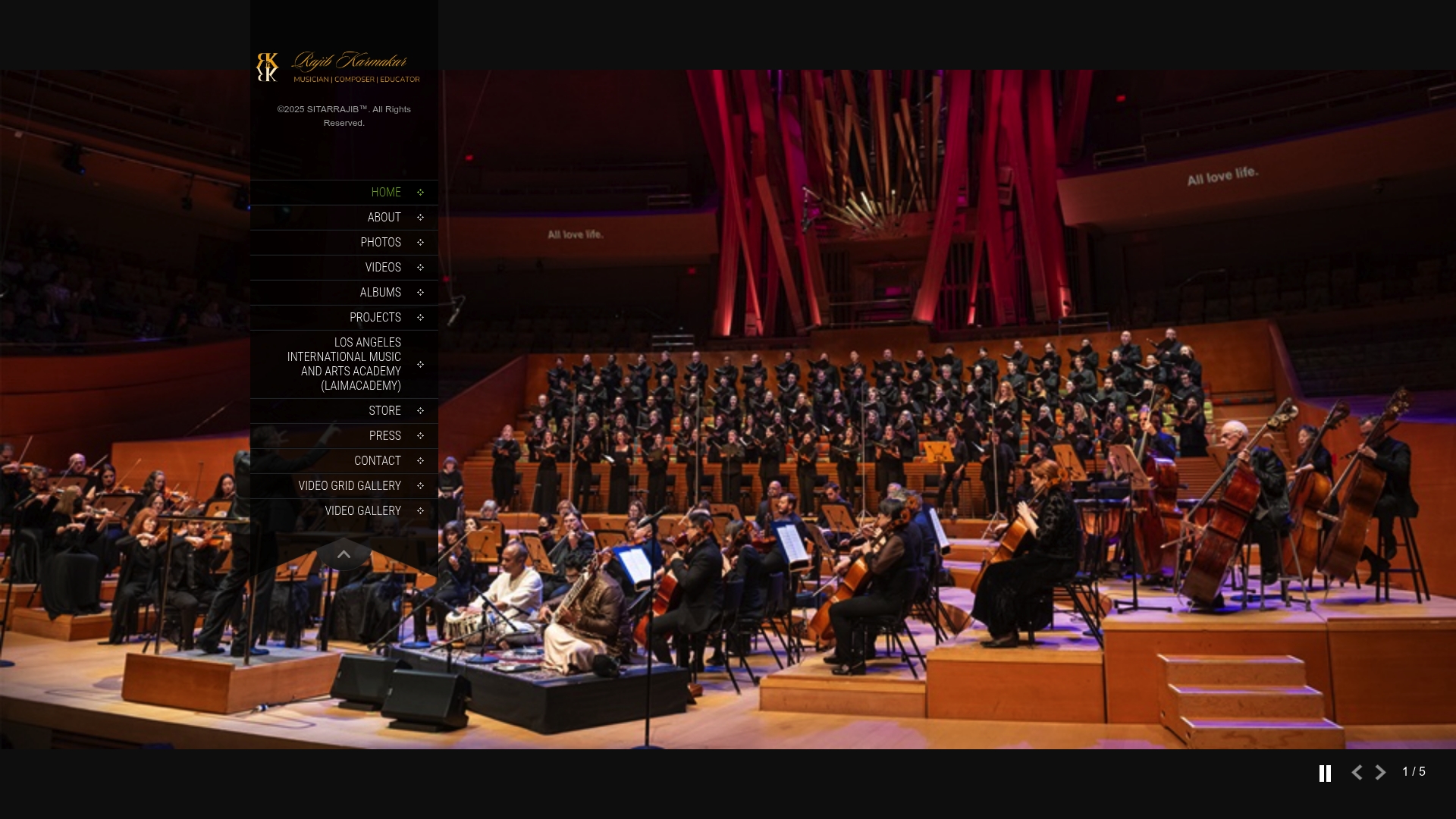
If you’re a producer who needs a tanpura or sitar drone recorded properly, with jivari detail intact rather than flattened into a generic loop, a live session sitar recording with Rajib Karmakar gives you that texture without the guesswork of mic placement and tuning that trips up most home setups. Event planners looking to bring authentic drone-based Indian classical music to a corporate event or ceremony can also see how it fits their program through our corporate event performance guide. Reach out to check dates and discuss what your project needs.
Sources
- Effect of the position of the jivari threads on the tanpura string vibrations: A quantitative study
- Drones in Indian Music
- The Role of the Tanpura Drone in Pitch Perfection | 12NOTEZ
- The Sruti Box and Tambura: The Heartbeat of Every Concert | RagaRasa
- Tanpura — Wikipedia