

Yes, you can use live looping with sitar, and it works better than most people expect. The most reliable approach is an iPad running Loopy Pro paired with a foot controller, or a Boss RC pedal if you want a standalone box with no screen to manage. The one thing to get right from day one: lock your timing and control your frequencies, or your loops turn to mud fast.
TL;DR:
- Lock your timing and control your frequencies to prevent loops from becoming muddy, especially given sitar’s dense harmonic content and microtonal ornamentation.
- Use a dedicated bus routing system and apply conservative EQ adjustments, such as high-pass filters and low-mid cuts in the 300 to 600 Hz range, to keep layered loops clear and distinct on stage.
- Prioritize building each looping project around four tracks—drone, rhythm, motif, and lead—and rehearse timing against a click to ensure precise, reliable performances.
- Limit the number of layers in a performance and save space for intentional silence and call-and-response patterns to maintain musical clarity and dynamics.
- Match loop length to the tala cycle rather than a fixed duration, favoring shorter loops for rhythmic motives and longer ones for melodic phrases aligned with rhythmic cycles.
Table of Contents
- Why live looping suits sitar (and where it gets tricky)
- Which rig should a sitarist actually build?
- How do you keep layered sitar loops clear onstage?
- What does a reliable looping rehearsal and show-day workflow look like?
- What performance habits separate good looping sets from sloppy ones?
- Rajib Karmakar’s starter template for looping sitar
- Which artists have made live looping work with sitar?
- How long should a loop be for a sitar composition?
- Where to learn more
- What actually matters when you loop sitar live
- Sources
Why live looping suits sitar (and where it gets tricky)
A solo sitarist can build a full soundscape without anyone else onstage. Loop a drone, layer a rhythmic motif, add a melodic phrase on top, and you’ve got something that sounds like a small ensemble. That’s the appeal, and it’s real.
But sitar isn’t a clean single-note instrument. Sympathetic strings ring under everything you play, and that resonance stacks when you loop. Microtonal ornamentation like meend (the signature glide between notes) can blur when several looped layers compete for the same frequency space.
Here’s when looping helps and when it hurts:
- Helps: textural drones that fill space behind a lead line, rhythmic motifs (tabla-style pulses) that anchor tempo, layered call-and-response between recorded and live phrases.
- Hurts: stacking multiple ornamented melodic lines, which buries the subtlety that makes a raga phrase interesting in the first place.
Projects like Alam Khan’s collaboration with the Del Sol String Quartet show what’s at stake when Indian classical phrasing meets layered or ensemble textures. The nuance survives only when the arrangement leaves it some room.
Which rig should a sitarist actually build?
You have two honest paths, and they solve different problems.
The software-first path puts an iPad running Loopy Pro at the center of everything. Dub FX’s touring setup shows what this looks like at a professional level: AUv3 effects loaded directly into the app, saved set lists so you don’t rebuild patches between songs, and full routing control. Pair the iPad with a MIDI controller like the Akai APC40 MK2 for grid-based control, or something lighter like the iRig Blueboard if you just need reliable foot switches for record, overdub, and clear. This setup is modular. You can rearrange your signal chain without buying new gear, which matters once you start writing more complex sets.
The pedal-first path means a Boss RC series unit, most notably the RC-600. No screen, no app crashes, no charging an iPad before a gig. You get internal mixing and panning across multiple tracks, and video documentation from performances like Maati Baani’s live looping arrangement of “Sajan More Ghar” shows this format working in a real fusion context. The tradeoff is fewer routing options and no plugin ecosystem.
For inputs, a DI box off your sitar’s pickup gives you a clean, controllable signal. A condenser mic placed to catch sympathetic string resonance adds air, but it also picks up stage noise, so in-ear monitoring is usually the safer call over wedges for looping work.
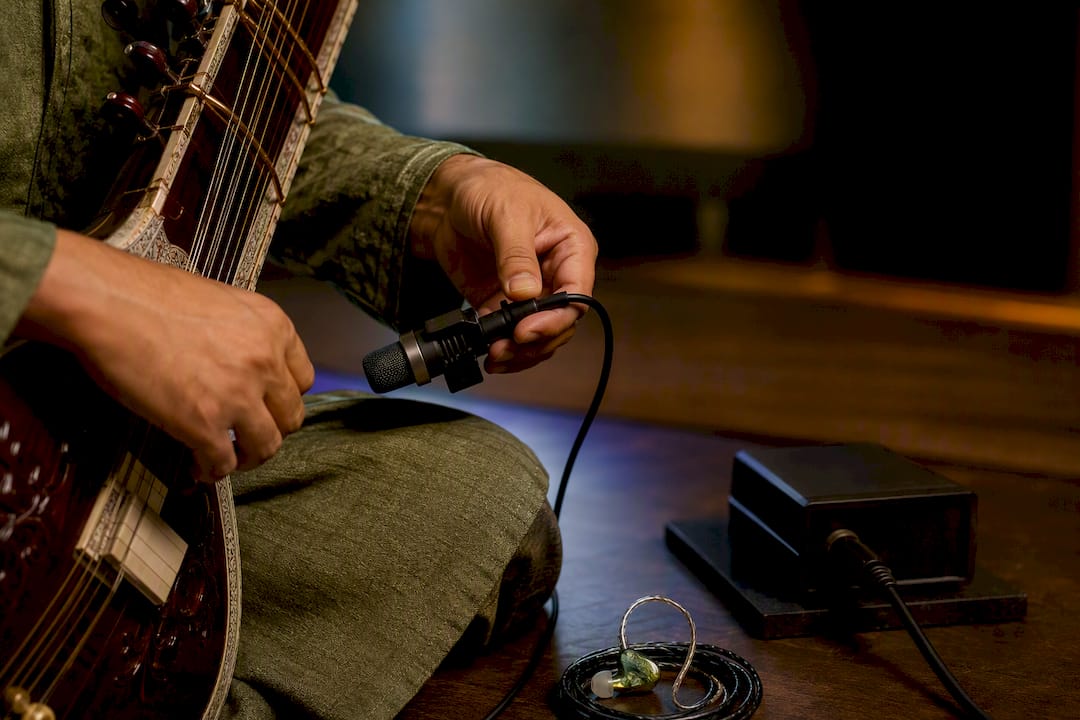
Pro Tip: Buy the looper and a dependable footswitch first. Everything else, controllers, multi-effects, extra pedals, can wait until you know exactly what your set demands.
How do you keep layered sitar loops clear onstage?
Sitar’s harmonic content is dense before you even start looping it. Stack three or four layers without EQ discipline and the mix collapses into buzz.
Start with a high-pass filter on drone loops to cut the low-end rumble that builds up under sustained layers. When two melodic loops overlap in range, pull a conservative low-mid cut, generally in the 300 to 600 Hz zone, from one of them so they don’t fight. Add presence with a gentle boost around 2 to 4 kHz rather than pushing volume, which just amplifies string noise along with the tone you want.
Routing matters as much as EQ. Send each loop to its own bus rather than dumping everything into one channel. Daniel Park’s professional busking rig uses color-coded routing and dedicated buses specifically so effects and monitoring stay predictable, and so he never accidentally records into the wrong track mid-performance. That’s a lesson worth stealing directly.
- Gate sympathetic string buzz gently rather than aggressively, since a hard gate chews into your sustain.
- Favor DI plus a touch of reverb over a hot live mic when the room is loud or reflective.
- Avoid pitch-warping time-stretch algorithms on any loop carrying microtonal ornamentation. Tempo-based tools that don’t shift pitch preserve raga intonation; pitch-correction style stretching does not.
One insight from working sitarists worth internalizing: sitar’s rich harmonic content rewards conservative stacking. Loop fewer melodic lines and let drones or rhythmic motifs carry the texture instead.
What does a reliable looping rehearsal and show-day workflow look like?
Treat every song like its own mini studio session. Build one project per tune with pre-recorded stems, drone, pulse, and percussion, sitting ready to trigger, and map your controller so overdub, undo, and clear sit on buttons you can hit blind.
- Practice the first-loop drill against a click until your loop length lands exactly on the beat every time. Set quantization conservatively; it’s a safety net, not a substitute for locked timing.
- Rehearse using undo mid-set, not just clear. A mistimed layer you can undo saves a performance a hard reset would kill.
- Run a full soundcheck: DI and mic levels, in-ear versus front-of-house balance, and a test overdub and clear cycle before anyone hears you play a note.
- Bring a backup footswitch and confirm your power plan, since a dead battery or a disconnected pedal mid-loop is the single most common failure onstage.
- If a guest musician joins, give them a separate input channel and a distinct loop destination color, so nothing gets captured into the wrong track by accident.
Pro Tip: Practice the “first-loop accuracy” drill with a metronome and a muted pickup until locking a loop feels automatic. Quantization forgives small errors; it won’t fix a performer who never learned to feel the tala cycle.
Johnny A.’s approach to live guitar looping is instructive here too: pre-configured patches and parallel signal paths mean he’s managing music onstage, not troubleshooting a rig.
What performance habits separate good looping sets from sloppy ones?
The best looped sitar sets sound intentional, not accumulated. Decide what goes down first, usually the drone or the core rhythmic motif, and treat everything after that as an addition you have to justify.
- Stop adding layers once the texture is full; one more loop rarely improves a mix that’s already dense.
- Build in redundancy: a spare footswitch, mapped undo you’ve actually rehearsed, and a hard cap on how many layers you’ll stack in any one section.
- Use loops for call-and-response against your live playing instead of building one static bed and soloing over it forever.
- Leave space. Silence between phrases is what makes the next loop entrance land.
Dynamics matter more in a looped set than a straight solo performance, since a flat volume across every layer flattens the whole arrangement into background noise.
Rajib Karmakar’s starter template for looping sitar
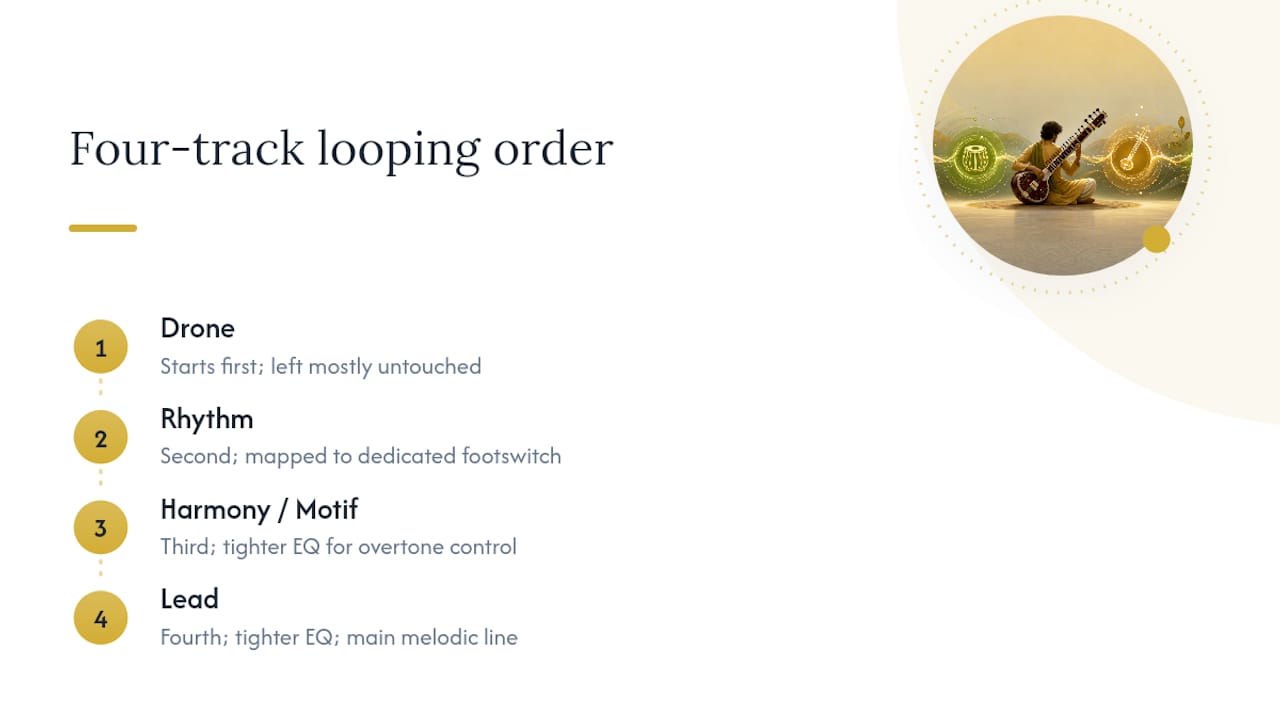
I build every looping project around four tracks: drone, rhythm, harmony or motif, and lead. The drone goes down first and stays untouched for most of the piece. Rhythm follows, mapped to a dedicated footswitch so I never scrub through menus mid-performance. Harmony and lead get tighter EQ, since that’s where sitar’s overtone density causes the most trouble.
My rehearsal routine leans hard on timing drills against a click before I ever touch a stage, plus practicing set transitions so a song change doesn’t stall the room. When a tabla player or vocalist joins, they get their own input and their own loop color from the first rehearsal, not the first show.
If you want to go deeper on the technical side, a technical requirements guide for sitar performance covers gear specifics, and lessons and workshops walk through this template hands-on.
Which artists have made live looping work with sitar?
Fusion performers have proven this isn’t a novelty technique. YoYo Sitar’s live looping demonstrations show the instrument working in three distinct roles: as a lead voice cutting through a mix, as a textural drone sitting under other instruments, and as a repeating motif that anchors an arrangement while other elements shift around it.
Maati Baani’s looped version of “Sajan More Ghar” is a useful reference point because it’s built for a fusion audience, not a purist classical setting. The looping is audible and intentional, layered rhythm under a vocal-and-string lead, rather than hidden in the mix.
What these examples share is restraint. None of them stack five competing melodic lines. They pick one or two structural roles for the loop (drone, pulse, occasional motif) and let the live playing carry the rest. That’s the pattern worth copying: looping supports the performance, it doesn’t try to replace the musicianship happening in real time.
The broader lesson from the Alam Khan and Del Sol String Quartet project applies here too. Even outside a strict looping context, when sitar shares space with other layered sound sources, the phrasing that makes a raga recognizable needs deliberate protection. That doesn’t happen by accident. It happens because the performer decided, in advance, what the loop is allowed to cover and what stays live.
How long should a loop be for a sitar composition?
Match your loop length to the tala cycle you’re playing in, not to a round number of seconds. A loop that cuts across a rhythmic cycle instead of aligning with it will always feel subtly off, even to listeners who couldn’t tell you why.
For a piece in a cycle like teentaal (16 beats), loop lengths that map to 4, 8, or 16 beats keep your layers phase-locked to the underlying pulse. Shorter loops, one or two beats, work well for rhythmic motifs and small ornamental fragments, but they demand tighter timing accuracy since any drift compounds quickly across repetitions.
Longer loops, a full melodic phrase or an entire old-style passage, give you more room for expressive variation, but they also lock you into that content for a while. If you’re improvising live over a long loop, plan your phrase structure before you hit record. A loop capturing a half-finished musical idea is much harder to build on than one that captures a complete, self-contained phrase.
A useful rule: shorter loops for anything rhythmic, longer loops for anything melodic, and always align to the tala rather than the clock. Compositions built this way layer more naturally as lead, drone, or motif without fighting the underlying cycle.
Where to learn more
For concrete templates, study Daniel Park’s Loopy Pro rig walkthrough and Dub FX’s artist spotlight. If you’re documenting your own looping sets for video, the Music Video Marketplace guide to looping videos covers practical filming setups worth adapting.
What actually matters when you loop sitar live
Most advice on live looping treats every instrument the same: grab a looper, stack some layers, improvise on top. That advice fails sitarists more often than it helps them, because it ignores how much harmonic information a single sitar note already carries before you’ve looped anything.
The conventional wisdom says more layers equal a bigger sound. For sitar, that’s backwards. The instrument’s sympathetic strings do the layering work for you. Your job as a performer is restraint, not accumulation. I’d rather hear a sitarist loop one drone and one rhythmic motif with total control than five competing melodic lines fighting for the same frequency space.
Prioritize timing discipline before you buy a single piece of gear. A perfectly mapped controller and a pristine EQ chain won’t save a loop that’s rhythmically loose against a tala cycle. Get the drill work done first. The rig comes second.
— Rajib