
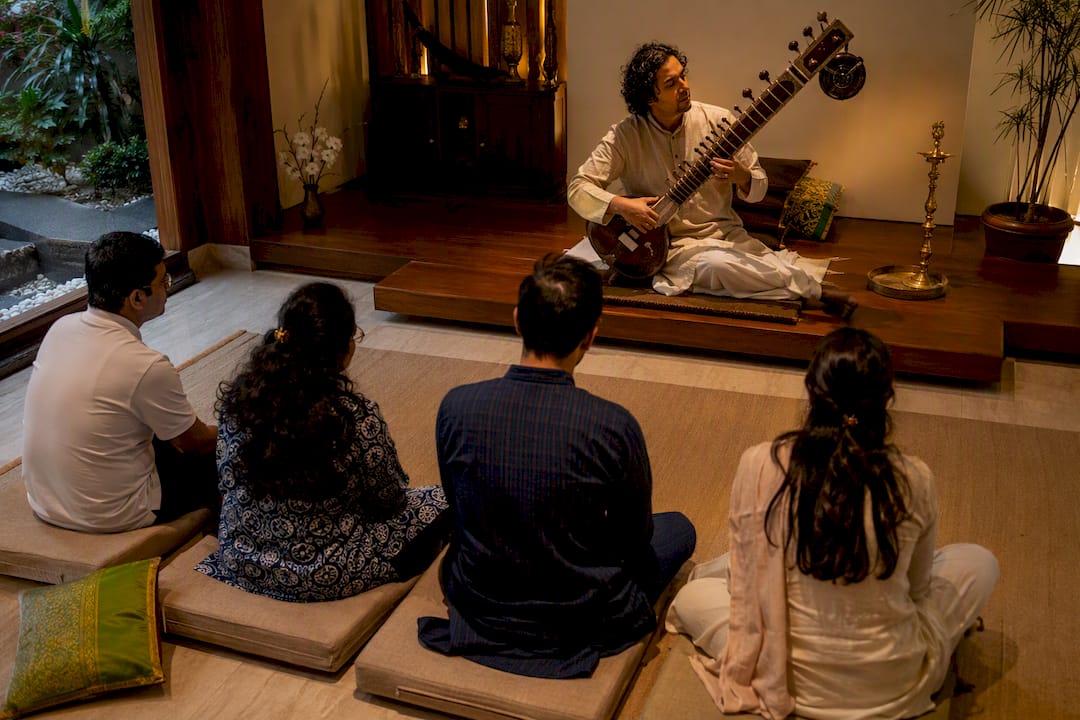
An Indian music workshop gives you concentrated, hands-on exposure to raga, tala, and performance aesthetics that a single lesson can’t match. Pick a two-hour intro if you just want a taste of the tradition, or a multi-day immersive if you want repertoire and improvisation skills you can actually use. Either way, check the faculty background and daily schedule before you register, then book at your level.
TL;DR:
- Short introductory workshops are suitable for complete beginners, offering basic exposure to raga concepts without prerequisites.
- Multi-day immersive programs involve daily practice, performances, and structured sessions that deepen technical and improvisation skills.
- Skill progression requires matching workshop level to your experience, with longer residencies demanding prior familiarity with basic raga and tala concepts.
- In-person baithak sessions provide close-up observation of performers, significantly speeding up learning compared to classroom demonstrations.
- Private lessons or online courses are better for ongoing refinement, while workshops excel at delivering immediate repertoire and performance confidence.
Table of Contents
- What does an Indian music workshop actually look like?
- Core Curriculum: What Skills You’ll Actually Walk Away With
- Who Should Attend, and What Level Do You Need?
- What Does It Cost, and How Do You Register?
- How to Choose the Right Workshop for You
- Why Baithak-Led Immersion Teaches Faster Than a Classroom
- When a Workshop Beats Private Lessons, and When It Doesn’t
- Learn With SITARRAJIB: Workshops and Private Lessons
- Where to Learn More Before You Book
- Sources
What does an Indian music workshop actually look like?
Formats vary more than most people expect, and picking the wrong one wastes both your time and your money.
At the short end, you’ll find two-hour introductory sessions built for cultural learners and travelers with zero background. These combine demonstration, conversation, and light hands-on participation. The Sounds of India workshop model is a good example: no prior training required, and the format leans on Q&A and direct interaction with the artist rather than lecture-style teaching.
Move up a level and you hit weekend intensives and 3 to 4 day residential programs. These are where the real curriculum starts. A well-run multi-day program schedules two sessions a day, totaling roughly 4 to 6 hours of practice, split between technical drilling and evening performance. The NCPA’s Guru in Residence program follows this exact structure, and it’s a useful reference point when you’re comparing offers.
At the far end sits the full retreat: 7-day immersive formats that function closer to a residency than a class. These programs build in daily raga sadhana, structured swar and laya work, and evening baithak sessions with guest artists. The Naadras seven-day Hindustani music retreat is built this way, stacking morning technical sessions on top of evening performance immersion.
A typical day inside a multi-day workshop tends to include morning and evening sessions totaling several hours of practice, often with a midday break and informal practice. Evening baithak sessions offer intimate concert settings where faculty or guest artists perform, letting participants watch phrasing and ornamentation up close.
That baithak piece is what separates an immersive workshop from a classroom. You’re not just told how a raga should feel. You watch a musician build it in real time, a few feet away, and that changes how you hear the same raga the next morning. Organizers also build in flexibility. A raga developing in an unexpected direction, or a performer running long during baithak, often means the printed schedule bends. Go in expecting structure with give in it, not a rigid hourly grid.
Core Curriculum: What Skills You’ll Actually Walk Away With
Strip away the marketing language and every serious workshop teaches four things: raga, tala, technique, and repertoire. Here’s what each one covers in practice.
Raga development starts with alaap, the slow, unmetered exploration of a raga’s notes and mood. From there you move into bandish, the fixed composition that anchors the raga, and finally taan, the fast improvisational runs that show mastery. Most workshops sequence these in that order because skipping straight to improvisation without solid alaap work produces technically correct but emotionally flat playing.
Tala and laya work covers bols (the rhythmic syllables used to internalize a beat cycle), layakari (rhythmic variation within a fixed tala), and counting drills that build your internal clock. This is often the part beginners underestimate. Singing or playing a raga is one skill. Staying inside a 16-beat teentaal cycle while doing it is a completely different muscle, and most workshops dedicate real time to isolating it before combining it with melody.
Voice culture and instrumental technique get their own block, tailored to what you’re studying. Vocalists work on breath control, pitch accuracy against a tanpura drone, and sustained note work. Sitar and other instrumental students focus on right-hand stroke patterns, left-hand ornamentation like meend, and posture. Tabla students drill bol pronunciation and hand independence. If rhythm concepts feel abstract on paper, a quick guide to tala instruments can make the counting drills click faster once you’re back home practicing.
Repertoire and performance share close the loop. You learn one or two bandish compositions well enough to perform them, often in a closing baithak or informal recital on the workshop’s last day. That performance moment matters more than it sounds. It’s the difference between having absorbed information and having usable, playable material.
- Alaap, bandish, and taan practiced in sequence, not isolation
- Bol recitation and layakari drills to build rhythmic independence
- Technique sessions specific to your instrument or voice
- A closing performance or baithak share to consolidate what you learned
Pro Tip: Record every practice session on your phone, even the rough ones. Raga work is aural, not written, and you’ll hear progress in playback that you can’t feel in the moment.
Who Should Attend, and What Level Do You Need?
Three types of learners show up to these workshops, and each one needs a slightly different offer.
- Curious beginners with no formal training want the two-hour or one-day introductory format. You’ll get exposure to raga concepts, a hands-on try at an instrument or vocal exercise, and enough context to know if you want to go deeper. No prerequisites here.
- Intermediate students who already study privately or online, and want depth beyond their weekly lesson, are the best fit for 3 to 4 day intensives. You should already understand basic sur (note) recognition and simple tala counting before you register, because the pace assumes it.
- Advancing performers chasing aesthetic refinement, stage-ready repertoire, or direct time with a senior artist should look at the longer residencies and masterclasses. Some institutions, including the NCPA’s masterclass program, give preference to applicants meeting a published baseline, such as an All India Radio grade or equivalent.
That third category points to something worth flagging directly: organizers sometimes assume a skill floor they don’t spell out clearly in the marketing copy. A workshop billed as “immersive” for advancing musicians can move fast enough to leave an unprepared beginner lost by day two, watching everyone else keep pace while they scramble to catch up.
If you’re not sure where you land, undersell yourself slightly and email the organizer directly. Most will tell you honestly whether the cohort skews toward newer students or seasoned players. If a program still looks out of reach, an introductory session or a run of private lessons will build the baseline you need before you commit to a multi-day intensive.
What Does It Cost, and How Do You Register?
Fees swing widely depending on format, but you can anchor your expectations with real numbers instead of guessing.
Institutional workshops tend to run cheap relative to what you get. The NCPA’s Guru in Residence program, for instance, charges Rs.1,800 for a three-day intensive, with an observer rate around Rs.500 per day for people who want to sit in without full participation. Independent, artist-led retreats and multi-day residencies generally price higher once lodging and meals are bundled in, since you’re paying for a full immersive experience rather than a classroom seat.
Before you send payment, run through a short registration checklist:
- Confirm the deposit amount and whether it’s refundable if you cancel
- Ask about the participant cap. Smaller cohorts mean more one-on-one correction time
- Check the language of instruction, especially for workshops taught partly in Hindi or another regional language
- Get the exact daily schedule in writing, not just a general description
On the packing side, bring a notebook for notation, comfortable floor-sitting attire if the workshop uses traditional seating, and your own instrument if you have one. Most organizers provide tanpura or drone accompaniment, but confirm this in advance rather than assuming. A recording device or app for capturing practice sessions is worth the extra bag space.
Online workshops solve the geography problem but come with a real trade off. You get the curriculum and often live instruction, but you lose the baithak dimension almost entirely. Watching a performance through a screen, delayed by even a fraction of a second, strips out the physical and acoustic cues that make in-person baithak such an effective teaching tool. Treat online formats as a strong option for theory and technique, and treat in-person immersives as the format for developing aesthetic sense.
How to Choose the Right Workshop for You
Most bad workshop experiences trace back to a mismatch that a five-minute email exchange would have caught.
Start with a checklist before you hand over a deposit:
- Faculty bio: Who is actually teaching, and what is their performance and teaching background?
- Participant cap: How many students per session, and how is the cohort split by level?
- Sample schedule: Can the organizer show you an actual hour-by-hour day, not just a vague description?
- Baithak inclusion: Does the program include evening performance sessions, or is it classroom-only?
- Level match: Does the stated prerequisite match where you honestly are right now?
Email the organizer directly if any of this is missing from the event page. Ask what percentage of the cohort is returning students versus first-timers, whether the faculty performs regularly outside the workshop circuit, and what happens if the group skews far above or below your level. A reasonable organizer answers these without hesitation.
Watch for red flags too. A workshop with no published schedule, vague faculty credentials (“renowned artist” with no name or lineage attached), or a group size that keeps growing as registration fills are all signs the program is optimized for revenue over instruction. Cohort mismatch is a real, common issue. Instructors themselves flag that mixing widely different skill levels in one cohort reduces hands-on time for every participant, not just the struggling ones.
Your decision heuristic should come down to weekly practice capacity, not ambition. If you currently practice twenty minutes a day, a seven-day retreat demanding six hours of daily immersion will overwhelm you physically before it teaches you anything. Match intensity to what you can actually sustain, then build up from there.
Why Baithak-Led Immersion Teaches Faster Than a Classroom
Baithak is the intimate, close-quarters concert setting where a musician performs for a small, seated audience, often just a few feet away, with no stage barrier between artist and listener. It’s not a lecture and it’s not a formal concert hall performance. It’s closer to watching a craftsperson work, where you see every micro-decision the musician makes in real time.
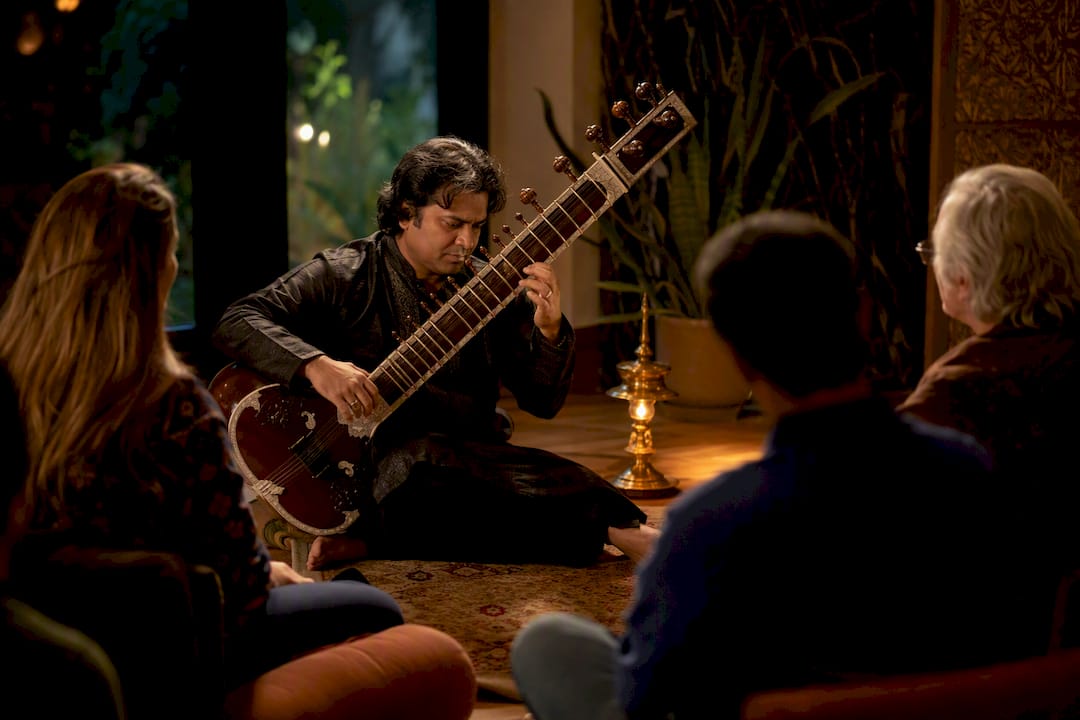
The pedagogical value comes from proximity. When you watch a raga unfold in a baithak setting, you see the exact moment an artist chooses to bend a note with meend, or delay a phrase for tension before releasing it. That kind of ornamentation is nearly invisible on a recording and even harder to catch from the back of a concert hall. Rajib Karmakar’s own performance work, documented across his sitar concerts, reflects exactly this kind of close, phrase-by-phrase musicality that a classroom demonstration alone struggles to convey.
Participants who go through workshop-style immersion generally leave with two concrete assets: a bandish they can perform from memory, and a working sense of how alaap should breathe before it resolves into rhythm. Neither of those comes from reading notation. Both come from repetition inside a structured practice block, paired with direct exposure to a musician performing the same raga live.
The practical advice for carrying this home is simple but easy to skip. Keep practicing the specific bandish you learned, at the tempo you learned it, for at least a few weeks before you move to new material. Musicians who jump straight to a new raga right after a workshop tend to lose the muscle memory and phrasing they just built. Consolidation matters as much as acquisition.
A raga isn’t fully learned until you’ve heard it performed live and then tried to recreate that same feeling yourself. That gap between hearing and doing is exactly what a baithak setting closes.
When a Workshop Beats Private Lessons, and When It Doesn’t
Workshops and private lessons solve different problems, and confusing the two leads to disappointment either way.
Pick a concentrated workshop when you need inspiration, a repertoire sprint, or performance readiness fast. If you’ve been stuck in a private-lesson rut, learning slowly but never quite performing anything, an intensive format forces the issue. You’ll leave with a piece you can actually play in front of people, which is a different outcome than steady incremental progress.
Private lessons or structured online courses win when you need consistency over time. Raga work, especially voice culture and technique refinement, rewards weekly correction more than a five-day burst. A workshop can’t fix a bad bowing habit or breath pattern the way a teacher checking in every week can.
My honest recommendation: try a short intro workshop before you commit to a longer intensive or a private teacher relationship. It’s the cheapest way to find out whether the immersive format actually suits how you learn, before you spend real money finding out the hard way.
— Rajib
Learn With SITARRAJIB: Workshops and Private Lessons
Rajib Karmakar offers teaching practice built around exactly the immersive, baithak-informed approach this guide describes. Rather than piecing together isolated sessions, one can access workshops, private sitar lessons, and cultural music experiences from a performer active in concerts, recordings, and film music. This approach means the repertoire taught traces back to material performed on stage, not a syllabus created independently from practical experience.
Sessions are structured around raga development, tala grounding, and sitar-specific technique, with performance-based learning drawn from live concert and recording work. If you’re weighing a multi-day intensive against something more personal and paced to your schedule, private lessons offer that flexibility without losing the immersive, listen-and-respond teaching style. Check current availability and event formats and reach out to book a session or ask about upcoming workshops.
Where to Learn More Before You Book
For readers who want to check formats and pricing directly before committing, these are the primary event pages worth reviewing.
- NCPA’s Guru in Residence: institutional masterclass with published fees and schedule detail.
- Naadras seven-day retreat: full immersive residency with baithak evenings.
- Sounds of India: accessible two-hour introductory format for beginners.
- Naadrass raga workshop: detailed sample-day structure and program objectives.
Reading the actual event page, not a secondhand summary, remains the fastest way to confirm a program fits your level before you register.
Sources
- Guru in Residence – NCPA
- Naadras – A 7-day immersive Hindustani music workshop
- Indian Music Workshop & Classes – Sounds of India
- Naadrass – Immersive Raga & Conscious Musicianship Workshop | Naman’s Music