
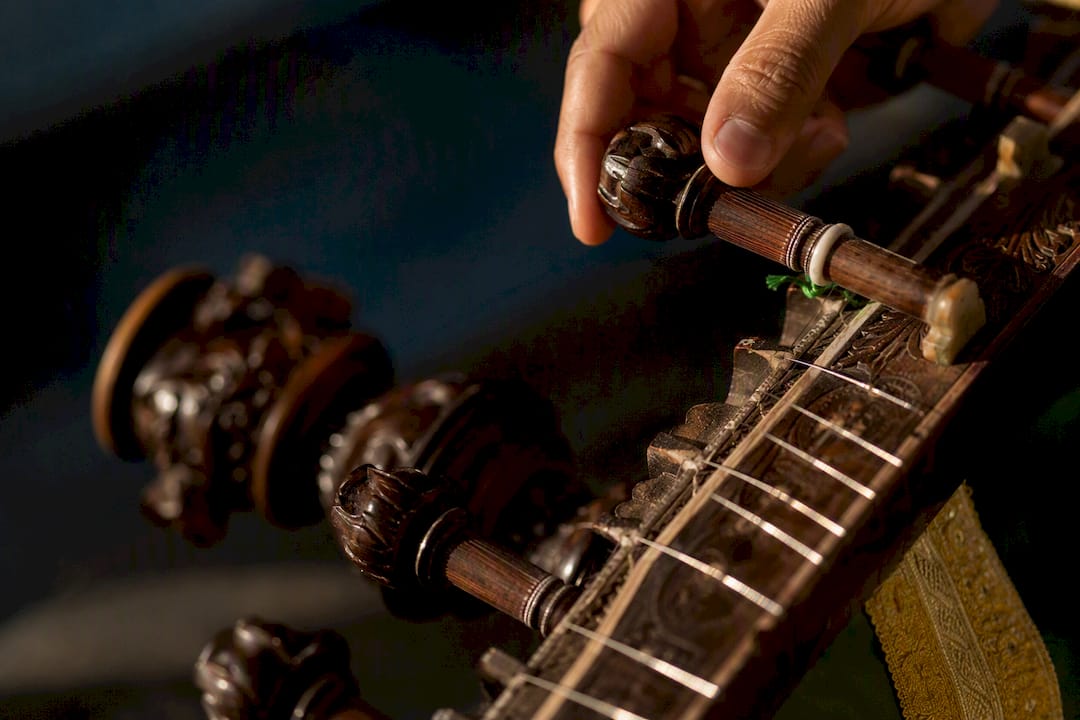
Pick a tonic Sa (C, C#, and D all work fine), then tune your main baj/nayaki string to that pitch with a tone generator or fixed reference. From there, tune jora, jure, and kharaj strings to their relative intervals, set the chikari, and tune the tarab strings last. Confirm every string with an octave check or harmonic before you play a single note.
TL;DR:
- Proper tuning requires setting the main string to a fixed pitch first using a tone generator or reference, then tuning other strings relative to it.
- New strings stretch for days, requiring multiple retuning passes, and tuning stability depends heavily on correct string gauges and peg friction.
- Sympathetic strings should be tuned starting from the root note and adjusted based on resonance, emphasizing ear training over tuner precision.
- The lower bass string’s tuning style influences melodic options, with Ravi Shankar favoring Kharaj pancham and Vilayat Khan preferring Gandhar pancham, depending on ragas.
- Prioritizing harmonic accuracy on primary strings before tuning sympathetic strings ensures a solid foundation and better overall sound during practice and performance.
Table of Contents
- Pre-Tuning Checklist: What to Set Up Before You Touch a Peg
- How Do You Tune the Main Sitar Strings Step by Step?
- How Do You Tune the Sympathetic (Tarab) Strings?
- Ravi Shankar or Vilayat Khan Tuning: Which Style Fits You?
- Which Tuning Tools Actually Work for Sitar?
- Maintenance, String Gauges, and Quick Fixes for Common Tuning Problems
- What a Working Sitarist Prioritizes Backstage
- Why Most Tuning Advice Skips the Part That Actually Matters
- Sources
Pre-Tuning Checklist: What to Set Up Before You Touch a Peg
Before you turn a single peg, get your setup right. Rushing this stage is why players spend twenty minutes chasing a pitch that keeps drifting.
- Sit in your normal playing position with the mizrab on your finger. Your body angle affects string tension slightly, so tune in the position you’ll actually play in.
- Check every string for fraying or dullness, and keep a spare set on hand. Old strings hold pitch poorly no matter how carefully you tune them.
- Confirm tuning beads are seated on the main strings. They let you make tiny pitch corrections without over-stressing the peg.
- Have your tone generator, chromatic tuner app, or a fixed Sa reference ready before you start.
- If you’re a beginner, mute the sympathetic strings with a cloth strip. Some teachers recommend skipping tarab tuning entirely at first so you can focus on the main strings without the extra overhead.
- Settle each peg firmly into its hole and check that the frets sit tight against the neck.
How Do You Tune the Main Sitar Strings Step by Step?
The main strings carry the melody, so they get tuned first and tuned carefully. Most players start with C or C# as the tonic Sa, though D works too if your instrument and strings can handle the extra tension.
Here’s the order that keeps you from constantly re-checking strings you already set:
- Baj (Sa): Tune this to your chosen tonic first. Everything else is measured against it.
- Jora and jure strings: These sit in fixed relative intervals above Sa. Tune them by ear against the baj string, then confirm with a tuner.
- Kharaj strings: These bass strings anchor the lower register. Tune them an octave below Sa and check the octave relationship carefully.
- Chikari strings: Set these to their drone intervals once the melodic strings are stable.
Once the pitches are roughly set, play a harmonic on the baj string (lightly touch the string at its midpoint while plucking) and compare it against the octave string. If they beat against each other instead of ringing clean, you’re not quite there yet.
New strings stretch for days after installation, so expect to retune the same string three or four times in a single sitting. This isn’t a sign you’re doing something wrong. Sitar teachers commonly recommend multiple tuning passes as new strings settle into their final tension, and skipping that step is the single biggest reason beginners think their tuning “won’t hold.”
Pro Tip: If a peg keeps slipping after you’ve tuned it, dust a little chalk or rosin on the peg where it meets the pegbox. It adds friction without forcing you to jam the peg in harder, which just cracks the wood over time.
If a bronze bass string rattles against a fret during fast passages, that’s usually a jawari or action issue rather than a tuning problem. More on that below.
How Do You Tune the Sympathetic (Tarab) Strings?
Tarab strings don’t get played directly. They vibrate in sympathy with the main strings, and that sympathetic vibration is what gives the sitar its distinctive shimmer. Most sitars carry between 11 and 13 sympathetic strings, each tuned to a specific note of the raga you’re planning to play.
Work through them in this order:
- Tune the longest tarab string to Sa first. This anchors every other string against a fixed reference.
- Work upward through the scale, tuning each successive string to the next note the raga calls for.
- For a raga like Bilaval, that typically means setting the tarab strings to Sa, Re, Ga, Ma, Pa, Dha, and Ni, repeated across octaves depending on how many strings your sitar carries.
- If you’re switching ragas mid-practice, you don’t need to retune every tarab string. Adjust only the ones whose notes differ from the previous raga.
Tarab tuning rewards a trained ear more than a tuner. A chromatic app will get you close, but the resonance you’re listening for is the sympathetic ring that builds as you play the main strings, not just a static pitch match. If that ring sounds thin or muddy, retune the tarab strings a hair sharper or flatter until the resonance opens up. This is one area where reducing tarab complexity while you’re still learning genuinely speeds up progress. Fewer strings to manage means more attention on getting the main strings and technique solid.
Ravi Shankar or Vilayat Khan Tuning: Which Style Fits You?
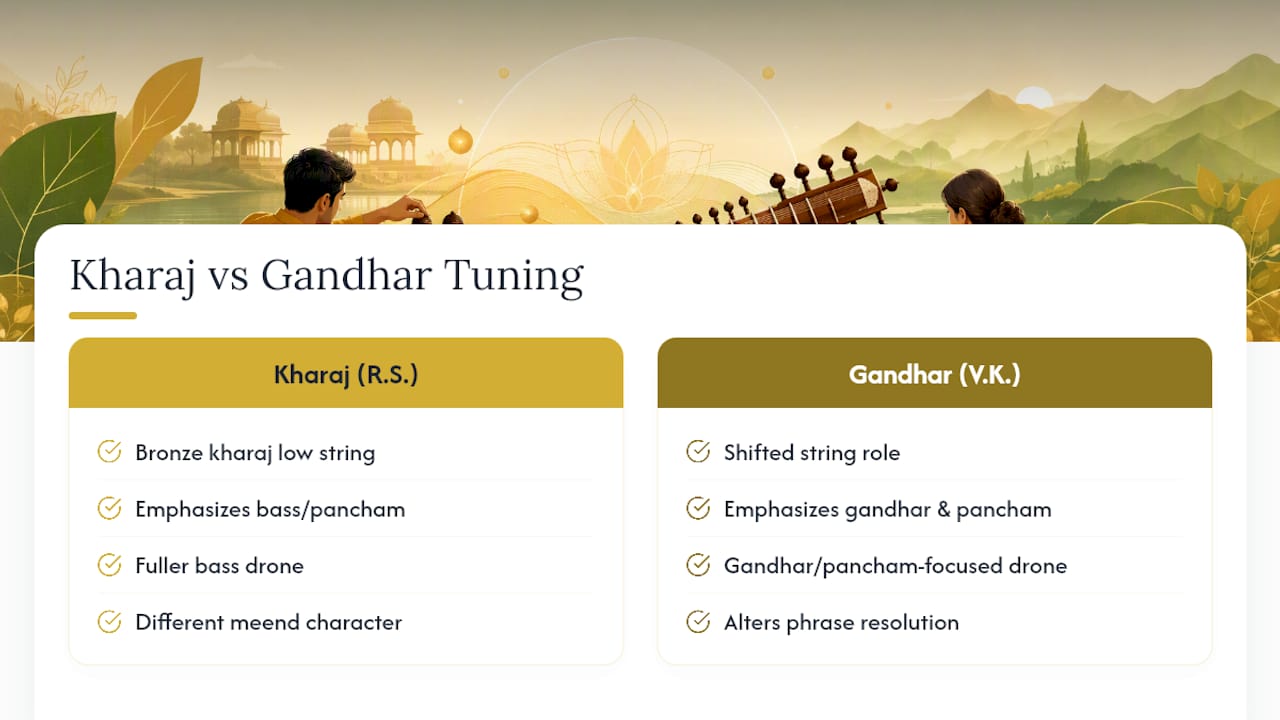
The two dominant tuning traditions differ mainly in how the bass strings are laid out and what that layout does to your melodic options. Kharaj pancham tuning, associated with Ravi Shankar, places a bronze kharaj string tuned low, giving the instrument a fuller bass drone and a slightly different meend (pitch bend) character on the main strings.
Gandhar pancham tuning, associated with Vilayat Khan, shifts a string role to emphasize the gandhar and pancham intervals more directly, which changes how certain phrases resolve melodically. Converting a sitar from one style to the other usually means changing the gauge on the fourth string to a heavier bronze bass and retuning it to a low Sa, a modification worth discussing with a repair specialist rather than attempting blind.
Neither style is objectively better. Your choice should follow the raga tradition you’re studying and, frankly, which drone sound you personally find more satisfying under your fingers.
Which Tuning Tools Actually Work for Sitar?
A tone generator with an adjustable reference pitch beats a standard chromatic tuner for sitar work, because you’re setting a fixed Sa and tuning everything relative to it rather than hunting for individual note names. Phone apps that let you lock a custom reference frequency work the same way and are worth having as a backup.

The catch: most visual tuners default to Western equal temperament, while Indian classical intonation depends on just intonation intervals that don’t always match those equal-tempered readings. A tuner will get every string in the right neighborhood. Getting the sitar to actually sing requires listening to harmonics and making small ear-based corrections the tuner can’t tell you about. This same tension between equal temperament and pure intervals shows up across other instruments too. Wind players wrestle with it constantly, and the pitch-accuracy techniques clarinetists use rely on the same ear training principle: trust your ear over the display once you’re close.
Maintenance, String Gauges, and Quick Fixes for Common Tuning Problems
String gauge affects both tension and tone, and getting it wrong makes tuning stability worse no matter how carefully you turn the pegs. Godden Music’s stringing charts show that sympathetic strings typically run light steel gauges in the .009 to .010 inch range, while main strings vary more depending on whether you’re set up for kharaj pancham or gandhar pancham tuning.
A few maintenance habits keep tuning stable session after session:
- Change main strings every few months of regular playing, sooner if you notice dull tone or visible fraying.
- After installing new strings, expect several retuning passes over the first few days as the strings stretch and settle.
- If a bass string rattles against a fret during fast playing, some players attach a small wire hook to the fret and hook the string under it to stop the buzz during performance.
- Loose frets can usually be nudged back into position by hand, but persistent slipping pegs may need chalk, rosin, or a peg that’s been reseated by a repair tech.
Pro Tip: If your sitar’s tone sounds flat or lifeless no matter how precisely you tune, the problem might not be tuning at all. It’s often the jawari. Jawari adjustment shapes the buzzing overtone quality that defines sitar tone, and it’s specialized enough that a proper jawariwala, not a home fix, is the right call if the bridge needs real work.
What a Working Sitarist Prioritizes Backstage
On stage, stability beats perfection every time. A slightly imperfect resonance that holds steady through a forty minute set is worth more than a mathematically pure tuning that drifts by the second piece.
Before any performance, lock the main strings first, then the chikari, then run through the tarab strings once with the house acoustics in mind, since a room full of people absorbs high frequencies differently than an empty practice space. Humidity and temperature shifts backstage can pull a sitar out of tune faster than a full evening of playing, so a final check right before walking out matters more than people expect. If you’re planning a performance and want the technical side handled, our guide to sitar performance requirements covers what typically needs attention beyond tuning alone.
Treat everything in this guide as scaffolding, not scripture. Ear training closes the gap that no checklist ever will.
Why Most Tuning Advice Skips the Part That Actually Matters
Most sitar tuning guides treat the process like a mechanical checklist: hit these pitches, in this order, done. That framing undersells what’s actually happening, which is a negotiation between an equal-tempered tuner and an instrument built for just intonation. The tuner gets you close. Your ear gets you correct.
The conventional advice also tends to front-load sympathetic string tuning for beginners, as if a fuller sound early on equals faster progress. It usually does the opposite. Managing 13 tarab strings before your main-string technique is solid just adds friction to an already steep learning curve. Strip that complexity out first.
If there’s one thing worth prioritizing above all else, it’s harmonic checking on the main strings before you ever touch the tarab. A sitar with a slightly imperfect drone but rock-solid main strings will always sound better than the reverse. Get the foundation right, then let the resonance build on top of it. That’s not the flashy part of tuning, but it’s the part that actually determines whether your practice time moves you forward or just keeps you retuning the same string for the tenth time.
— Rajib
Sources
- How the sitar’s sympathetic strings and jawari create its resonant sound — India Today
- Tuning & Strings — India Instruments
- Sitar Stringing & Tuning — Godden Music