
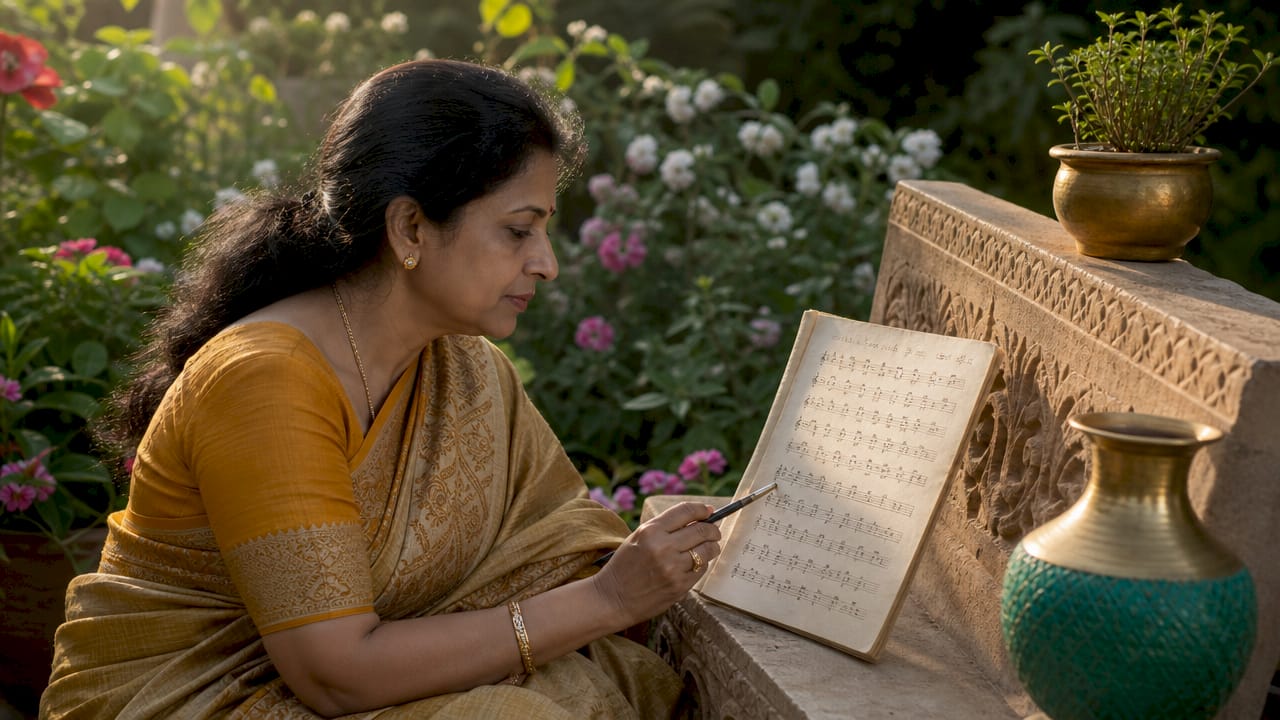
Swaralipi is the Indian music notation system, an alphabetic framework using seven fundamental syllables to represent pitch, melody, and rhythm. The seven swaras, Sa, Re, Ga, Ma, Pa, Dha, and Ni, form the backbone of Indian classical music notation. Unlike Western staff notation, swaralipi does not rely on a five-line staff or fixed clef positions. Reformers like Vishnu Narayan Bhatkhande and Vishnu Digambar Paluskar shaped the modern system in the early twentieth century, giving institutions a structured way to teach and preserve repertoire. Understanding this system is the first step toward reading Indian music with confidence.
How the Indian music notation system represents pitch
The seven swaras are abbreviated as S, R, G, M, P, D, and N. These letters appear in sequence to spell out a melody, much the way letters spell a word. Sa and Pa are fixed tonal anchors. They never change their pitch quality, regardless of the raga or scale in use.
The remaining five notes, Re, Ga, Ma, Dha, and Ni, can appear in natural (shuddh), flat (komal), or sharp (tivra) forms. Komal notes are typically written with an underline or a lowercase letter, depending on the regional notation style. Tivra Ma, the only sharp variant in common use, is marked with a vertical line above the letter M.
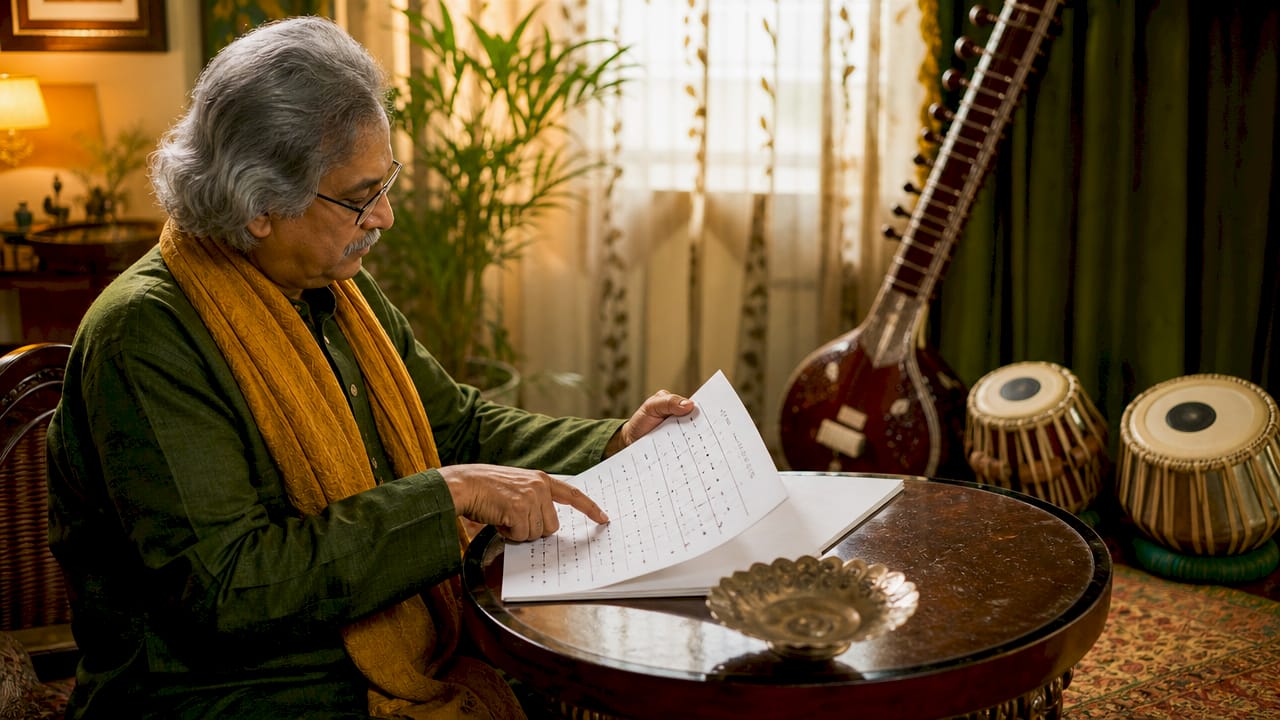
Octave placement is shown through dots. A dot above a letter places the note in the upper octave, called Taar Saptak. A dot below places it in the lower octave, called Mandra Saptak. No dot means the note sits in the middle octave, Madhya Saptak. This three-tier system covers the full practical range of most Indian classical instruments and voices.
The contrast with Western staff notation is significant. Western notation uses fixed 12-tone equal temperament, while Indian music relies on just intonation with microtonal shifts. That difference means a Western-trained musician cannot simply map swaralipi onto a staff and expect accurate results. The pitch relationships are fluid, not fixed.
Pro Tip: Write out the swaras of a raga you are studying as a single row of letters with octave dots. Reading it aloud as a sentence trains your eye and ear to work together from the start.
Swaras at a glance
| Swara | Abbreviation | Variants |
|---|---|---|
| Sa (Shadja) | S | Shuddh only |
| Re (Rishabh) | R | Shuddh, Komal |
| Ga (Gandhar) | G | Shuddh, Komal |
| Ma (Madhyam) | M | Shuddh, Tivra |
| Pa (Pancham) | P | Shuddh only |
| Dha (Dhaivat) | D | Shuddh, Komal |
| Ni (Nishad) | N | Shuddh, Komal |
How rhythm and ornamentation are written in Indian notation
Tala, the rhythmic cycle, is marked alongside the swaras using a small set of symbols. The symbol X marks the sam, the first and most important beat of the cycle. The symbol 0 marks the khali, an empty or unaccented section. Numbers mark the tali, the remaining accented beats.
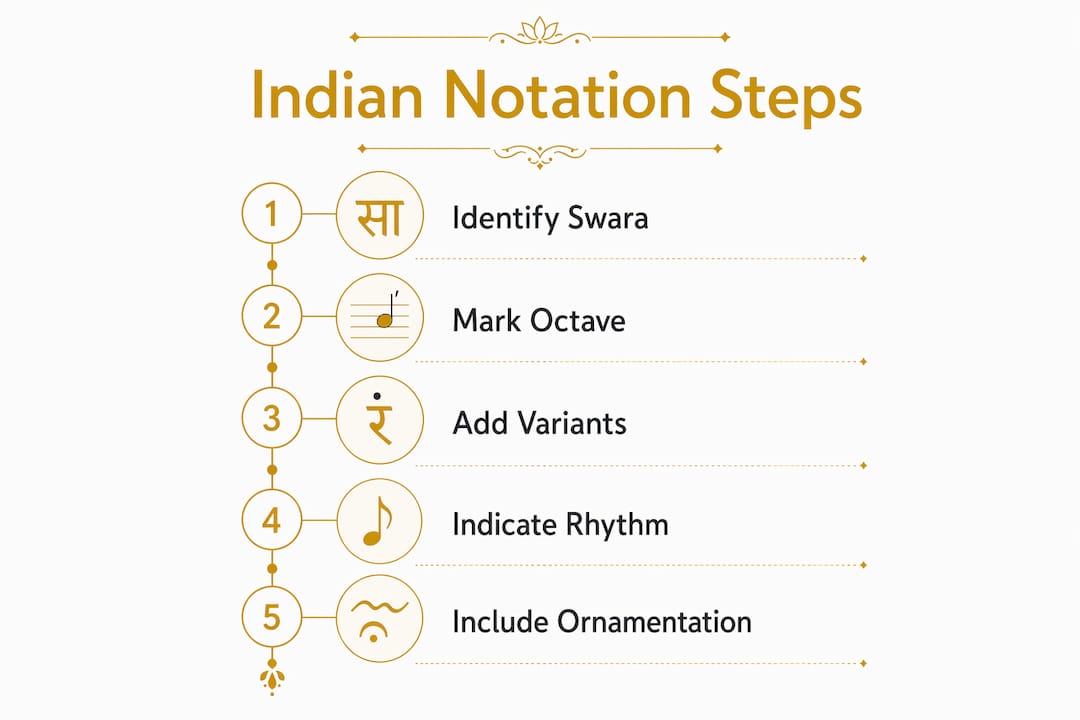
Common talas each carry a fixed beat count. Kaharwa runs 8 beats, Dadra runs 6 beats, Teentaal runs 16 beats, and Rupak runs 7 beats. Each tala divides into sections called vibhags, and the notation places the X, 0, and number markers at the start of each vibhag. This gives you a visual map of where the rhythmic weight falls across the cycle.
Note duration is shown through additional marks. Different pedagogical traditions use slightly different systems. Bhatkhande’s system uses koshi marks, while Goswami’s system uses vertical bars called danda. Hyphens extend a note across a beat. These variations exist across regional and institutional traditions, so knowing which system a piece of notation uses matters before you read it.
Ornamentation symbols add another layer of detail. Meend, a slide between notes, is shown as ~. Kan, a grace note, is shown as ^. Murki, a quick ornamental turn, appears in parentheses. Gamak, an oscillating ornament, is shown as /. These symbols give visual cues, but they do not fully capture the fluidity of a live performance.
- Sam (X): The first beat of the tala cycle, the rhythmic anchor
- Khali (0): The empty beat, lighter in feel and often unaccented
- Tali (numbers): Accented beats that divide the cycle into sections
- Meend (~): A smooth slide connecting two notes
- Kan (^): A brief grace note before the main swara
- Murki ( ): A rapid ornamental turn around a central note
- Gamak (/): A vigorous oscillation between adjacent notes
Pro Tip: When you first read a tala cycle in notation, clap the vibhag pattern before adding any swaras. Feeling the rhythm in your hands before your fingers play it prevents mechanical reading later.
What are the real limits of notation in Indian classical music?
Notation captures the skeleton of a composition. It records which notes appear, in which order, and within which rhythmic framework. What it cannot record is the life inside those notes.
Expressive elements like gamakas and microtonal srutis are transmitted through the guru-shishya parampara, the traditional teacher-student relationship. A guru demonstrates a phrase. The student listens, imitates, and repeats until the phrase becomes part of their body. No symbol on a page replicates that process. The notation gives you the address; the oral tradition takes you inside the house.
“Notation is a map, not the territory. The srutis, the gamakas, the rhythmic elasticity of a great performance all live outside written symbols. They pass from teacher to student through sound, not script.” — Rajib Karmakar, Sitarrajib
True mastery of forms like Dhrupad requires oral transmission because microtonal and expressive subtleties cannot be adequately represented in any notation system. This is not a flaw in swaralipi. It reflects the nature of Indian classical music itself, which treats pitch as a living, breathing thing rather than a fixed point on a grid.
Musicians trained in Western notation face a specific challenge. They must unlearn the assumption that every note has a single correct pitch. In Indian music, the same swara can sit slightly higher or lower depending on the raga, the phrase, and the emotional intent. That flexibility is the point, and notation can only gesture toward it.
How to read and use Indian music notation effectively
Reading Indian music notation well is a skill built through consistent, structured practice. These steps give you a clear path from the page to the performance.
- Learn the seven swaras by sound first. Sing Sa, Re, Ga, Ma, Pa, Dha, Ni aloud before you ever look at a written score. Your ear needs to own these sounds before your eye reads them.
- Identify the tala before reading any swaras. Find the X, 0, and number markers. Clap the cycle. Count the beats. Only then add the melodic layer.
- Sing the sargam aloud with the tala. Experienced students sing sargam aloud to internalize rhythmic cycles and phrasing before playing. This bridges the gap between notation and musical flow.
- Use notation as a memory aid, not a script. Read a phrase from the page, then close your eyes and sing it from memory. Repeat until the page is unnecessary.
- Listen to recordings of the composition. Find a recording by a respected performer and listen before you practice. The notation tells you what notes to play. The recording tells you how they should feel.
- Work with a teacher for ornamentation. Symbols like ~ and ^ point to ornaments, but the actual execution requires demonstration. A teacher at Sitarrajib can show you the difference between a written meend and a performed one.
- Apply notation in both classical and contemporary contexts. Swaralipi works for a traditional bandish and for a film score written in Indian scales. The system is flexible enough to serve both, which makes it worth learning thoroughly.
Beginners often experience notation as mechanical, but consistent practice leads to internalization and less reliance on the page. The goal is not to read faster. The goal is to need the page less.
Key takeaways
The Indian music notation system, swaralipi, is a letter-based framework that encodes pitch, octave, rhythm, and ornamentation, but it functions as a structural scaffold that must be paired with oral learning to produce authentic performance.
| Point | Details |
|---|---|
| Seven swaras form the base | S, R, G, M, P, D, N represent all pitches; dots above or below indicate octave. |
| Tala symbols structure rhythm | X marks sam, 0 marks khali, and numbers mark tali across the rhythmic cycle. |
| Ornamentation is partially notated | Symbols like ~ and ^ point to ornaments but require live demonstration to execute correctly. |
| Notation captures skeleton only | Srutis, gamakas, and expressive nuance are transmitted through oral teacher-student tradition. |
| Singing sargam builds internalization | Vocalizing swaras with tala before playing prevents mechanical reading and deepens musicality. |
Why I think notation is a tool, not a teacher
I have taught Indian classical music for years, and the most common mistake I see is students treating notation like a script. They watch the page instead of listening to the sound. The page becomes a wall between them and the music.
Swaralipi is genuinely useful. It helped reformers like Bhatkhande preserve hundreds of compositions that might otherwise have been lost. Historical notation systems shaped how institutions teach Indian classical music today, and that matters. But preservation and performance are two different things.
When I sit down with a new student, I ask them to close their eyes before they open the notation book. We sing the raga together first. We feel the tala in our hands. Only after that do we look at the written form. The notation then confirms what the ear already knows, rather than replacing what the ear should learn.
The students who progress fastest are the ones who use notation to check their memory, not to read in real time. They internalize a phrase, set the page aside, and play from feeling. That is the balance this tradition asks for. Notation supports the work. It does not do the work.
— Rajib
Learn Indian classical music with Sitarrajib
Sitarrajib offers private sitar lessons and workshops that combine written notation study with the oral teaching methods that Indian classical music requires. Rajib Karmakar, based in Los Angeles, teaches students at all levels how to read swaralipi and apply it in both classical and contemporary performance settings.
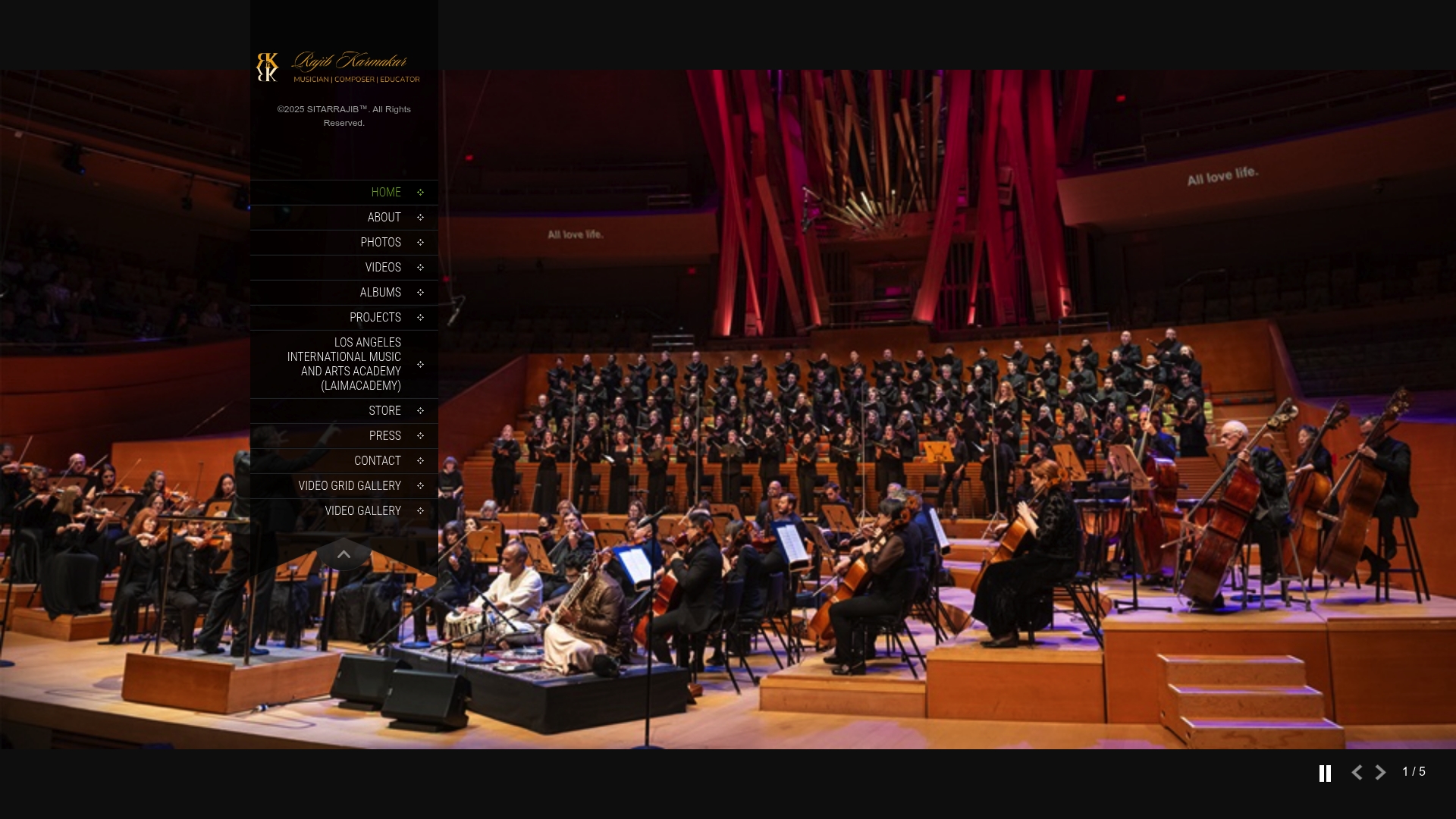
You can watch notation come alive in live sitar performances that demonstrate how written scores translate into expressive, microtonal playing. Audio recordings on the Sitarrajib music page give you reference points for how swaras, talas, and ornaments actually sound in practice. For a full picture of the educational approach, visit Sitarrajib and connect directly.
FAQ
What is the Indian music notation system called?
The Indian music notation system is called swaralipi. It uses the seven sargam syllables, Sa, Re, Ga, Ma, Pa, Dha, and Ni, abbreviated as S, R, G, M, P, D, N, to represent pitch and melody.
How do octaves work in Indian music notation?
A dot above a swara letter indicates the upper octave (Taar Saptak), a dot below indicates the lower octave (Mandra Saptak), and no dot indicates the middle octave (Madhya Saptak).
Can Western sheet music be used for Indian classical music?
Western staff notation is based on fixed 12-tone equal temperament, while Indian music uses just intonation with microtonal variations. This makes Western notation inadequate for capturing Indian classical music accurately.
What do the symbols X, 0, and numbers mean in Indian notation?
X marks the sam, the first beat of the tala cycle. 0 marks the khali, the unaccented section. Numbers mark the tali, the remaining accented beats that divide the cycle.
Why is oral tradition still necessary if notation exists?
Notation records the pitch-rhythm skeleton of a composition. Expressive elements like gamakas, srutis, and rhythmic elasticity are transmitted through the guru-shishya parampara and cannot be fully captured in written symbols.