
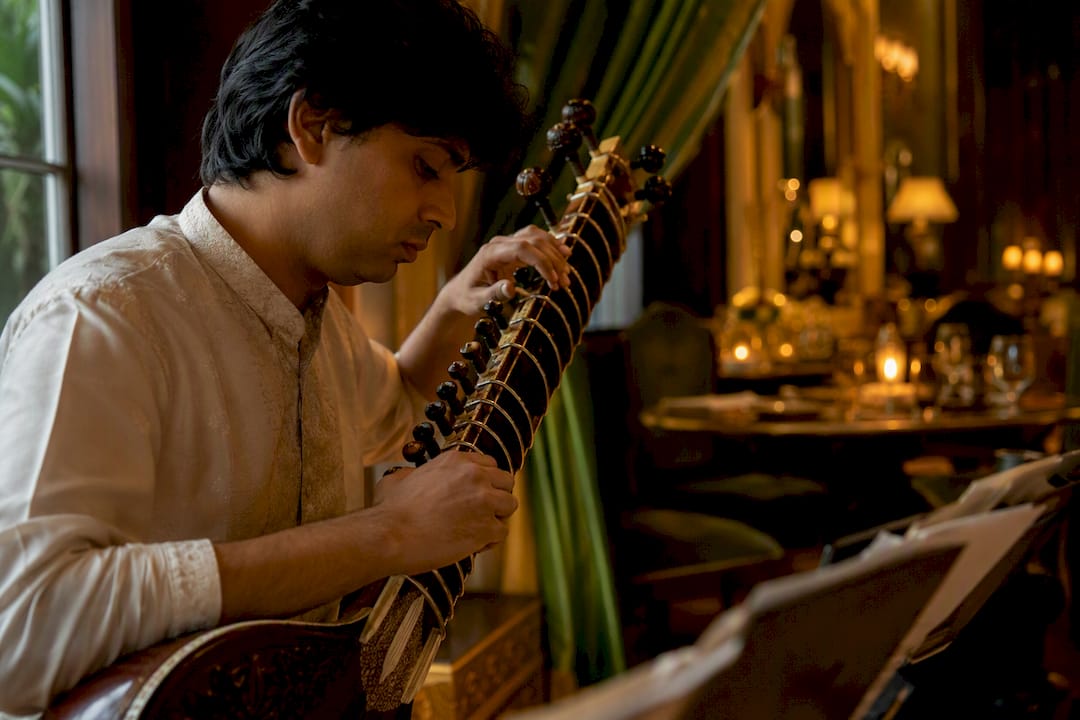
Yes, a live sitar performance belongs at your gala dinner, solo or as part of a curated ensemble, if you build it into a clear run-of-show and technical rider first. The instrument’s warmth works because it fills a room without fighting conversation. Your next move: lock the run-of-show before you request a quote, book 3 to 6 months ahead for peak season, and loop in SITARRAJIB (Rajib Karmakar) as your point of contact for both the performance and the technical plan.
- Solo sitar or duo works for intimate dinners (50 to 150 guests).
- Larger galas (300+) usually call for a 7 to 10 piece ensemble.
- Confirm mic, monitor, and sound check windows before signing.
Key Takeaways
Live sitar music succeeds at gala dinners when planners match ensemble size and repertoire to each phase of the evening and lock technical details before the event.
| Point | Details |
|---|---|
| Match the phase | Use solo or duo for cocktails and dinner, larger ensembles for featured moments. |
| Book early | Reserve 3 to 6 months ahead for peak gala season to secure your preferred artist. |
| Confirm the rider | Specify mic type, monitor mix, and stage size before the sound check. |
| Send a full brief | Include guest count, run-of-show, and audience profile when requesting a quote. |
| Contact Sitarrajib | Rajib Karmakar and Sitarrajib offer solo-to-ensemble sitar bookings with rider support and run-of-show coordination. |
Table of Contents
- Why Sitar Music Fits an Elegant Gala Dinner
- How to Structure Cocktail, Dinner, and Main Program Music
- Which Sitar Ensemble Configuration Fits Your Gala?
- What Does Gala Dinner Sitar Music Typically Cost?
- What to Send an Artist When Requesting a Quote
- Common Mistakes Planners Make With Live Sitar Music
- An Artist’s View on Programming a Gala Dinner Set
- Book a Live Sitar Set for Your Next Gala Dinner
- Frequently Asked Questions
- Sources
Why Sitar Music Fits an Elegant Gala Dinner
The sitar has a wide dynamic range. It can sit quietly under table conversation at a whisper, then swell into a focused, featured piece when the room turns to listen. That flexibility is why it works for gala dinners in a way a full horn section often does not.
Repertoire matters as much as volume. Melodic, meditative Raags suit a contemplative or black-tie tone, while lighter fusion arrangements fit a more contemporary or cross-cultural program. Artists who perform for summits and formal dinners often lean on this range specifically because it brings serenity without becoming background noise.
For planners, the value is simple: you get a distinctive, culturally rich act that elevates a formal dinner without ever overpowering it.
- Ask the artist for a sample setlist tied to your event’s tone.
- Confirm volume expectations for dinner versus a featured set.
- Request 2 to 3 repertoire options for different phases of the night.
Pro Tip: Ask the sitarist to prepare one meditative set for dinner and one slightly more energetic piece for a featured moment. That contrast keeps the evening from feeling flat.
How to Structure Cocktail, Dinner, and Main Program Music
Treat the evening as three distinct musical layers, not one continuous playlist. Each phase asks something different of the sitar.
- Cocktail hour: ambient, conversational, solo or duo, low volume to support mingling.
- Dinner service: background but present, duo or quartet, moderate volume tuned to conversation, not performance.
- Main program: featured 15 to 20 minute set, full ensemble if budget allows, full listening volume during speeches, awards, or a signature moment.
A 500-person gala typically settles on a 7 to 10 piece configuration for the main program specifically because it can carry a large room and cue in and out of speeches cleanly.
Here’s a sample run-of-show for a 4-hour gala:
- 6:00 to 6:45 PM: Arrivals and cocktail hour, solo sitar or duo.
- 6:45 to 8:00 PM: Dinner service, duo or quartet, background volume.
- 8:00 to 8:20 PM: Speeches and awards, music cues only between segments.
- 8:20 to 8:45 PM: Featured sitar performance, full ensemble if booked.
- 8:45 to 10:00 PM: Handover to DJ or dance act, or continued ambient set.
Sets typically run 30 to 45 minutes with short breaks, so plan recorded music or a secondary act to cover transitions.
Which Sitar Ensemble Configuration Fits Your Gala?
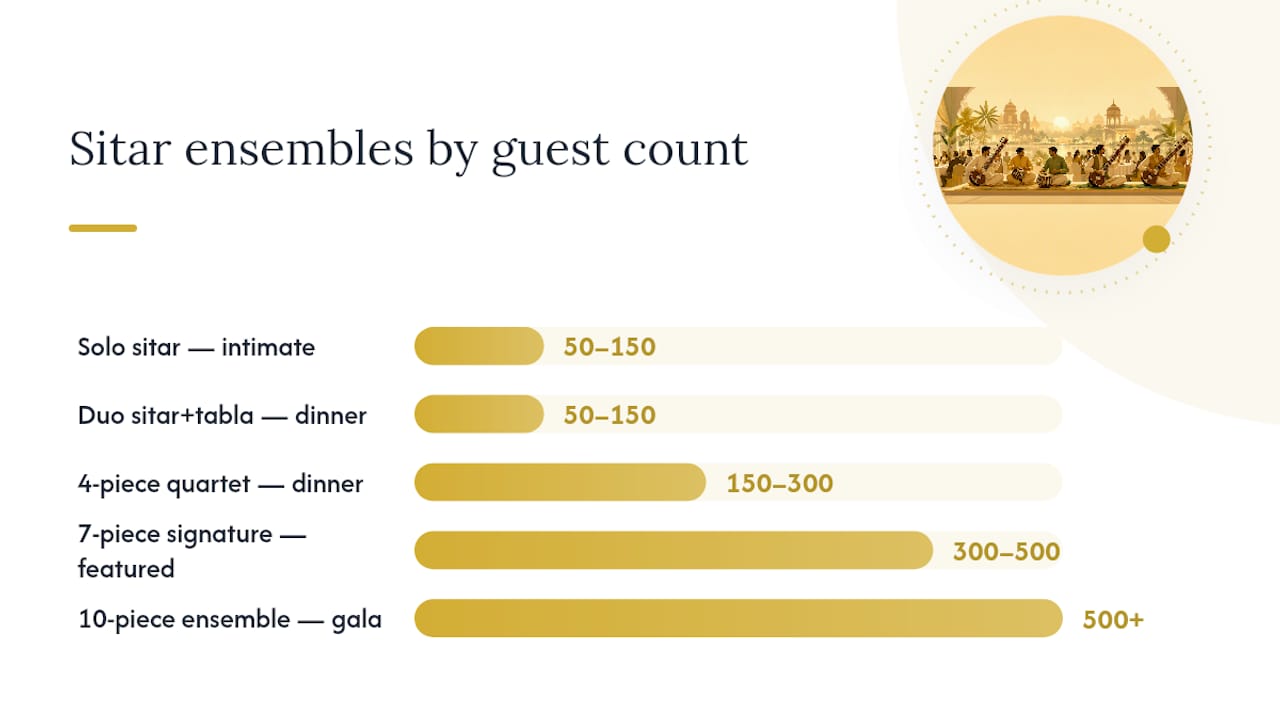
Configuration should follow guest count and program role, not just budget. A solo sitarist reads intimate and personal; a 10-piece ensemble reads like a signature moment guests will remember.
| Configuration | Best For | Guest Count |
|---|---|---|
| Solo sitar | Cocktail hour, intimate dinners | 50 to 150 |
| Duo (sitar + tabla) | Dinner background, small galas | 50 to 150 |
| 4-piece quartet | Dinner or short featured set | 150 to 300 |
| 7-piece signature | Featured main program moment | 300 to 500 |
| 10-piece ensemble | Large gala, dance handover | 500+ |
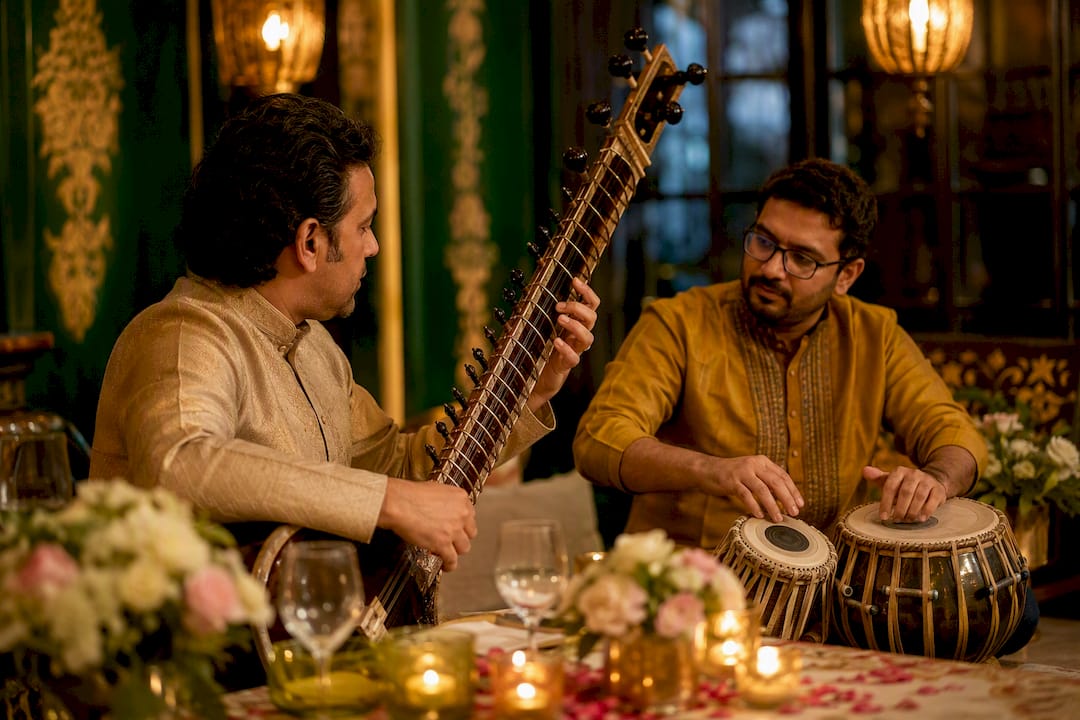
Larger ensembles typically require a raised stage and a full monitoring system, so confirm stage size early with your venue’s AV team.
On the technical side, sitar performances rely on precise miking. A small-diaphragm condenser or dedicated pickup system preserves the instrument’s warmth while letting it cut through room noise. A separate monitor mix keeps the ensemble in sync without bleeding into house sound.
- Minimum inputs: 1 to 2 channels for solo/duo, 6 to 10 for a full ensemble.
- Confirm riser placement so the sitarist has sightlines to a conductor or bandleader.
- Request a dedicated sound check window, not a shared line check with other acts.
- Ask whether the artist brings a PA or requires the venue’s system.
What Does Gala Dinner Sitar Music Typically Cost?
Price moves on a few clear levers: artist reputation, ensemble size, set length, and travel distance. A solo sitarist for a cocktail hour costs far less than a 7-piece ensemble booked for a featured evening set with full sound support.
Full live bands with sound typically run from $5,550 for a 5-piece up to $11,580 for an 8-piece, and sitar ensembles follow a similar logic: size and travel explain most of the price movement.
Bookings that start in a moderate to high range for a solo or duo artist reflect reputation and demand more than raw ensemble size, so ask directly how the artist’s fee breaks down.
- Book several months ahead for peak gala season.
- Expect a deposit (often 30 to 50%) at contract signing.
- Confirm travel and per diem costs in writing before the balance is due.
- Ask what’s included: sound engineer, rider support, rehearsal time.
What to Send an Artist When Requesting a Quote
A vague inquiry gets a vague quote. Send the artist a complete picture of your event, and you’ll get an accurate number back the first time.
Your brief should make clear the event format, guest count, audience profile, and atmosphere you want the music to create. Specify whether you’re booking background dinner music or a featured 15 to 20 minute set, since the rider and structure differ between the two.
Include:
- Date, venue, and exact guest count.
- Audience profile and dress code.
- Timed run-of-show with start and end windows for each segment.
- Stage dimensions, load-in time, and whether the venue provides sound.
- Contract items: cancellation terms, travel, overtime policy, and payment milestones.
- Name a single point of contact for day-of coordination.
- Attach your run-of-show as a document, not a verbal summary.
- Confirm the sound check window in the same email.
Common Mistakes Planners Make With Live Sitar Music
The most frequent error is booking one act to do two jobs. A sitarist hired for a serene dinner set gets asked, mid-event, to “pick up the energy” for dancing. That’s the wrong instrument for that job. Book a separate high-energy act for any dance segment and let the sitar do what it does best.
The second mistake is underestimating acoustic needs. Sitar requires specific miking and a dedicated monitor mix; skip that planning and the instrument either disappears under room noise or overpowers the table nearest the stage.
The third is a vague or missing run-of-show. Transition cues between speeches and music need to be programmed into the sound console in advance and rehearsed at sound check, not improvised live.
Pro Tip: Send your timed run-of-show at least two weeks before the event so the artist can shape Raags and arrangements to match each phase of the night.
An Artist’s View on Programming a Gala Dinner Set
Every gala has its own pace, and I build the set around that pace rather than a fixed playlist. A formal dinner asks for restraint; a featured moment asks for something the room can lean into. Choosing the right Raag for each phase is the real craft, not just playing well.
I work directly with venue AV teams before load-in so the rider, mic choice, and sound check are settled, not improvised. Planners can expect clear communication and a coordinated run-of-show from first contact through the final cue.
Book a Live Sitar Set for Your Next Gala Dinner
Sitarrajib gives you what a generic entertainment agency usually can’t: direct access to the artist, a technical rider built specifically for sitar, and program guidance for gala dinners rather than a one-size-fits-all band package.
A standard quote from Sitarrajib includes set length options, a technical rider you can hand straight to your AV team, travel terms, and coordination support for your run-of-show. Whether you need a solo set for cocktails or a full signature ensemble for your main program, the scope gets built around your event, not a template. Send your date, guest count, and run-of-show to request a quote, and check availability early since peak season books out fast.
Frequently Asked Questions
Is live sitar music appropriate for a formal corporate gala?
Yes. Its dynamic range lets it sit quietly under conversation during dinner and swell into a focused, featured moment during a main program segment, which suits most black-tie or formal gala formats.
How many musicians do I need for gala dinner music?
It depends on guest count and role. A solo sitarist or duo covers cocktails and dinner for up to 200 guests, while galas over 300 guests typically call for a 7 to 10 piece ensemble for the featured set.
How far in advance should I book a sitarist for a gala?
Book 3 to 6 months ahead for peak gala season, earlier if you want a specific artist or a larger ensemble configuration.
What should I include when requesting a quote?
Send the date, venue, guest count, audience profile, a timed run-of-show, stage dimensions, and whether the venue provides sound. That level of detail speeds up an accurate quote and rider match.
Can sitar music work alongside a DJ or dance band later in the evening?
Yes, but treat them as separate acts. Book the sitar for the dinner and featured program segments, then hand off to a dedicated dance act rather than asking the sitarist to cover both roles.
Sources
- How to Plan Live Music for a Corporate Event – Complete Guide
- How to Plan Music for a 500-Person Corporate Gala | uRequest Live Blog