
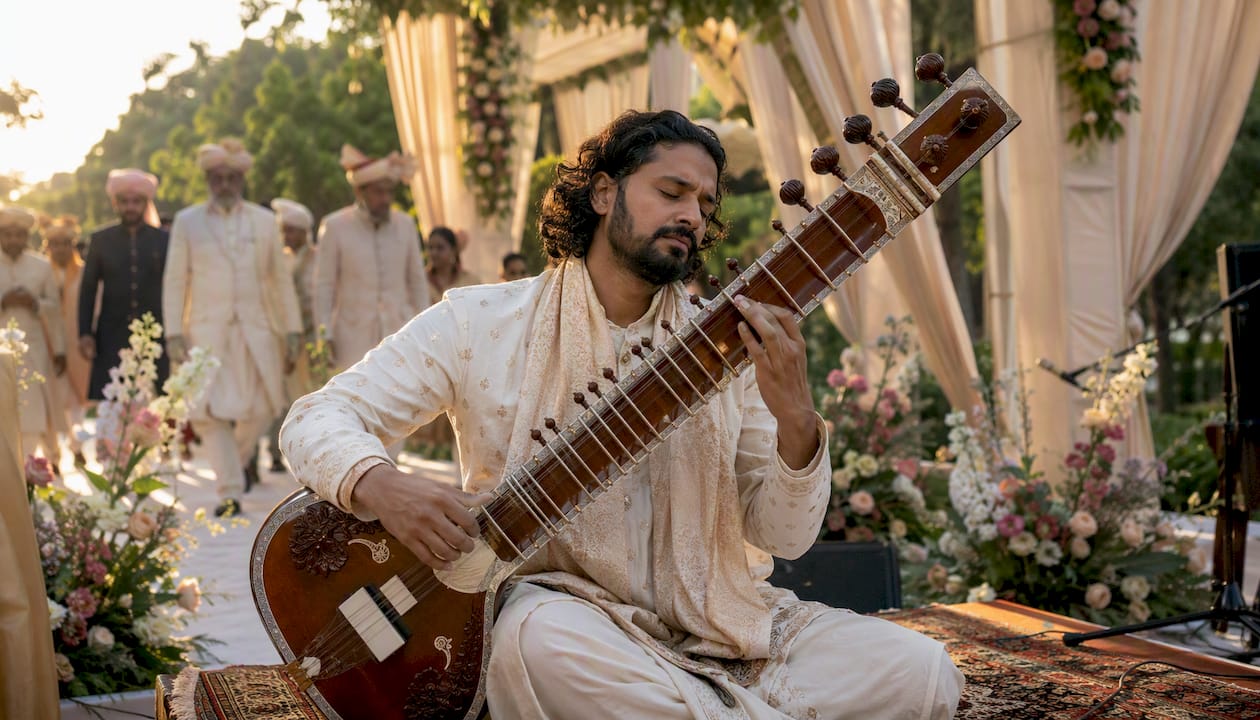
Use one steady, warm song for the wedding party and one slower, more dramatic song for the couple’s entrance. That split alone solves most of the guesswork. Here are three you can copy right now: Canon in D (Pachelbel) for a classical, unmistakable entrance; A Thousand Years in The Piano Guys instrumental arrangement for a modern, emotional build; or Can’t Help Falling in Love as a gentle instrumental for a relaxed, familiar feel.
- Match tempo to walking pace, not to the song’s original speed.
- Live musicians can slow down or stretch a phrase if your pace changes on the day.
- Recorded tracks are simpler to manage but can’t adjust once they start.
Pro Tip: Walk the aisle length at your natural pace and time it. Most processionals run 20 to 40 seconds per person or couple, so pick a song section that matches, not the whole track.
Key Takeaways
Matching processional music to your actual walking pace, not the original song length, is what makes a ceremony feel intentional instead of rushed.
| Point | Details |
|---|---|
| Use two distinct cues | Pick one steady song for the wedding party and one dramatic song for the couple’s entrance. |
| Follow timing benchmarks | Aim for 2 to 4 minutes for the wedding party and 2 to 3 minutes for the couple’s entrance. |
| Build in a buffer | Leave 3 to 5 seconds of silence between the wedding party and the couple’s cue. |
| Consider Indian options | Dhol suits arrivals, shehnai suits the bride’s entrance, and sitar bridges hybrid ceremonies. |
| Hire for flexibility | Sitarrajib’s live sitar arrangements adjust tempo in real time to match your actual pace. |
Table of Contents
- What Ceremony Processional Music Actually Covers
- How Many Songs You Need and How to Time Them
- Curated Song Picks for Every Processional Moment
- Indian Processional Music: Baraat, Shehnai, and Filmi Options
- Live Music or Recorded Tracks: What to Brief Your Musicians
- How to Choose Your Processional Songs Step by Step
- A Musician’s View: Why Sitar and Small Ensembles Work for Processionals
- Three Sample Processional Sequences You Can Copy
- What Actually Changes on the Wedding Day
- Book Live Sitar Music for Your Ceremony Processional
- Sources
What Ceremony Processional Music Actually Covers
The ceremony processional is the music that carries every entrance from the first guest being seated to the couple reaching the altar. It sets the emotional pace for the whole ceremony, so the shifts between songs matter as much as the songs themselves.
A typical ceremony breaks into six moments:
- Prelude: background music while guests are seated.
- Family seating: parents and grandparents walk in.
- Wedding party processional: bridesmaids, groomsmen, or the full party.
- Bride or couple entrance: the main event.
- Pause: a beat before the ceremony begins, sometimes held through the first kiss later.
- Recessional: the walk back out as a married couple.
Separate cues for each moment aren’t just tradition. They create a clear energy shift, building from calm to celebratory, so the couple’s entrance actually feels different from everything before it.
How Many Songs You Need and How to Time Them
Plan for several songs total to cover the prelude, family seating, wedding party, couple, and recessional moments of the ceremony. Some couples combine prelude and family seating into a single longer piece, which is fine as long as the transition to the wedding party feels distinct.
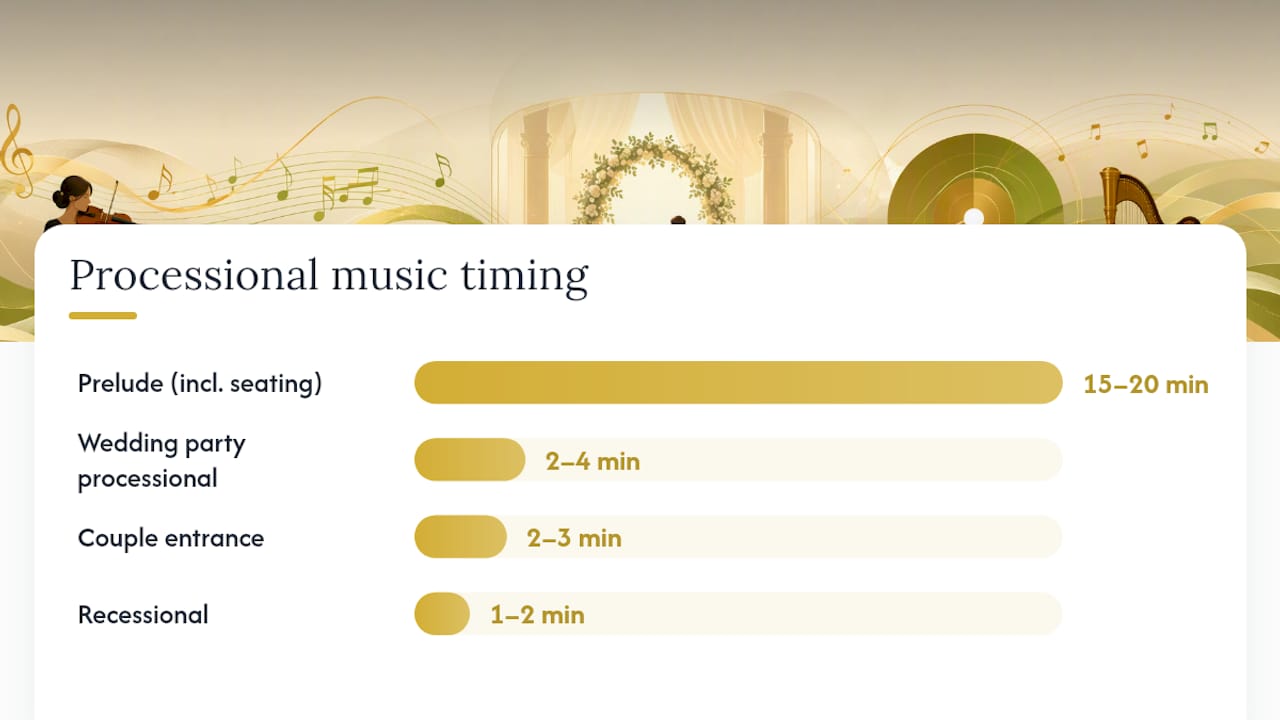
Professional planners generally recommend timing by walking pace rather than a fixed song length, and a wedding ceremony music guide drawn from more than 500 weddings backs that up with concrete minute ranges.
| Ceremony moment | Recommended length |
|---|---|
| Prelude | 15 to 20 minutes (background, loops or multiple tracks) |
| Wedding party processional | 2 to 4 minutes |
| Bride or couple entrance | 2 to 3 minutes |
| Recessional | 1 to 2 minutes |
Build in a 3 to 5 second silent buffer between the wedding party’s final entrance and the couple’s cue. That short gap gives guests time to turn, gives photographers a clean framing moment, and gives the couple’s song room to breathe instead of overlapping with applause or shuffling feet.
- Don’t pick a full 4 minute song and force the whole thing. Use the first minute or the chorus if that’s all the walk needs.
- Cue the recessional the instant the officiant says “you may kiss,” not after.
- If your aisle is short, favor tempo over track length when choosing the couple’s entrance song.
Pro Tip: Ask your musician or DJ to fade out rather than cut off. An abrupt stop breaks the mood right when guests are watching the couple settle in.
Curated Song Picks for Every Processional Moment
Classical and instrumental
- Canon in D (Pachelbel): the most recognized processional piece, works as solo piano, string quartet, or full ensemble.
- Air on the G String (Bach): slower and more intimate, strong for a smaller ceremony or an outdoor setting.
Instrumental covers of modern songs
- A Thousand Years (Christina Perri), instrumental version by The Piano Guys: the most requested modern processional cover, works beautifully as solo piano or piano and cello.
- Vitamin String Quartet arrangements of nearly any pop song: a safe pick if you want a familiar melody without lyrics competing for attention.
Modern songs that work as instrumentals
- Your Song (Elton John): light and warm, a good fit for a relaxed, garden-style ceremony.
- Turning Page (Sleeping at Last): written for a wedding scene, and its slow build fits a couple’s entrance almost perfectly.
- Can’t Help Falling in Love (Elvis): instrumental arrangements keep it timeless without the crooning feel of the original vocal.
Upbeat, bridal-party energy
For the wedding party walk, a slightly brighter tempo helps signal “the celebration is starting.” String quartet covers of upbeat pop songs or a lively baroque piece both work, as long as the tempo stays walkable.
Indian and Bollywood processional picks
- Din Shagna Da (Jasleen Royal): a widely used modern Bollywood processional song with an emotional, ceremonial feel.
- Instrumental filmi arrangements, adapted for sitar or a small ensemble, give a hybrid ceremony a distinctive sound without needing a full vocal track.
Pro Tip: Instrumental covers keep the focus on the moment itself instead of on lyrics guests might start singing along to. Save vocal tracks for the reception.
Indian Processional Music: Baraat, Shehnai, and Filmi Options
A baraat is the groom’s procession in North Indian and Punjabi weddings, and it’s built around a dhol drummer, brass instruments, and often a live band. According to Baraat planning guides, a baraat can run anywhere from 30 minutes to two hours depending on scale, though modern urban versions are frequently shortened and staged entirely within the venue.
Different moments call for different instrumentation:
- Dhol and brass: high energy, best for the groom’s arrival or baraat itself.
- Shehnai or sarangi: traditionally used for the bride’s entrance, with a mournful, ceremonial tone that suits a slower walk.
- Sitar or instrumental filmi arrangements: a good middle ground for a hybrid ceremony blending Indian and Western elements, and worth exploring further if you’re curious why Indian classical music suits ceremonies.
If any part of the procession happens on a public street, check with the venue or local authorities about permissions and amplification. Dhol groups and brass bands are loud by design, so confirm the space can handle that volume, and think through choreography if dancers are part of the arrival.
Live Music or Recorded Tracks: What to Brief Your Musicians
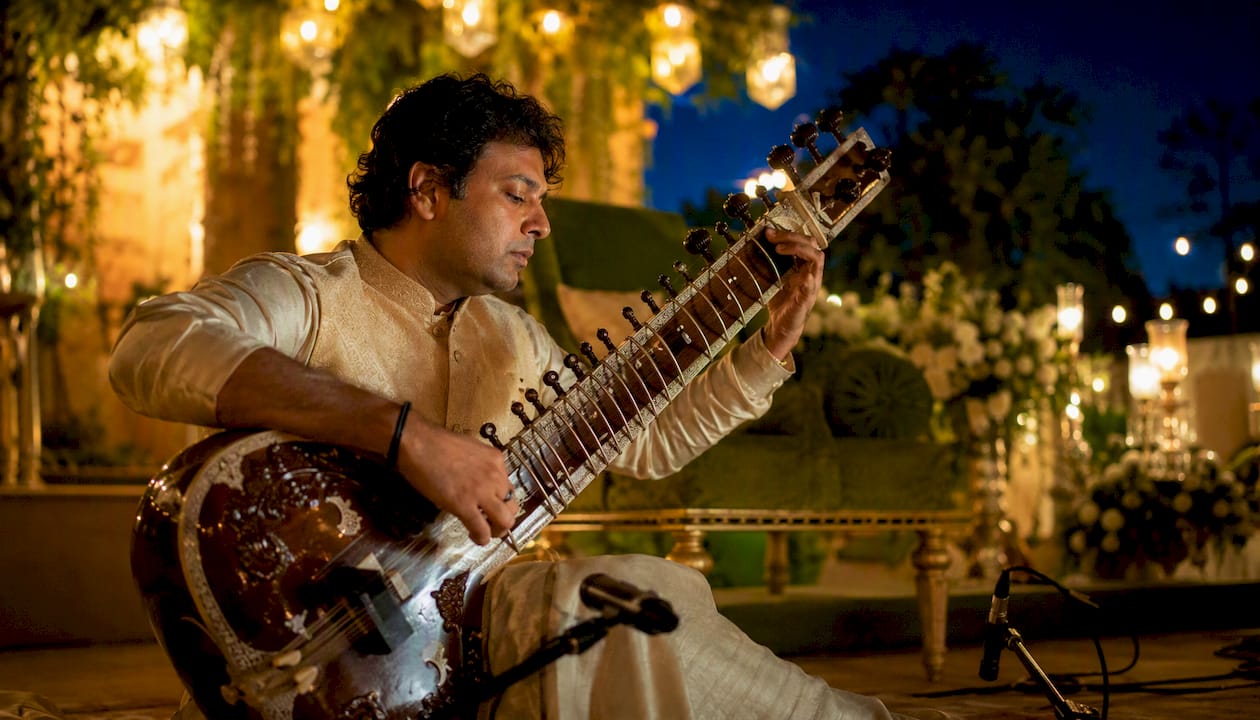
Live music gives you tempo flexibility. A musician can slow down mid-phrase if the aisle is longer than expected or if the couple pauses to greet someone, something recorded tracks simply cannot do once playback starts. Cap City Band’s guide to instrumental processional songs makes the same case: real-time dynamic and tempo adjustments are the single biggest advantage of hiring a live performer over pressing play.
Recorded tracks win on predictability and cost. There’s no soundcheck to schedule and no travel fee to budget for.
Whichever route you choose, brief your musician or DJ on:
- Exact tempo and any planned tempo changes mid-song.
- Where each cue starts and stops, including buffers between moments.
- Soundcheck timing and mic placement, especially outdoors.
- A backup plan (charged speaker, second device, or a musician who can vamp longer if needed).
- Licensing, if a recorded track will play for a large public gathering.
Ask about musician hourly rates versus a DJ’s flat fee, plus equipment rental and travel, before you commit to either path.
Pro Tip: Give musicians a written cue sheet, not just a verbal rundown. Verbal instructions get forgotten under wedding-day pressure; a printed sheet doesn’t.
How to Choose Your Processional Songs Step by Step
- List every ceremony moment you need music for (prelude, family, wedding party, entrance, recessional).
- Assign a mood to each moment: calm, celebratory, dramatic, joyful.
- Shortlist two or three song options per moment before committing to one.
- Walk the aisle at your real pace while playing each shortlisted song to test the fit.
- Confirm audio equipment, backup power, and a contingency plan with your musician or DJ.
Before booking anyone, ask these questions directly:
- Can you adjust tempo live if our pace changes?
- Will you play an instrumental arrangement of this specific song?
- Have you performed at this venue, and do you know its acoustics?
Walk away if a vendor won’t commit to a soundcheck, refuses to provide a written cue plan, or pushes back on learning a song you’ve specifically requested. Those are the moments that go wrong on the actual day.
A Musician’s View: Why Sitar and Small Ensembles Work for Processionals
Translating a vocal melody onto sitar means finding phrasing that breathes the way the original singer did, then slowing it to match a walking couple rather than a recording artist’s timing. A sitar and tabla duo suits an intimate ceremony; shehnai and harmonium carry more volume for a larger outdoor space; a string quartet sits comfortably between the two.
- Sitar and tabla: best for smaller, quieter ceremonies.
- Shehnai and harmonium: better for larger or outdoor venues.
- String quartet: versatile middle ground for Western-style ceremonies.
Pro Tip: Rehearse a full-speed walk-through with musicians before the wedding day, including one timed 3 to 5 second pause between the wedding party and the couple’s entrance. That pause is where photographers get their best shot.
Three Sample Processional Sequences You Can Copy
Classic formal: Air on the G String (prelude) → Canon in D, faster section (wedding party) → Canon in D, slower opening (couple entrance) → Wedding March (recessional).
Modern instrumental: Vitamin String Quartet cover of a favorite pop song (wedding party) → The Piano Guys’ A Thousand Years (couple entrance) → an upbeat string quartet cover (recessional).
Hybrid Indian and Western: dhol arrival music (baraat or guest arrival) → sitar-adapted Din Shagna Da (couple entrance) → an upbeat filmi instrumental (recessional).
What Actually Changes on the Wedding Day
In rehearsal, the walk always looks faster than it feels once real nerves and a full aisle of guests are involved. The single most common adjustment on the day is stretching the couple’s entrance song by 15 to 20 seconds because the actual pace runs slower than the practice run.
Pro Tip: Agree on a silent hand signal with your musician ahead of time, something as simple as a raised hand meaning “hold here.” It lets them extend a phrase without anyone in the room noticing the cue.
Book Live Sitar Music for Your Ceremony Processional
Sitarrajib offers what a printed track never can: a live sitar arrangement that bends to your actual walking pace instead of forcing you to match a recording. Rajib Karmakar performs adapted versions of classical, modern, and Bollywood processional pieces, arranged specifically for solo sitar or a small ensemble with tabla, so the sound stays intimate without losing presence.
Booking is straightforward. Share your ceremony timeline, your preferred songs or moods for each moment, your venue’s acoustics (indoor, outdoor, amplified or not), and a contact for sound logistics. From there, arrangements get built around your actual aisle length and pace rather than a generic tempo. Explore how Indian classical music suits ceremonies and reach out with your date and venue details to check availability.
Sources
- Wedding Ceremony Music Guide — Prelude, Processional, Recessional (2026)
- Instrumental Wedding Processional Songs — The Knot
- Instrumental wedding songs — Brides
- Baraat: The Indian Wedding Procession (2026 Planning Guide)
- 10 Unforgettable Instrumental Processional Songs — Cap City Band