
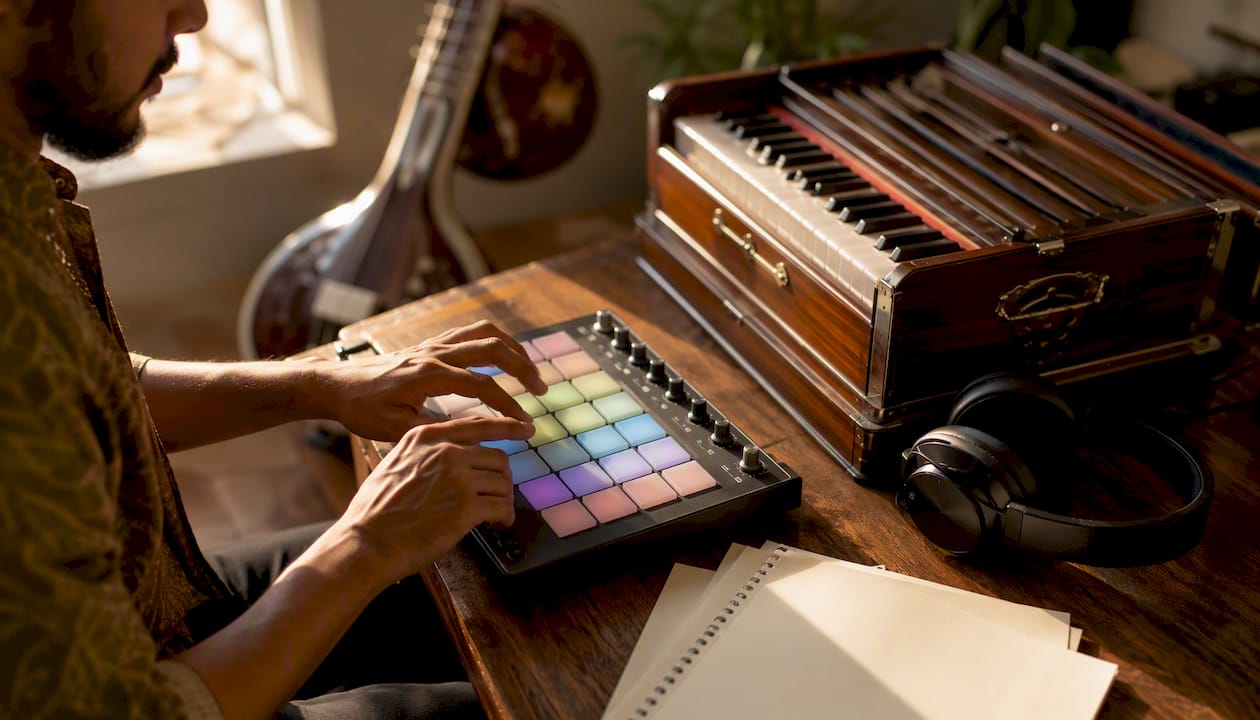
To compose music for dance, map choreography counts to musical phrase lengths first, then build rhythm, harmony, and arrangement around that map. Everything else follows from that single decision.
Here is your quick-start checklist:
- Identify the dance form and confirm which counts the choreographer uses (8-count, 6-count, or phrase-based).
- Pick a BPM that fits the style and feels natural at full movement speed.
- Sketch 8-bar phrases and mark where key choreographic events land.
- Run a click-track test with dancers before committing to a final arrangement.
Pro Tip: Before you write a single note, ask the choreographer to walk you through the piece in counts. Thirty minutes of that conversation saves hours of revision later.
Because music and dance are both created through time, composers who understand how the body moves produce more synchronized, effective results. Start there.
Key Takeaways
Composing music for dance works best when you map choreography counts to phrase lengths first, then build every other musical decision around that structure.
| Point | Details |
|---|---|
| Map counts before writing notes | Confirm the choreographer’s counting system (8-count, 6-count, or phrase-based) before sketching any music. |
| Use 8-bar phrases and 32-bar forms | Structure your score in 8-bar units and 32-bar AABA sections so dancers find clear musical landmarks. |
| Humanize your MIDI and stems | Manually shape velocity and timing in your DAW; deliver labeled stems (kick, bass, pads, leads) for rehearsal flexibility. |
| Test with a click track and live run | Record every rehearsal run, note which bars felt off, and triage structural edits before cosmetic ones. |
| Sitarrajib for live sitar and custom scores | Rajib Karmakar offers spotting sessions, custom composition, and labeled stem delivery for dance productions. |
Table of Contents
- How do you compose music for dance from scratch?
- Why do phrase lengths matter so much in dance scoring?
- How do you build a groove that dancers can actually feel?
- What chord choices and melodic hooks work best for dance?
- How should you arrange and deliver stems for a dance production?
- How do you work with choreographers from first meeting to final delivery?
- How do you test your music with dancers before the final version?
- An annotated 32-bar example you can adapt right now
- How do sitar and Indian classical textures work in dance scoring?
- What experienced composers learn about writing for dancers
- Sitarrajib: commission a scored dance project or sitar textures
- Sources
How do you compose music for dance from scratch?
The first decision is not which notes to write. It is which dance form you are scoring and what counting system the choreographer uses. Get that wrong and even a well-crafted piece will fight the movement.
Identify the dance form and its counting logic
Different forms use different count structures. Ballet and contemporary work often use 8-count phrases grouped into 32-bar sections. Ballroom styles like waltz run in 3/4 time with moderate tempo, while quickstep is a fast 4/4 style. House and club forms typically sit in the 120–130 BPM range with a four-on-the-floor pulse. Folk and social dance forms generally use 32-bar tunes built from repeated 8-bar units. Each of these shapes how you write.
Confirm the following in your first spotting session with the choreographer:
- Are they counting in 8s, 6s, or phrase-based groups?
- Do any sections use irregular counts (5, 7, or mixed)?
- Are there specific gestures or lifts that need a musical accent on a precise beat?
- Is the piece performed to live music, playback, or both?
BPM ranges by dance style
Tempo is not just feel. It determines whether a dancer can physically execute the movement. Here are practical starting ranges:
- Ballet (adagio): 40–60 BPM
- Ballet (allegro): 120–160 BPM
- Contemporary/modern: 60–120 BPM, often flexible
- Waltz: 84–90 BPM in 3/4
- Quickstep: 196–208 BPM in 4/4
- House/club dance: 120–130 BPM
- Folk/social dance: 100–120 BPM
Pro Tip: Record a video of the choreographer marking through the piece at full speed, then tap the BPM against that footage before you commit to a tempo. Your ear alone will often land 5–10 BPM off.
Writing for dance requires a strong rhythmic sense that includes harmonic movement and extended phrase lengths, not just a literal pulse. Dancers use harmonic shifts and melodic landmarks as much as they use the beat.
Why do phrase lengths matter so much in dance scoring?
Phrase structure is where most timing problems start. Dancers count in 8s because 8 counts map cleanly to a musical bar in 4/4 time at two beats per count, or to two bars at one count per beat. Either way, the 8-count phrase is the basic unit.
The 32-bar structure and how it maps to movement
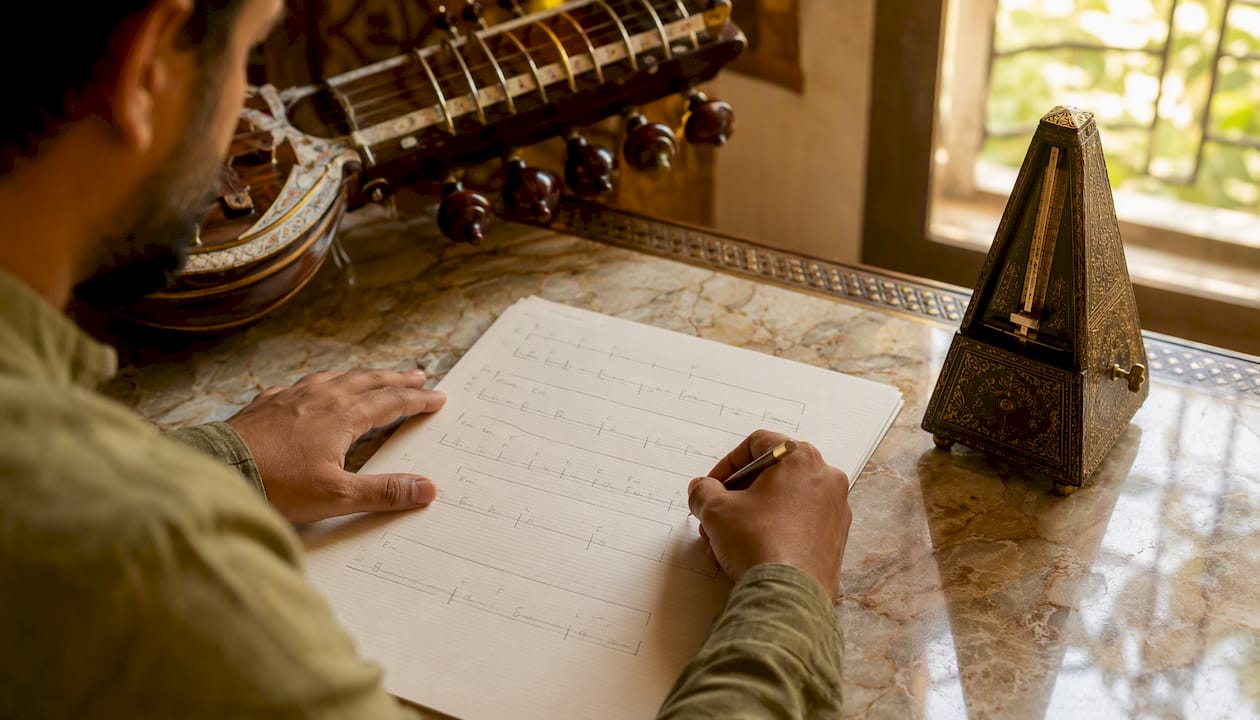
Folk and traditional dance tunes commonly use a 32-bar structure built from repeated 8-bar A and 8-bar B units, a form that maps cleanly to step-counted choreography. The same logic applies across ballet, contemporary, and social dance. A standard 32-bar AABA structure looks like this:
| Section | Bars | Typical choreographic event |
|---|---|---|
| A (first) | 1–8 | Opening phrase, establish motif |
| A (repeat) | 9–16 | Repeat with variation, add layer |
| B (bridge) | 17–24 | Contrast, lift, or turn sequence |
| A (return) | 25 | Resolution, closing phrase |
This structure gives dancers four clear landmarks. The B section is where choreographers often place the most demanding movement, so your music should peak in energy or harmonic tension there.
A spotting-map template you can reuse
A spotting map is a simple grid that aligns musical events with choreographic events. Use this structure for any piece:
- Column 1: Bar number
- Column 2: Beat number within the bar
- Column 3: Musical event (chord change, accent, silence, motif entry)
- Column 4: Choreographic event (entrance, lift, turn, exit, freeze)
- Column 5: Notes (confirmed with choreographer, or still to check)
Fill this in during your spotting session and update it after every rehearsal run. It becomes your single source of truth for the score.
For context on how traditional music integrates into event programming, the 32-bar structure has been a reliable framework across folk, social, and ceremonial dance for generations.
How do you build a groove that dancers can actually feel?
A groove that works for dancers is not just a steady beat. It is a pulse with enough internal detail that the body can lock onto it without consciously counting. That means your subdivision choices matter as much as your tempo.
Subdivision, syncopation, and percussion layering
Start with the subdivision that fits the style. Eighth-note subdivisions work for most ballroom and folk forms. Sixteenth-note subdivisions add drive and are standard in house, funk, and contemporary. Triplet subdivisions give a swing or shuffle feel and work well in jazz-influenced or African-derived forms.
Syncopation is useful, but use it deliberately. A syncopated accent on the “and” of beat 2 can cue a specific arm movement. A syncopated bass hit on the “and” of beat 4 can signal a direction change. When syncopation is random or decorative, dancers lose their footing.
Percussion layering builds the groove from the floor up:
- Start with the kick drum or bass pulse (the floor).
- Add a snare or clap on beats 2 and 4.
- Layer hi-hats or shakers for subdivision detail.
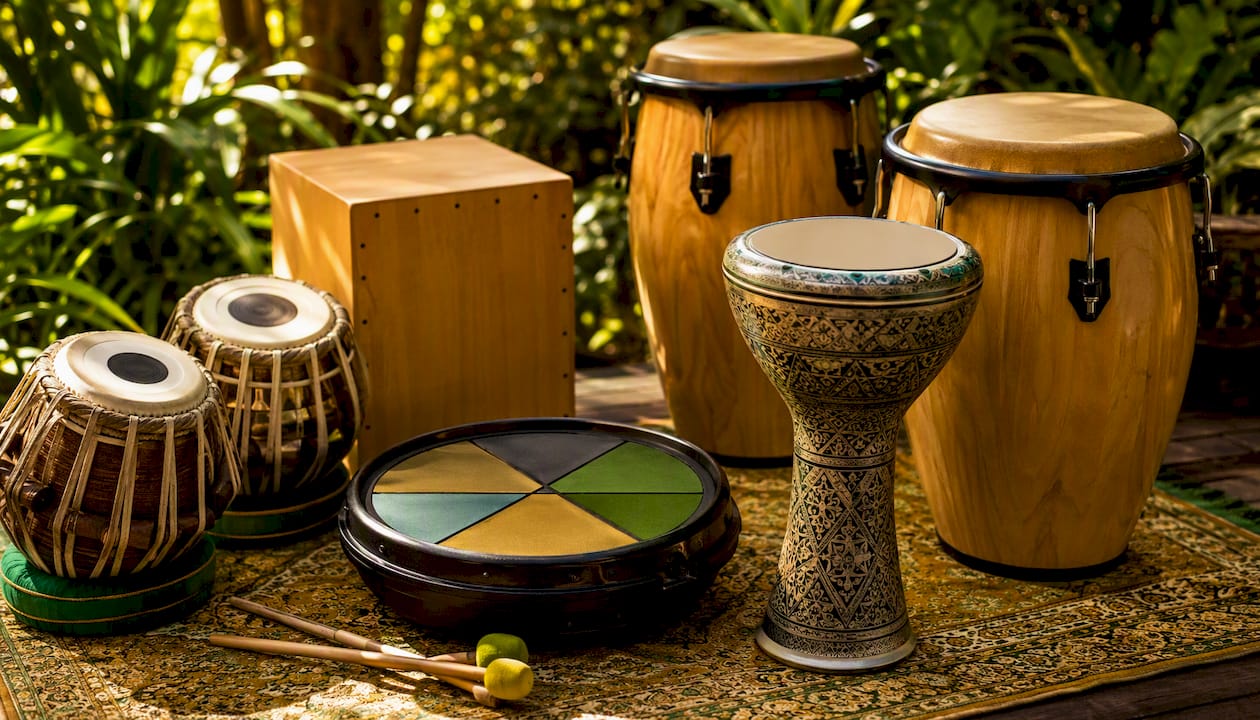
- Add secondary percussion (congas, tabla, frame drum) for texture and fill.
- Reserve cymbal crashes and accents for choreographic hit points.
Contemporary dance and club tracks often center on a four-on-the-floor kick, off-beat hi-hat, and looped 2–4 bar harmonic patterns, with arrangement built around a strong 8-bar loop in a build, drop, and break form.
Avoiding soulless MIDI
Producers and composers should avoid over-reliance on automated MIDI. Manually shaping rhythms and arpeggios using eighths, 16ths, and triplets keeps the music alive and maintains movement interest. Canned loops have a mechanical evenness that dancers often describe as “flat.” The fix is simple: draw in your MIDI notes by hand, vary the velocity across each hit, and nudge individual notes slightly off the grid where the style calls for it.
Pro Tip: In your DAW, zoom into the piano roll and manually adjust the velocity of every kick, snare, and hi-hat hit. Even a 10-point velocity difference between the downbeat kick and the off-beat hi-hat makes the groove feel human.
What chord choices and melodic hooks work best for dance?
Harmony in dance music serves a different function than in a concert piece. Dancers use chord changes as landmarks, not as emotional narrative. Keep the harmonic rhythm predictable and the chord vocabulary clear.
Chord palettes and harmonic rhythm
Simple triads and seventh chords work reliably under movement. Major and minor triads give clear tonal centers. Major 7 and minor 7 chords add warmth without harmonic ambiguity. Suspended chords (sus2, sus4) create tension that resolves naturally into a phrase boundary, which is useful for cueing a turn or a jump.
Set your harmonic rhythm to match phrase structure. A chord every two bars works well for slow, sustained movement. A chord every four bars suits long adagio phrases. Faster harmonic rhythm (one chord per bar) works for energetic sections but can feel choppy if overdone.
Key insight: Harmonic movement is part of rhythm in dance scoring. A chord change on bar 5 of an 8-bar phrase tells the dancer “halfway point” as clearly as a snare hit. Use that signal deliberately, and resist changing chords mid-phrase unless the choreography specifically calls for it.
Melodic motif design
A motif is a short, repeatable melodic idea, typically 2–4 bars. In dance scoring, motifs work as leitmotifs that attach to specific characters, movements, or sections of the choreography. Keep the motif simple enough to recognize on first hearing and varied enough to stay interesting across repeats.
Practical motif strategies:
- Call and response: State the motif in bars 1–2, answer it in bars 3–4. This gives dancers a two-bar preparation and a two-bar execution window.
- Motif transformation: Transpose the motif up a third in the B section to signal contrast without losing the listener.
- Rhythmic augmentation: Double the note values in the final A section to create a sense of resolution and weight.
How should you arrange and deliver stems for a dance production?
Arrangement for dance is about giving the choreographer options and giving the sound system enough clarity to fill a performance space. Both goals require thinking in stems from the start.
Stems delivery checklist
Deliver your final mix as separate stems so the choreographer and sound designer can adjust levels in rehearsal without asking you for a new mix:
- Kick drum (mono, dry)
- Full percussion bus (stereo)
- Bass (mono or stereo, depending on the arrangement)
- Pads and sustained harmony
- Lead melody or motif
- Vocals or featured instrument
- FX and transitions (reverb tails, risers, sweeps)
- Full mix (stereo master)
Label every file with bar numbers and BPM in the filename. A file named “Track_120BPM_Kick_Bars1-64.wav” saves everyone time.
Dynamics, sidechain, and EQ for dance spaces
Dynamics in dance music are not about quiet and loud in the concert sense. They are about energy management across the arc of the piece. Keep your loudest moments for the choreographic climax, and use gradual builds rather than sudden drops.
Sidechain compression between the kick and the bass keeps the low end clean on a large PA system. Set the attack fast (1–5 ms) and the release to match the kick’s decay. This prevents bass buildup that muddies the floor energy.
For EQ, cut the bass below 40 Hz to reduce room rumble, and give the kick a presence boost around 2–4 kHz so it cuts through in a reverberant space. Pad the mids slightly (around 300–500 Hz) to keep the mix from sounding boxy in a large studio or theater.
Pro Tip: Mix your track on small speakers or earbuds at least once before finalizing. Dance spaces often have poor acoustics, and a mix that sounds great on studio monitors can fall apart on a venue PA. If the groove holds on earbuds, it will hold anywhere.
For practical guidance on planning a music experience that translates well from studio to stage, the same principles of clarity and energy management apply.
How do you work with choreographers from first meeting to final delivery?
A clear process protects both the composer and the choreographer. Set expectations early, document everything, and build revision rounds into the timeline before you start writing.
Suggested project timeline
| Milestone | Timing | Deliverable |
|---|---|---|
| Initial spotting session | Week 1 | Spotting map, confirmed BPM, count system |
| First sketches | Week 2–3 | 2–3 rough demos (MIDI or rough recording) |
| Choreographer feedback | Week 3–4 | Annotated spotting map with revisions |
| Draft score/track | Week 4–5 | Full draft, stems for rehearsal |
| Rehearsal edits | Week 5–7 | Revised stems after live run-throughs |
| Final delivery | Week 8 | Final stems, full mix, cue sheet |
What to include in a simple contract or SOW
A statement of work for a dance composition project should cover:
- Number of pieces and total duration
- Number of included revision rounds (two is standard)
- Whether rehearsal attendance is included and how many sessions
- Deliverable formats (WAV stems, PDF score, MIDI files)
- Performance rights: who holds the sync license, and whether the composer retains publishing
- Licensing basics: is the piece for a single production run, or does the choreographer want perpetual rights?
For licensing specifics when the score involves Indian classical elements, licensing Indian classical music for film and performance follows similar principles and is worth reviewing before you sign.
Providing early sketches for choreographers is standard practice. Dancers often interpret music differently than musicians, so early alignment on counts prevents most timing friction.
Pro Tip: Send a rough 8-bar loop before you write the full piece. If the choreographer can mark through it comfortably, you have the right feel. If they hesitate, fix the tempo or groove before investing more time.
How do you test your music with dancers before the final version?
Testing is where you find out what the score actually does in a room with moving bodies. No amount of studio listening replaces a live run-through.
Click tracks and tempo maps
A click track gives dancers and musicians a shared time reference. Export your DAW’s click at the project BPM and send it to the rehearsal director before the first run. If the piece has tempo changes, export a tempo map as well so the conductor or playback operator can follow it.
For pieces with ritardando or accelerando sections, use your DAW’s tempo automation to write the change gradually rather than as a sudden jump. A gradual tempo shift of 4–6 BPM over 4 bars is nearly invisible to dancers but sounds intentional rather than accidental.
Run-through protocols
During a rehearsal run, record the session on a simple audio recorder or phone. After the run, note:
- Which bars felt rushed or dragged (ask the choreographer, not just your own ear)
- Where dancers lost the count or hesitated
- Which accents landed correctly and which were missed
- Any sections where the music felt too dense or too sparse
Triage your changes into two categories: structural edits (shaving or adding bars) and cosmetic edits (adjusting an accent, changing an instrument level). Do structural edits first, then cosmetic.
Composers can use musical “sleight of hand” to absorb rehearsal timing shifts. Overlapping motifs and subtle cues make beat changes feel natural in performance, so a one-bar extension or cut does not sound like a mistake.
Pro Tip: When a dancer consistently arrives at a cue one beat early, the problem is usually in the bar before the cue, not the cue itself. Look at what the music is doing in bars 6–7 of the phrase, not bar 8.
An annotated 32-bar example you can adapt right now
Here is a practical lead-sheet example in AABA form at 110 BPM in 4/4, suitable for contemporary or folk-influenced choreography. Use it as a template and adapt the chords, motif, and BPM to your style.
The A phrase (bars 1–8)
Chord progression: Dm | Dm | F | F | C | C | Am | Am
Motif: A four-note ascending figure (D–E–F–A) on beats 1–2 of bar 1, answered by a descending figure (A–G–F–E) on beats 1–2 of bar 3.
Spotting annotations:
- Bar 1, beat 1: Entrance cue. Dancer steps on the downbeat.
- Bar 4, beat 3: Arm extension. The F chord sustain supports a held position.
- Bar 7, beat 1: Preparation for turn. The Am chord signals the phrase is closing.
- Bar 8, beat 4: Pickup into the repeat. A single pickup note © leads into bar 9.
The B section (bars 17–24)
Chord progression: Bb | Bb | Gm | Gm | F | F | C | C (with a sus4 on the final C)
Motif transformation: The original four-note motif is transposed up a minor third (F–G–Ab–C), giving the B section a contrasting color without losing the melodic connection.
Spotting annotations:
- Bar 17, beat 1: Lift or jump cue. The Bb chord provides a clear harmonic contrast from the A section.
- Bar 20, beat 1: Peak of the phrase. The Gm chord sustains under the highest point of the movement.
- Bar 23–24: Csus4 resolving to C. This two-bar resolution cues the return to the A section and gives dancers time to land and reset.
Adapting this example
- For ballet: slow the BPM to 72, extend the A phrase to 16 bars, and use maj7 chords (Dmaj7, Fmaj7) for a more sustained, lyrical feel.
- For house/club dance: raise the BPM to 124, replace the chord progression with a two-bar loop (Dm–F), and add a four-on-the-floor kick under the full structure.
- For folk or social dance: keep the 110 BPM, add a fiddle or sitar melody on top of the chord progression, and repeat the full 32-bar structure twice before introducing a variation.
Pro Tip: Print the spotting map and tape it to your monitor during the session. When a dancer flags a timing issue, you can mark the exact bar and beat in real time rather than trying to reconstruct it from memory afterward.
The 32-bar AABA structure used in this example is the same framework that folk and traditional dance tunes have relied on for generations, precisely because it maps so cleanly to step-counted choreography.
How do sitar and Indian classical textures work in dance scoring?
Integrating sitar and raga-based textures into a dance score is practical and effective when done with care. The key is choosing scales and rhythmic frameworks that give dancers clear pitch centers and reliable pulse cues.
Scale selection and drone placement
Ragas provide rich melodic material, but not every raga suits a dance context. For dance scoring, choose ragas with clear, stable pitch centers and avoid sustained microtonal ornaments (meend and gamak) in loud or reverberant spaces without close monitoring. Raga Yaman (a Lydian-flavored scale) and Raga Bhairavi (a Phrygian-flavored scale) both translate well because their characteristic intervals are easy for Western-trained dancers to internalize as harmonic landmarks.
A drone (tanpura or synthesized drone) placed under the full mix gives the sitar a tonal anchor and helps dancers orient to the pitch center. Keep the drone low in the mix during active movement sections and bring it forward in slower, sustained passages.
Recording and mixing sitar for dance stems
For live session sitar recording, a large-diaphragm condenser microphone placed 12–18 inches from the main resonator captures the full harmonic range of the instrument. Add a second microphone near the gourd for the lower sympathetic string resonance. Deliver the sitar as a separate stem so the choreographer can adjust its level in rehearsal without touching the rhythm section.
When using sitar samples rather than live recording, layer two or three velocity layers and add subtle pitch variation between notes to avoid the mechanical repetition that makes sampled strings sound artificial. Indian classical music suits ceremonial and performance contexts precisely because the live instrument carries a presence that samples approximate but rarely match.
Hiring checklist for a live sitar session
- Confirm the raga or scale framework with the composer before the session.
- Provide a rough mix with click track at least one week before recording.
- Agree on the number of takes and whether improvised variations are included.
- Clarify stem delivery format and whether the sitarist retains any publishing rights.
- For festival or live performance contexts, review how sitar fits festival programming to understand stage logistics and monitoring needs.
Pro Tip: When integrating sitar into a contemporary dance score, start with the sitar as a textural element in the B section only. This gives the instrument a clear dramatic role without requiring dancers to orient to an unfamiliar timbre throughout the entire piece.
For guidance on cultural fusion in event programming, the same principle applies: introduce the unfamiliar element at a moment of contrast, not at the opening, so the audience and dancers have a reference point first.
What experienced composers learn about writing for dancers
Most timing problems in dance scores are not tempo problems. They are phrase-length problems. A piece can be at exactly the right BPM and still feel wrong if the phrase boundaries do not land where the choreographer expects them. The fix is almost always structural: add or remove two bars, not adjust the tempo.
Over-composition is the other common trap. When a score fills every moment with melodic and harmonic activity, dancers have no room to breathe or to let the movement speak. Resist filling every moment. Dancers need temporal and physical space. A bar of sustained harmony or a single percussion hit can carry more choreographic weight than a fully orchestrated passage.
The third lesson is about live versus recorded performance. A locked playback track is precise but inflexible. A live musician can follow a dancer who is slightly off tempo, compress a phrase by a beat, or extend a held note. When the production allows for live music, that flexibility is worth the added coordination. When it does not, build your playback track with enough internal space that small timing variations do not become visible errors.
Sitarrajib: commission a scored dance project or sitar textures
Sitarrajib offers a direct path from concept to finished score for dance productions that need something more than a stock track. Rajib Karmakar brings together live sitar performance, custom composition, studio recording sessions, and workshops, all tailored to the specific counts, style, and staging of your production.
A typical engagement starts with a spotting session, moves through sketch delivery and rehearsal edits, and ends with fully labeled stems ready for playback or live performance. Whether you need a full dance score, a sitar texture layer for an existing track, or a workshop on composing for movement, the process is clear and the deliverables are specific. To get started, visit the live session sitar recording page and send a brief creative brief: your dance form, BPM range, total duration, and any spotting notes you already have.
Sources
- Tunes — Colin Hume
- Composing a Ballet | Brian Elias
- Music Composition And Dance: A Synchronised Creative Process — Diagonal Dance
- How to Make House Music — MusicProductionWiki