
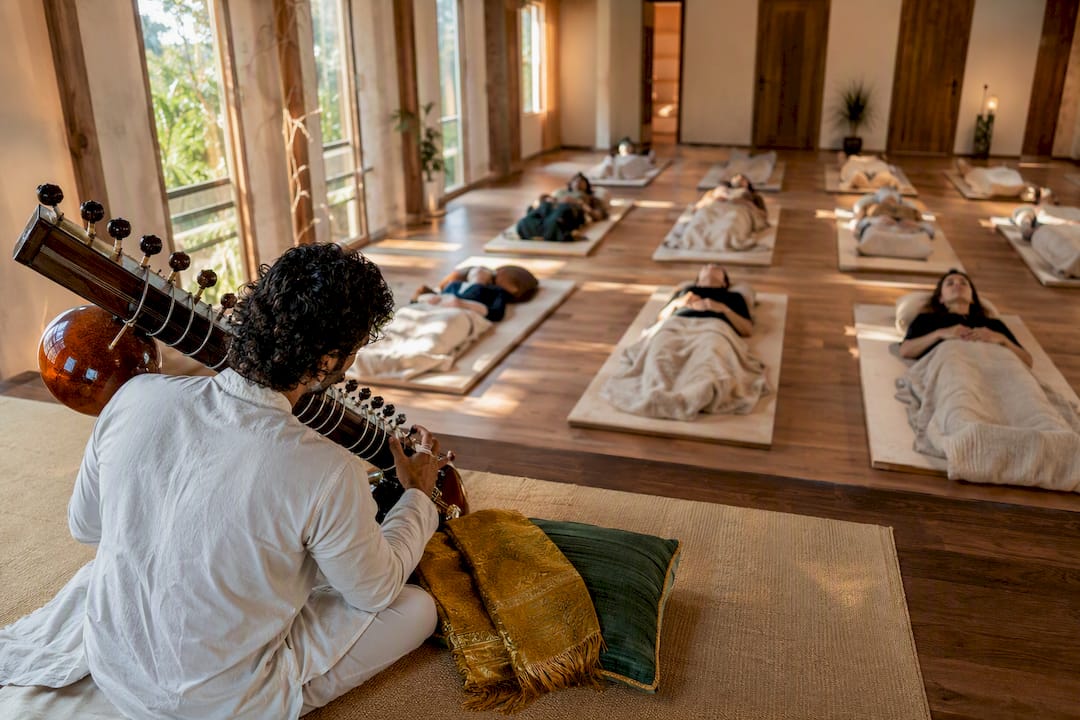
A sitar sound bath is an immersive listening session that uses the sitar’s resonant drone and sliding notes to guide the body into a slower, calmer state, making it ideal to combine with repeatable relaxing bath ideas for a full at-home ritual. It suits anyone dealing with stress, restlessness, or a busy mind who wants a passive, low-effort way to unwind. Start with a recording tonight, then look for a live session near you.
TL;DR:
- Sitar sound baths utilize drone and slow melodic movement to promote relaxation, with session structures emphasizing grounding, exploration, and sound wash phases.
- Common instrument layers like crystal bowls, chimes, and shruti boxes are added to broaden sonic textures and deepen meditative effects.
- Timing of ragas according to the time of day influences the emotional tone, with evening ragas suited for easing into stillness and night ragas fostering introspection.
- Live sessions provide immersive resonance and shared energy, while recordings offer flexibility and repeated access, with high-quality playback crucial for low-frequency richness.
- The facilitator’s intent, pacing, and raga choice matter more than instrument complexity or recordings, emphasizing that meaningful structure drives relaxation outcomes.
Table of Contents
- What Makes a Sitar Sound Bath Different From a Concert?
- What Happens During a Typical Session?
- Which Instruments Join the Sitar in a Sound Bath?
- How Do Ragas and Time of Day Shape the Music?
- Should You Attend Live or Listen to a Recording?
- Does the Research Actually Support These Benefits?
- How Do You Get the Most Out of a Sitar Sound Bath?
- What Does a Practitioner’s Perspective Add to This?
- What Most Guides Get Wrong About Sitar Sound Baths
- If You Want a Guided Sitar Sound Bath, Here’s How SITARRAJIB Can Help
- Sources
- FAQ
What Makes a Sitar Sound Bath Different From a Concert?
A sitar sound bath isn’t a performance you watch. It’s a session designed for you to feel, with the sitar acting as the main instrument of relaxation rather than the centerpiece of a show. The music leans on drone, sustain, and slow melodic movement instead of the fast, technical passages you’d hear at a classical recital.
You’ll find three common formats:
- Meditative recital — a solo or small-group sitar performance played specifically for stillness, with minimal audience interaction
- Sound-therapy session — sitar combined with other healing instruments, often guided by breathwork or brief instruction
- Hybrid multimedia experience — sitar paired with visuals, lighting, or recorded nature sounds for a fuller sensory environment
Sessions typically run for a duration suitable to immersive sound experiences and work equally well for a single listener at home or a room full of participants lying on mats. Some practitioners frame the experience around sitar’s role in supporting meditation practice, treating it as a tool rather than a performance to applaud.
What Happens During a Typical Session?
A well-run session moves through distinct phases, each with its own purpose. Most facilitators follow a version of this sequence:
- Grounding (5–10 minutes) — settling into position, slow breathing, sometimes a short chant to quiet the mind before any music starts
- Alaap and exploration (15–30 minutes) — the sitarist opens with the unmetered, drone-supported alaap section of a raga, building slowly without percussion
- Development and layering (15–30 minutes) — the melody develops rhythm and intensity, sometimes joined by additional instruments or looped textures
- Sound wash and closing (10–15 minutes) — the music softens into sustained tones or silence, giving the body time to settle before the session ends
- Integration (5 minutes) — a quiet pause or brief guided reflection before participants move or speak again
This structure differs from a concert on purpose. Experienced performers often note that breathwork, chanting, and backing loops are added specifically to keep listeners in an immersive, therapeutic state rather than an attentive, evaluative one. Event listings for sitar-based mental health sessions frequently describe a similar arc: breathwork prelude, classical exploration, then integrated sound wash.
Which Instruments Join the Sitar in a Sound Bath?
The sitar rarely works alone in a sound-bath setting. Practitioners commonly layer in a small set of complementary instruments to widen the sonic texture and hold attention without adding tension.
- Crystal singing bowls — sustained overtones that fill the space between sitar phrases
- Koshi chimes — light, breath-like accents used during transitions
- Shruti box — a hand-pumped drone instrument that reinforces the tonal center under the sitar
- Monochord — a low, continuous hum that anchors the body’s sense of stillness
- Flute or voice — occasional melodic or textural color, used sparingly
Some sessions use live layering, where the sitarist and accompanying musicians build the soundscape in real time, while others rely on pre-recorded backing tracks for consistency. Practitioners who blend sitar with crystal bowls, chimes, and shruti box describe this mixed approach as key to making sessions feel immersive rather than static. Instrument choice matters too. A deeper, resonant instrument like a surbahar reaches lower registers than a standard sitar, which some facilitators use specifically to deepen the meditative effect.
Pro Tip: If you’re comparing recordings, listen for how much low-end resonance the mix carries. A thin, tinny recording won’t deliver the same body sensation as one with a fuller low frequency range.
How Do Ragas and Time of Day Shape the Music?
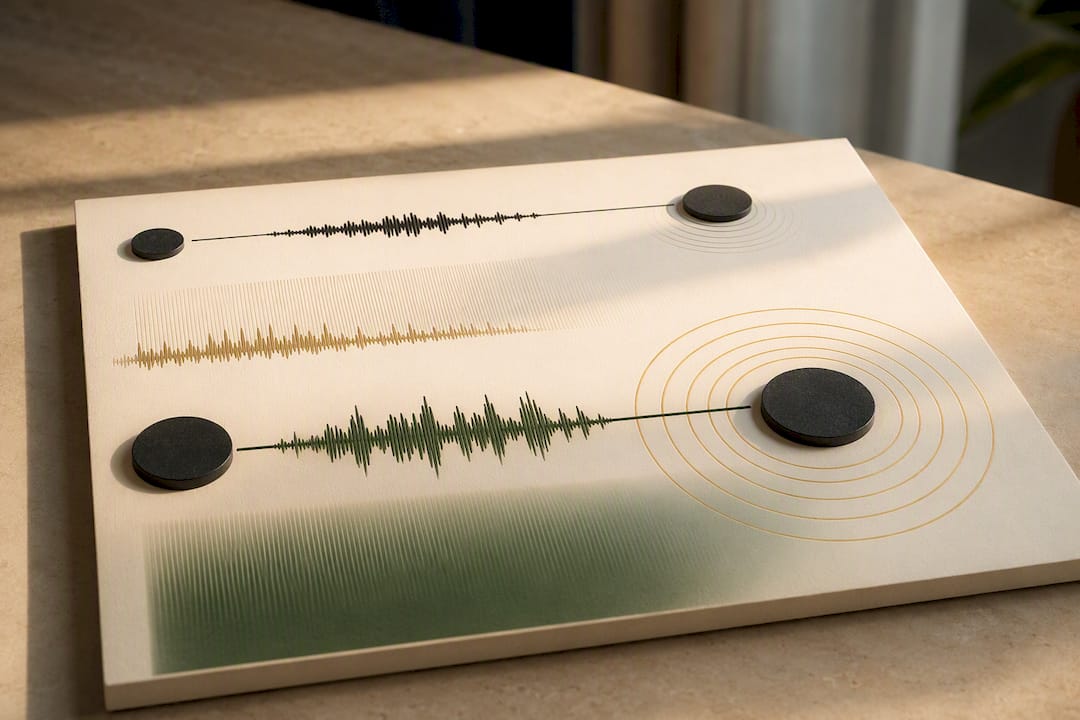
Hindustani classical tradition assigns certain ragas to specific times of day, based on the emotional and physiological qualities each raga is believed to evoke. A facilitator planning an evening session will lean on different melodic material than one planning a late-night or early-morning sitting.
- Evening sessions typically favor lighter, more approachable ragas that ease listeners from an active day into stillness
- Night sessions often draw on deeper, more contemplative ragas meant to support introspection and rest
- Grounding or midday sessions may use steadier, less dramatic ragas that avoid emotional peaks
Facilitators working with mixed or beginner audiences tend to choose accessible entry points rather than the most complex or obscure ragas in the tradition, since early-evening raga choices are generally easier for newcomers to settle into. If you want to go deeper on how these compositions are structured, it helps to understand the different forms raga-based music can take.
Should You Attend Live or Listen to a Recording?
Both formats work, but they serve different needs. A live sitar sound bath gives you the physical resonance of the instrument in the room, plus the shared energy of a group breathing and settling together. That’s difficult to replicate through speakers.
Recordings solve a different problem: access. You can use them anytime, repeat a session that worked well, and control your own environment completely.
- Live sessions suit people who want a fuller sensory experience and don’t mind scheduling around an event
- Recordings suit people who need flexibility, want to build a regular practice, or don’t have a live session nearby
- For recorded listening, use a speaker system capable of reproducing low overtones rather than laptop or phone speakers
- Set the volume so the music feels present in the room rather than something you’re straining to hear
Recorded sitar sound-bath tracks are widely available on platforms like Spotify and YouTube, often sized between 10 and 60 minutes to fit different schedules. That range makes it easy to test the format before committing to a longer live session.
Does the Research Actually Support These Benefits?
Calming instrumental music, sitar included, is associated with lower stress markers and slower breathing patterns in the people who listen to it. Wellness practitioners point to sitar specifically for its steady drone and glide-heavy phrasing, which encourages the kind of slow, sustained attention that supports relaxation and focus.
What the pattern suggests: Listeners in raga-based sessions often report a shift toward calmer mood and reduced mental chatter, according to practitioners running these sessions regularly, though this reflects observed experience rather than controlled clinical measurement.
A sitar sound bath is not a treatment for anxiety, depression, or any diagnosed condition, and it shouldn’t replace medical or psychological care. Think of it as a relaxation practice that complements other support, not a substitute for it. The general stress-reduction effects of sitar listening are well documented in wellness contexts, even where formal clinical trials remain limited.
How Do You Get the Most Out of a Sitar Sound Bath?
Preparation is minimal, but a few habits make a real difference in how deeply you settle into the session.
- Before the session: arrive or set up early, wear loose comfortable clothing, and silence your phone completely rather than just muting it
- During the session: keep your posture relaxed but upright if seated, breathe slowly through the nose, and let emotional responses (tears, restlessness, sleepiness) pass without judging them
- After the session: give yourself five to ten quiet minutes before jumping back into tasks, and consider a short journal entry or gentle stretching to help the effects settle in
Pro Tip: If strong emotions surface mid-session, don’t fight them. Sitar-based sessions often stir up feelings that meditation without music doesn’t, and letting them move through you is part of the process.
What Does a Practitioner’s Perspective Add to This?
SITARRAJIB is the performance and recording brand of Rajib Karmakar, an internationally recognized sitarist, composer, and educator based in Los Angeles who builds sessions specifically around the therapeutic use of the instrument rather than concert-style display. His approach draws on formal Indian classical training combined with years of adapting that tradition to wellness, film, and cross-cultural audiences.
A typical SITARRAJIB session opens with a short grounding period, moves into an alaap-based exploration matched to the time and setting, and closes with a layered sound wash that gives the room time to settle before anyone speaks. Instrument choice, whether a standard sitar or a deeper surbahar, is picked to match the depth the session calls for.
For recorded work, mic placement and low-frequency capture matter as much as performance. Readers curious about the technical side can look at how sitar recording techniques shape the final mix.
What Most Guides Get Wrong About Sitar Sound Baths
Most advice on this topic treats every sitar sound bath as interchangeable, as if the instrument alone guarantees a calming outcome. It doesn’t. The format, the raga choice, the facilitator’s pacing, and even the recording quality all shape whether a session actually lands or just plays in the background.
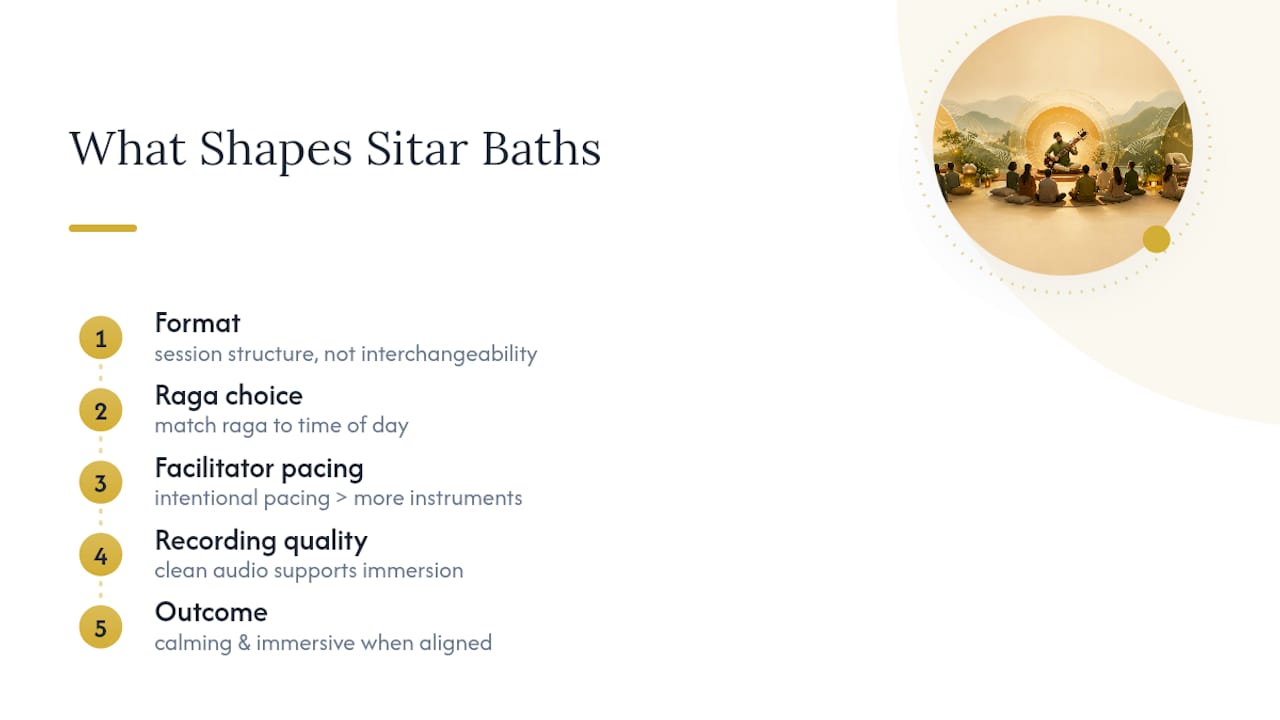
The bigger gap in conventional advice is timing. Plenty of guides list ragas without explaining why time of day matters, treating raga selection as decoration instead of a structural choice that affects how a session feels from the first minute. A late-night raga played at noon doesn’t carry the same weight, and a facilitator who ignores that distinction is skipping a core part of the tradition.
If you’re prioritizing anything here, prioritize the facilitator’s structure over the instrument list. A single sitar played with intention, proper pacing, and the right raga for the hour will outperform a crowded arrangement of five instruments with no plan behind it. Complexity isn’t the goal. Intentional pacing is.
— Rajib
If You Want a Guided Sitar Sound Bath, Here’s How SITARRAJIB Can Help
Reading about sitar sound baths only gets you so far. If you want the real thing, you can book a live performance, commission a studio recording session, or arrange a private workshop where the format is tailored to your group.
For event organizers and wellness planners, live sitar performance fits naturally into corporate programming, retreats, and cultural events where you want something more grounded than background music. You can see how a sitar performance benefits corporate event programming if you’re weighing it against other wellness offerings. For producers and creators who want a professionally recorded sitar track for their own project or personal practice, the studio recording process for producers outlines what a session involves and what you walk away with. Reach out through the artist’s site to check available dates and discuss the format that fits your event or recording goal.
Sources
FAQ
Is Sitar Music Good for Mental Health?
Sitar music is widely used in wellness settings to support relaxation and slower breathing, and practitioners report mood improvements from raga-based sessions, though it works best as a complement to care rather than a replacement for it.
What Instruments Are Played in a Sound Bath?
Beyond the sitar, common additions include crystal singing bowls, Koshi chimes, the shruti box, monochord, and sometimes flute or voice, all chosen to widen the sound bath’s texture without adding tension.
What Is the Sound of Sitar?
The sitar produces a resonant, buzzing tone with long sustain and sliding pitch bends, created by sympathetic strings that ring alongside the melody, giving it a fuller sound than most single-string instruments.
Do Sound Baths Unblock Chakras?
Some practitioners frame sound baths through chakra and energy frameworks, but this is a belief-based interpretation rather than a scientifically established effect; the more consistently observed outcome is reduced stress and calmer breathing.