
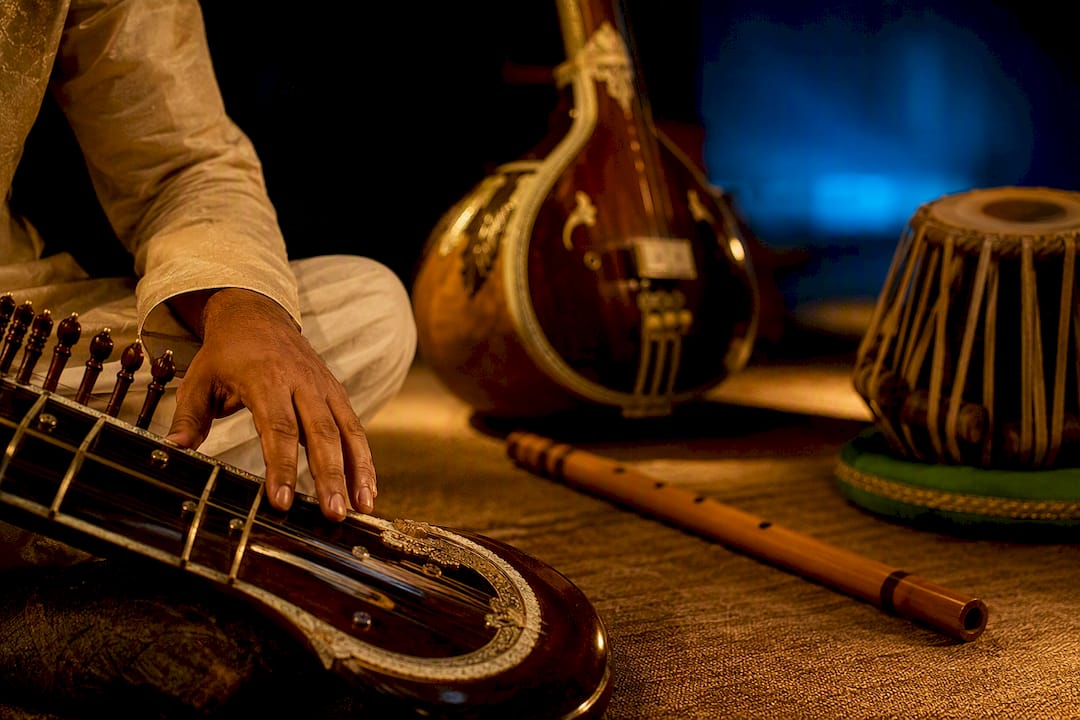
Indian classical music runs on four instrument families: Tat (string), Sushir (wind), Avanaddha (drums), and Ghan (idiophones). The canonical names to know are the sitar, tabla, bansuri, veena, sarod, sarangi, tanpura, and mridangam. This guide walks through each family, explains the construction details that shape their sound, and points out where Hindustani and Carnatic traditions split on which instruments carry the melody, the rhythm, and the drone.
TL;DR:
- Most Indian string instruments use sympathetic strings to produce resonances that significantly influence the instrument’s sound and are often missing or distorted in sampled versions.
- The sitar’s meend slide bends notes by pulling strings sideways, creating a distinctive shimmer only reproduced accurately in live performance.
- Hindustani instruments like the tabla and sitar have different tuning and construction from their Carnatic counterparts, despite sharing names, due to regional influences and history.
- Proper listening to techniques like the drone, slide, and tone bending is more valuable than memorizing instrument categories for understanding Indian classical music.
- Learning to hear and shape sliding techniques and resonance in live or private lessons offers deeper insight than just knowing instrument types or classifications.
Table of Contents
- What Are the Traditional Categories of Indian Classical Instruments?
- The String Family: Sitar, Sarod, Veena, and More
- The Wind Family: Bansuri, Shehnai, and Nadaswaram
- Percussion and Idiophones: Tabla, Mridangam, and the Rhythm Section
- Hindustani vs. Carnatic: Same Names, Different Instruments
- Why the Sitar Sounds the Way It Does
- Historical Roots and Cultural Weight
- Musicians Who Defined These Instruments for Modern Audiences
- How Tuning and Scale Work on Indian Classical Instruments
- What Actually Matters When You’re Learning to Listen
- Hear These Instruments Live or Learn to Play One
- Sources
What Are the Traditional Categories of Indian Classical Instruments?
The four-way classification comes from the Natya Shastra, a text that organized instruments long before the modern Western system existed. It still shapes how museums, conservatories, and the India Culture portal group instruments today, and it maps cleanly onto the Hornbostel-Sachs system used in ethnomusicology worldwide.
- Tat (Tantu): stringed instruments, plucked or bowed. Sitar, sarod, veena, sarangi, violin.
- Sushir: wind instruments, played by breath. Bansuri, shehnai, nadaswaram.
- Avanaddha: membranophones, drums with a stretched skin. Tabla, mridangam, pakhawaj.
- Ghan: idiophones, instruments that sound through their own material. Ghatam, manjira, jal tarang.
Some contemporary discussions add a fifth, informal category for electronic and synthesized instruments, since digital tanpura apps and sampled tabla loops now show up in practice rooms and even on stage. They sit outside the traditional four groups, but they borrow heavily from the acoustic instruments they imitate, which is part of why the differences between a real and virtual sitar matter so much to trained ears.
The String Family: Sitar, Sarod, Veena, and More
String instruments carry most of the melodic weight in Indian classical music, and each one gets there differently.
The sitar has a long fretted neck, a gourd resonator, and typically 18 to 20 strings, six or seven of which are played while the rest vibrate sympathetically underneath. The sarod drops the frets entirely. Its fretless metal fingerboard lets players slide directly under the strings with a fingernail, producing a denser, more percussive attack than the sitar’s rounded slides. The veena family (Saraswati veena in the south, rudra veena in the north) is the oldest of the group, with a long history as a solo and meditative instrument. The santoor, a trapezoidal box strung with metal wires and struck with light wooden mallets, comes from Kashmir and produces a bright, cascading tone unlike anything else in the string family. The tanpura (or tambura) never plays melody at all. It sits in the background, its four or five open strings tuned to the tonic and fifth, providing the constant drone that every raga performance is built on. The sarangi, bowed and fretless, is prized for its vocal quality, close enough to the human voice that it’s the traditional accompaniment for singers. The violin, adopted from European trade contact, was restrung and retuned for Carnatic music and now plays both solo and accompaniment roles across South India.
Pro Tip: In a live performance, listen for what happens after a long slide, or meend. On a fretted instrument, the sympathetic strings keep ringing after the main note stops, creating a shimmer that trails behind the phrase. That lingering resonance is one of the clearest ways to tell a sitar or sarod recording from a synthesized version.
The Wind Family: Bansuri, Shehnai, and Nadaswaram
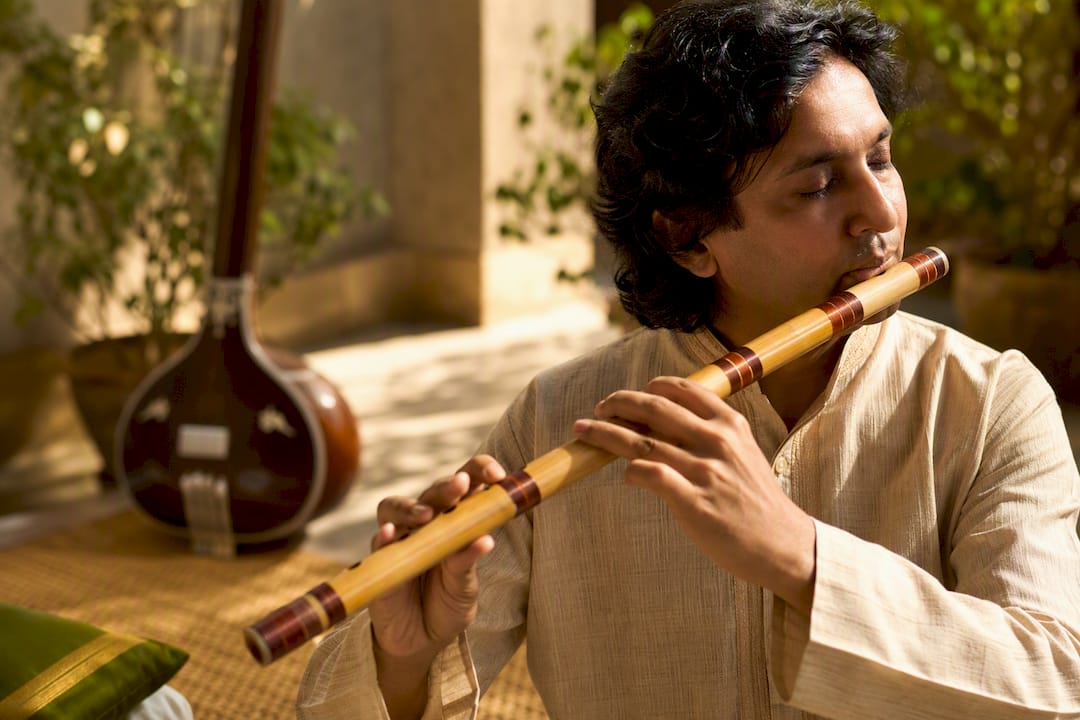
The bansuri, a side blown bamboo flute, is the primary wind instrument in Hindustani music, while its southern counterpart, the venu, plays the same functional role in Carnatic performance. Both are transverse flutes, meaning the player blows across a hole rather than into an end, which gives them the breath control needed for long, curving raga phrases.
The shehnai and nadaswaram work differently. Both are double reed instruments, loud and piercing, historically played at temples and weddings rather than in intimate concert settings. The shehnai belongs to the north, the nadaswaram to the south, and the nadaswaram is considerably longer and louder, built for outdoor processions rather than indoor recitals.
Tuning on wind instruments is trickier than on strings, since there are no frets or sympathetic strings to lean on. Players shift pitch entirely through breath pressure and finger position, which makes raga ornamentation on the bansuri or venu a matter of pure embouchure control rather than mechanical sliding.
Percussion and Idiophones: Tabla, Mridangam, and the Rhythm Section
The tabla is actually two drums: the smaller wooden dayan, tuned to the tonic, and the larger metal bayan, which provides bass tones through hand pressure on the skin. This paired design is unique to Hindustani music. Carnatic music instead uses the mridangam, a single double headed barrel drum descended from the older pakhawaj, played horizontally across the lap.
- Tabla — the primary rhythm instrument in Hindustani music, played as a pair.
- Mridangam — the core Carnatic drum, a single body with two tuned heads.
- Pakhawaj — the older barrel drum that preceded the tabla in northern devotional and dhrupad music.
- Ghatam — a clay pot struck by hand, common in Carnatic ensembles.
- Kanjira — a small frame drum with a single jingle, used for rhythmic texture in Carnatic performance.
- Manjira — small hand cymbals that mark tala in devotional and folk contexts.
Hindustani vs. Carnatic: Same Names, Different Instruments
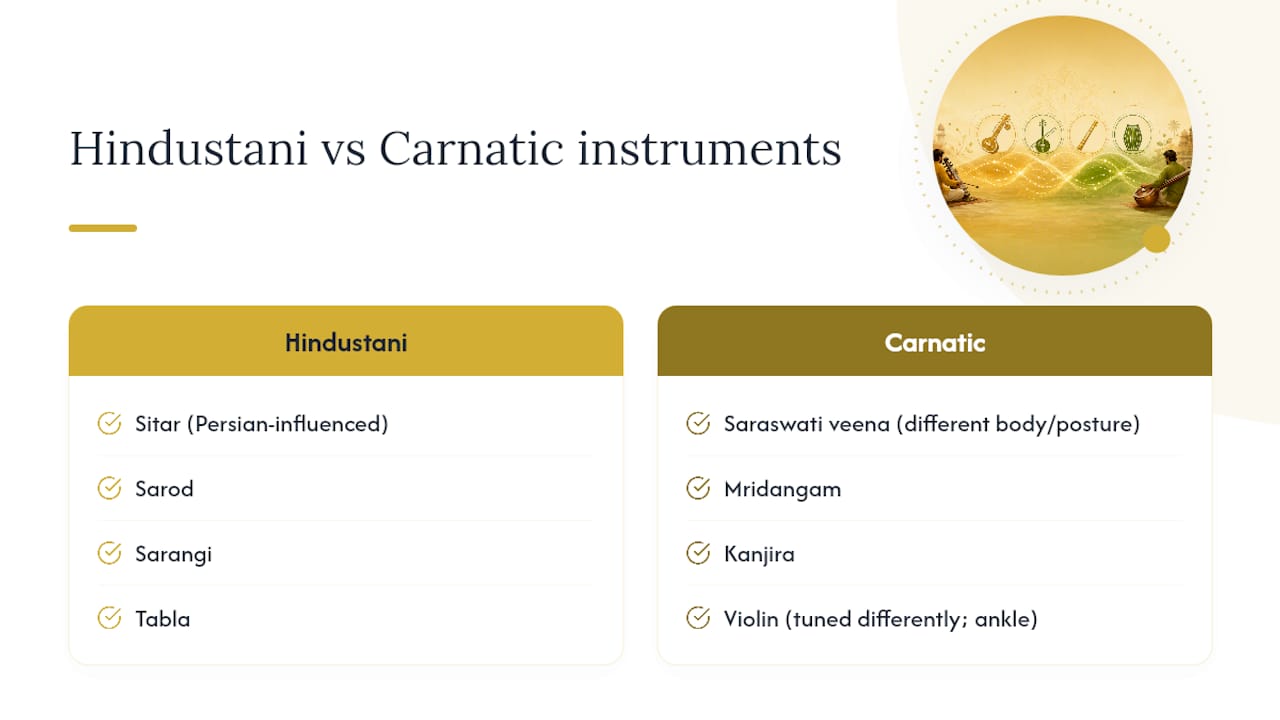
Hindustani music leans on sitar, sarod, sarangi, and tabla, while Carnatic music centers on the Saraswati vina, mridangam, kanjira, and violin, according to a comparative overview on Indian classical music. The bansuri is one of the few instruments that carries real weight in both traditions.
Names can be deceptive. A “veena” in the north often refers to the rudra veena, a large fretted instrument with two gourd resonators, while the Saraswati veena of the south has a different body shape and playing posture entirely. The bansuri and venu are functionally the same instrument, but they’re calibrated to different pitch systems within their respective traditions. Even the violin isn’t identical across regions. Carnatic players tune it differently and hold it against the ankle rather than under the chin, a technique adaptation that changes how ornaments get executed.
The Metropolitan Museum of Art’s essay on South Asian instruments traces much of this divergence to Persian influence on northern instruments like the sitar and santoor, a history that never touched the south in the same way.
Why the Sitar Sounds the Way It Does
Meend, the signature slide of Hindustani string playing, works by pulling a string sideways across a fret rather than moving the finger up and down the neck. On the sitar, that pull can bend a note by several semitones without a new pluck. On the sarod, without frets to pull against, the slide happens by dragging the fingernail directly along the string, producing a smoother but less elastic bend.
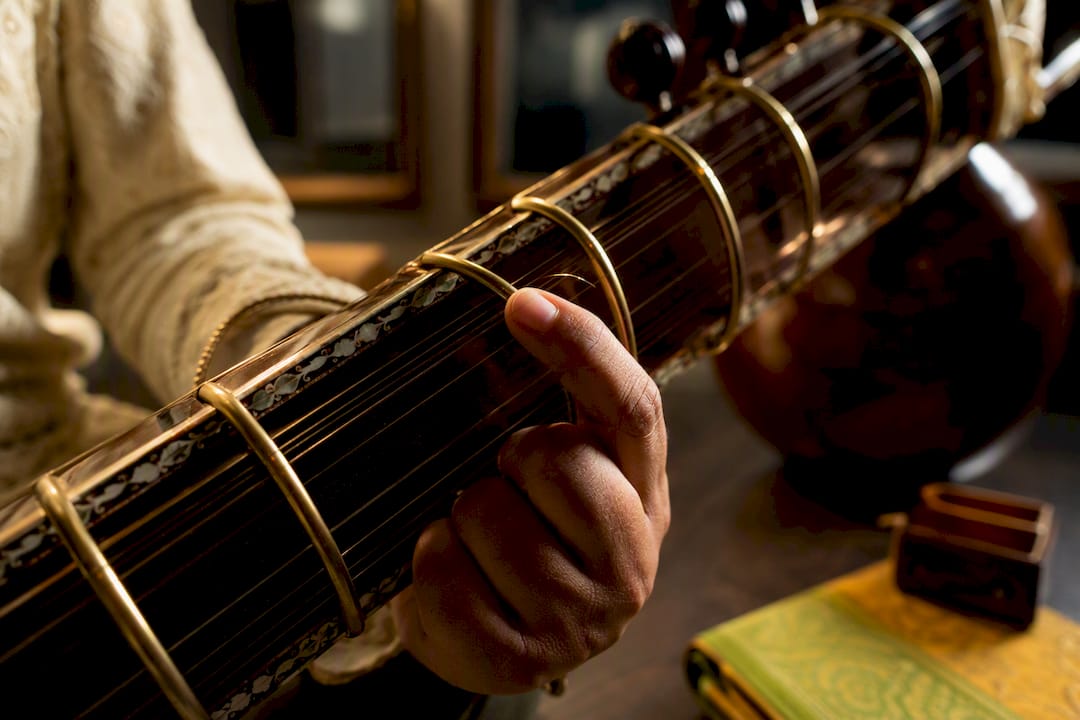
Sympathetic strings sit beneath the main playing strings, untouched by the hand, vibrating only in response to the notes played above them. A technical analysis of sitar recordings found that the decay patterns and secondary vibrations of meend on a real sitar are frequently missing or distorted in sampled and virtual instrument versions. That gap explains why sitar samples versus live performance so often sound noticeably different to trained listeners, even when the notes played are identical. Fretted instruments trade some slide flexibility for these sympathetic overtones. Fretless instruments trade the shimmer for a wider, more continuous slide.
Historical Roots and Cultural Weight
Most of these instruments carry centuries of layered history rather than a single origin story. The veena’s lineage stretches back furthest, tied to devotional and court music long before the sitar existed in anything like its current form. The sitar itself developed through Persian and Central Asian contact with northern Indian courts, which is why its name and much of its construction differ so sharply from the older, purely indigenous veena.
The tabla’s origin is debated among scholars, but its rise paralleled the growth of khayal vocal music, which needed a rhythm partner more flexible than the pakhawaj’s fixed, resonant tone. Percussion instruments like the ghatam and kanjira, meanwhile, grew out of devotional and folk practice in the south before being absorbed into formal Carnatic concert structure.
None of these instruments developed in isolation from religious or court life. Temple processions shaped the shehnai and nadaswaram’s loud, outdoor voice. Royal patronage shaped the sitar and sarod’s refinement as solo concert instruments. The tanpura’s drone, meanwhile, reflects something more philosophical: a musical worldview built around a fixed, unchanging tonal center against which everything else moves. That drone concept, more than any single instrument, is what ties the whole system together across regions and centuries.
Musicians Who Defined These Instruments for Modern Audiences
Certain performers didn’t just play these instruments well. They changed how audiences worldwide understood what the instruments could do. Ravi Shankar’s international touring in the twentieth century turned the sitar from a regional concert instrument into a globally recognized sound, influencing musicians far outside Indian classical music entirely. Ali Akbar Khan did comparable work for the sarod, building it into a serious solo voice on the world concert stage rather than a supporting instrument.
Bismillah Khan spent decades elevating the shehnai from a ceremonial instrument played at weddings and temples into a legitimate solo concert voice, a shift that reshaped how the instrument is programmed today. Shivkumar Sharma did something similar for the santoor, adapting a folk instrument from Kashmir into a full classical solo instrument with its own repertoire. On the Carnatic side, violinists like Lalgudi Jayaraman helped standardize the violin’s role as both accompanist and soloist, cementing techniques that Carnatic violin students still study.
Each of these figures solved the same basic problem from a different angle: how to take an instrument built for a specific traditional role and expand its vocabulary without losing what made it distinct in the first place. That tension between preservation and expansion still defines how contemporary players approach these instruments.
How Tuning and Scale Work on Indian Classical Instruments
Indian classical music doesn’t use fixed, tempered tuning the way a piano does. Instead, every performance tunes around a chosen tonic, called Sa, and everything else, including the raga’s specific intervals, gets calculated relative to that one pitch. This is why the tanpura’s drone matters so much: it establishes Sa and Pa (the fifth) as constant reference points that the soloist bends around all night.
Sitar and sarod players retune their instruments for each raga, adjusting frets or string tension to bring out the specific intervals a given raga calls for, since Indian classical scales include microtonal shades (shrutis) that don’t map neatly onto Western semitones. The tabla’s dayan is tuned to match the performance’s tonic using a small hammer on the drum’s rim, while the bayan is tuned more loosely for bass weight rather than a specific pitch.
Wind instruments face a stiffer challenge. A bansuri is built for one specific pitch and can’t be retuned mid performance, so serious players own multiple flutes of different lengths and pick the one that matches the evening’s chosen Sa. Carnatic violinists, similarly, retune their strings before each performance to match the reference pitch of the vocalist or lead instrument they’re supporting, a habit that non-Indian violinists rarely need to develop.
What Actually Matters When You’re Learning to Listen
Most guides to Indian classical instruments stop at naming and categorizing, and that’s a real gap. Knowing that the sitar is a Tat instrument with sympathetic strings tells you almost nothing about what to listen for once the music starts. The more useful skill is training your ear to catch the specific techniques, the meend’s pull, the tanpura’s drone locking the whole performance to one tonal center, the way a tabla player’s bayan pressure shifts a drum’s pitch mid phrase.
The conventional advice, memorize the instrument list, gets the order backward. Names and categories matter, but they’re a reference system, not a listening skill. What separates someone who genuinely understands this music from someone who’s just memorized a glossary is the ability to hear a sympathetic string ringing after a slide, or to notice when a Carnatic violinist retunes for a different raga mid concert.
If you take one thing from this guide, prioritize listening over labeling. Put on a recording, follow the drone, track a single meend from pull to release, and only then worry about whether the instrument in front of you is Tat or Sushir. The categories will make more sense once your ear has something to hang them on.
— Rajib
Hear These Instruments Live or Learn to Play One
Reading about sympathetic strings and meend only gets you so far. Sitarrajib exists for the part that comes after: hearing a real sitar in the room, or learning to shape a slide yourself instead of just recognizing one on a recording. Live sitar performances, studio recording sessions, film and media scoring, private sitar lessons, and workshops are available.
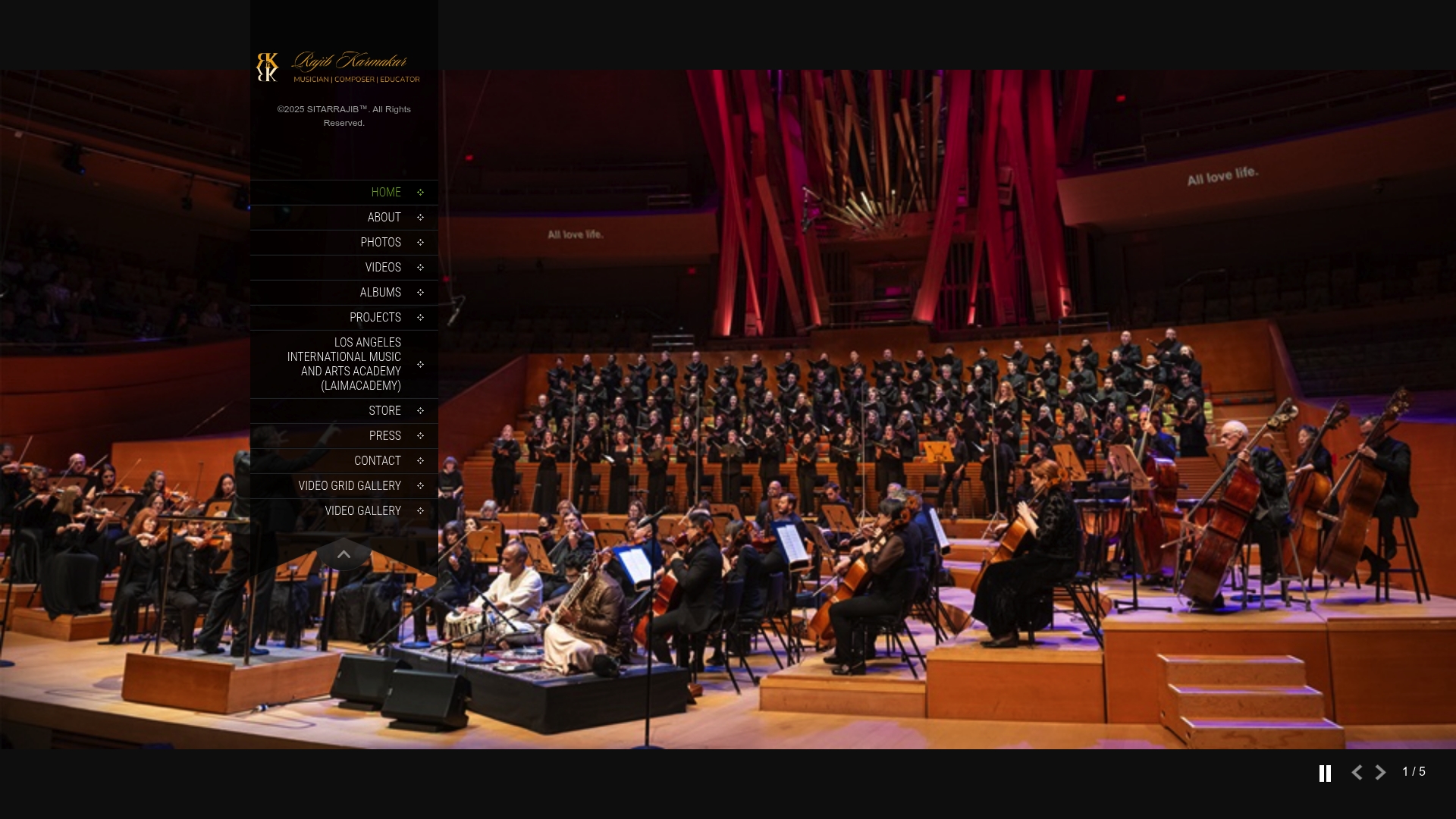
A wedding or corporate event benefits from live sitar in a way a playlist never will, since a soloist can read the room and shape a raga to the moment. A recording project needs the sympathetic resonance and meend control this guide describes, not a sampled substitute. And if you’re a learner who wants to internalize what’s been explained here about frets, drones, and sliding technique, private lessons are the direct route. If you’re planning an event, the ceremony and event guide covers where a live sitar performance fits, and how to start booking one.
Sources
- Indian classical music – Wikipedia
- Musical Instruments of the Indian Subcontinent – The Metropolitan Museum of Art
- Musical Instruments – Indian Culture (India Culture portal)
- Late-breaking demo: study of meend in sitar (ISMIR)