
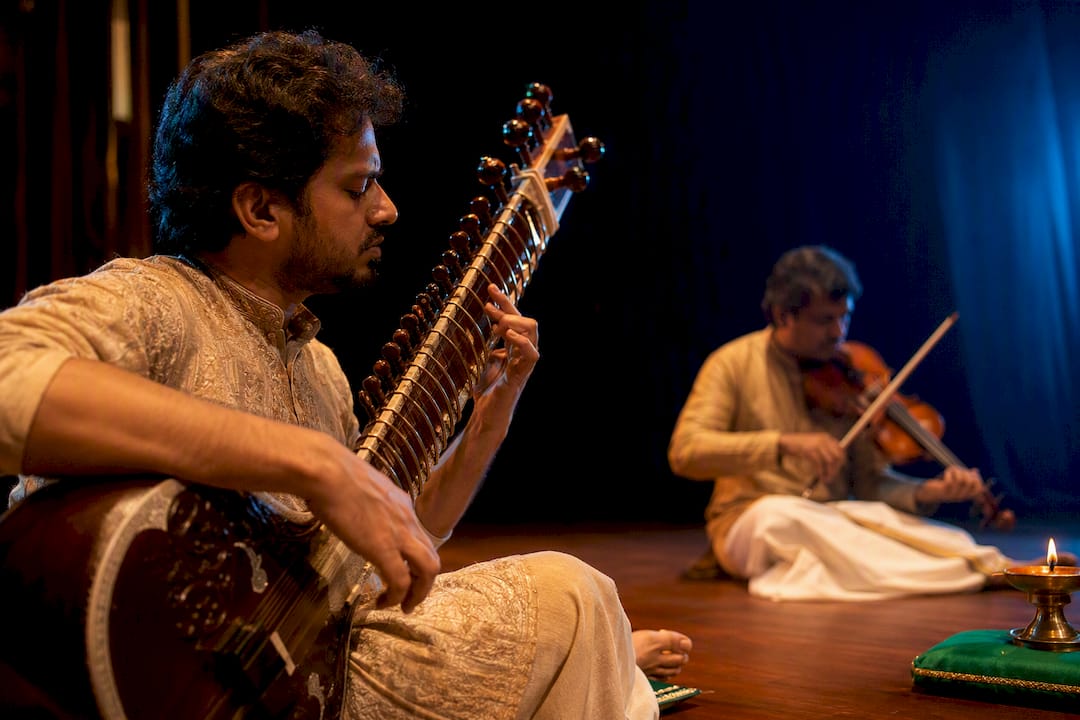
Hindustani music centers on extended improvisation and time based raga exploration. Carnatic music centers on tightly composed kritis and mathematically precise rhythmic cycles. Both grew from the same root, the raga and tala system described in ancient Indian musicology, then split into two distinct paths after the 13th century. Everything from instrument choice to concert length flows from that one difference: how much of the performance is invented on the spot versus written down and passed on. The rest of this guide walks through the history, the theory, and the sound itself, so you can hear the difference and not just read about it.
TL;DR:
- Hindustani music emphasizes improvisation and raga unfolding, while Carnatic focuses on composed kritis and fixed rhythmic cycles.
- The two systems diverged mainly after the 13th century due to foreign influence in the north and devotional movements in the south.
- Carnatic ragas are organized under 72 melakarta scales, whereas Hindustani ragas map to 10 thaat groupings; scale similarity does not guarantee identical sound.
- Ornamentation techniques differ: Carnatic uses rapid gamakas, while Hindustani relies on slow meend slides, shaping each tradition’s distinct sound.
- Concerts in each tradition vary: Carnatic covers multiple pieces in a fixed sequence, while Hindustani explores fewer ragas with extended improvisation.
Table of Contents
- Hindustani vs Carnatic: Quick Comparison Highlights
- Where Did Hindustani and Carnatic Music Diverge?
- How Do Melakarta and Thaat Raga Systems Compare?
- What Ornaments Define Each Tradition’s Sound?
- How Do Tala Systems and Percussion Differ?
- Which Instruments Anchor Each Tradition?
- How Are Carnatic and Hindustani Concerts Structured?
- How Do Gharanas and Guru-Shishya Lineage Shape Style?
- Which Ragas Should You Listen to First?
- Are Hindustani and Carnatic Music Really That Different?
- A Sitarist’s View on Practicing Across Both Traditions
- Who Are the Defining Composers in Each Tradition?
- How Popular Are These Traditions Today?
- How Did Geography Shape These Two Traditions?
- Why the Simple Version of This Comparison Falls Short
- Sources
Hindustani vs Carnatic: Quick Comparison Highlights
You want the short version first. Here it is.
- Emphasis: Hindustani leans on improvisation and gradual raga unfolding. Carnatic leans on composition, with the kriti as the anchor of a performance.
- Classification: Hindustani ragas map to 10 Bhatkhande thaats. Carnatic ragas map to 72 melakarta scales, a far larger and more exhaustive grid.
- Instruments: Sitar, sarod, and bansuri lead Hindustani ensembles. Veena, violin, and mridangam anchor Carnatic ones.
- Percussion role: Tabla in Hindustani music often follows the soloist. Mridangam in Carnatic music frequently converses with the soloist as an equal voice.
- Concert shape: Hindustani recitals may spend 30 minutes on a single raga’s alap. Carnatic kutcheris move through a set sequence of pieces at a brisker pace.
- Raga overlap: Yaman (Hindustani) and Kalyani (Carnatic) share a scale. Bhairav and Mayamalavagowla are close cousins. Bageshri and Hindolam overlap in mood but not in ornament.
Neither system is “harder.” They’re built for different goals, and that difference shows up in every section below.
Where Did Hindustani and Carnatic Music Diverge?
Both traditions trace back to shared texts, particularly the Natyashastra and the Sangita Ratnakara, which laid out early ideas about raga, tala, and performance aesthetics. For roughly a thousand years, North and South Indian music developed along a single continuum. The split most scholars point to began after the 13th century, when the Delhi Sultanate’s arrival brought sustained Persian and Arabic musical contact into the north.
That contact reshaped Hindustani music’s vocabulary, its instruments, and eventually its social structure, giving rise to court patronage systems and, later, the gharana network of family based teaching lineages. Hindustani classical music absorbed these influences in ways Carnatic music largely did not, since the south stayed comparatively insulated from Sultanate era courts.
Meanwhile, the south went through its own transformation, driven less by foreign contact and more by the Bhakti devotional movement. Composers began writing structured devotional pieces meant to be sung as fixed compositions, not just frameworks for improvisation. That habit of composing complete, memorable pieces, rather than treating melody as a launching pad, became the backbone of what we now call Carnatic music.
It’s worth resisting the urge to draw too clean a line here. A panel discussion reported by The Hindu on the north-south split noted that many ragas kept traveling between regions well after the divergence, adapting as they went. Muthuswami Dikshitar, one of the Carnatic Trinity, is documented adapting the Hindustani raga Jaijaiwanti into what became Dwijavanti. The split was real, but it was never a wall.
How Do Melakarta and Thaat Raga Systems Compare?
Carnatic theory organizes ragas under the melakarta system, a set of 72 parent scales built on a strict mathematical logic that assigns every possible combination of seven notes, each with two variants, a fixed slot. Venkatamakhin formalized this scheme, and its completeness is part of why Carnatic pedagogy treats scale identity as foundational.
Hindustani theory uses Bhatkhande’s thaat system instead, a looser grouping of just 10 parent scales. Thaat was never meant to be exhaustive. Pandit Bhatkhande built it as a practical teaching tool to organize ragas that already existed in oral tradition, not as a generative grid like melakarta.
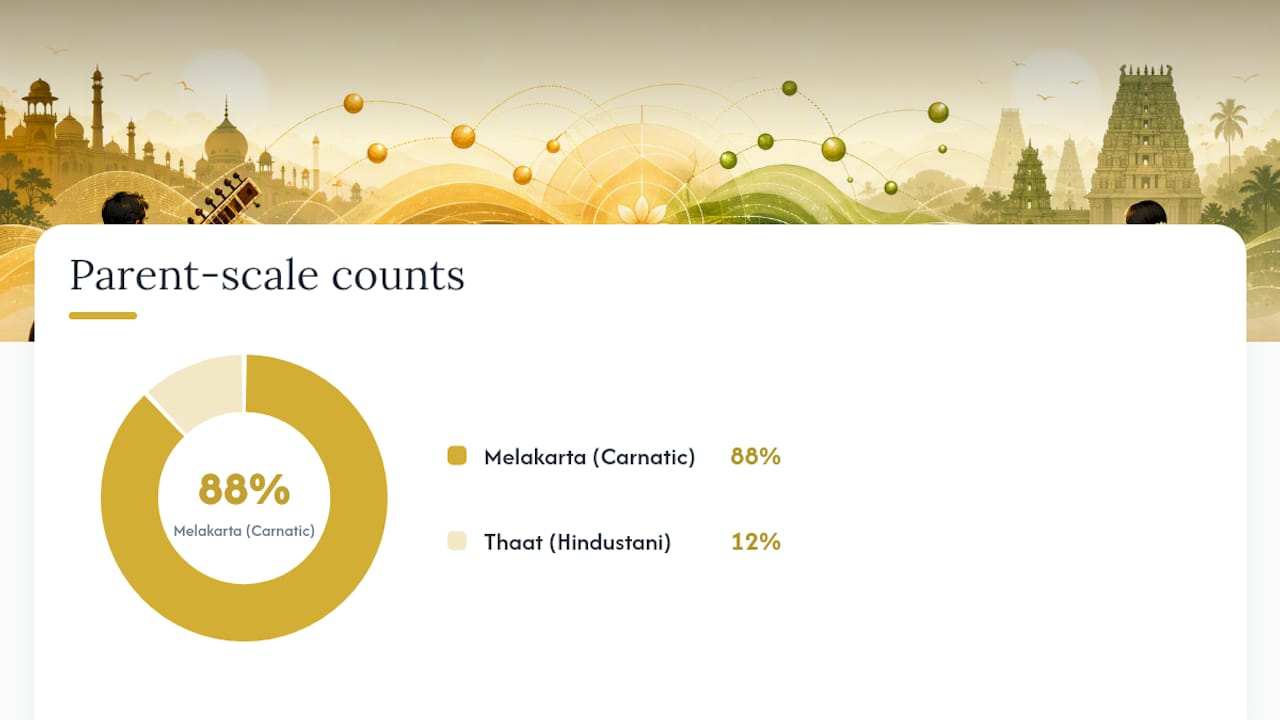
That difference in ambition explains a lot. Melakarta can theoretically produce a scale for any raga, existing or hypothetical. Thaat groups what’s already there and doesn’t worry about mathematical completeness.
Mapping between the two systems produces some genuinely useful correspondences:
- Kalyani (Carnatic) and Yaman (Hindustani) share the same swaras, both using a raised fourth.
- Mayamalavagowla (Carnatic) and Bhairav (Hindustani) both use a flattened second and sixth, giving them a similar somber color.
- Shankarabharanam (Carnatic) lines up with Bilawal (Hindustani), both mapping to what a Western ear would call a major scale.
Here’s the catch: identical scale content doesn’t guarantee identical sound. Two ragas can share every note and still feel like different worlds because of pakad, the characteristic phrase that identifies a raga regardless of its scale. Learning to listen for pakad, rather than just counting notes, is the fastest way to tell related ragas apart across systems.
What Ornaments Define Each Tradition’s Sound?
Ornamentation is where these two traditions sound most obviously different, even to a first time listener. Both use gamakas, the family of oscillations, slides, and pitch inflections that give a raga its personality, but they deploy them differently.
Carnatic music treats gamakas as essential to a note’s identity. A svara sung or played without its proper gamaka isn’t just plain, it’s arguably incorrect. Techniques like kampita (a controlled oscillation around a pitch) and nokku (a quick touch of an adjacent note) are catalogued and taught almost like vocabulary words.
Hindustani music relies more heavily on meend, the smooth glide between two notes, especially on instruments like the sitar and sarod where a single string can bend continuously across several pitches. Where Carnatic ornamentation often oscillates rapidly, Hindustani meend tends to unfold slowly, stretching the transition to build tension before the destination note arrives.
Microtonal shading, or shruti, matters in both traditions, but the phrasing built around it differs. Listen for speed: fast, repeated oscillation usually signals Carnatic gamaka technique. A long, unhurried slide between two pitches usually signals Hindustani meend.
How Do Tala Systems and Percussion Differ?
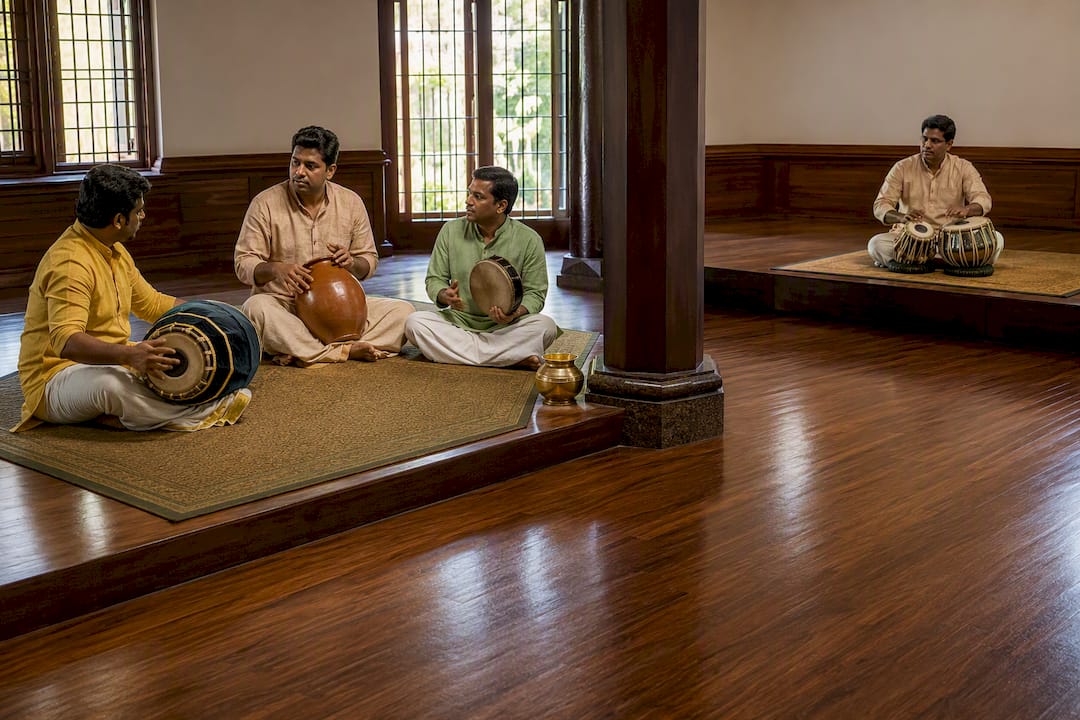
Carnatic rhythm runs on an elaborate framework built from the suladi sapta tala system, seven base talas that expand into dozens of variations through jati combinations. The mridangam doesn’t just keep time in this system, it actively converses with the soloist, trading phrases and building rhythmic tension that erupts in the tani avartanam, a dedicated percussion showcase near the end of a piece.
Hindustani rhythm uses fewer talas in everyday practice, with cycles like Teentaal (16 beats) and Ektaal (12 beats) covering most performances. The tabla’s signature contribution is layakari, rhythmic play that speeds up, doubles, or reshapes a phrase within the fixed cycle rather than multiplying the cycle types themselves.
Solo percussion format reflects this same split. A tani avartanam is a structured dialogue between multiple percussionists, often including mridangam, ghatam, and kanjira together. A tabla solo, by contrast, is typically one performer building a single, escalating rhythmic argument. Both are display pieces. They just display different things: coordination and variety in one, individual virtuosity and speed in the other.
Which Instruments Anchor Each Tradition?
Carnatic ensembles typically center on the veena or violin as melodic voices, with mridangam as the primary percussion and often a ghatam or kanjira added for rhythmic texture. Hindustani ensembles more commonly feature the sitar, sarod, or bansuri, backed by the tabla.
Both traditions rely on a drone, the tanpura, which sits underneath everything and never stops. It’s easy to overlook, but the tanpura’s steady hum is what lets every gamaka and meend register as a deviation from something fixed.
Accompanist prominence differs too. In a Carnatic kutcheri, the violinist often shadows the vocalist’s phrases in near real time, and the mridangam player gets genuine solo space. In a Hindustani recital, the tabla player supports more than converses for most of the piece, stepping forward mainly during layakari passages or the closing jhala.
Instrument choice also shapes technique. The sitar’s movable frets and long sustain favor meend. The veena’s fixed frets favor the fast, precise gamaka work Carnatic music demands.
How Are Carnatic and Hindustani Concerts Structured?
A typical Carnatic kutcheri opens with a varnam, a warm up composition that displays both melody and rhythm, then moves through a sequence of kritis, each introduced with a short alapana and sometimes expanded with niraval and kalpana swaram improvisation. The concert usually closes with a ragam tanam pallavi, the most improvisation heavy segment Carnatic music offers, followed by lighter pieces.
A Hindustani recital usually centers on one raga at a time, opening with an unmetered alap that can run well past 20 minutes before any rhythm enters. Time theory, or samay, assigns specific ragas to specific hours of the day, and serious performers still program around it, choosing a morning raga for a morning concert rather than whatever sounds impressive.
The practical effect: a Carnatic concert covers more ground, often five or six distinct pieces in two hours. A Hindustani recital might spend that same two hours on two ragas total, favoring depth over breadth. Neither approach is more “authentic.” They’re built around different definitions of a satisfying performance.
How Do Gharanas and Guru-Shishya Lineage Shape Style?
Hindustani music organizes its teaching lineages into gharanas, family or regional schools each associated with a signature approach to voice production, raga treatment, or instrumental technique. The Gwalior, Kirana, and Jaipur-Atrauli gharanas, among others, produce audibly different versions of the same raga, and a trained ear can often identify a musician’s gharana within a few phrases.
Carnatic pedagogy runs on guru-shishya parampara too, but without the same branded school identity. Continuity here centers less on a named lineage and more on a shared, enormous corpus of kritis, especially those of the Carnatic Trinity, that every student learns in roughly the same form regardless of teacher.
Notation plays a smaller role in both traditions than most newcomers expect. Hindustani music leans on oral transmission almost entirely, with notation used mainly as a memory aid rather than a performance script. Carnatic notation is a bit more standardized for teaching kritis, but improvisation sections are never written down. Sitarrajib’s notation primer breaks down how this notation actually functions and where it falls short of capturing what a guru transmits by ear.
Which Ragas Should You Listen to First?
Nothing clarifies this comparison faster than direct listening. Try these pairings and note where to focus your ear:
- Yaman vs Kalyani: Same core scale. Listen to the alap in each. Yaman’s meend stretches notes slowly; Kalyani’s gamaka moves faster.
- Bhairav vs Mayamalavagowla: Both somber, flattened second and sixth. Compare morning renditions of each for the shared mood.
- Bageshri vs Hindolam: Related pentatonic feel. Listen for how Carnatic treatment adds gamaka density that Hindustani phrasing leaves open.
- Desh vs Kapi: Listen to the niraval section in a Kapi kriti versus a Desh thumri’s freer phrasing.
- Malkauns vs Hindolam (closely related): Compare a tani avartanam in a Hindolam piece against a Malkauns jhala for contrasting rhythmic climax styles.
- Bhoopali vs Mohanam: Nearly identical scales. Listen for pakad differences in the opening phrases alone.
Are Hindustani and Carnatic Music Really That Different?
Jugalbandi performances, where a Hindustani and Carnatic musician share a stage and trade phrases, have grown into their own genre precisely because the systems share enough common ground to make dialogue possible. Cross-adaptation has been happening for centuries, not just on modern fusion stages.
Some scholars argue the popular framing overstates the gap between the two systems. The truth sits in between: the differences are real and audible, but they’re differences of emphasis, not incompatible languages. If you’re a listener trying to decide which “camp” you prefer, don’t. Focus on what you’re drawn to, long unfolding improvisation or tightly built composition, and follow that instinct across both traditions rather than picking a side.
A Sitarist’s View on Practicing Across Both Traditions
Spend enough time on sitar and you notice something quickly: chasing scale accuracy gets you nowhere near as far as chasing phrase identity. A raga’s pakad tells you more about its character than any list of notes ever could, and that holds whether you’re working through a Hindustani thaat or trying to understand a melakarta derived scale from the south.
For students trying to move between the two systems, the advice is simple: practice ornamentation before you practice mapping. Drilling meend and gamaka independently, on their own, without worrying yet about which raga they belong to, builds the physical vocabulary that makes every raga afterward easier to absorb. Sitarrajib’s guide to improvisation on sitar walks through how that phrasing work actually happens in practice, string by string.
The other habit worth building early: listen to alap sections on repeat before you touch an instrument. Improvisation isn’t invented from nothing. It’s built from a stock of phrases absorbed through years of listening, then reassembled in the moment. Watching that process happen live, in performance footage, teaches things a textbook can’t.
Who Are the Defining Composers in Each Tradition?
Carnatic music’s compositional backbone rests on the Trinity: Tyagaraja, Muthuswami Dikshitar, and Syama Sastri, all active in the late 18th and early 19th centuries. Tyagaraja alone is credited with roughly 24,000 compositions, and his kritis in ragas like Todi and Kharaharapriya remain concert staples nearly two centuries later. Dikshitar’s Sanskrit-heavy compositions, often built with a slower, more meditative gait, still anchor the ragam tanam pallavi segment of many kutcheris today.
Hindustani music doesn’t organize around a single trinity in the same way, since its compositional forms, bandish in khayal and the older, more austere dhrupad repertoire, developed across generations of court musicians rather than one concentrated era. Tansen, at Akbar’s court in the 16th century, remains the most cited early figure, credited with shaping several ragas still performed today. Later gharana founders, particularly in the Gwalior and Kirana traditions, contributed their own signature bandish compositions that carry their school’s stylistic fingerprint.
The practical difference shows up in concert programming. A Carnatic musician often names the exact kriti and composer on a printed program. A Hindustani musician more often names the raga and leaves the composition, and how far it will be improvised beyond, unstated until the performance actually happens.
How Popular Are These Traditions Today?
Both traditions maintain strong, active concert circuits, but their contemporary visibility looks different. Carnatic music runs on a dense annual calendar anchored by Chennai’s December music season, when dozens of sabhas host back to back kutcheris over several weeks, drawing both dedicated rasikas and a growing number of younger, first time attendees.
Hindustani music’s public footprint leans more toward major festival circuits, like the long running Sawai Gandharva Bhavatarini Mahotsav in Pune, alongside a steady stream of solo recitals in smaller, intimate settings that suit its slower, more exploratory format.
Globally, sitar and tabla have carried Hindustani music into wider recognition for decades, partly through 20th century crossover moments with Western musicians, and that visibility continues through festival bookings, film scoring work, and collaborative concert programming abroad. Carnatic music has built its own international presence through diaspora communities, particularly in the United States and United Kingdom, where sabha style concerts and youth competitions keep the tradition active outside India. Neither tradition is fading. Both are adapting to new audiences without abandoning their core structure.
How Did Geography Shape These Two Traditions?
Geography did more than draw a line on a map here. The Vindhya and Satpura mountain ranges created enough separation between north and south to let each region’s music develop somewhat independently even before the medieval divergence accelerated things.
The north’s exposure to overland trade and successive waves of Central Asian and Persian contact, through the Delhi Sultanate and later the Mughal court, injected instruments, scales, and performance conventions that never reached the south with the same intensity. Court patronage under Mughal rulers gave Hindustani music a courtly, secular character that shaped its instrumental repertoire and its gharana structure.
The south’s relative geographic insulation let its devotional Bhakti movement develop with less external interruption, reinforcing a temple and composition centered culture. Carnatic music’s close ties to Tamil, Telugu, and Kannada devotional literature, and to temple performance traditions, gave it a textual, composition anchored identity that persists in how kritis are taught and performed today. Climate and regional language also shaped vocal technique, with Carnatic vocal styles often reflecting the phonetic patterns of Dravidian languages in ways Hindustani khayal singing, rooted in Hindi, Urdu, and Braj Bhasha, does not replicate.
Why the Simple Version of This Comparison Falls Short
Most explanations of Hindustani vs Carnatic music stop at “one improvises, one composes,” and that’s not wrong, it’s just thin. The research behind this comparison points somewhere more useful: the real value isn’t in picking a side, it’s in learning to hear how each tradition builds its identity, through pakad, through gamaka speed, through where the percussionist sits in the conversation.
Conventional advice tells students to memorize scale correspondences first, Yaman equals Kalyani, Bhairav equals Mayamalavagowla, and call it done. That’s backwards. Phrasing defines a raga far more than its scale does, and two ragas with identical notes can sound like different worlds once ornamentation enters the picture.
If you’re a student trying to move between these systems, or just a listener trying to hear the difference for the first time, start with your ears, not your theory books. Put on an alap and a kriti back to back. Notice the pacing before you notice the notes. Everything else in this comparison, the talas, the instruments, the gharanas, makes more sense once that instinct is in place.
— Rajib
Sources
For readers who want to go further, The Hindu’s panel coverage offers real historical nuance on the divergence. The Wikipedia overview is solid for structural basics, and RagaRasa’s comparison breaks down theory clearly. Reading the Sangita Ratnakara directly, even in translation, remains the best way to see where both traditions actually started.
- How Indian classical music got divided into Hindustani and Carnatic – The Hindu
- Hindustani classical music – Wikipedia
- Carnatic vs Hindustani: Understanding the Two Great Traditions | RagaRasa