
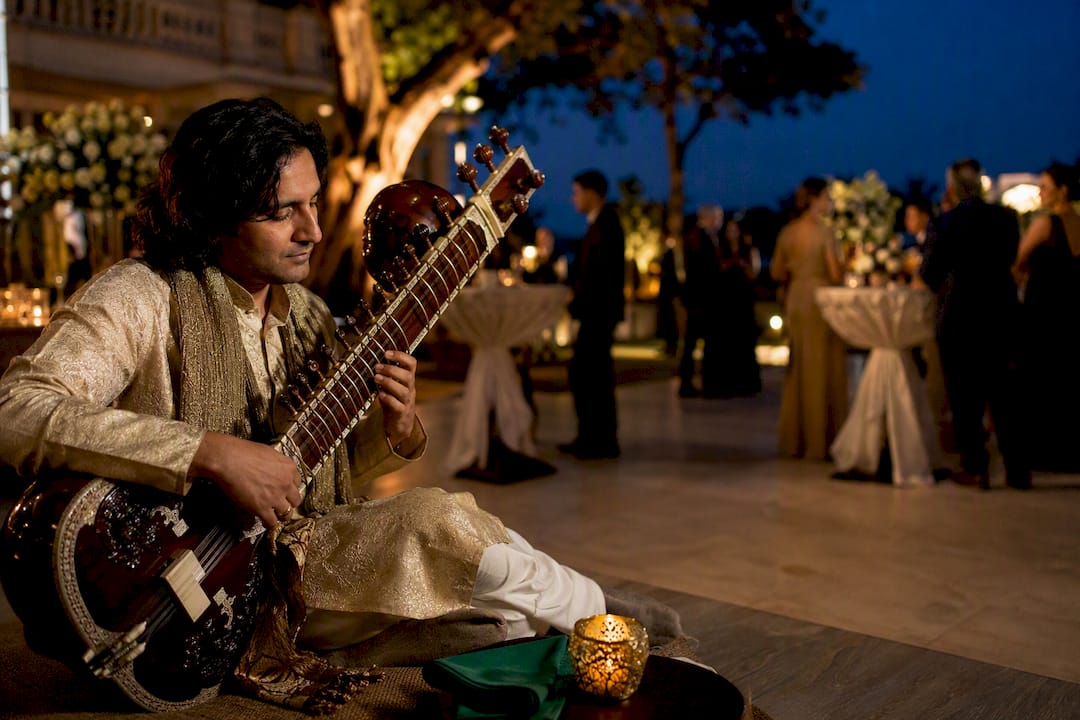
Hire live music matched to each reception moment, not one act for the whole night: a solo instrumentalist or duo for cocktail and dinner, then a compact band or DJ hybrid once the party opens. That structure gives you room control and memorable moments a playlist can’t match. Rajib Karmakar of Sitarrajib, a sitarist who specializes in exactly this transition, is worth considering for the cocktail-to-dinner stretch.
TL;DR:
- Matching different live acts to each reception moment enhances atmosphere and perceived value, with solo acts for cocktail hour and larger bands for dancing.
- Proper planning of cues and transitions between acts, particularly from dinner to dance music, prevents awkward pauses and maintains momentum.
- Smaller acts like solo instrumentals or duos cost less and require minimal equipment, while full bands demand significant space, sound, and lighting setups.
- Clear technical and logistical details, including stage space, power, and load-in times, are crucial to avoid on-the-day problems and ensure smooth performances.
- Booking should include recent live recordings and references, with detailed contracts covering equipment, travel, and performance limits, not just demo videos.
Table of Contents
- Types of Live Music for Receptions and What Each One Does
- Building the Reception Energy Curve Moment by Moment
- What Drives the Price of Live Reception Music
- Technical and Logistical Checklist Before You Sign
- How to Vet a Live Act Before You Book Them
- Live Band vs. DJ vs. Hybrid: Choosing the Right Format
- Sample Reception Timelines You Can Hand to Any Band
- Programming Sitar for Cocktail and Dinner: An Expert View
- Talking to Your Performer About Music Preferences and Limits
- Common Problems During Live Reception Performances and How to Fix Them
- What Planners Consistently Get Wrong About Reception Music
- Book Live Reception Music That Fits Every Moment
- Sources
Types of Live Music for Receptions and What Each One Does
The mistake most planners make is picking a single act and asking it to cover cocktail hour, dinner, and the dance floor. Different moments need different instrumentation, and matching the two is the fastest way to raise the perceived value of your event without raising the budget much at all.
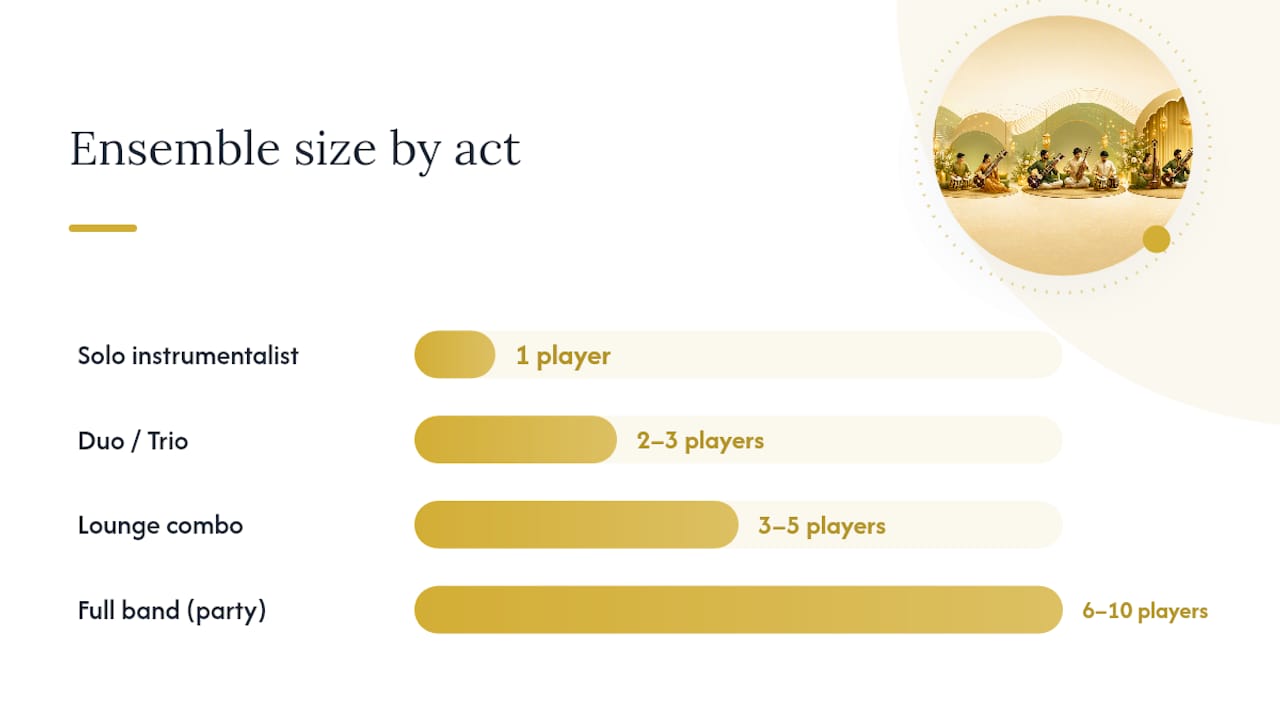
A solo sitar, saxophone, or violinist works best where conversation matters more than volume: arrivals, cocktail hour, and dinner service. These acts need almost no stage, run on battery-powered amps or a single DI box, and can set up in a corner without disrupting foot traffic. A duo (voice plus guitar, or sitar plus tabla) adds texture while staying just as portable.
Lounge and jazz combos (three to five players) suit dinner service and the first thirty minutes after, when guests are still seated but want something with more movement than background ambiance. Fusion ensembles that blend Indian classical instruments with Western rhythm sections work well for receptions where the guest list spans generations and musical tastes.
Bollywood cover bands and regional folk groups are built for the party segment. These acts run six to ten players, need a proper stage riser, and draw meaningfully more power than a solo act. Rock and pop cover bands fill the same role for Western-style receptions.
Classical ensembles (string quartets, sitar and tabla pairings) fit ceremonies, entrances, and formal cocktail hours where elegance matters more than dance-floor energy.
Here’s how footprint typically scales with act type:
- Solo instrumentalist: no stage required, one power outlet, fits any room size
- Duo or trio: small stage or cleared floor space, two to three outlets
- Lounge quartet or quintet: 8×8 foot stage minimum, dedicated sound zone
- Full band (six plus players): stage riser, house or rented PA, lighting truss for larger venues
Match the act to the room before you match it to the guest list. A ten-piece band in a 40-guest private dining room overwhelms the space no matter how good the musicians are.
Building the Reception Energy Curve Moment by Moment
Reception music should climb in intensity the way a good film score does, not jump straight to full volume. Cocktail hour and dinner music should build momentum toward the dance floor gradually, with tempo and volume rising in stages rather than all at once. Planners who treat this as one continuous programming decision, instead of separate playlists bolted together, get smoother transitions and fewer awkward silences.
- Cocktail hour (60 to 90 minutes): Keep it light, acoustic, and conversational. Fifteen to twenty five songs is a workable target for this block, favoring instrumental or lightly vocal arrangements that don’t compete with mingling guests.
- Dinner service: Soften further. Ballads, jazz standards, or a solo sitar set work here because they support conversation instead of demanding attention. Plan for twenty to thirty five songs across a typical dinner length.
- Speeches and toasts: Cut music entirely or drop to near silence. This is a coordination point, not a programming one; more on that below.
- First dance: Full-length song, no fades, no mashups unless specifically requested. This is the one moment where the act should not improvise.
- Peak party: Tempo and volume both increase. This is where a full band or DJ takes over from the dinner-hour act.
Guest demographics change this sequencing. A reception heavy with older relatives and cross-generational guests benefits from a longer, gentler build; a younger crowd tolerates a faster climb into dance-floor energy. Venue acoustics matter just as much: a marble-floored ballroom reflects sound aggressively and needs a lighter touch than a carpeted hotel function room. Loop in your MC or DJ on cue points well before the event. The handoff between a live act’s last dinner song and the DJ’s first dance-floor track is where most reception music mistakes happen, and it’s entirely preventable with a five-minute planning call.
What Drives the Price of Live Reception Music
Band size is the single biggest cost driver, but it’s rarely the only one. Duration, travel distance, sound and lighting requirements, custom arrangements, and rehearsal time for first-dance songs all stack on top of the base fee.
Here’s what typically moves the number:
- Band size: A solo act costs a fraction of a ten-piece band; each added musician adds their own fee, not a proportional slice.
- Hours booked: Most acts price in blocks (often four hours) with overtime billed separately and usually at a premium rate.
- Travel: Distance from the performer’s home base adds mileage or a flat travel fee, especially for destination receptions.
- Sound and lighting: Venues without house PA systems require rented equipment, which can add substantially to a quote.
- Custom arrangements: Asking a band to learn a specific first-dance song or blend genres (say, a sitar arrangement of a Western pop track) usually carries an arrangement fee.
- Rehearsal and overtime: Extra rehearsal time for custom pieces, or running past the contracted hours, both cost more than planners expect.
Pro Tip: Ask every quote for a full breakdown of what’s included: sound equipment, lighting, travel, and overtime rate per hour. A quote that bundles everything into one number without itemizing these hides the real cost drivers, and that’s exactly where budget surprises come from on the day.
Solo instrumentalists for cocktail and dinner tend to sit at the lower end of the market, since they need minimal equipment and only one performer’s time. Full bands with six or more players, sound reinforcement, and lighting sit considerably higher, with destination events adding travel on top. Off-peak dates and weekday receptions typically unlock meaningful savings, and staged payments (deposit, balance closer to the date) are standard enough that you should expect them, not negotiate against them.
Technical and Logistical Checklist Before You Sign
The difference between a smooth performance and a chaotic one usually comes down to logistics decided weeks in advance, not day-of improvisation. Every act, from a solo sitarist to a full band, needs a clear answer to these before contracts get signed.
- Load-in window: Confirm the exact time the act can access the venue and how long setup takes for their specific instrumentation.
- Stage footprint: Measure the space you’re offering against what the act actually needs; a written stage plot from the performer prevents mismatches.
- PA and monitor plan: Know whether the venue provides sound reinforcement or the act brings their own, and who owns the monitor mix.
- Power access: Confirm outlet count and amperage near the performance area, especially for larger bands with amps and keyboards.
- Backline and staging: Drum risers, mic stands, and DI boxes should be listed explicitly in the rider, not assumed.
Venue coordination matters just as much as the technical rider. Confirm parking and load-in access routes with the venue directly, not just the band, since loading docks and freight elevators vary wildly between properties. For outdoor receptions, get a written weather contingency plan from both the venue and the act; a sitar or acoustic guitar without a covered stage is one light rain shower away from a canceled set. Check the venue’s own noise ordinances or in-house sound limits before you book anything above a duo.
Pro Tip: Ask for the performer’s technical rider and logistics checklist before you finalize the venue layout, not after. A rider written for a six-piece band that arrives to a room with two outlets and no loading access is a problem you can solve for free two months out and can’t solve for any amount of money two hours out.
Rider basics to lock down include hospitality (water, meals for load-in-to-load-out shifts over a few hours), a green room or holding space, and a single point of contact on both sides for day-of communication.
How to Vet a Live Act Before You Book Them
Booking on a demo reel alone is the most common mistake planners make, and it’s an avoidable one.
- Request recent live videos, not just studio recordings. Live footage reveals timing, stage presence, and crowd reading in ways a polished studio track never will.
- Ask for a full-set recording, ideally from an actual wedding reception, not a showcase gig. This shows how the act handles pacing over hours, not just three minutes of highlight reel.
- Call references from other weddings, and ask specifically about punctuality, MC coordination, and how the act handled anything that went wrong.
- Confirm insurance and cancellation policy in writing. Many venues now require liability coverage from performers, and you need to know this before, not during, load-in.
- Run a short audition or trial if the booking is high-stakes: a few requested songs, a quick MC interaction exercise, and a timing check (can they hit a precise thirty-second entrance cue, for example) tells you more than any conversation will.
- Nail down contract essentials: deposit amount and due date, overtime rate, travel reimbursement terms, force majeure language, and any timeline penalty clauses for late arrival.
None of this takes more than a week to complete for a single act, and it eliminates the vast majority of day-of surprises planners describe after the fact.
Live Band vs. DJ vs. Hybrid: Choosing the Right Format
Each format solves a different problem, and the right choice depends on budget, venue acoustics, and how much song variety you need across a long reception.
Live bands deliver authenticity and stage presence that a DJ can’t replicate, but they’re limited to their rehearsed repertoire and cost more per hour of coverage. DJs offer far broader song selection and lower cost, with instant genre switching, but lack the visual and emotional impact of musicians on a stage. Combining live musicians with a DJ is increasingly common precisely because it keeps the dance floor packed while preserving flexibility, our internal guide on live band versus DJ tradeoffs breaks this down further.
- Choose a band alone when authenticity and a specific genre (Bollywood covers, jazz) matter more than song variety.
- Choose a DJ alone when budget is tight or the venue’s acoustics favor amplified, mixed sound over live instrumentation.
- Choose a hybrid when you want live energy during peak moments but need the song catalog a DJ provides for the rest of the night.
Pro Tip: If you go hybrid, get the band and DJ on a shared call before the event to agree on monitor mixes and exact handoff timing. A live saxophonist sitting in over a DJ’s set only works when both sides know precisely when the other starts and stops.
Sample Reception Timelines You Can Hand to Any Band
Templates save planners from reinventing the run-sheet for every event. Here are three starting points.
- Intimate dinner reception (under 80 guests): Solo sitar or acoustic duo for arrival and cocktail hour (60 minutes), continuing softly through a seated dinner (75 minutes), pausing completely for toasts, then a single live set or DJ transition for dancing (90 minutes).
- Mixed-age large reception (150 plus guests): Duo or trio for cocktail hour (90 minutes), lounge quartet through dinner (90 minutes), full band or hybrid setup for two 20 to 30 minute dance sets with one medley bridging them, separated by a short DJ-only interlude.
- Destination or compressed timeline reception: Entrance music timed to 30 to 60 seconds as guests are seated, a tight 45 minute combined cocktail-and-dinner block with a solo act, then straight into a single extended party set since there’s no time for multiple breaks.
Across all three, keep entrance music short and precise (30 to 60 seconds), give the first dance its full uninterrupted length, and structure the party into sets of 20 to 30 minutes with a short break between them so musicians aren’t playing four hours straight. Build in a clear cue for pausing when speeches start, and confirm with your MC exactly how the handback to music will be announced.
Programming Sitar for Cocktail and Dinner: An Expert View
Rajib Karmakar has spent years arranging sitar for exactly the cocktail-to-dinner stretch where most receptions lose momentum. His approach treats the instrument as a scoring tool, not a novelty act.
The sitar works best in the first ninety minutes of a reception because it holds attention without demanding it. You can build cinematic momentum under conversation, the same way a film score does under dialogue, and guests feel the shift even when they’re not consciously listening to it.
When blending sitar with contemporary songs or a DJ set, starting pieces in a neutral tonal center and using short repeated motifs gives the DJ a clean cue point for tempo shifts, which matters most during entrance music and the transition into dinner. This same logic explains why sitar suits cocktail hours so well: it fills the room without competing with guests trying to talk.
Talking to Your Performer About Music Preferences and Limits
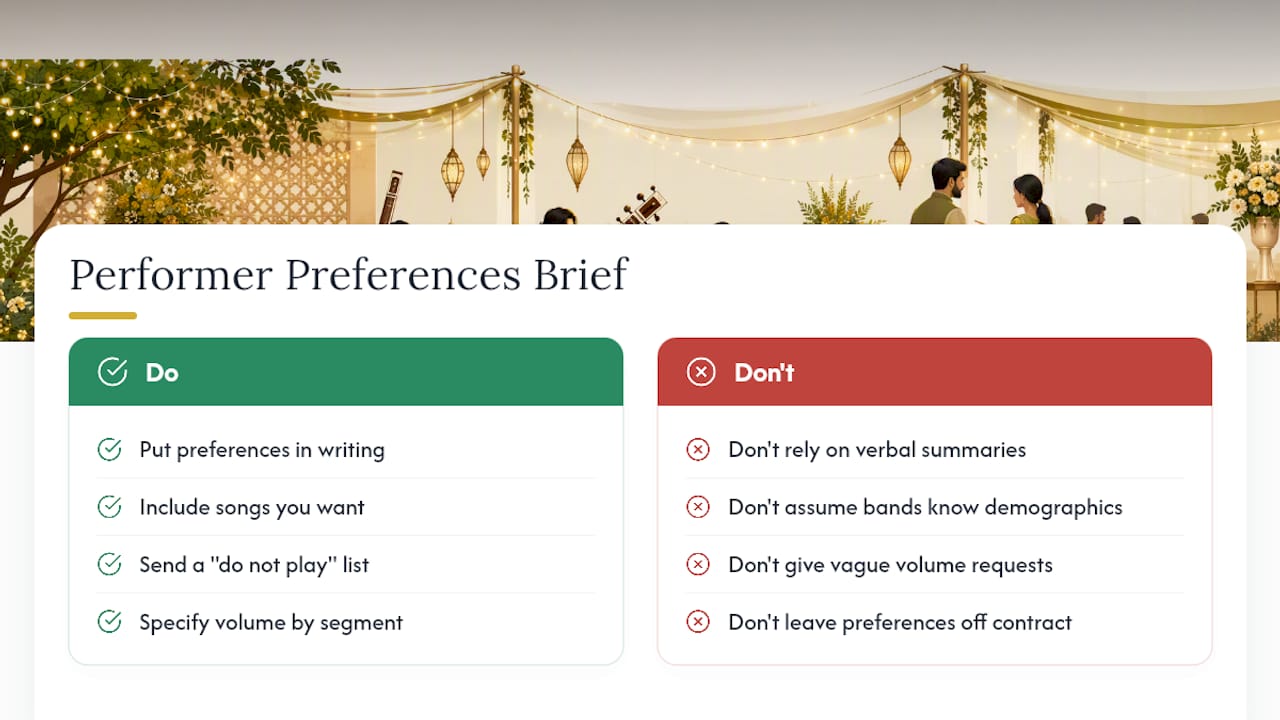
The clearer you are up front, the fewer awkward conversations you’ll have mid-reception. Give every act a written list, not a verbal summary, covering three things: songs you want, songs you explicitly don’t want, and any cultural or religious restrictions on content or volume.
Send a “do not play” list even if it feels unnecessary. Certain songs carry personal history for couples or families that a band has no way of knowing unless you tell them. The same goes for genre restrictions tied to guest demographics; if half the reception is over seventy, say so plainly rather than assuming the band will figure it out from the room.
Be specific about volume expectations by segment, not just overall. “Keep dinner quiet enough for conversation” is more useful to a band than “not too loud,” because it tells them exactly which moment the instruction applies to.
If you’re blending genres, such as pairing a sitar with Western pop songs, tell the performer which songs matter most for the arrangement and which are flexible. Bands and solo acts alike work faster and deliver better results when they know your non-negotiables versus your open-to-suggestion list.
Finally, put all of this in writing and attach it to the contract, not just an email thread. Verbal preferences get lost between the planning call and the actual performance date, especially when multiple vendors are involved.
Common Problems During Live Reception Performances and How to Fix Them
Even well-vetted acts run into predictable issues. Knowing the fix in advance turns a potential disaster into a two-minute correction.
Sound bleed between zones. Cocktail music in one area competing with dinner announcements in another usually means speakers were positioned without considering room layout. Fix it by walking the venue with the sound engineer before the event, not during setup.
Overrunning sets. A band running long on their dinner set eats into first-dance timing. Build five to ten minute buffers into every segment of the run-sheet specifically for this.
Equipment failure. A dead DI box or a blown amp mid-reception happens more often than anyone wants to admit. Confirm backup gear is part of the rider, and ask acts directly whether they travel with spares.
Awkward handoffs between live music and speeches. This is almost always a communication gap, not a musical one. Give the band a clear signal (a hand raise from the MC, a specific cue word) for exactly when to stop and start.
Guest requests derailing the set. A well-meaning guest asking for an unplanned song mid-dinner can throw off pacing. Brief the act in advance on how to politely defer these to the party segment instead.
Most of these trace back to planning gaps rather than performer skill, which is exactly why the vetting and logistics steps earlier in this guide matter as much as talent does.
What Planners Consistently Get Wrong About Reception Music
The conventional advice treats reception music as a single booking decision: pick a band, book them for the night, done. That framing misses where the real value sits, which is in the transitions, not the acts themselves.
Most planners overinvest in the party-hour band and underinvest in cocktail and dinner programming, treating those hours as filler before the “real” entertainment starts. That’s backwards. Dinner is where guests actually notice music, because they’re not distracted by dancing. A poorly chosen dinner playlist or an ill-fitting duo sticks in memory far longer than a slightly generic party set does.
Sitar and other Indian-classical solo instruments get dismissed too quickly as niche or ceremonial, when they’re genuinely effective tools for exactly the cocktail-to-dinner window planners neglect. The instrument’s texture holds attention without forcing volume, which is precisely what that stretch of a reception needs.
If you take one thing from this guide, prioritize the handoff points over the acts themselves. A great band with no rehearsed transition plan will still create an awkward reception; a modest act with airtight cues will feel seamless.
— Rajib
Book Live Reception Music That Fits Every Moment
Sitarrajib gives planners a done-for-you alternative to piecing together separate acts for cocktail, dinner, and handoff logistics: one specialist who arranges the sitar around your existing DJ or band, rather than making you coordinate two unfamiliar vendors on the day of the event.
Rajib Karmakar’s services cover solo sitar performances, bespoke arrangements that blend Indian classical textures with contemporary reception songs, and direct coordination with your DJ or band for clean tempo handoffs. Planners who book Sitarrajib skip the guesswork on logistics: sample recordings, a technical rider built for solo-instrument setups, and a consultation to map the exact moments sitar should cover during your reception. For studio work or bespoke session recordings tied to your reception, the live session recording services page details what’s available. Reach out through Sitarrajib to check date availability and get a quote built around your specific run-sheet.
Sources
For deeper sequencing guidance, the cocktail and dinner music breakdown covers tempo-building in detail, while wedding reception music planning offers song-count benchmarks. If your reception includes filmed coverage, cinematic wedding video music choices is worth a look, alongside our own sitar performance logistics guide for technical rider details.
- Cocktail and Dinner Music That Builds Your Wedding Night | DJ Hank Austin
- Wedding Cocktail Hour and Dinner Music Guide (2026)
- Weddings – Trey Daniels