
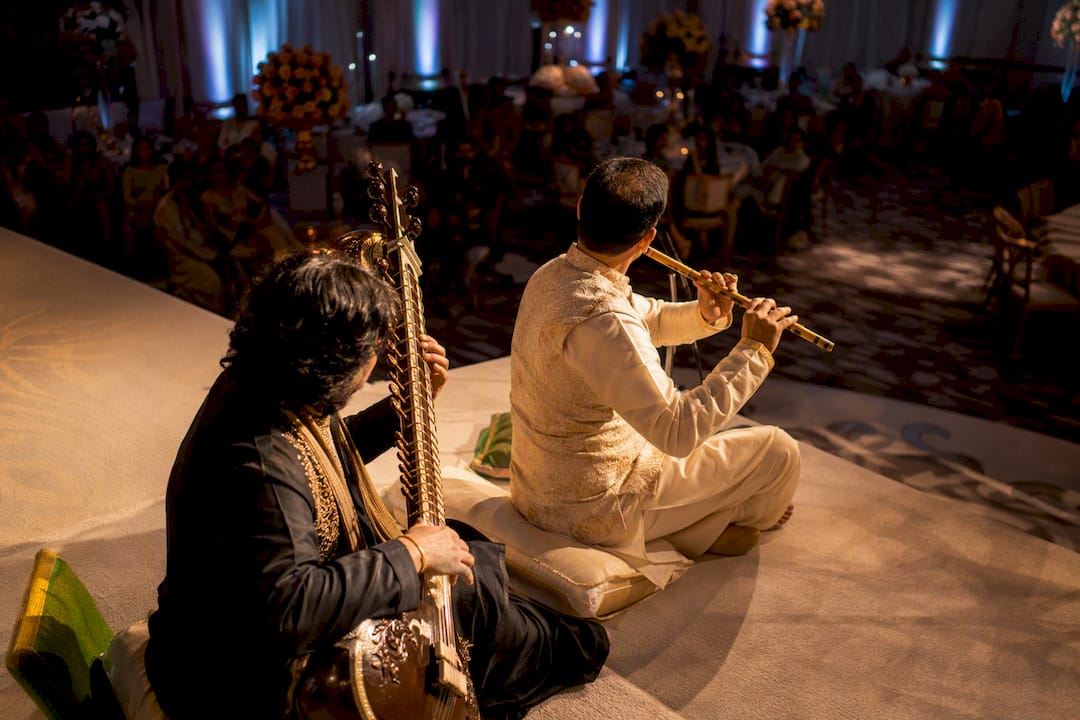
Book short, purpose-built sitar performance blocks instead of a recorded playlist, and your sangeet gets moments a speaker system cannot fake. A live sitar entrance medley, a 10 to 20 minute fusion performance block split into acts, and an ambient lounge set that hands off cleanly to the DJ cover the whole evening. SITARRAJIB, led by sitarist Rajib Karmakar, builds these sets around your choreography and timeline, not the other way around.
TL;DR:
- Live sitar performances should include well-timed entrance medleys, fusion covers, and ambient lounge sets to create memorable moments a playlist cannot replicate.
- The optimal setup varies by venue size, from solo sitar for intimate gatherings to ensembles with percussion, flute, or violin for larger or high-energy events.
- Sitar segments need careful scripting within the program, including rehearsals and cue points, to ensure smooth transitions and maximize impact during key moments.
- Confirm technical requirements such as power, seating, sound, and load-in logistics in advance to prevent last-minute issues on the event day.
- Building guest participation with sing-alongs, call-and-response rhythm breaks, and regional language blending enhances engagement and cultural authenticity.
Table of Contents
- Sangeet Music Ideas Built Around Live Sitar
- Choosing the Right Sitar Setup for Your Venue and Guest List
- Timing Live Sitar Into Your Sangeet Program
- What to Confirm Before the Performer Arrives
- Booking Checklist and Fee Guidance for a Sitar Performer
- Getting Guests Involved Instead of Just Watching
- Blending Regional Sounds and Languages Across the Evening
- Adjusting Sitar and Fusion Sets for Every Age and Energy Level
- Author’s Note From Rajib
- Book Live Sitar for Your Sangeet Through SITARRAJIB
- Sources
Sangeet Music Ideas Built Around Live Sitar
You don’t need a full concert. You need three or four well-placed moments that a DJ playlist can’t replicate. Here are the formats that work across most sangeet programs, whatever your theme.
Instrumental sitar entrance medley. Two to three minutes, built for the couple’s walk-in. Keep the mood warm rather than showy: a slow raga-based melodic line that rises into a brighter phrase as the couple reaches the stage. Two solid ideas: a gentle alap-style opening that resolves into a familiar folk melody, or a direct build from silence into a recognizable tune the crowd claps to instantly.
Fusion sitar covers. Popular song hooks get re-arranged as sitar-forward motifs, not played over a backing track. The performer isolates the hook, states it on sitar, then repeats it with rhythmic variation so it stays melodic and danceable without ever sounding like karaoke.
Dance-friendly classical arrangements. Raga-based rhythmic medleys in fast teentaal or a similar cycle give choreographed family acts something to count steps to. These work especially well for group numbers where multiple age groups are dancing together.
Ambient sitar lounge set. Slow tempo, solo sitar or a soft duo with tabla, played during dinner service or cocktail hour rather than the main performance slot. This is where the instrument’s texture does the work quietly, without demanding attention.
Sitar and percussion ensemble. For high-energy group performances, a three to five piece setup (sitar, tabla or electronic percussion, sometimes flute or violin) carries more volume and rhythmic drive than solo sitar alone.
A typical performance run might look like: a two to three minute entrance medley, a break for toasts, then a 12 to 15 minute performance block divided into two acts (one classical dance arrangement, one fusion cover), followed by a smooth handoff into ambient lounge music while the DJ preps the next segment.
Pro Tip: Send your performer a two or three song “mood board” instead of a fixed setlist. Naming the feeling you want (celebratory, romantic, high energy) gives an experienced sitarist more room to build a medley that actually lands than a rigid track list does.
Choosing the Right Sitar Setup for Your Venue and Guest List
The right instrumentation depends less on budget and more on room size, guest count, and how much dancing is planned. A ballroom with 300 guests needs different projection than a backyard sangeet with 40.
- Solo sitar works well for intimate gatherings under 75 guests or for ambient lounge sets where background texture matters more than volume.
- Duo (sitar and tabla) covers most mid-size sangeets and adds rhythmic drive for one or two danceable acts.
- Three to five piece ensemble (sitar, percussion, and often flute or violin) suits larger venues or high-energy group choreography where solo sitar would get lost in the room.
- Acoustic vs. amplified matters most for dance segments: amplified or electronics-assisted sitar holds up against foot stomping and clapping far better than a purely acoustic setup.
- Tabla vs. electronic percussion is a real trade-off. Tabla sounds warmer and more traditional; electronic percussion locks tighter to a choreographed count and travels easier.
Before you book, ask every candidate performer: How flexible is your repertoire with theme changes? Have you worked with choreographed acts before? What are your travel and rehearsal requirements? A performer who has arranged live music for ceremonies before will usually answer these without hesitation.
Timing Live Sitar Into Your Sangeet Program
Modern sangeet nights are built as performance blocks with multiple short acts, not one long set, so your sitar segments should be scripted into that rhythm rather than dropped in as filler.
- Entrance medley: 2 to 3 minutes, live sitar only, timed to the couple’s walk from door to stage.
- Main performance block: 10 to 20 minutes total, split into 2 to 4 acts, alternating dance-forward arrangements with a quieter classical moment.
- Live to DJ handoff: script the cue in advance. A common one: the sitar sustains a final note as the DJ fades in a beat under it, so the transition never feels like a hard stop.
- Ambient set: live sitar returns during dinner or a lull, handing off again once the dance floor opens.
Run at least one rehearsal with the choreographer and performer together, especially for surprise acts like a parent’s dance number. A click track helps if the choreography is tightly timed; a flexible tempo works better for freer, more emotional pieces. Save the sitar’s biggest moment, whether that’s the entrance or a surprise family performance, for when it will actually cut through the room, and let the DJ carry the high-volume dance stretches. Timing details like this are worth locking into the entrance music plan before the day itself.
What to Confirm Before the Performer Arrives
A few overlooked logistics decisions cause most day-of problems for traditional-instrument acts.
- Seating: an armless, stable chair or a low platform at the right height. Cross-legged floor seating looks beautiful but needs a firm, even surface, not carpet over uneven flooring.
- Sound: confirm mic or DI input, monitor needs, and build in at least 30 to 45 minutes of soundcheck time before guests arrive.
- Power: dedicated circuits for any electronic percussion or amplification, plus a backup outlet in case of a tripped breaker.
- Load-in and storage: clear parking access, a secure spot to store the instrument between sets, and enough space near the stage for the resonating body of the sitar to sit unobstructed.
- Setup and teardown: build 45 minutes to an hour into the schedule on each end, even for a solo performer.
Pro Tip: Assign one single point of contact, a planner or stage manager, for the performer’s arrival and technical needs. A short technical rider paired with one dedicated contact eliminates most last-minute scrambling.
A detailed technical requirements guide is worth sharing with your venue coordinator well before the event.
Booking Checklist and Fee Guidance for a Sitar Performer
Send this brief to every performer you’re considering: event date and time, arrival window, exact set lengths, any theme or song preferences, rehearsal availability, and the cancellation policy.
- Travel distance adds to the fee, especially for ensembles requiring multiple performers to be transported.
- Ensemble size is the biggest cost driver: solo sitar costs the least, a duo more, and a three to five piece ensemble the most.
- Custom arrangements (fusion covers written specifically for your event) take rehearsal time and usually carry a separate arrangement fee.
- Licensing matters if you want a specific copyrighted song adapted; ask upfront whether the performer handles this or whether you need to.
As a rough shape rather than a fixed quote: solo sitar bookings tend to sit at the lower end of live-performer pricing, duos in the middle, and full ensembles at the top, with custom arrangements and travel pushing any of those higher. Confirm in writing whether any recorded backtrack will be used and who holds rights to an arranged cover before you pay a deposit. The complete booking guide walks through each of these points in more detail.
Getting Guests Involved Instead of Just Watching
The best sangeet music moments aren’t always the ones on stage. Build in a few points where guests sing or move along rather than just watch.
A short sing-along works well right after the entrance medley, when a familiar folk tune or wedding song is still fresh in everyone’s ears. Ask your performer to hold the melody simple and repeat the hook twice so guests without any musical background can join in by the second pass. For older relatives who won’t dance but love to sing, this moment often means more than the choreographed acts.
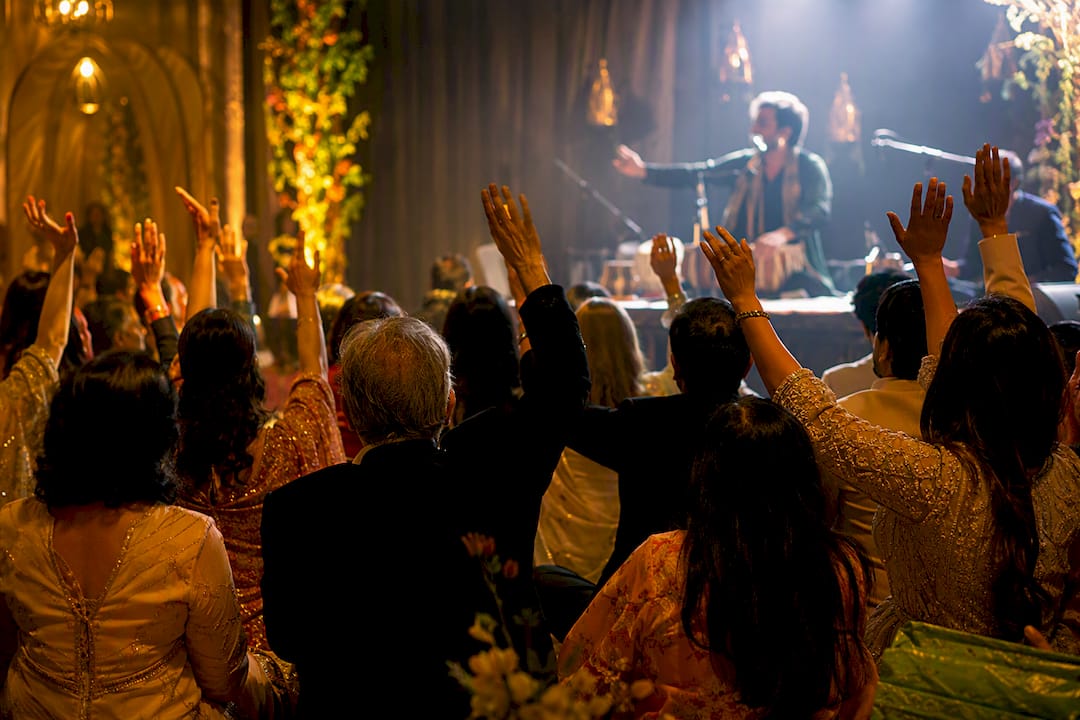
Call-and-response rhythm breaks work especially well during the percussion-heavy sections of a performance block. A tabla or percussion player can prompt a clapping pattern that spreads through the crowd in seconds, no instructions needed.
If your sangeet includes a Sufi or qawwali-inspired segment, a group hand-raise or gentle sway during the chorus tends to happen naturally, since the format already invites participation. Brief your performer on which two or three moments in the night you want to open up this way. A sitarist experienced with sangeet crowds will know how to leave space in the arrangement, a pause, a repeated phrase, a nod to the crowd, that makes joining in feel obvious rather than staged.
Blending Regional Sounds and Languages Across the Evening
Sangeet traditions carry roots in Punjabi and Gujarati wedding customs, but most modern programs pull from several regions and languages in a single night, and live sitar handles that mixing better than a fixed playlist can.
Decide early which languages and regional styles matter to your families: Punjabi bhangra energy, a Gujarati folk segment, a Bollywood-era favorite, maybe a Sufi qawwali moment. Hand that list to your performer as a theme brief rather than a song list. Since sangeet themes vary from Sufi nights to disco-inspired sets, a sitarist who arranges rather than just plays covers can shift texture between segments, brighter and more percussive for bhangra energy, slower and more ornamented for a Sufi passage, without needing a DJ to switch tracks.
The transition points matter most. A short instrumental bridge on sitar between a Punjabi-language segment and a Bollywood-Hindi segment smooths what would otherwise be an abrupt jump. This is also where a sitar and flute or sitar and violin pairing earns its place: the second melodic instrument can echo a regional folk phrase while the sitar carries the underlying rhythm, so the blend feels intentional rather than stitched together.
Adjusting Sitar and Fusion Sets for Every Age and Energy Level
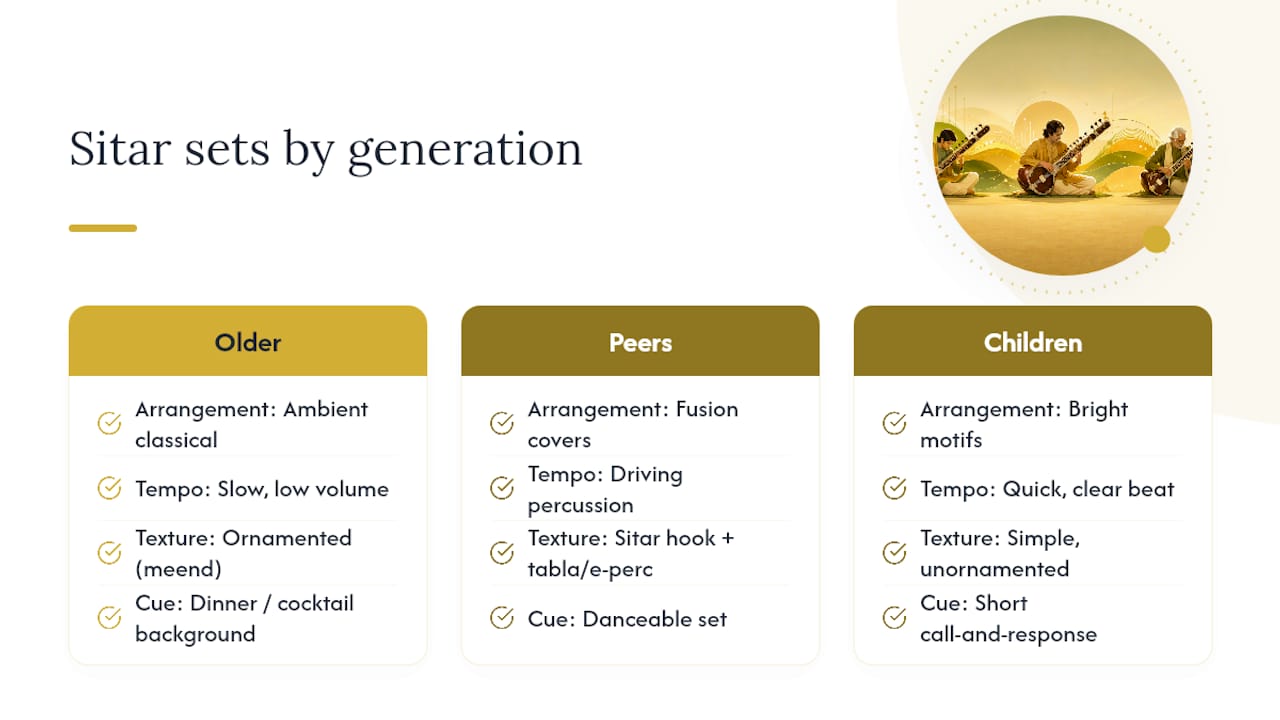
A sangeet crowd usually spans three generations at once, and the same arrangement rarely satisfies all of them equally.
For grandparents and older relatives, slower ambient sitar during dinner or cocktail hour tends to land better than anything percussion-heavy. Classical ornamentation, the slides and bends a sitarist calls meend, reads as respectful and rich rather than background noise to this group, even at low volume.
For the couple’s peer group and younger cousins, fusion covers with a driving percussion line hold attention far better than a pure classical piece. Keep the sitar hook recognizable and let a tabla or electronic percussion part carry the danceable energy underneath it.
For young children at the event, short, brighter melodic phrases with a clear beat work best; anything too slow or ornamented loses their attention within a minute. A quick, playful call-and-response moment during a percussion break usually gets them moving without needing a separate “kids’ segment.”
The practical fix is simple: brief your performer on which segment of the night serves which generation, and let the arrangement shift tempo and texture accordingly rather than trying to please everyone with one uniform set.
Author’s Note From Rajib
I build every sangeet set the same way: start from the raga’s emotional core, then let fusion elements carry the dance energy without diluting the sitar’s voice. That balance, classical depth with contemporary rhythm, is what makes a live set memorable instead of just present. SITARRAJIB offers full booking support, a technical requirements guide, and sample performance videos so you can hear the arrangement style before committing to a date.
— Rajib
Book Live Sitar for Your Sangeet Through SITARRAJIB
SITARRAJIB gives you what a recorded playlist can’t: a performer who builds the entrance medley, dance-friendly fusion covers, and ambient lounge set around your actual timeline instead of forcing your program around fixed tracks. Rajib Karmakar arranges each set, solo sitar, sitar and tabla duo, or a full ensemble, specifically for your venue, guest count, and theme, with rehearsal time built in for choreographed acts.
Watch sample performance videos to hear the range before you reach out, then use the complete sangeet booking guide to confirm your date, request a repertoire tailored to your theme, and get a fee quote based on ensemble size and travel.
Sources
For the cultural background behind sangeet traditions, see The Knot’s sangeet ceremony guide and Cultural India’s overview of sangeet rituals. For booking and technical details, review SITARRAJIB’s booking guide and technical requirements guide.
- What Is a Sangeet? The Music-Night Primer | Okanagan Wedding Co.
- Indian Wedding Sangeet Ceremony – Ideas & Significance
- What Is a Sangeet? The Music-Night Primer (Falguni Shane Peacock blog)