
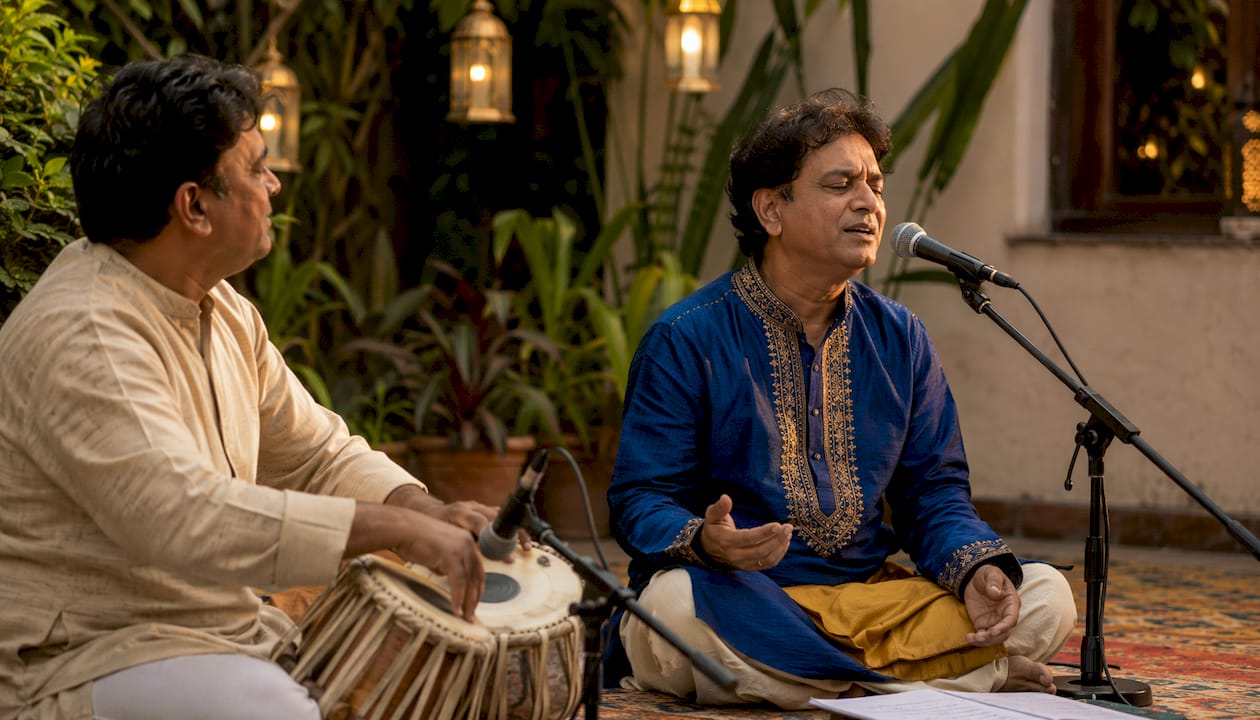
A bandish is a fixed, raga-based composition that serves as the structured foundation of a Hindustani classical music performance. Think of it as the anchor point every performer returns to, no matter how far the improvisation travels.
- Core elements: A bandish is set to a specific raga (melodic framework) and tala (rhythmic cycle), and its notes and phrases are fixed by composition rules.
- Alternate names: In vocal music, it is often called a cheez. In instrumental music, the same concept goes by gat.
- Performance role: The bandish anchors improvisation. Performers depart from it to explore the raga, then return to it to signal structure and stay coordinated with the tabla player.
Table of Contents
- What does “bandish” actually mean?
- How a bandish is built: sthayi, antara, and more
- How bandish form changes across khayal, dhrupad, thumri, and gat
- How the bandish functions during a raga performance
- What makes a bandish musically effective
- How to listen to a bandish: a step-by-step guide
- How a bandish differs from a regular song
- What you should take away from this
- Key Takeaways
- Why bandish mastery is the real foundation
- Ready to learn bandish with a real teacher?
- Useful sources and recommended listening
What does “bandish” actually mean?
The word bandish comes from the Hindi/Urdu root meaning “to bind” or “binding together.” That literal meaning tells you exactly what the composition does: it binds the raga’s melodic grammar to the tala’s rhythmic cycle in a single, repeatable structure.
The alternate names reflect context. Cheez (literally “thing” or “piece”) is the common term in khayal vocal traditions. Gat is used in instrumental traditions, particularly on sitar and sarod. All three words point to the same idea: a composed, fixed piece that holds the performance together.
Historically, the naming also reflects lineage. Different gharanas (hereditary schools of music) favored different terms, and the same composition could carry a different name depending on who taught it and where.
How a bandish is built: sthayi, antara, and more
A standard bandish has two main sections, and knowing them helps you follow any performance.
- Sthayi (also spelled astayi): The opening, main phrase. It typically moves in the lower to middle register of the raga and is the section performers return to most often after improvisation. Vocal bandishes commonly have two sections: the sthayi and the antara.
- Antara: The second phrase. It usually reaches into the upper register and provides melodic contrast. The antara’s role) is to develop the raga’s character in a higher range before the performer returns to the sthayi.
- Sanchaari and aabogh: Older dhrupad forms sometimes include these additional sections, which extend the composition’s melodic journey before resolving back to the sthayi.
Every time a performer finishes a stretch of improvisation, they land back on the sthayi. That return is a structural signal, not just a habit. It tells the tabla player and the audience where the performance stands in the tala cycle.
Pro Tip: When you listen to a khayal performance, count how many times the singer returns to the same opening phrase. Each return is the sthayi landing on the sam (the first beat of the tala cycle). That moment of return is the bandish doing its job.
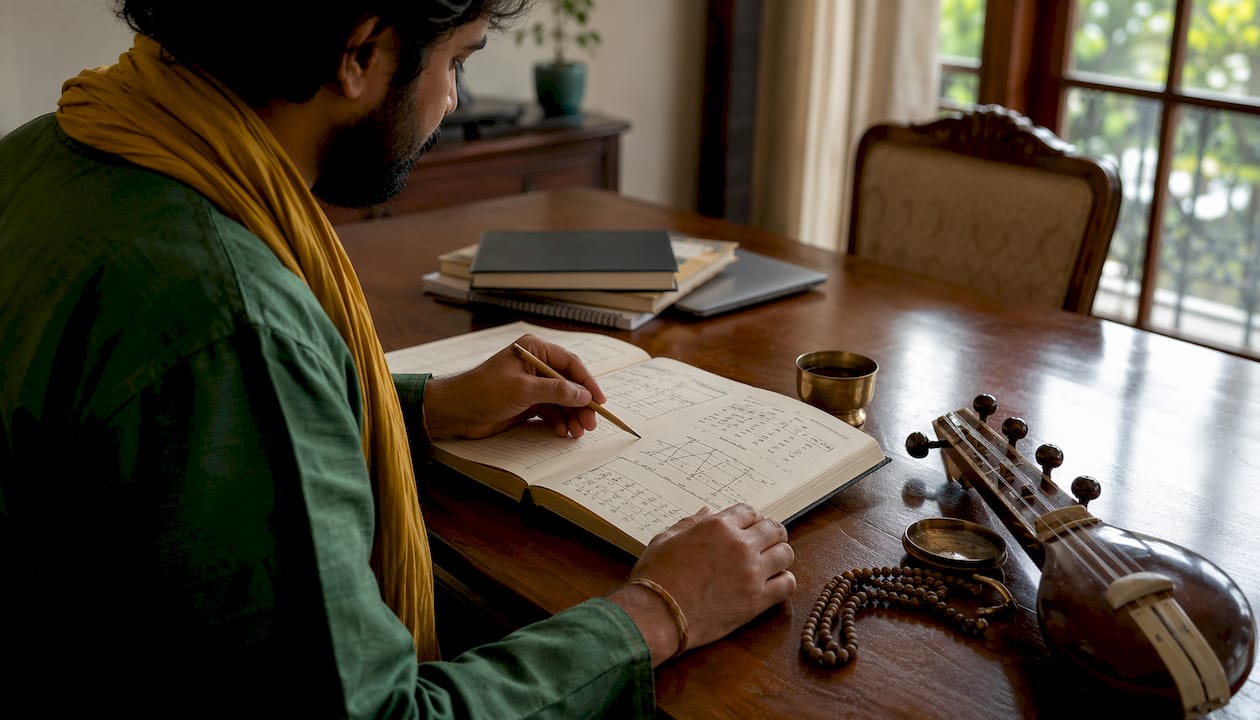
How bandish form changes across khayal, dhrupad, thumri, and gat
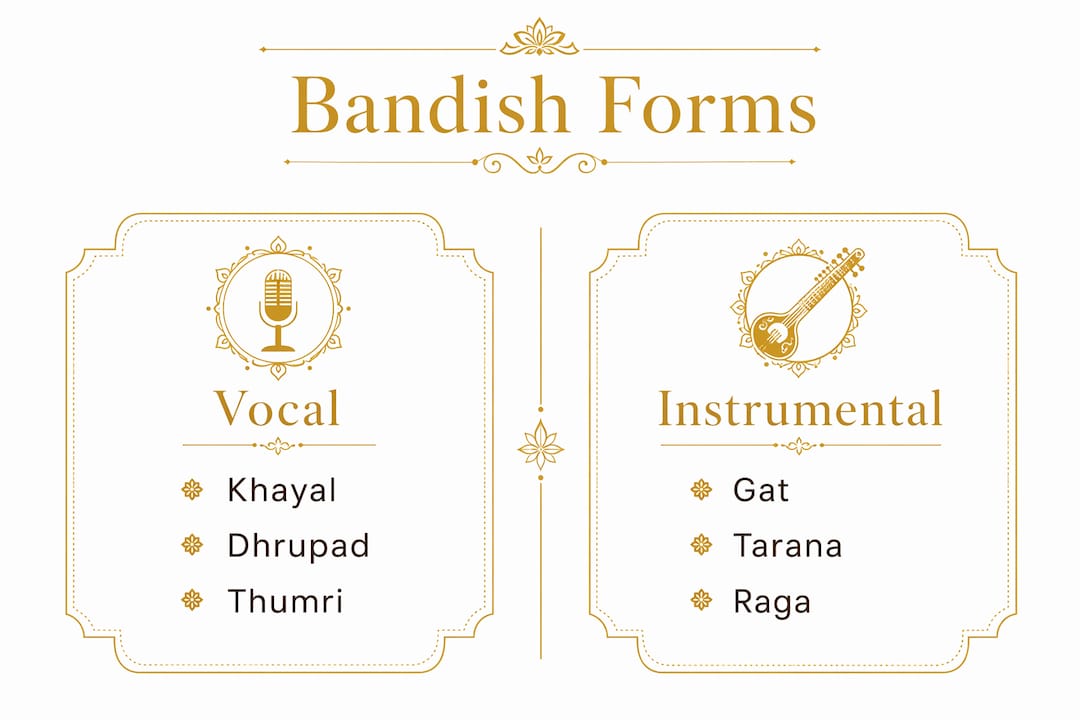
The meaning of bandish in music stays consistent, but its shape shifts depending on the genre. Here is a quick comparison.
| Form | Tempo convention | Structure | Lyrical character |
|---|---|---|---|
| Khayal (vocal) | Vilambit (slow), madhyalaya (medium), or drut (fast) | Sthayi + antara; shorter, lyrical phrases | Lyrics present but often secondary to melody |
| Dhrupad (vocal) | Slow to medium; older, more austere | Four sections (sthayi, antara, sanchaari, aabogh) | Devotional or philosophical texts; words carry more weight |
| Thumri (light classical) | Medium to brisk | Looser structure; more lyrical flexibility | Romantic or devotional; lyrics are central |
| Instrumental gat (sitar, sarod) | Vilambit or drut | Sthayi + antara; no lyrics | Melody carries the full compositional load |
Khayal bandishes tend to be shorter and more lyrical, designed to leave room for extensive improvisation. Dhrupad bandishes are older in form and more architecturally complex. Thumri sits closer to a song in feel, with the lyrics playing a bigger role. The instrumental gat strips away words entirely, letting the melodic line and ornamentation carry everything. For a broader look at raga-based compositions, the forms connect in ways that reward further study.
How the bandish functions during a raga performance
A raga performance does not start with the bandish. It typically opens with an alaap, an unmetered, improvised exploration of the raga’s notes and mood. Only after that does the tabla enter and the bandish begin.
Scholarly treatments describe the bandish as the fixed composition that holds a central position in North Indian raga performance, functioning as both a standalone piece and a base for further development. Once the bandish is introduced, the performer uses it as a home base. They depart into improvised passages called taan or bol-taan, then return to the sthayi at the sam. That return keeps the performance coherent and keeps the tabla player and vocalist or instrumentalist synchronized.
The bandish acts as the composed floor on which the performer’s improvisations dance. Without it, there is no structure to depart from or return to. Understanding sitar improvisation helps clarify just how much the bandish shapes what the performer can and cannot do.
Pro Tip: To spot the bandish in a live performance, listen for the moment the tabla and the vocalist or instrumentalist seem to “click” together on a strong beat. That is the sam, and the phrase landing on it is almost certainly the sthayi of the bandish.
What makes a bandish musically effective
Not every fixed composition qualifies as a strong bandish. Effective ones follow specific rules and carry certain aesthetic qualities.
- Raga grammar: Every note and phrase must stay within the rules of the assigned raga. A bandish that uses a note the raga forbids is simply wrong, not creative.
- Tala alignment: Key syllables and melodic peaks must land on meaningful beats in the tala cycle. The sam placement of the sthayi’s opening note is especially important.
- Syllabic economy: In vocal bandishes, lyrics often serve sound and syllabic fit rather than poetic prominence. A single syllable may be stretched across many notes.
- Melodic motif: The best bandishes contain a short, memorable melodic idea that captures the raga’s character and invites elaboration.
- Suitability for improvisation: A bandish that leaves no room to explore is a poor scaffold. The composition should suggest directions without exhausting them.
Gharana lineage shapes all of this. A bandish passed down through the Jaipur-Atrauli gharana will carry different ornamental preferences and textual choices than one from the Agra gharana, even when both are set to the same raga.
How to listen to a bandish: a step-by-step guide
You do not need formal training to recognize a bandish. Follow these steps with any khayal or instrumental recording.
- Find the drone. The tanpura (or a tanpura app) plays a continuous drone. That is the tonal center of the raga.
- Listen through the alaap. The opening section has no rhythm. The performer is introducing the raga’s notes and mood without a beat.
- Notice when the tabla enters. That moment marks the start of the bandish. The first phrase you hear after the tabla enters is the sthayi.
- Track the returning phrase. Every time the performer comes back to that opening phrase and lands on the strong beat, you are hearing the sthayi return to the sam.
- Listen for the shift upward. When the melody climbs into a higher register, that is the antara. After it resolves, the performer returns to the sthayi again.
For practical listening in the U.S., search for “Yaman khayal vilambit” or “Bhairavi thumri” on Spotify, Apple Music, or YouTube. These are among the most accessible ragas for new listeners. Notation alone cannot capture what you hear in a recording: the bends, slides, and ornaments that make each bandish distinct.
Pro Tip: Pay attention to the ornaments between notes, not just the notes themselves. Meend (a smooth glide between pitches) and gamak (a rapid oscillation) are often what give a bandish its personality. You will not find those in written notation.
If you want to hear these elements in a live context, Rajib Karmakar’s sitar concerts offer a clear window into how a bandish anchors a full performance. You can also explore music passion and listening more broadly if you are just getting started with Indian classical music.
How a bandish differs from a regular song
A bandish and a song may both have melody and words, but they serve very different purposes.
- Rule-bound vs. free: A bandish must adhere to raga grammar; a song’s composer has no such constraint. Every note choice in a bandish is accountable to the raga’s rules.
- Scaffold vs. finished product: A song is complete as written. A bandish is a starting point. The performance builds on top of it through improvisation.
- Lyrics as secondary vs. central: In many classical bandishes, the words exist to fit the melodic and rhythmic structure. In a song, the lyric is usually the point.
- Hundreds of bandishes can exist for a single raga, each offering a different interpretive angle. A song does not work that way; it is its own complete statement.
What you should take away from this
- A bandish is a fixed melodic composition in Hindustani classical music, set to a specific raga and tala.
- Its two main sections are the sthayi (lower register, returning phrase) and the antara (upper register, contrasting phrase).
- It functions as the anchor of a raga performance: improvisation departs from it and returns to it at the sam.
- Vocal forms use the term cheez; instrumental forms use gat; the underlying concept is the same.
- To spot a bandish while listening, track the phrase that returns to the strong beat after each improvised passage.
If you want to go deeper, the best next step is to learn one bandish slowly with a teacher, map its syllables to the tala, and then try improvising within the raga’s rules.
Key Takeaways
A bandish is the fixed, raga-bound composition that anchors every Hindustani performance, giving both performer and listener a structural home base to return to.
| Point | Details |
|---|---|
| Core definition | A bandish is a fixed composition set to a specific raga and tala in Hindustani classical music. |
| Main structural sections | The sthayi (lower, returning phrase) and antara (upper, contrasting phrase) form the two core parts. |
| Performance function | Performers depart into improvisation and return to the sthayi at the sam to maintain rhythmic coordination. |
| Difference from a song | A bandish is constrained by raga grammar and serves as a scaffold; a song is a finished, rule-free product. |
| Sitarrajib | Rajib Karmakar teaches bandish structure and raga performance through private lessons and workshops in Los Angeles. |
Why bandish mastery is the real foundation
Most beginners focus on scales and notes. The bandish is where the real learning happens. Dr. Prabha Atre describes the bandish as a condensed seed form of a raga: it suggests direction and limits for elaboration rather than exhaustively defining the raga. That framing changed how I think about teaching.
When a student learns a bandish correctly, they are not just memorizing a melody. They are internalizing where the raga wants to go, which notes carry weight, and how the tala shapes every phrase. Practicing a bandish reveals where key syllables land on the sam and how specific notes interact with the rhythmic cycle. That is the laboratory work of Indian classical music.
Oral transmission matters here more than most people realize. Many bandishes were historically protected within gharanas and passed from teacher to student without notation. Versions of the same bandish can vary between teachers because each lineage made interpretive choices that notation never recorded. A recording helps, but it still cannot show you the subtle pressure on a note or the timing of an ornament. That is why learning from a teacher, not just a playlist, is the path that actually works.
Ready to learn bandish with a real teacher?
Sitarrajib offers private sitar lessons, workshops, and studio sessions designed around exactly this kind of structured learning. Whether you want to understand how a bandish is built, hear one performed live, or start learning one yourself, Rajib works with students at all levels from his base in Los Angeles.
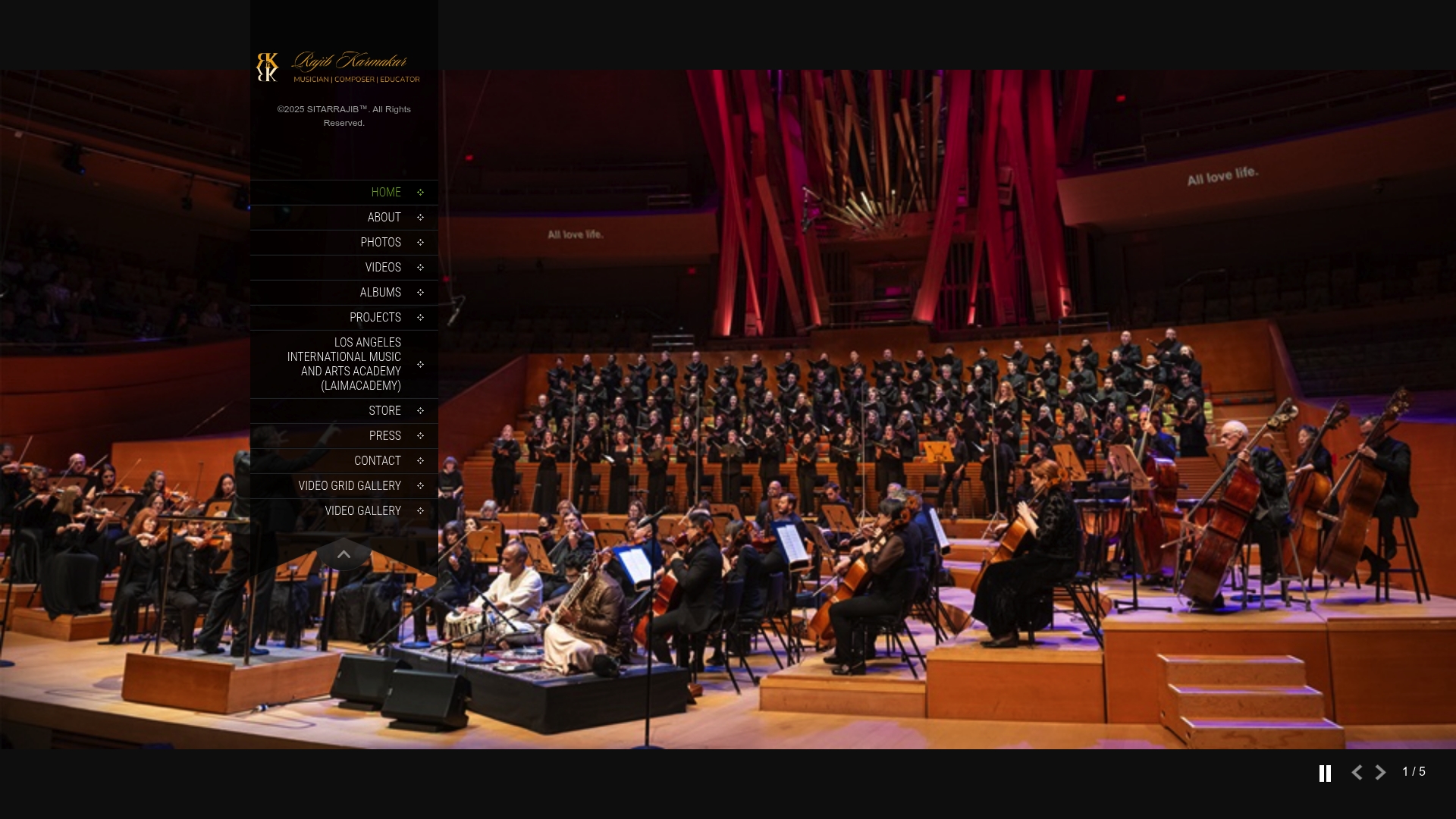
If you are a producer or filmmaker, live session sitar recording with Sitarrajib gives you access to authentic bandish-based performances captured with full studio quality. For event planners, a sitar performance for corporate events brings this tradition to your audience in a format that works for any venue. Reach out through sitarrajib.com to check availability and get started.
Useful sources and recommended listening
- Bandish — Wikipedia: A solid starting overview of the term, its structure, and its role in Hindustani music.
- Antara (music) — Wikipedia): Focused entry on the antara section and its melodic function.
- Bandish: A Perspective by Dr. Prabha Atre — Nadsadhna: A practitioner’s essay on bandish as a raga seed form; highly recommended for anyone studying composition.
- Bandish: The Heart of Khayal — SwarGanga: Pedagogical breakdown of how bandish functions in khayal performance.
- Rules of Bandish Composition — Sursanskaar: Detailed look at compositional constraints, lyric prosody, and aesthetic principles.
- What is a bandish? — The Hindu BusinessLine: Accessible journalism-style explainer with context on raga variety and bandish diversity.
- bandish — Wiktionary: Quick etymological reference for the word itself.
- Streaming search tips (U.S.): On Spotify or Apple Music, search “Raga Yaman khayal” for a slow vilambit example, “Raga Bhairavi thumri” for a lighter form, or “Raga Bhairav dhrupad” for an older, multi-section bandish. YouTube also has extensive archival recordings from All India Radio that are free to access.