
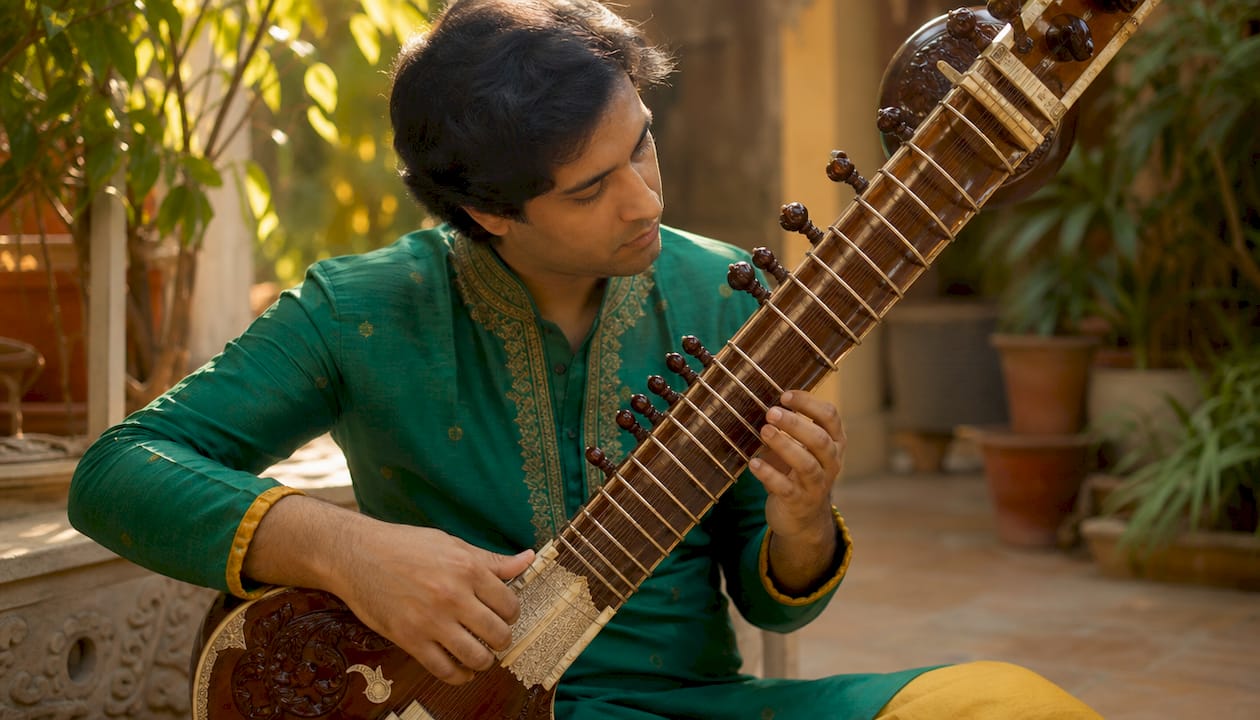
Meend on the sitar is defined as a continuous glide between two notes, produced by pulling the main string sideways across the instrument’s curved, raised frets. This technique is the foundational ornament of Hindustani classical music and the primary reason the sitar sounds vocal and expressive. Skilled players can bend pitch by 5 to 6 notes from a single fret position. That range gives the sitar a melodic flexibility no Western fretted instrument can match. If you want to understand what is meend on sitar, start here: it is not a stylistic flourish. It is the grammar of the instrument.
What is meend on sitar, and how does it work physically?
Meend works because of the sitar’s unique construction. The frets are tall, curved, and tied with gut or nylon, which means the string sits high above the fingerboard. The sitar’s curved high frets allow the string to be pulled laterally across the fret surface without losing contact, creating a smooth, continuous pitch rise. Pressing down, as a guitarist would, produces only a marginal pitch change. Pulling sideways produces the full glide.
The physics are straightforward. When you pull the string across the fret, you increase its tension and effective vibrating length simultaneously. The result is a pitch that rises smoothly from the starting note to the target note without any gap in sound. This is what separates meend from a simple pitch shift.

How to perform a basic ascending meend
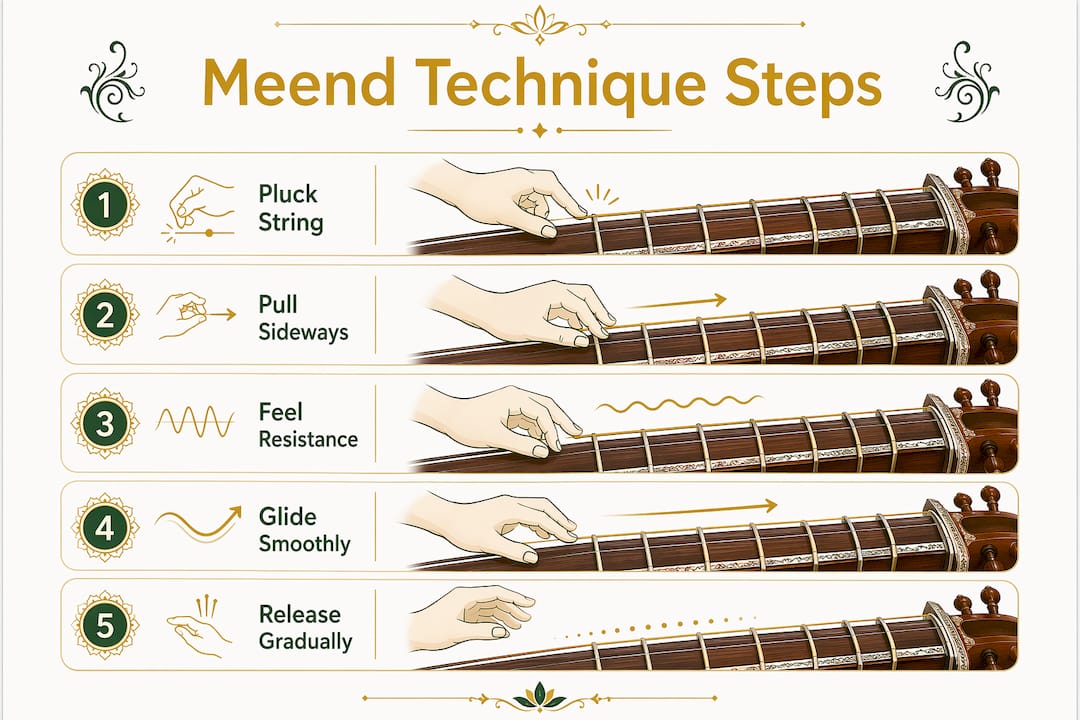
Learning the physical steps in order makes the technique much easier to build correctly from the start.
- Pluck the string firmly. Use your right-hand index finger with a strong, confident stroke. A weak pluck means the note decays before the glide completes.
- Place your left-hand index finger on the starting note. Keep the finger curved, not flat, so the tip contacts the string cleanly.
- Pull the string sideways toward the lower strings. Move the string across the fret in a controlled, steady motion. Do not press down.
- Sustain the pull until you reach the target pitch. Listen carefully. The glide should arrive at the destination note without overshooting.
- Release slowly for a descending return if needed. Controlled release creates a descending meend back to the original note.
Common beginner mistakes include pressing the string down instead of pulling it sideways, plucking too softly, and losing string contact mid-glide. Each of these breaks the sound and ruins the effect.
Pro Tip: Practice the pull motion without plucking first. Just move the string sideways slowly and feel the resistance. Once your hand knows the direction and pressure, add the pluck. This builds muscle memory faster than trying to coordinate both actions at once.
Why is meend so important in Indian classical music?
Meend is considered the most important ornament in Hindustani classical music and appears constantly in classical performance. That status is not arbitrary. Indian classical music is built on ragas, each of which has specific rules about which notes to emphasize, which to approach gradually, and which to connect with glides. Meend is the tool that executes those connections.
The concept of rasa, the emotional essence of a musical phrase, depends heavily on how notes are connected, not just which notes are played. A bare sequence of notes can feel mechanical. The same sequence with meend feels alive, emotional, and intentional.
“Indian classical music prioritizes flowing glide over discrete notes, differing from Western musical emphasis on note clarity. Meend creates a river of sound effect, allowing performers to navigate microtones, called shruti, that are fundamental to emotional expression in ragas.”
Gamaka, Meend, and Andolan: Ornamentation in Eastern Classical Music
This distinction matters for musicians trained in Western traditions. Western music treats notes as fixed points. Indian classical music treats them as destinations reached through a path. Meend is that path.
The technique also connects sitar playing to vocal music, which sits at the top of the Indian classical hierarchy. Vocalists use a technique called gamaka to ornament notes with glides and oscillations. Meend on the sitar replicates that vocal quality directly. The Maihar Seniya Gharana, the school associated with Pandit Ravi Shankar and Pandit Nikhil Banerjee, treats meend as the primary vehicle for achieving the sitar’s singing quality. Both masters built their expressive styles around continuous, vocal-like melodic arcs.
Key reasons meend holds this central role in Indian classical music:
- It expresses microtones (shruti) that lie between the twelve standard notes of the scale.
- It connects notes in a way that mirrors the human voice, the gold standard in Indian classical aesthetics.
- It allows the performer to convey specific emotional states tied to each raga.
- It distinguishes a musical phrase from a mere sequence of pitches.
- Educators introduce it early because every raga phrase eventually requires it.
You can watch this vocal quality in action through Rajib Karmakar’s sitar performances, where meend shapes the emotional arc of each phrase.
What are the different types of meend on sitar?
Meend is not a single, fixed technique. Advanced players distinguish between simple meend and circuitous meend, each serving a different expressive purpose.
Simple meend is a straight glide from one note to another. It is the foundation and the most common form. You pluck, pull, and arrive. The path is direct.
Circuitous meend traces a non-linear path through multiple notes before arriving at the destination. The player pulls to an intermediate note, releases slightly, then continues the pull or changes direction. This creates a complex melodic curve that carries far more emotional weight than a straight glide.
Beyond these two categories, advanced sitar playing uses meend in several specific ways:
- Pull and release: The player pulls to a higher note, then releases the string back to the original pitch. This creates a falling glide that feels like a sigh or a question.
- Integration with kan swar: A kan swar is a grace note, a brief touch of an adjacent note before landing on the main note. Combining it with meend creates a phrase that approaches the target from above or below with a glide attached.
- Integration with gamak: Gamak is a forceful, repeated oscillation. When combined with meend, it produces phrases that surge and recede with intensity.
- Integration with andolan: Andolan is a slow, gentle oscillation on a single note. Meend can lead into or out of andolan to create a seamless emotional arc.
Meend combined with ornaments like kan swar, gamak, and andolan produces the layered melodic texture that defines advanced sitar playing. In raga improvisation, these combinations allow the performer to tell a musical story with a single phrase.
How do you overcome the common challenges of mastering meend?
Mastering meend requires balancing string tension and maintaining a continuous resonating pluck throughout the glide. Inconsistent pressure leads to abrupt breaks in sound mid-glide. This is the most common problem for learners at every level.
The challenges fall into a few clear categories:
- Sound breaks mid-glide: Usually caused by insufficient pluck strength or losing finger contact with the string during the pull.
- Uneven pitch bend: The glide accelerates or slows unevenly, making the phrase sound choppy. This comes from inconsistent pull speed.
- Overshooting the target note: The player pulls too far and lands above the intended pitch. Ear training fixes this faster than any physical drill.
- Pressing instead of pulling: The most common mistake for beginners, especially those with guitar experience. Pressing down tightens the string against the fret and produces a different, less fluid sound.
- Weak tone at the end of the glide: The note decays before the glide completes. Solve this with a stronger initial pluck and a faster pull.
Pro Tip: Record yourself practicing meend and listen back without playing along. Your ear catches pitch inaccuracies and sound breaks far more reliably when you are not focused on the physical act of playing. Ten minutes of critical listening per practice session accelerates progress more than an extra hour of repetition.
Ear training is the most underrated part of meend practice. You need to hear the target note clearly in your mind before your hand can find it reliably. Singing the glide before playing it on the instrument is a technique many classical teachers use. It builds the internal pitch map that your fingers then follow.
Practice routines that build meend proficiency:
- Slow, deliberate glides across one fret, holding the destination note for a full count of four.
- Ascending and descending meend pairs on the same string, maintaining even pull and release speed.
- Meend within a specific raga phrase, repeating until the glide lands on pitch every time.
- Practicing with a tanpura drone in the background to train pitch accuracy against a fixed reference.
Key Takeaways
Meend is the single most important ornament on the sitar because it enables the vocal, microtonal expression that defines Hindustani classical music.
| Point | Details |
|---|---|
| Core definition | Meend is a continuous pitch glide produced by pulling the sitar string sideways across curved frets. |
| Physical mechanics | Pull the string laterally, never press down; a strong initial pluck sustains the sound through the full glide. |
| Musical importance | Meend expresses microtones and emotional nuance that bare note sequences cannot convey. |
| Types of meend | Simple meend is a straight glide; circuitous meend traces complex melodic paths for deeper emotional effect. |
| Practice priority | Ear training and slow, deliberate repetition build pitch accuracy faster than speed-focused drills. |
Meend changed how I hear music, not just how I play it
I have been playing the sitar for decades, and meend is still the technique I return to most in my own practice. Not because I have not mastered it, but because it never stops teaching you something.
The biggest shift for me came when I stopped thinking about meend as a physical action and started thinking about it as a listening exercise. The hand follows the ear. If your internal pitch is vague, your glide will be vague. When I work with students at Sitarrajib, the ones who improve fastest are the ones who sing the phrase first, then play it. That sequence forces the ear to lead.
There is also something worth saying about patience. Western musical training often rewards speed and complexity. Meend rewards slowness and control. A single, perfectly executed glide in a raga carries more weight than a dozen fast ornaments. I have seen audiences go completely still during a slow meend in Raga Yaman. That silence is the response you are working toward.
My honest advice: do not rush past meend to learn more ornaments. Spend months on it. The expressive depth of the sitar lives in this one technique more than any other. Get it right, and everything else on the instrument opens up.
— Rajib
Learn sitar techniques directly from Rajib Karmakar
Rajib Karmakar is an internationally recognized sitarist, composer, and educator based in Los Angeles. Through Sitarrajib, he offers private sitar lessons, workshops, and performance experiences for musicians at every level.
Whether you are just starting to practice meend or working to refine advanced ornamentations, Rajib’s teaching connects technical precision with the expressive depth that Indian classical music demands. His private sitar lessons cover everything from foundational technique to raga improvisation, with direct feedback tailored to where you are in your practice. Explore his work and get in touch to find the right path for your learning.
FAQ
What is meend on the sitar?
Meend is a continuous pitch glide on the sitar, produced by pulling the string sideways across the curved frets after a single pluck. Skilled players can bend pitch by 5 to 6 notes from one fret position.
How is meend different from vibrato?
Meend is a one-directional or multi-directional glide between two distinct notes, while vibrato (andolan) is a repeated oscillation around a single note. They are separate ornaments that can be combined in a phrase.
Why do sitar players use meend so often?
Meend is the primary way sitar players express microtones and replicate the vocal quality central to Hindustani classical music. Every raga contains phrases that require meend to convey their correct emotional character.
Can beginners learn meend right away?
Yes, and most classical teachers introduce meend early because it is foundational to correct sitar phrasing. The basic pull technique is learnable quickly; consistent pitch accuracy and tonal clarity take sustained practice to develop.
What is the difference between simple and circuitous meend?
Simple meend is a straight glide from one note to another. Circuitous meend traces a non-linear path through intermediate notes before arriving at the destination, creating a more complex and emotionally layered phrase.