
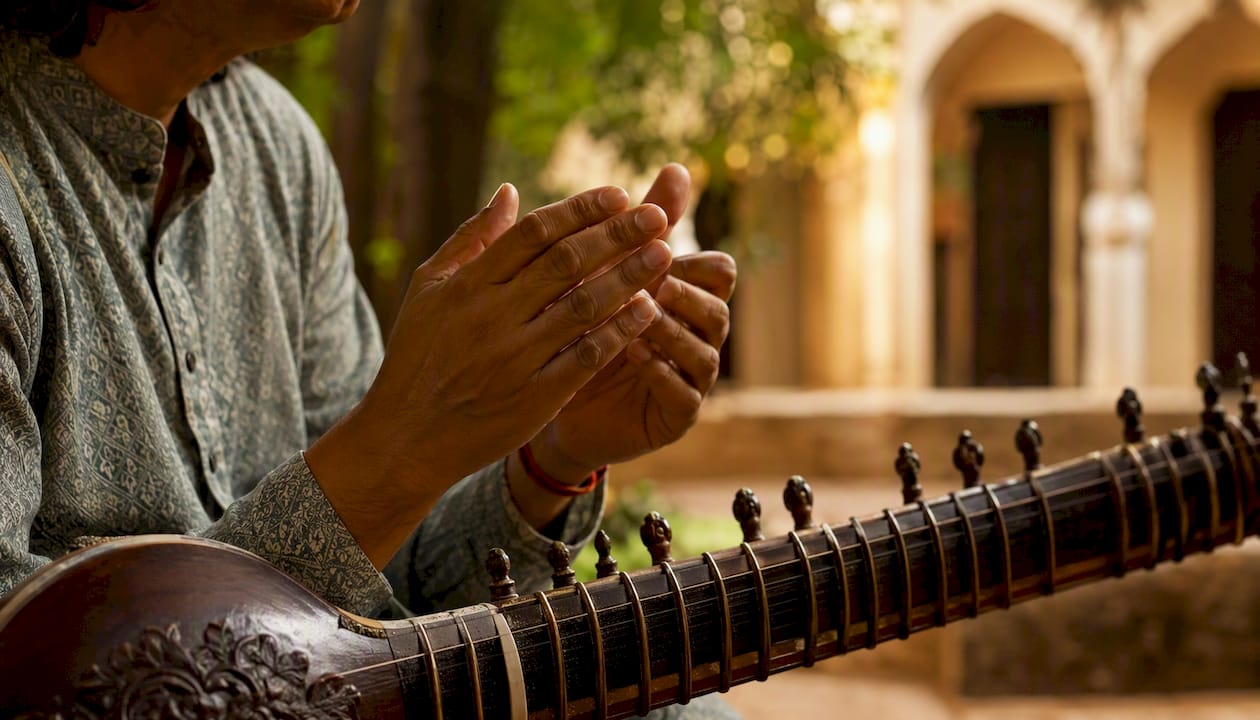
Taal (tala) is the cyclical rhythmic framework sitarists use to time phrasing, land on the Sam, and coordinate with the tabla. As a rhythmic system, it is not a simple beat count. It is a loop with a built-in resolution point, and every phrase a sitarist plays is shaped around returning to that point. If you are a student, an event organizer, or someone preparing to book a sitar performance in the U.S., understanding taal gives you a real working map of what is happening on stage.
The core elements you will see throughout this guide:
- Sam — the first beat of the cycle, the resolution point every phrase aims for
- Mātrā — a single beat unit within the cycle
- Vibhāg — a group of mātrās, like a measure within the loop
- Tālī / Khālī — clapped (tālī) and waved (khālī) hand gestures marking vibhāg accents
- Thekā — the tabla’s mnemonic syllable pattern that identifies a taal
- Lay — tempo class (slow, medium, fast)
Key Takeaways
Taal is a closed rhythmic loop, not a linear bar count, and every phrase a sitarist plays is shaped to resolve on Sam, the cycle’s first beat.
| Point | Details |
|---|---|
| Sam is the target | Every sitar phrase aims to land on Sam, the first beat of the next cycle. |
| Three taals to start | Teentaal (16), Keherva (8), and Rupak (—) cover most beginner and event contexts. |
| Practice sequence | Clap, recite bols, play over lehra, then add tihāī — in that order. |
| Event planning basics | Confirm accompanist, 8×8 stage space, condenser mic setup, and 30-minute sound check. |
| Sitarrajib for bookings | Rajib Karmakar offers lessons, workshops, and live performances for U.S. venues. |
Table of Contents
- What every sitar student needs to know about taal terminology
- Why tala is not the same as Western time signatures
- Common taals every sitarist should recognize
- How a sitarist uses taal during practice and in live performance
- A 4-week micro-practice plan to internalize tala
- What event organizers should expect when booking a sitar performance
- Useful learning tools and lehra resources
- How this guide was assembled
- The historical roots of taal in Indian classical music
- How taal integrates with melody and improvisation on the sitar
- A practical event-planning checklist for U.S. venues
- Why taal is the part most students underestimate
- Book a sitar performance, lesson, or workshop with Sitarrajib
- Sources
What every sitar student needs to know about taal terminology
The table below maps each term to a short definition and a practical cue you will use in lessons or at a performance.
| Term | Definition | Performance cue |
|---|---|---|
| Mātrā | One beat unit | Count each mātrā aloud while clapping |
| Avartan | One full cycle of the taal | Feel the loop restart at Sam |
| Vibhāg | A group of mātrās within the cycle | Mark each vibhāg with a clap or wave |
| Sam | Beat 1, the cycle’s resolution point | Land your phrase here |
| Tālī | A clap marking an accented vibhāg | Clap on tālī beats during practice |
| Khālī | A wave marking an unaccented vibhāg | Wave (no sound) on khālī beats |
| Thekā | The tabla’s identifying syllable pattern | Recite bols (dha, dhin, na) to internalize |
| Lay | Tempo class: vilambit, madhya, drut | Start vilambit (slow), build to drut (fast) |
| Layakari | Rhythmic play within the cycle | Subdivide mātrās for variation |
| Jati | Rhythmic grouping (e.g., 3s, 4s, 5s) | Use to shift feel without changing beat count |
Claps and waves are the traditional timekeeping signals used in both practice and live performance. When you see a sitarist or a student briefly clap or wave during a piece, that is not casual movement. It is cycle-tracking in real time.
Why tala is not the same as Western time signatures
Western music counts bars in a linear sequence: bar 1, bar 2, bar 3, and so on. Tala works differently. Each avartan is a closed loop, and Sam functions as the start of the next cycle, not the end of the current one. That single shift in thinking changes everything about how you phrase and improvise.
A few key contrasts:
- Western 4/4 has equal-weight beats with a strong downbeat. Tala has tālī (accented) and khālī (unaccented) vibhāgs that create an internal tension and release within the loop.
- A Western musician counts forward to the barline. A sitarist counts forward to Sam, which is always the beginning of the next cycle.
- Tihāī (a phrase repeated three times to land on Sam) only makes sense when you feel the cycle as a loop. It does not work as a linear count.
Pro Tip: If you are coming from a Western music background, try this: set a lehra track for Teentaal (16 beats) and clap on beats 1, 5, 9, and wave on beat 13. Do that for two minutes before you touch your instrument. You will start to feel the loop rather than count toward a barline.
Common taals every sitarist should recognize
These seven taals cover most of what you will encounter in lessons, concerts, and event programs. Each carries a fixed mātrā count and vibhāg grouping, and experienced listeners can often identify a taal from its thekā alone.
Taals range from short cycles like Dadra (6) and Keherva (8) to longer composite cycles, and each carries genre associations that matter when you are programming an event or choosing a practice focus. For annotated audio examples showing exact mātrā counts and vibhāg markers, the CompMusic UPF taal examples page is one of the most useful free resources available.
How a sitarist uses taal during practice and in live performance
Every melodic phrase a sitarist plays, whether a gat, a meend slide, or a fast tan run, is timed to resolve on Sam. The phrase does not simply end. It arrives. That arrival is what gives Indian classical music its sense of dramatic release.
In live performance, the sitarist and tabla player communicate continuously through subtle signals: a nod, a brief clap, a glance. These gestures are performance-grade timekeeping that keeps both musicians synchronized across long improvised passages. The tabla supplies the thekā as a steady anchor, while the sitarist plays around and against it, building tension through layakari before snapping back to Sam.
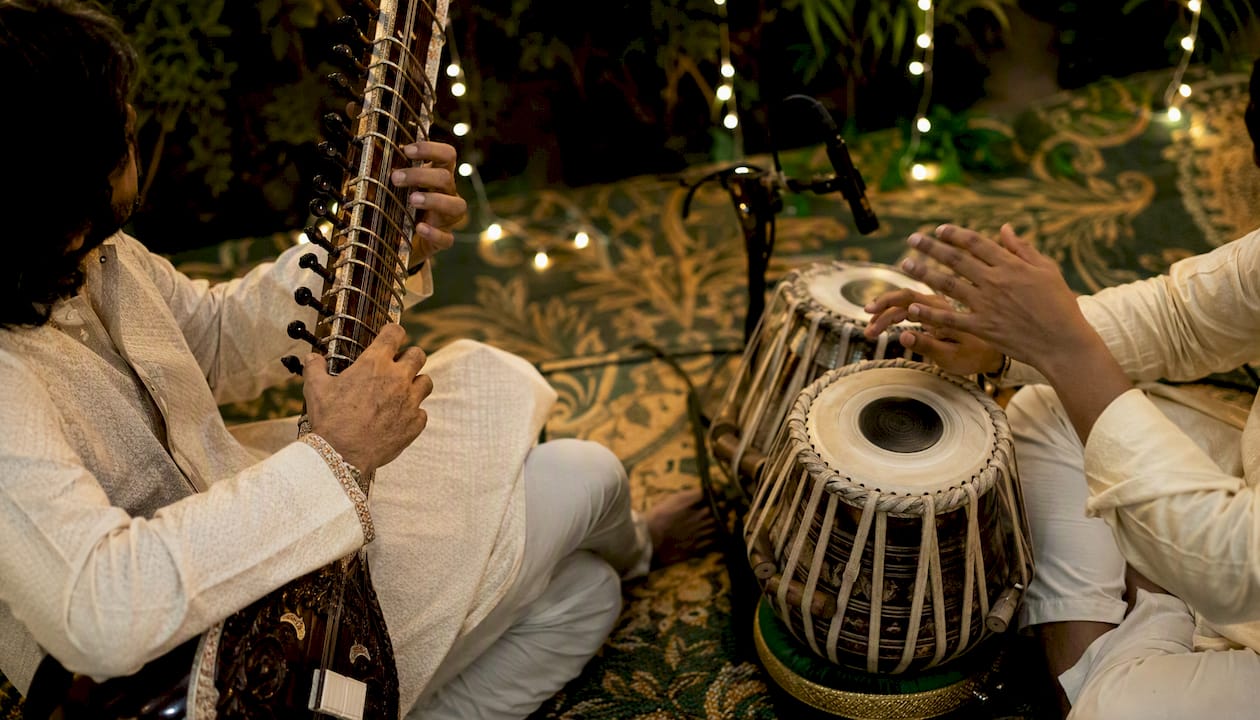
Tihāī is the clearest example of this. A sitarist plays a short phrase, repeats it exactly three times, and the third repetition lands on Sam. The math has to work out across the cycle, which is why reciting bols while clapping before playing is such an effective drill. You internalize the cycle before your fingers get involved.
Pro Tip: Practice your tihāī at half tempo first. Count backward from Sam to find where the phrase needs to start, then clap through it three times before playing it. Most timing errors in tihāī come from starting in the wrong place, not from playing the phrase wrong.
A 4-week micro-practice plan to internalize tala
This plan works for Teentaal (16 beats) as a starting point. Each session is 10–20 minutes.
- Week 1: Clap, count, and speak the thekā. Clap tālī on beats 1, 5, 9 and wave on beat 13. Recite the bols aloud (dha, dhin, dhin, dha…) at a slow, comfortable pace. No instrument yet.
- Week 2: Play simple gat fragments over a lehra track. Use a lehra app (Lehra Pro or a tabla drone app) set to vilambit (slow) tempo. Play a 4-mātrā phrase and repeat it across two full cycles. Focus on landing on Sam.
- Week 3: Add tihāī and layakari. Build a simple tihāī: a 4-mātrā phrase repeated three times to land on Sam at beat 1. Then try subdividing mātrās into groups of 3 (layakari) over the same lehra.
- Week 4: Full performance run-through. Play a complete gat with a tabla player or a recorded lehra at madhya (medium) tempo. Record yourself and check Sam landings on playback.
Troubleshooting tips:
- Missing Sam consistently? Go back to clapping only. No instrument until the cycle feels automatic.
- Losing count in longer taals? Mark vibhāg boundaries with a colored pen on a printed thekā sheet.
- Rushing toward Sam? Slow the lehra by 20% and practice at that tempo for a full week before speeding up.
Combining clapping, reciting bols, and playing over lehra is the most reliable sequence for internalizing tala as a cycle rather than a linear count.
What event organizers should expect when booking a sitar performance
Booking a sitar performance in the U.S. involves a few logistics that differ from standard band bookings. Here is a practical checklist.
- Confirm accompanist status. A solo sitar set is possible, but a sitar-plus-tabla duo is the standard for concerts and formal events. Ask upfront whether the sitarist brings an accompanist or whether you need to arrange one separately.
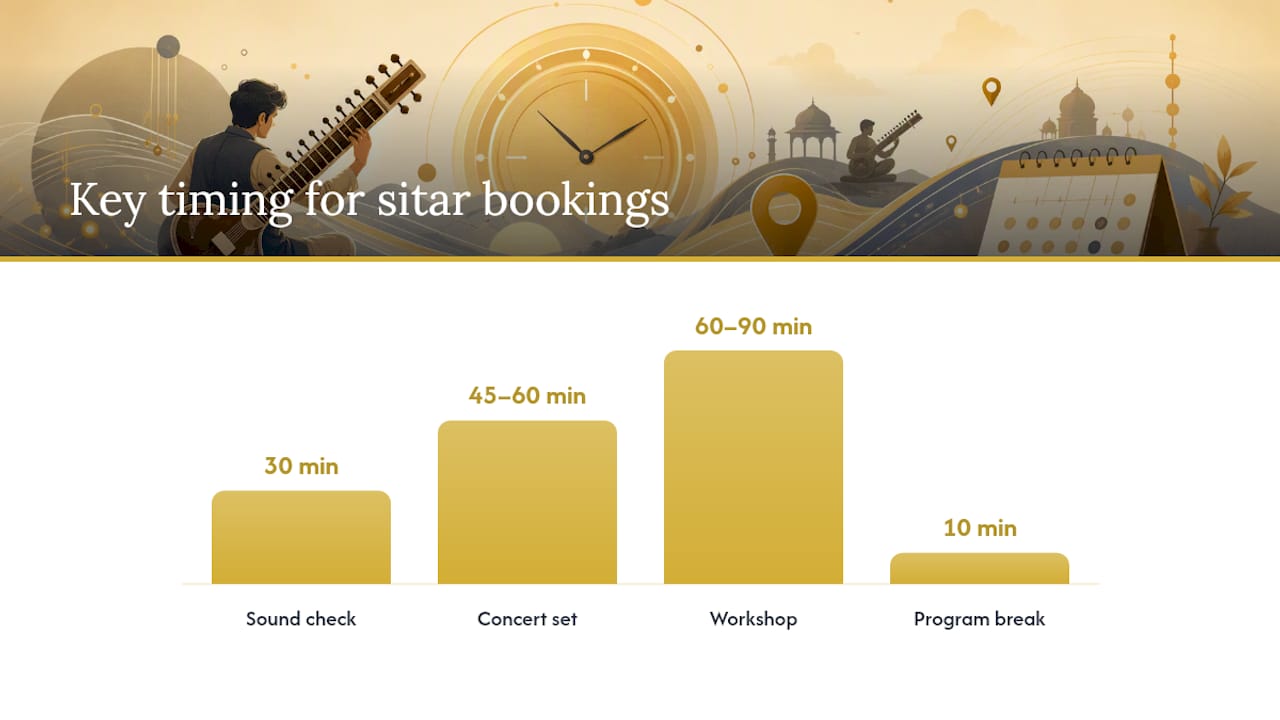
- Set length. A typical concert set runs 45–60 minutes. A workshop runs 60–90 minutes with Q&A. Build in a 10-minute break for longer programs.
- Sound requirements. The sitar is a quiet acoustic instrument. A DI box or a small-diaphragm condenser microphone (e.g., AKG C451 type) placed 6–12 inches from the resonator is standard. The tabla needs a similar setup. Ask for the full technical rider before finalizing the contract.
- Stage space. Both musicians sit on the floor on a low platform or carpet. Allow at least an 8×8 foot area. The sitar requires a gourd rest and cannot be placed near air conditioning vents.
- Rehearsal and warm-up time. Allow 30 minutes before the performance for sound check and warm-up.
- Questions to ask the musician: Do you bring your own tabla player? What taals and tempo do you prefer for this type of event? Do you need a warm-up room? Are there temperature or humidity requirements for the instrument?
For sitar performance logistics specific to U.S. venues, including stage diagrams and sample riders, that resource covers the details in full.
Useful learning tools and lehra resources
For students:
- Lehra Pro (iOS/Android): generates lehra loops for common taals at adjustable tempos. Start with Teentaal at vilambit (slow) before moving to madhya.
- iTablaPro: tabla thekā playback with individual bol highlighting. Useful for thekā recognition drills.
- Raag Hindustani (Raag-hindustani): free annotated text explanations of tala structure, tempo classes, and practice sequences.
- CompMusic UPF (Compmusic): annotated audio examples with waveform visualizations for Teentaal, Rupak, Jhaptal, and others. The best free resource for seeing and hearing taal simultaneously.
For event organizers:
- SwarGanga (Swarganga): clear written explanations of thekā and taal structure. Useful for writing program notes.
- HD Asian Art’s cultural soundscapes resource covers annotated audio and cultural background that can enrich audience-facing program descriptions.
For deeper cultural context on cyclical concepts in South Asian traditions, the HD Asian Art piece on Samsara offers useful background for program notes and audience introductions.
How this guide was assembled
This guide was written by Rajib Karmakar, sitarist and educator at Sitarrajib, drawing on published musicology sources, annotated audio examples, and practical teaching notes developed through private lessons and workshops. The taal definitions and practice sequences reflect both published theory (Darbar, SwarGanga, Raag Hindustani, CompMusic UPF) and author-tested exercises used in U.S.-based sitar instruction. The scope is intentionally sitar-focused and U.S.-venue-oriented. The phrase “taal instrument” in this guide refers to tala as a rhythmic system, not to any percussion instrument.
Sources synthesized:
- Darbar.org: tala as narrative and timekeeping scaffold
- SwarGanga: thekā, avartan, and cyclic Sam positioning
- Raag Hindustani: practice sequences and tempo classes
- CompMusic UPF: annotated audio examples and taal beat counts
- Chandrakantha.com: hand gesture (kriya) timekeeping
- Grokipedia/North Indian Tala: genre associations and taal range
The historical roots of taal in Indian classical music
Taal has been a formal system in Indian classical music for well over a thousand years. Its earliest documented framework appears in the Natya Shastra, an ancient Sanskrit treatise on performing arts, which codified rhythmic cycles and hand gesture signals that are still used today. The Hindustani (North Indian) tradition developed its own taal vocabulary through the medieval period, shaped by court music, devotional practice, and the guru-shishya (teacher-student) transmission system.
What makes taal historically significant is that it was never just a timekeeping tool. It was understood as a structural language, one that gave improvising musicians a shared framework without scripting what they played. That function has not changed. A sitarist performing Teentaal today is working within the same cyclic logic that court musicians used centuries ago, adapted for concert halls, festivals, and now U.S. venues.
How taal integrates with melody and improvisation on the sitar
Taal and raga (the melodic framework) are the two pillars of Indian classical music, and on the sitar they are inseparable. A raga supplies the notes and the mood. Taal supplies the time structure. The sitarist’s job is to elaborate the raga’s melodic material, called badhat, within the taal’s cycle, building phrases that create tension and then resolve on Sam.
Improvisation on the sitar is not free-form. Every meend (slide), gamak (oscillation), and tan (fast run) is shaped to fit within the current vibhāg and arrive at Sam on schedule. The raga-based compositional forms that sitarists use, including gat and alap, each have a different relationship to taal. Alap is free of taal entirely. Gat locks into a specific taal and tempo, and that is where the interplay with tabla becomes most audible.
A practical event-planning checklist for U.S. venues
Use this checklist when preparing a booking brief for a sitar performance or workshop at a U.S. venue.
Space and setup:
- Minimum stage area: 8×8 feet for sitar-plus-tabla duo
- Low platform or carpet for floor seating (no chairs needed for musicians)
- Keep the performance area away from AC vents and direct sunlight
- Ambient room temperature between 65°F and 75°F (sitar is humidity-sensitive)
Sound:
- One DI box or small-diaphragm condenser mic per instrument
- Separate monitor mix for musicians (they need to hear each other clearly)
- No heavy reverb or effects on the sitar channel
Scheduling:
- 30-minute sound check before doors open
- 45–60 minutes for a concert set; 60–90 minutes for a workshop
- 10-minute break built into programs over 60 minutes
Program details:
- Confirm taal and raga preferences with the musician two weeks before the event
- Request a written program note (one paragraph) for printed materials
- For festival programming, confirm set placement relative to other acts (sitar works well as an opening or closing set)
For corporate event bookings, the same checklist applies with the addition of confirming background vs. featured performance mode, since the taal and tempo choices differ between the two contexts.
Why taal is the part most students underestimate
Most students come to sitar focused on the left hand: the meend slides, the note choices, the raga. Taal feels like something the tabla player handles. That assumption costs months of progress.
The cycle is not the tabla player’s job alone. Every phrase you play either fits the cycle or fights it. When you internalize Sam as a destination rather than a beat number, your phrasing changes. Phrases start to breathe. The returns feel earned rather than accidental. That shift does not come from more finger practice. It comes from clapping, counting, and reciting bols until the loop runs in the background of your thinking without effort.
For organizers: what you are watching when a sitarist and tabla player exchange glances and nods mid-performance is not casual communication. It is real-time cycle management across a shared loop. That coordination is what makes a live Indian classical performance feel alive in a way a recording cannot fully capture.
Book a sitar performance, lesson, or workshop with Sitarrajib
Sitarrajib offers private sitar lessons, workshops, and live sitar-plus-tabla performances for concerts, festivals, weddings, and corporate events across the U.S. Each booking is led by Rajib Karmakar, which means you get a sitarist who teaches the same taal framework this guide covers, not a generic world music act.
For event organizers: send a booking inquiry with your date, venue size, stage specs, and whether you need a solo sitar set or a sitar-plus-tabla duo. For students: private lessons cover taal, raga, and technique from beginner through advanced levels. For producers: live session sitar recording is available for film, media, and studio projects. Check the sitar performance logistics page for rider details, then reach out to confirm availability.
Sources
- What is Tala? Beyond just Rhythm and Providing a Beat
- Understanding Taal – Rhythm, Theka, and Structure | SwarGanga
- Examples of Taal in Hindustani music — CompMusic UPF
- Rhythm (taal) in Indian Classical Music – Raag Hindustani
- Tala — Basic concepts of Indian classical music
- North Indian Tala — The Infinite Wiki