
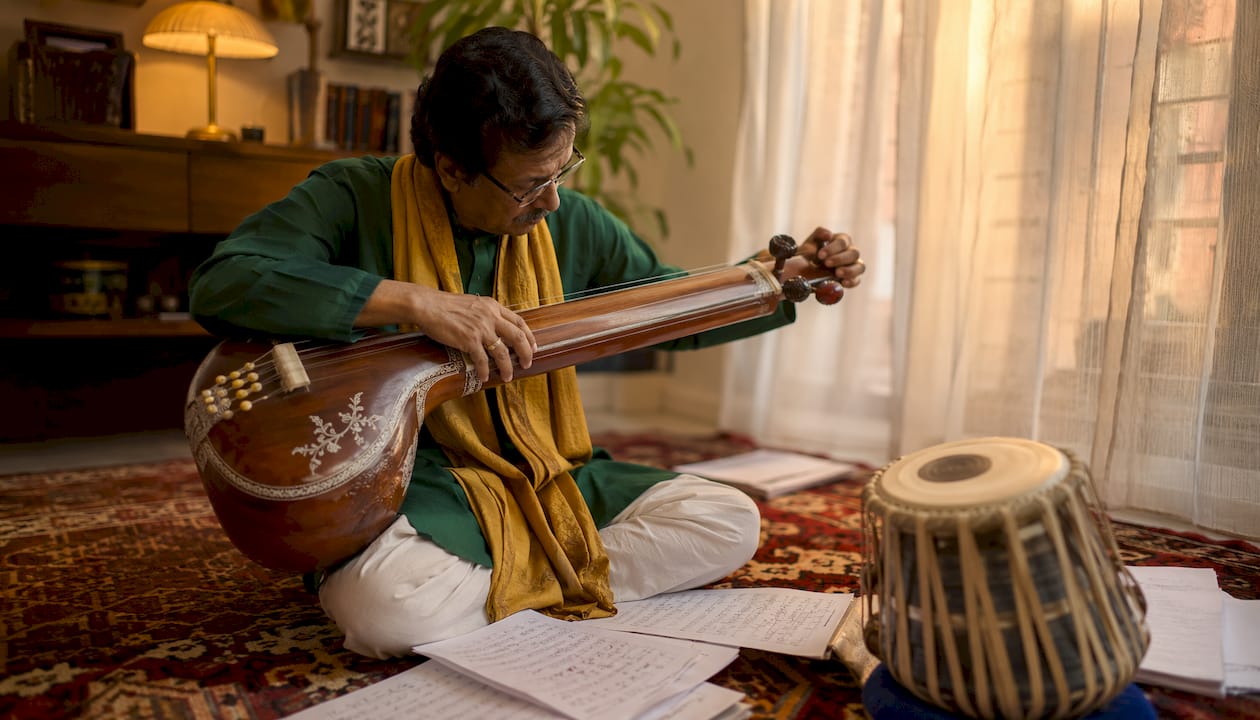
Microtones, known in Indian classical music as shrutis, are the fine pitch shades that define raga identity, emotional color, and ornamentation. Without them, two ragas that share the same seven notes would sound identical. Three things shrutis do right away: they align each note to the tanpura drone so the interval “rings” with the harmonics, they separate closely related ragas through tiny pitch shifts that change the entire mood, and they power expressive ornaments like meend (pitch slides), gamaka (oscillations), and andolan (gentle pitch wavering). The 22-shruti tradition, first described in the ancient Sanskrit treatise the Natyashastra, gives this system its historical name, though modern performers treat shrutis as flexible tonal regions rather than fixed steps on a scale.
- Shrutis create raga-specific pitch color that no fixed-pitch instrument can fully replicate.
- The tanpura drone is the constant reference: every shruti placement is judged against its harmonic spectrum.
- Ornaments like meend, gamaka, and andolan depend entirely on microtonal control.
- The 22-shruti count is a theoretical framework, not a set of discrete keys to press.
- Perceptual research confirms that trained musicians hear and produce shrutis differently from untrained listeners.
Bottom line: Shrutis are the living pitch grammar of Indian classical music. Learn to hear them and you hear the music at a completely different level.
Table of Contents
- What are shrutis, and how do they differ from Western microtones?
- Where did the 22-shruti system come from?
- How do microtones actually work in raga performance?
- Why the tanpura is essential for hearing and producing shrutis
- Can you actually hear shrutis? What the research says
- How are shrutis measured and notated?
- The big debate: 22 fixed shrutis vs. continuous microtonality
- Guided listening: where to hear shrutis in recordings
- Practitioner notes from Rajib Karmakar (Sitarrajib)
- Key Takeaways
- What actually changes when you start hearing shrutis
- Learn microtones directly with Sitarrajib
- Useful sources and further reading
What are shrutis, and how do they differ from Western microtones?
A shruti is a functional microtonal region within an octave in Indian music theory. The word itself means “that which is heard.” The system distinguishes between swaras (the seven primary notes: Sa, Re, Ga, Ma, Pa, Dha, Ni) and shrutis (the smaller pitch steps or tonal regions that sit within and between those notes). Think of swaras as the broad pitch categories and shrutis as the precise intonation choices that give each swara its character in a specific raga.
The word “microtone” is a broader, Western-coined term. The term was coined before 1912 specifically to avoid calling shrutis “quarter-tones,” which was already misleading because shrutis are not uniformly a quarter of a semitone. Calling them quarter-tones implies a fixed, equal division of the octave, which is exactly what shrutis are not. Indian shruti practice is context-driven and raga-specific, unlike the tempered microtonal experiments of 20th-century Western composers.
Here is a quick comparison of key terms and how they relate:
| Term | Meaning in Indian Music |
|---|---|
| Shruti | A microtonal pitch region or small interval; the fine intonation shade of a swara |
| Swara | One of the seven primary notes (Sa, Re, Ga, Ma, Pa, Dha, Ni) |
| Komal / Tivra | Flat (komal) or sharp (tivra) variant of a swara |
| Meend | A smooth, controlled pitch slide between two notes |
| Andolan | A slow, gentle oscillation around a single pitch |
| Gamaka | A broad category of ornamental pitch movements |
| Tanpura | A four-string drone instrument that provides the harmonic reference |
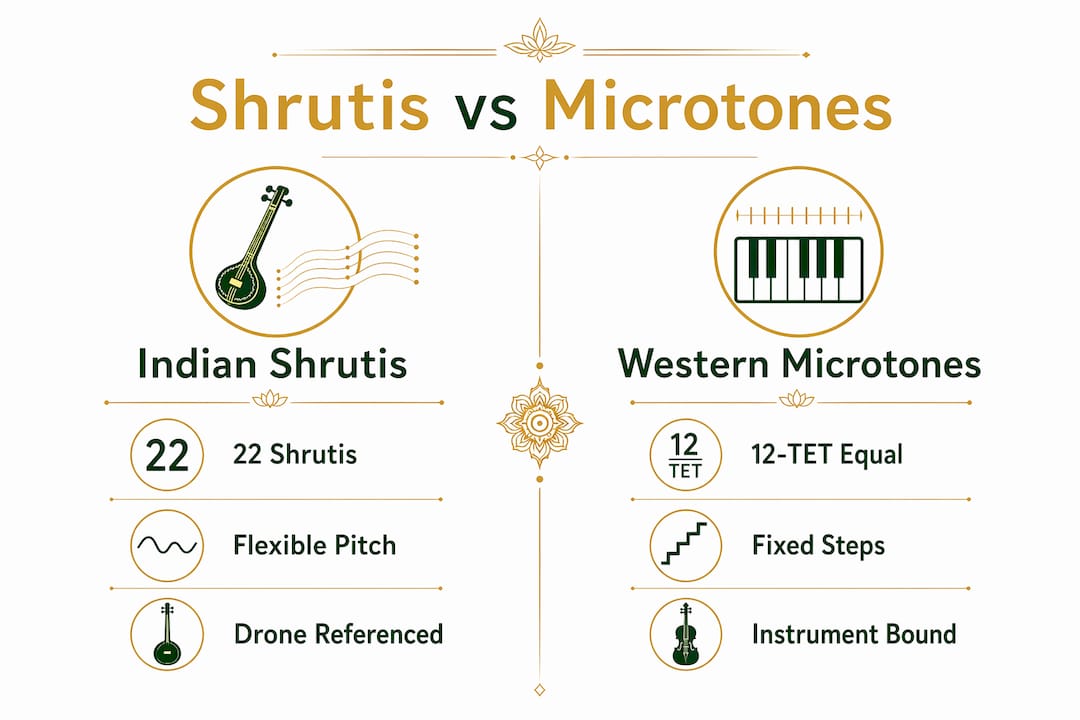
And a quick comparison with 12-tone equal temperament (12-TET):
| Feature | 12-TET (Western) | Indian Shruti Practice |
|---|---|---|
| Pitch division | 12 fixed, equal semitones per octave | Flexible tonal regions; varies by raga |
| Intonation | Fixed, tempered | Contextual, drone-referenced |
| Ornament basis | Vibrato, dynamics | Meend, gamaka, andolan (pitch-based) |
| Reference | Keyboard / equal temperament | Tanpura harmonic series |
The practical difference is that a raga’s Re (second degree) in Bhairav is placed lower than the Re in Bhimpalasi, even though both are called “komal Re.” That shift is a shruti difference, and it changes the entire emotional character of the raga.
Where did the 22-shruti system come from?
The Natyashastra, written around 200 CE and attributed to Bharata Muni, is the earliest known systematic attempt to describe intonation for musical instruments in South Asia. Bharata outlined seven primary swaras and then subdivided the octave into twenty-two microtonal positions called sruti-s. His system was not arbitrary: the 22 positions were derived from cycles of perfect fifths (3:2, or 702 cents) and perfect fourths (4:3, or 498 cents), the most consonant intervals available to the ear.
The medieval treatise Sangeet Ratnakar (13th century) built on Bharata’s framework, and later theorists continued to refine and debate the exact cent values and ratios. The three types of shruti described in classical theory are:
- Pramana shruti (“standard” shruti): a small interval often cited around 21.5 cents in academic reference.
- Nyuna shruti (“deficient” shruti): a somewhat larger interval, described in treatises and analyses.
- Purna shruti (“fulfilling” shruti): a prominent interval in ancient theory, with value depending on context.
These three types combine to produce the 22 positions across the octave. The timeline of the tradition looks like this:
- ~200 CE: Bharata’s Natyashastra establishes the 22-shruti framework based on consonant interval cycles.
- 13th century: Sangeet Ratnakar elaborates and systematizes the theory.
- 19th–20th century: Colonial-era musicologists attempt to map shrutis to Western cent values.
- 20th century onward: Empirical researchers using pitch-analysis tools reframe shrutis as statistical tonal regions, not fixed steps.
The key point is that the 22-shruti count is descriptive and interpretive. It describes the theoretical pitch space available, not a prescriptive set of 22 keys that performers must hit. Modern scholarship treats the number as a useful framework for understanding pitch relationships, not as a tuning instruction.
How do microtones actually work in raga performance?
This is where the role of microtones in Indian music becomes most concrete. A raga is not just a scale. It is a complete melodic personality, and shruti placement is a big part of what gives each raga its identity. Raga Bhairav and Raga Todi both use komal Re and komal Ga, but the exact pitch placement of those notes differs between the two ragas. That difference, measured in fractions of a semitone, changes the emotional character completely.
Ornament types that depend on microtonal control:
- Meend: A smooth, continuous pitch slide from one note to another, passing through intermediate shrutis. The technique of meend on sitar requires precise left-hand pressure to land on the target shruti without overshooting.
- Gamaka: A broader oscillation that moves through a pitch region rather than landing on a single point. Common in Carnatic music but present in Hindustani styles too.
- Andolan: A slow, gentle wavering around a single pitch, used on specific notes in specific ragas (e.g., komal Ga in Darbari Kanada). The wavering itself is microtonal.
- Kan: A brief grace note, often a shruti away from the main note.
- Murki: A rapid ornamental cluster of notes, each of which may carry a shruti inflection.
Pro Tip: When you listen to a slow alap, pay attention to notes that seem to “hover” or “breathe” rather than land cleanly. That hovering is andolan, and it is one of the clearest places to hear shruti placement in real time.
Improvisation in the alap (the opening, unmetered exploration of a raga) is where shrutis are most audible. A skilled performer carves the tonal space of the raga note by note, approaching each swara from below or above, dwelling on specific shrutis to establish the raga’s mood. In vilambit (slow tempo) sections, there is enough time to hear every microtonal approach and departure. Instrument-specific techniques include string bending and glissando on sitar and sarod, voice inflection and portamento in vocal music, and embouchure adjustments and finger slides on bansuri (bamboo flute). In each case, the performer is not hitting a fixed pitch but navigating a tonal region defined by the raga’s grammar. The types of raga-based compositions that use these techniques most extensively are alap, jod, and the slower sections of bandish improvisation.
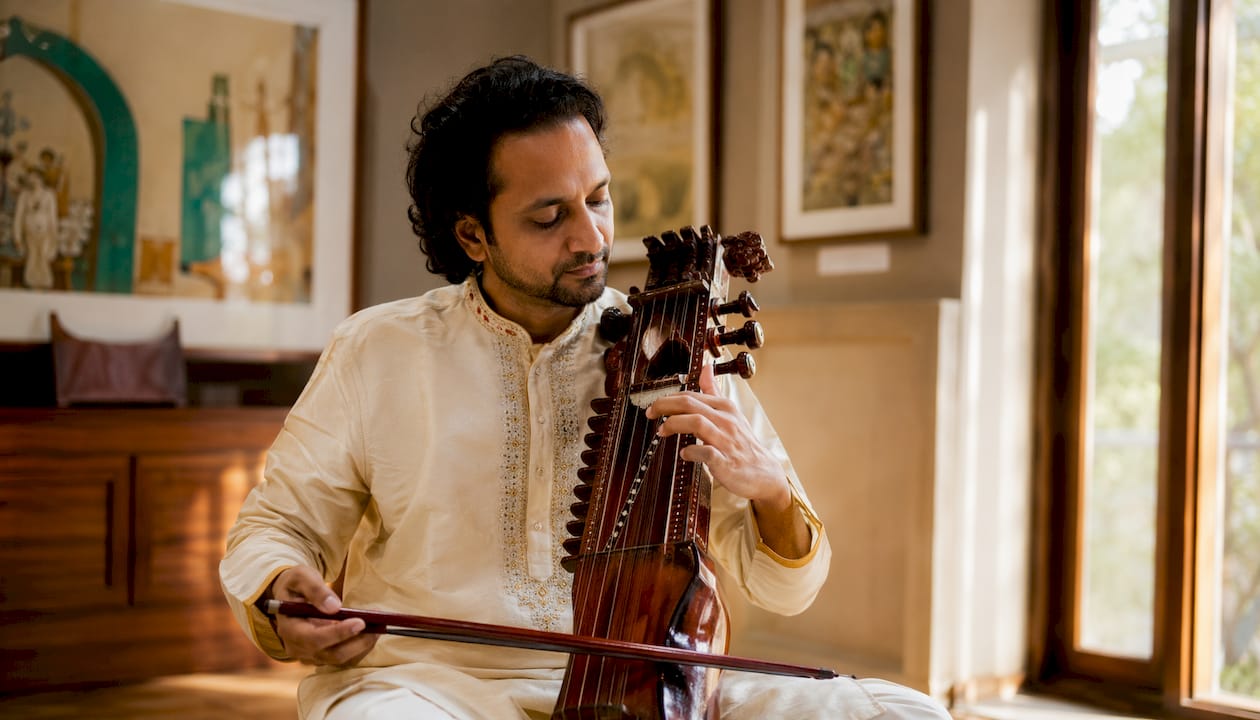
Why the tanpura is essential for hearing and producing shrutis
The tanpura is not just background sound. Its four strings, tuned to Sa, Pa (or Ma), and upper Sa, produce a continuous harmonic series that fills the acoustic space with overtones. Performers use those overtones as a reference grid: when a note is placed correctly, it “rings” or “locks in” with a partial of the tanpura. When it is slightly off, there is an audible beating or roughness. This is how microtones become audible in practice.
Instruments that can produce shrutis:
- Sitar and sarod: Fretless or curved-fret design allows string bending to reach any pitch in the tonal space. Sympathetic strings (taraf) resonate with the main strings and reinforce specific shrutis.
- Bansuri: Embouchure control and partial hole coverage produce microtonal inflections.
- Violin (in Carnatic music): Fully fretless; the bow and left hand together navigate the shruti space continuously.
- Voice: The most flexible instrument of all; trained singers can place a note within a few cents of any target shruti.
Fixed-pitch instruments like piano and harmonium cannot produce shrutis. Western fixed-pitch instruments) are limited to 12-TET and cannot realize raga-specific intonation or ornamentation. The harmonium, widely used in Indian devotional music, is often criticized by classical musicians for exactly this reason: it flattens the pitch space into 12 equal steps and removes the shruti distinctions that define a raga.
Pro Tip: To set up a practice environment for hearing shrutis, tune your tanpura carefully using a reference pitch (Sa = C, D, or whatever suits your voice or instrument), then sit in silence for two to three minutes before playing. The quiet and the drone together train your ear to notice small pitch differences that disappear in a noisy room.
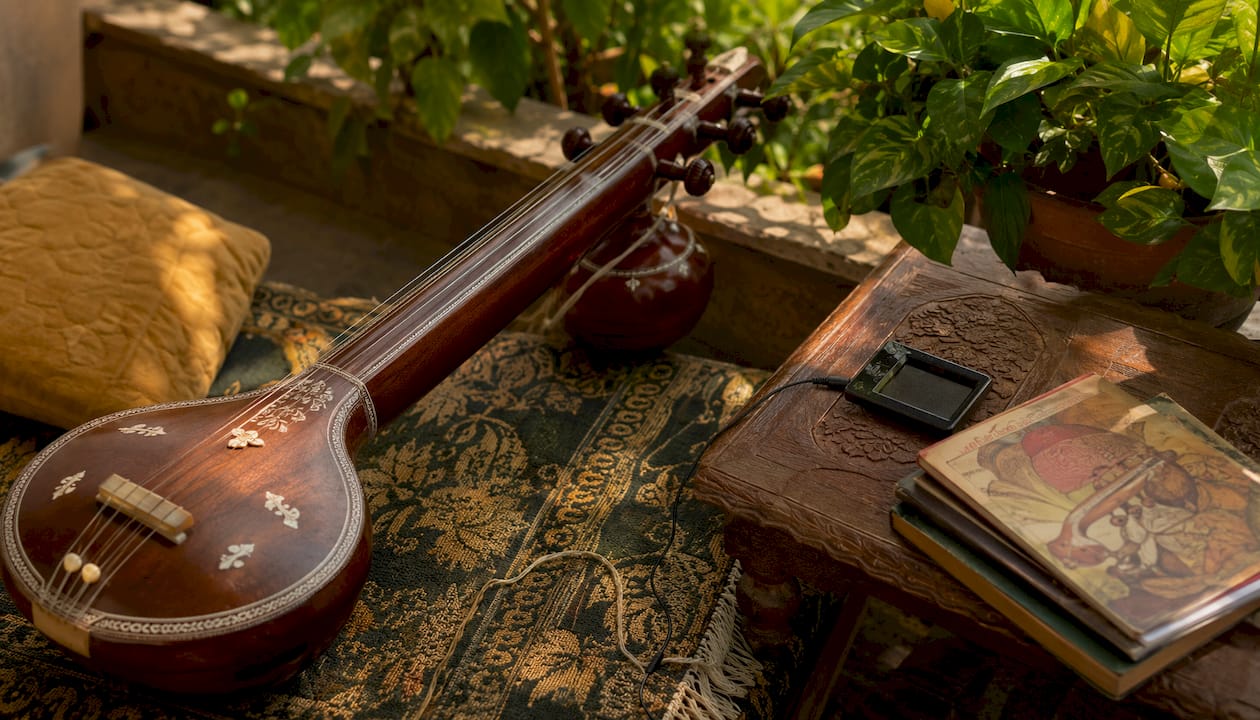
Tanpura tuning quality and the habit of referencing the drone are fundamental training tools for internalizing microtonal relationships. Performers and technicians often adjust the bridge (jawari) and sympathetic strings to maximize harmonic reinforcement, making the overtone series as clear as possible.
Can you actually hear shrutis? What the research says
Most untrained listeners cannot distinguish shrutis from “out-of-tune” notes on first exposure. Research on microtonal perception confirms that musical expertise facilitates the sensory and perceptual discrimination of microtonal intervals from 12-TET intervals, and an increased ability to categorize such intervals. Non-musicians, by contrast, tend to perceive microtonal intervals as instances of the nearest equal-tempered note. A 2015 conference study from ESCOM9 (Manchester) further showed that trained musicians produce distinct sensory responses to microtonal intervals compared with non-musicians. The good news: this discrimination is trainable.
A structured ear-training progression for shrutis:
- Start with tanpura listening only. Sit with a tanpura drone (live or a high-quality recording) for 10 minutes daily. Do not play anything. Just listen to the overtone series and notice which pitches emerge naturally from the drone.
- Sing Sa against the drone. Match your voice to the fundamental and hold it. Then move to Pa (the fifth). Notice when the interval “locks in” versus when it beats.
- Slow alap transcription. Choose a recording of a slow alap in a familiar raga. Transcribe each note by ear, noting whether it sounds higher or lower than the 12-TET equivalent. Do not use a keyboard as a reference.
- Interval-matching drills. Sing or play a note, then try to match a specific shruti variant (e.g., komal Ga in Darbari vs. komal Ga in Bhimpalasi). Use a tanpura as the only reference.
- Vocal sliding practice. Sing a meend from Sa to komal Ga slowly, stopping at intermediate points and checking each against the drone.
- Fretless instrumental practice. On a fretless instrument (or sitar with string bending), practice landing on a target shruti from below, then from above, until the approach is consistent.
Milestone checkpoints: first, you can recognize when a note drifts versus when it is intentionally inflected. Second, you can match a singer’s microtonal slide in real time. Third, you can identify raga-specific shruti placements by ear without seeing the notation. Most students reach the first milestone in four to six weeks of daily tanpura practice. The third milestone typically takes months to years of guided work.
How are shrutis measured and notated?
Cents are the standard unit for measuring microtonal intervals. One semitone in 12-TET equals 100 cents; one octave equals 1,200 cents. Researchers use cent values to map shruti positions as a reference frame, not as prescriptive tuning targets.
| Interval | Notes |
|---|---|
| 12-TET semitone | Fixed, equal temperament reference |
| Major whole tone (chatussruti Re) | Reference interval used in theoretical analyses |
| Pramana shruti (syntonic comma) | Smallest shruti unit, around 21.5 cents in the academic framework |
| Perfect fourth (suddha Ma) | Highly consonant; drone-referenced |
| Perfect fifth (Pa) | Core consonance; tanpura reference |
These figures serve as reference points for analysis. Actual performance varies by raga, artist, and style. A komal Ga in one artist’s Darbari Kanada may sit at a different cent value than the same note in another artist’s rendition, and both can be correct within the raga’s grammar.
Notation systems for shrutis are limited. Sargam (the Indian solfège system: Sa Re Ga Ma Pa Dha Ni) marks komal and tivra variants but cannot specify shruti-level distinctions. Western staff notation is even less suited to the task. Most shruti knowledge is transmitted orally, through demonstration and correction in the guru-shishya (teacher-student) relationship. Written cent annotations are used in academic analysis but are not part of performance practice. For a deeper look at how Indian notation systems handle these challenges, the Indian music notation system resource covers the practical limits of written representation.
Pro Tip: Avoid using 12-TET backing tracks as a reference for raga practice. The equal-tempered pitches will pull your intonation away from the drone-referenced shruti placements the raga requires. Use a tanpura app (iTabla Pro or similar) or a live tanpura instead.
The big debate: 22 fixed shrutis vs. continuous microtonality
The central controversy in shruti scholarship is simple to state: did Bharata describe 22 fixed, discrete pitches, or did he describe a theoretical framework that performers interpret flexibly? Modern analytical work using pitch-analysis tools shows that intonation in Hindustani performance is statistically distributed across ranges. Artists carve tonal shapes rather than hit fixed cent points.
Key positions in the debate:
- Traditional prescriptive view: The 22 shrutis are specific, fixed pitches derived from just intonation ratios. Performers should aim for these exact positions.
- Functional/regional view: Shrutis are tonal regions or gestalts. The same swara may be rendered slightly differently by two masters depending on style, raga, and context. The 22 number is descriptive, not prescriptive.
- Empirical evidence: Melodic movement analyzer (MMA) studies of recorded performances show pitch distributions that are continuous and variable, not clustered at 22 fixed points. Artists consistently use pitch as a fluid resource.
A common misconception is that performers mentally “count” 22 pitches and aim for specific ones. No working musician does this. What they do is internalize the raga’s characteristic pitch tendencies through years of practice with the drone, and their intonation reflects those tendencies automatically. Cross-cultural comparisons show that many world music traditions use pitch systems that are similarly fluid and context-dependent, which makes the Western impulse to map them onto fixed scales a recurring analytical problem.
The Carnatic tradition adds another layer. Research on South Indian music shows that some compositions use as many as 14 differentiated pitches within a single raga, and techniques like grahabheda (modal shift) can theoretically generate over 400 distinct pitch positions within an octave, reduced to around 98 for practical purposes. The 22-shruti framework is a starting point, not a ceiling.
Guided listening: where to hear shrutis in recordings
Knowing what to listen for makes all the difference. Here are the best recording types and specific moments to target:
- Slow alap with tanpura: The clearest place to hear shruti placement. Listen for notes that approach from below or above and settle into a specific position. Raga Bhairav’s komal Re is noticeably lower than the 12-TET equivalent; you can hear it “fall” into place against the drone.
- Darbari Kanada: Listen for the komal Ga. It is placed very low, and the andolan on that note is slow and deliberate. This is one of the most distinctive shruti placements in all of Hindustani music.
- Yaman: The tivra Ma (raised fourth) is the raga’s signature. In a slow alap, you can hear the performer approach it carefully, often from below, to land on the exact shruti that gives Yaman its characteristic openness.
- Bhairav: Both komal Re and komal Dha are placed low. In a vocal rendition, listen for the way the singer dwells on these notes and lets them resonate against the drone.
- Tanpura-only recordings: Before listening to a full performance, spend five minutes with a tanpura drone alone. Notice the overtones that emerge: the fifth, the major third, and higher partials. These are the acoustic anchors that performers tune to.
- Sitar alap recordings: The concert performances by Rajib Karmakar offer clear examples of how meend and shruti placement work together on the sitar. Watch and listen for the left-hand string bending that produces microtonal slides.
Listening practice tip: loop a two-to-four-bar phrase from a slow alap, slow it down using a playback app (Transcribe! or Amazing Slow Downer work well), and try to match each note with your voice or a fretless instrument. Check your pitch against the tanpura, not a keyboard.
Practitioner notes from Rajib Karmakar (Sitarrajib)
Rajib Karmakar is an internationally recognized sitarist, composer, and educator based in Los Angeles. His teaching approach connects the theoretical framework of shrutis directly to physical technique and listening practice, which is where most students get stuck.
Three exercises Rajib uses with students:
1. Tanpura interval matching. Tune the tanpura and play Sa. Then, without looking at any notation, sing or play each swara of the raga you are studying, one at a time, and hold each note until it either rings with the drone or reveals a beating. Adjust until the beating disappears. This trains the ear to locate the shruti by resonance, not by counting.
2. Meend carving drills. On sitar, practice a slow meend from Sa to komal Ga, stopping at three intermediate points along the way. At each stop, check the pitch against the tanpura. The goal is not to hit specific cent values but to feel the note “settle” into the drone’s harmonic field. This drill directly builds the left-hand control needed for expressive meend in performance.
3. Raga-specific shruti focus. Pick one raga and identify its two or three most characteristic shruti placements (e.g., the very low komal Ga in Darbari, or the tivra Ma in Yaman). Practice those specific notes in isolation, approaching from above and below, before working them into phrases.
Pro Tip: Rajib recommends that students record themselves practicing against a tanpura and listen back the next day. Distance from the performance makes it much easier to hear whether your intonation is settling into the drone or fighting it.
For students interested in workshops focused on microtone listening and sitar technique, Sitarrajib offers private lessons and structured workshop modules. Reach out through sitarrajib.com to ask about current availability.
Key Takeaways
Shrutis are the functional pitch grammar of Indian classical music: flexible, drone-referenced, and essential to raga identity, ornamentation, and emotional expression.
| Point | Details |
|---|---|
| Shrutis are tonal regions, not fixed steps | The 22-shruti count is a theoretical framework; performers navigate flexible pitch regions by raga and context. |
| Tanpura is the essential reference | Every shruti placement is judged against the tanpura’s harmonic series; tuning quality directly affects what you can hear. |
| Ornaments depend on microtonal control | Meend, gamaka, and andolan are impossible without precise shruti navigation on fretless or flexible-pitch instruments. |
| Ear training is progressive and takes time | Research confirms trained musicians discriminate shrutis better; daily tanpura listening and slow alap work build this skill over months. |
| Sitarrajib offers structured learning | Rajib Karmakar’s lessons and workshops connect shruti theory to sitar technique and practical ear training in Los Angeles. |
What actually changes when you start hearing shrutis
There is a specific moment that most serious listeners describe: you are sitting with a tanpura, you have been practicing slow alap for a few weeks, and suddenly a note you have heard a hundred times sounds different. Not wrong, but placed. You notice it is sitting slightly lower than you expected, and it is doing something to the drone, creating a kind of resonance you had not registered before. That is the beginning of shruti perception, and once it happens, you cannot unhear it.
The shift changes how you listen to everything. Vocal performances that once sounded smooth start to reveal their architecture: the deliberate approach to a komal note, the slight hold before a meend, the way a phrase ends on a shruti that leaves the raga’s mood hanging in the air. Phrasing choices that seemed like personal style turn out to be shruti choices, and those choices are the raga speaking. Patience and repeated listening matter more than any amount of theoretical study. A good teacher who can demonstrate and correct in real time is the fastest path, because shrutis are transmitted by ear, not by reading.
Learn microtones directly with Sitarrajib
If you want to move from understanding shrutis to actually hearing and producing them, structured guidance makes a real difference. Sitarrajib offers private sitar lessons, workshop modules focused specifically on microtone listening and raga intonation, and guided listening sessions where you work through specific ragas and their characteristic shruti placements with direct feedback.
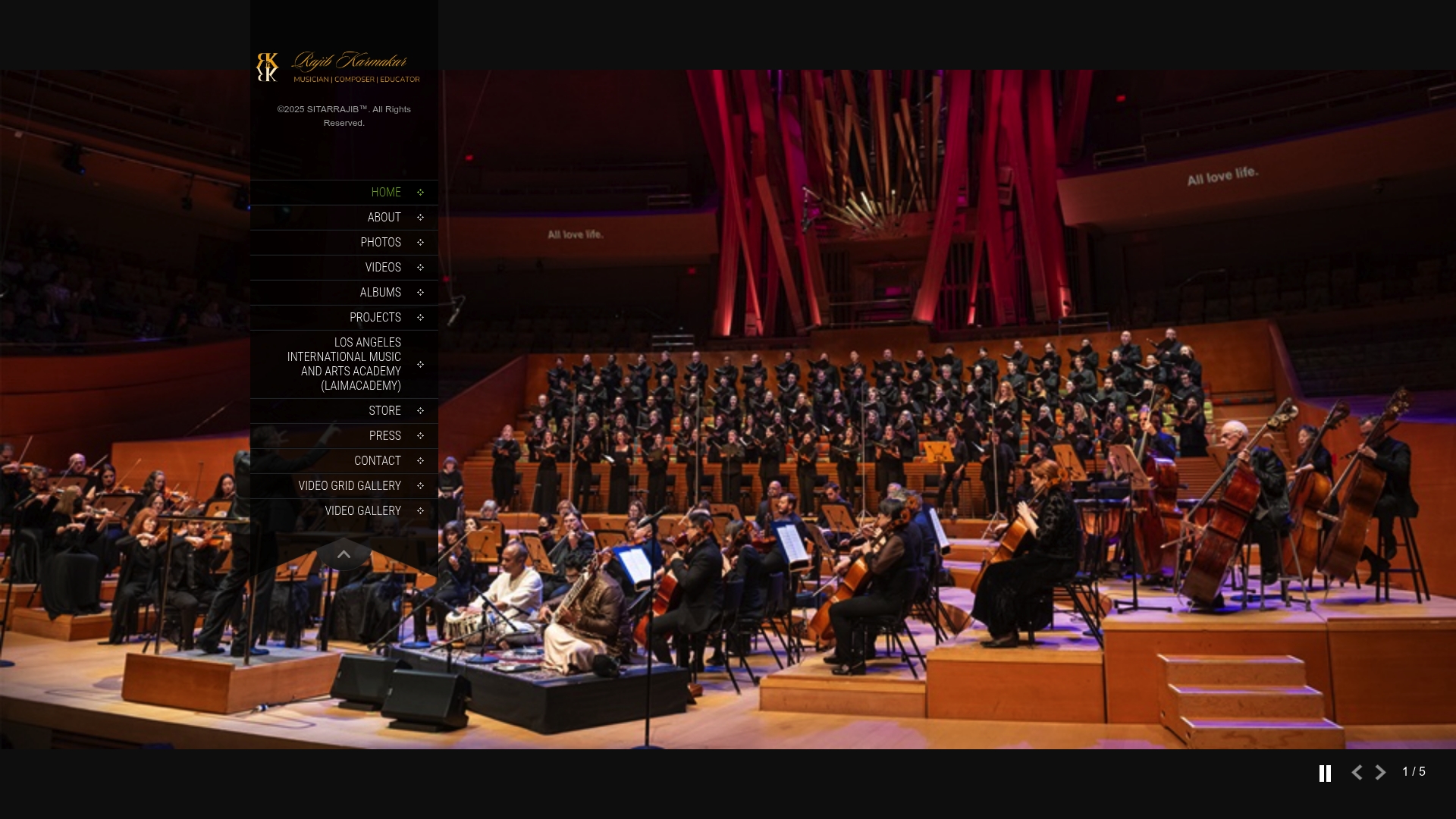
Students in these programs develop practical ear training, sitar technique for shruti production, and the ability to identify raga-specific intonation by ear. Whether you are a musician working on your own raga practice or a serious listener who wants to engage with Indian classical music at a deeper level, the sessions are structured to meet you where you are. For producers and composers interested in capturing microtonal detail in studio recordings, the sitar recording techniques guide covers the technical side of getting shrutis onto tape cleanly. To ask about lesson formats, workshop schedules, or availability, visit sitarrajib.com and get in touch directly.
Useful sources and further reading
Natyashastra (Wikipedia overview): The primary historical source for the 22-shruti system. Useful for understanding the textual origin of shruti theory and Bharata’s interval descriptions.
Stephens, “The Microtones of Bharata’s Natyashastra,” Analytical Approaches to World Music 6.1 (2017): Peer-reviewed analysis of Bharata’s sruti-s and their mathematical basis. Best source for understanding the samvadi interval logic and the vina experiment.
Classical Indian Tuning System (plainsound.org): Detailed breakdown of pramana, nyuna, and purna shruti types with cent values and ratio tables. Useful for the notation and measurement section.
Shruti in Contemporary Hindustani Music (Internet Archive): Empirical pitch-distribution analysis of recorded performances. Shows that intonation is statistically continuous, not fixed at 22 points.
SwarGanga: Shruti (Microtones) — Basic Concepts of Indian Classical Music: Practitioner-focused explanation of shrutis as flexible tonal regions. Accessible and performance-oriented.
Microtones in Indian Classical Music, Baithak Foundation (Google Arts & Culture): Lecture-demonstration format showing how tanpura harmonics make shrutis audible. Recommended as a first listening resource.
Huygens-Fokker Foundation: Microtonality: Global overview of microtonal traditions. Useful for placing Indian shruti practice in comparative context.
Reina, “Microtonality in South India: Not So Modal” (Huygens-Fokker): Detailed analysis of Carnatic microtonal practice, grahabheda, and the 22-sruti chart with cent distances. Advanced reading for practitioners.
Farbood et al., “How Different Are Our Perceptions of Equal-Tempered and Microtonal Intervals?” PLOS ONE (2015): Peer-reviewed ERP and behavioral study confirming that musical training mediates microtonal discrimination. The core perceptual science reference for this topic.
Shruti (music), Wikipedia): Good overview of musicological positions on shrutis as flexible pitch relationships rather than fixed notes.
Microtonality, Wikipedia: Historical and cross-cultural context for the term “microtone” and its relationship to Indian sruti terminology.