
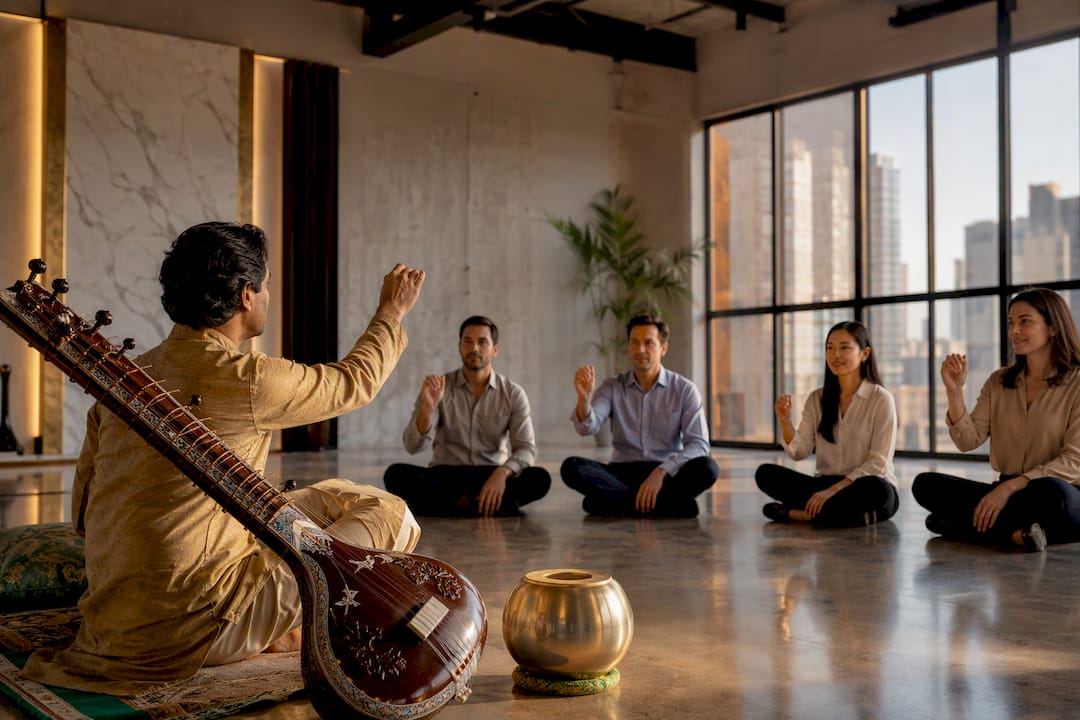
A corporate music workshop turns a roomful of quiet coworkers into an engaged, laughing group in under two hours, and it does that through low-barrier activities like drum circles, songwriting, and collaborative playlists. Sessions run 60 to 120 minutes, work for groups of 10 to 500, and travel well to virtual or hybrid teams. Tailored corporate workshops with an Indian classical touch are available for HR teams seeking that outcome.
TL;DR:
- Music workshops boost participation and bonding more effectively than traditional team-building activities, engaging teams across all age groups and experience levels.
- Activities like drum circles and songwriting should align with specific objectives, with the choice of format affecting energy levels, trust-building, and remote inclusivity.
- Planning requires defining clear goals, surveying attendees’ music preferences, testing technical setup, and including remote participants in chosen formats like playlist building or livestream concerts.
- Costs vary based on session length, facilitator seniority, travel, and deliverables, often more affordable than multi-day off-site retreats with comparable bonding benefits.
- Measuring success involves pre- and post-event surveys, tracking qualitative shifts, and repurposing shared recordings and playlists as lasting team culture artifacts.
Table of Contents
- Why a Corporate Music Workshop Actually Works
- Which Workshop Format Fits Your Team?
- How Do You Plan a Music Workshop That Hits Your Goals?
- What Does a Corporate Music Workshop Cost?
- How Do You Measure Whether the Workshop Worked?
- An Indian Classical Lens on Corporate Team Building
- Ready to Book a Sitar-Led Corporate Workshop
- Sources
Why a Corporate Music Workshop Actually Works
You don’t need a musical bone in your body to get value from a corporate music workshop. That’s the whole point. Music-based activities run on preference and participation, not skill, so a junior analyst and a VP end up on equal footing the moment the instruments come out.
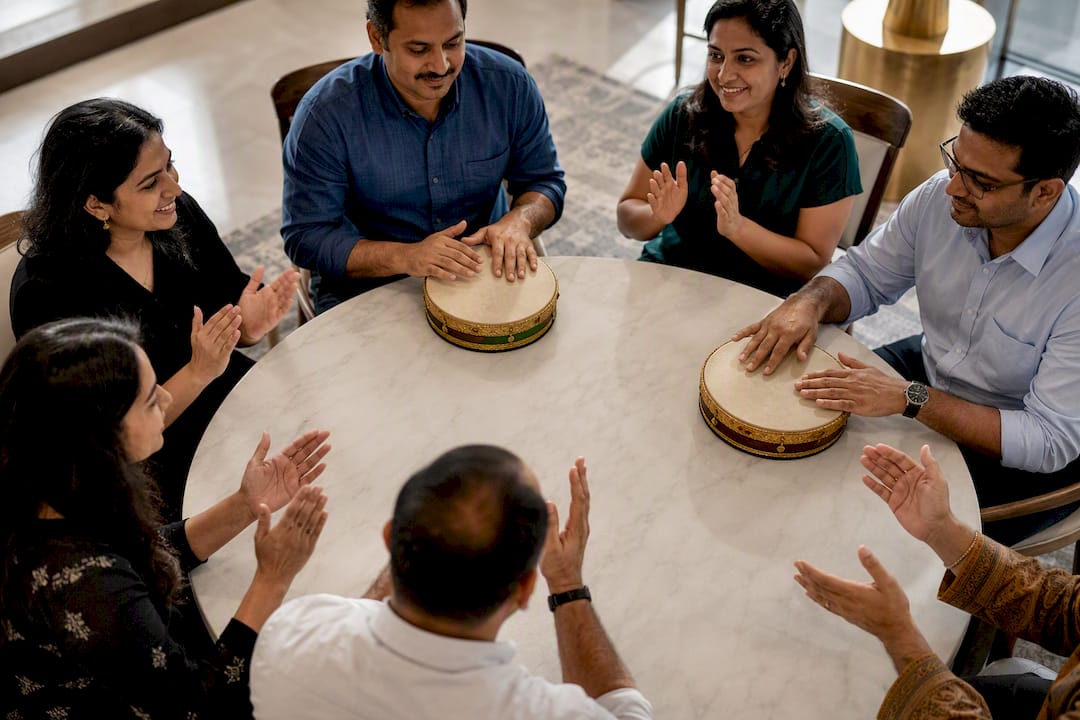
Music-led events tend to produce stronger engagement and faster bonding than many standard team-building formats, and organizers report better cross-departmental communication afterward. That matters because most HR calendars are already packed with trust falls and escape rooms that people forget by Friday.
What HR teams actually notice:
- Higher participation rates than lecture-style training, since there’s no wrong answer in a drum circle
- An immediate mood shift, visible in body language before the session even ends
- New conversations between people who normally never share a Slack channel
- A reusable artifact (a recording, a playlist) that outlasts the event itself
Statistic to know: Industry write-ups tracking music-led corporate events consistently show high enjoyment and strong participation across multi-generational teams, from interns to senior leadership. A workshop that works equally well for a 24-year-old and a 58 year old is rare in the team-building world.
Which Workshop Format Fits Your Team?
Not every music activity fits every objective. A drum circle builds energy fast. A songwriting session builds something closer to shared ownership.
- Drum circle: Everyone gets a hand percussion instrument and follows a facilitator’s rhythm cues. High energy, fully inclusive, works for 15 to 300 people, ideal at 45 to 60 minutes.
- Songwriting session: Small groups write and perform an original song tied to company values or a shared inside joke. Structured formats like this run around 90 minutes and get used specifically to build trust and leadership skills.
- Collaborative playlist building: Teams vote on songs for a shared work playlist, live or asynchronously. Low energy, works remotely, minimal setup, 20 to 30 minutes.
- Interactive concert: A performer leads ride-alongs, trivia, and audience voting. Scales to large groups and adapts easily to livestream for hybrid teams.
- Body percussion: No instruments needed, just claps, stomps, and vocal rhythm. Great icebreaker for groups without a budget for gear.
- Karaoke or light performance: Low-pressure stage time in small doses. Best for teams that already know each other well.
Hybrid teams do best with playlist building or a livestreamed interactive concert, since remote adaptations using voting and real-time chat keep everyone included without needing a shared room.
How Do You Plan a Music Workshop That Hits Your Goals?
Booking a facilitator is the easy part. Getting the session to actually serve your engagement goals takes a little prep work upfront.
- Define the objective first. Are you fixing cross-team silos, marking a milestone, or just giving a burned-out team a breather? The format should follow the goal, not the other way around.
- Survey attendees ahead of time. Asking employees for their top three song picks beforehand raises buy-in and gives the facilitator real material to build the session around.
- Check the room and the tech. Confirm space for movement, working mics, and whether you want the session recorded.
- Set a measurement plan. Decide your pre- and post-survey questions before the event, not after.
- Account for remote attendees. Pick a format that translates to video, and test the stream beforehand.
Sample 90-minute agenda:
| Time | Block | Objective |
|---|---|---|
| — | Icebreaker body percussion | Warm up the room, lower social guard |
| 10 to 60 min | Group songwriting | Build shared ownership and creative teamwork |
| 60 to 75 min | Group performance + recording | Reinforce accomplishment, create a keepsake |
| 90 minutes | Reflection and survey | Capture immediate feedback and sentiment |
Pro Tip: Send the song survey at least a week before the event. A facilitator who walks in with actual data on the room’s music taste customizes the session far better than one guessing on the fly.
What Does a Corporate Music Workshop Cost?
Pricing swings hard depending on a handful of variables, so a generic quote without context is close to meaningless. Facilitator seniority, travel distance, group size, session length, and whether you want custom songwriting or a professional recording all move the number.
- Lower range: Shorter sessions (45 to 60 minutes), local facilitator, no custom recording
- Mid range: 90-minute sessions with a songwriting or drumming component and a basic recorded takeaway
- Higher range: Multi-hour or multi-day programs, senior facilitators, travel, and studio-quality deliverables
Music-based sessions frequently land well below the per-person cost of a multi-day off-site retreat, while still producing comparable bonding results in a single afternoon.
Book 3 to 6 weeks out for standard formats, longer if you need a specific facilitator or a custom composition. Confirm sound equipment, microphones, recording permissions, and seating layout with the provider before signing off, since a poorly wired room can flatten even a great session.
How Do You Measure Whether the Workshop Worked?
A workshop that ends without any follow-up measurement is a nice afternoon and nothing more. A short pre and post survey turns it into a data point HR can actually cite in a budget review.
- Ask a 1 to 5 engagement rating before and immediately after the session
- Track a satisfaction score and one open-text feedback question
- Note qualitative shifts: did people from different teams talk who normally don’t?
- Check back at 30 and 90 days to see if the bump held or faded
Recorded tracks and shared playlists from the session double as culture artifacts. Teams reuse them in onboarding decks, internal newsletters, or a “how we work” welcome email for new hires, which stretches a single afternoon’s value across months. One industry write-up on music-led team building notes that these formats hold participant attention across age groups better than most standard off-sites, which is exactly the kind of signal worth citing back to leadership when the budget question comes up again next year.
An Indian Classical Lens on Corporate Team Building
Most corporate music workshops lean on Western pop and rock because it’s familiar. That familiarity is also why it rarely surprises anyone. Rajib Karmakar, the sitarist behind Sitarrajib, brings something a typical vendor roster doesn’t: a workshop built around Indian classical music, adapted for groups who’ve never touched a raga in their lives.
The sitar’s melodic patterns lend themselves to guided listening and simple call-and-response exercises, no musical background required. A session can end with a short recorded sitar clip or a curated playlist blending Indian classical themes with contemporary sound, giving HR teams a distinctive artifact rather than another generic playlist. For teams that value cultural variety in their programming, this is a genuinely different entry point than the usual drum circle. Sitarrajib’s guide on why sitar suits corporate events covers how this translates into a full session, and the sitar performance benefits guide breaks down what deliverables typically look like.
For readers weighing where a workshop fits inside a bigger engagement calendar, it’s worth noting that music sessions work well alongside other reward formats, including incentive travel programs that some HR teams already run.
— Rajib
Ready to Book a Sitar-Led Corporate Workshop
HR teams can book directly with a performing sitarist who builds each session around team size, goals, and comfort level with hands-on music.
To get an accurate quote, put together a short booking brief: your event date, headcount, preferred session length, whether you want a recorded deliverable, and any specific objective (cross-team bonding, stress relief, a milestone celebration). The corporate event booking guide walks through exactly what to include, and the technical requirements page covers sound and space needs so your venue is ready on the day. Send that brief in, and Sitarrajib will confirm scope, format, and pricing before you commit to a date.