
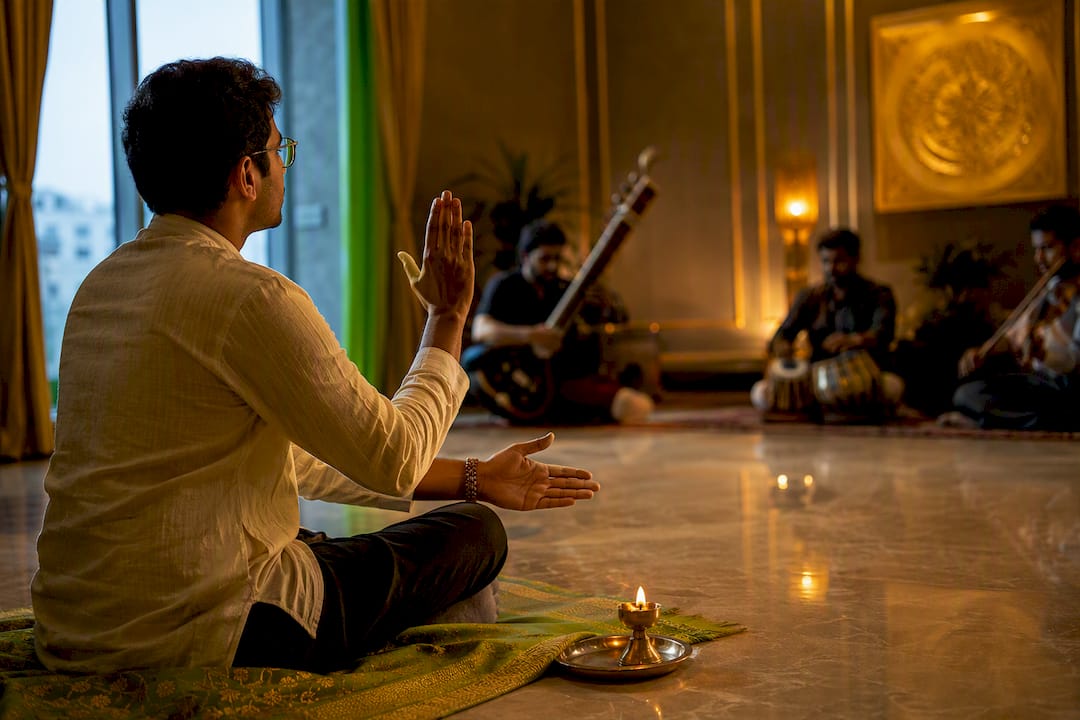
Tala is the cyclical rhythmic framework, or musical meter, that organizes time in Indian classical music. Every tala repeats around a fixed downbeat called the sam, with claps (tali) and waves (khali) marking its internal structure. It has no exact Western equivalent. Hindustani (North Indian) and Carnatic (South Indian) traditions both build on tala, but count and name its parts differently.
TL;DR:
- Tala is a flexible rhythmic framework that features stress patterns, divisions, and return points, making it more complex than Western time signatures.
- Recognizing tala structures like Tintal or Rupak requires identifying the sam, tali, and khali markers, which guide improvisation and performance.
- Carnatic and Hindustani traditions use different counting systems and terminology, with Carnatic favoring vocalized konnakol and Jati-based cycles.
- Practicing tala involves slow counting, vocalization, and visual tools, which help internalize complex asymmetric groupings and improvisational interactions.
- Understanding tala enhances listening skills by revealing how performers embed tension, displacements, and resolutions within a cyclic rhythmic context.
Table of Contents
- What Is Tala? Definition, Etymology, and Why It Matters
- The Core Building Blocks: Sam, Mātrā, Vibhag, Tali, and Khali
- Tala in Hindustani Music: Tintal, Rupak, and Jhaptal
- Tala in Carnatic Music: Suladi Talas, Jati, and Konnakol
- How Tala Shapes Classical Dance
- Practicing Tala: Drills, Improvisation, and the Pull Back to Sam
- A Practical Listening Plan to Train Your Ear
- Practitioner Notes: Teaching Tala the Way It’s Actually Learned
- Where Tala Came From and How It Changed Across Regions
- How Tala Compares to Western and Other Metrical Systems
- Common Roadblocks Students Hit and How to Push Through Them
- Tala in Fusion, Film Scores, and Contemporary Music
- Apps and Tools That Help You Practice Tala
- Why Understanding Tala Changes How You Listen
- Learn Tala Directly Through Sitarrajib’s Lessons and Workshops
- Sources
What Is Tala? Definition, Etymology, and Why It Matters
The word tala (IAST: tāla) comes from Sanskrit, where it means hand-clapping or tapping. That’s not a poetic footnote. It’s the literal origin of how the cycle gets marked in performance, because clapping and waving gestures are how musicians and audiences track a tala in real time, long before anyone learned to read notation. Wikipedia’s overview of tala) traces this etymology and frames tala as the rhythmic cycle governing Indian classical music broadly, across both major traditions.
Tala and raga are the two pillars holding up an Indian classical performance. Raga supplies the melodic material, the mood, the notes you’re allowed to bend and where. Tala supplies the time. Without it, a raga performance would drift formlessly. A tabla or mridangam player isn’t just keeping a beat under the melody. They’re mapping out a repeating architecture the soloist can lean against, push against, and eventually resolve into.
That last point is where a lot of new listeners get it wrong. Tala isn’t wallpaper. Musicians treat it as a creative framework, not a metronome running in the background. An educational piece from Darbar makes exactly this case: tala gives performers room to displace accents, stretch phrases across cycle boundaries, and build tension that only resolves when the cycle returns to sam.
A few common misconceptions worth clearing up early:
- Tala is not a time signature in the Western sense. It doesn’t just tell you the beats per measure. It carries built in stress patterns, “empty” beats, and a fixed return point.
- Tala is not fixed to one tempo. The same 16 beat cycle can be played slow for an alap-driven exploration or fast for a rhythmic finale.
- Tala is not simpler in Carnatic music just because it uses fewer named categories. The counting system is arguably more granular, as you’ll see below.
The Core Building Blocks: Sam, Mātrā, Vibhag, Tali, and Khali
Learn five terms and a tala stops sounding like noise and starts sounding like a map. Here’s what each one does inside the cycle.
- Mātrā is the basic beat, the smallest countable unit in the cycle. A 16 beat tala has 16 mātrās.
- Vibhag is a division, a grouping of mātrās, similar in spirit to a measure. A 16 beat tala might split into four vibhags of four beats each.
- Sam is beat one, the anchor of the entire cycle. It’s the moment melody, rhythm, and often the dancer’s foot all land together. Every improvisation, no matter how far it wanders, is built to resolve back at sam.
- Tali marks a vibhag with a clap. It signals “this division is stressed.”
- Khali marks a vibhag with a wave of the hand instead of a clap, signaling an unstressed or “empty” division, a deliberate release of tension rather than an absence of rhythm.
Put those together and you get a shape, not just a count. A tala’s personality comes from where the tali and khali fall, not from the beat total alone. Two talas can share a beat count and still feel completely different depending on how the vibhags are grouped and accented.
On the percussion side, tabla and mridangam players speak this structure through bols, the spoken syllables (dha, dhin, ta, na, and so on) that correspond to specific drum strokes. Carnatic vocal percussion uses a parallel system called konnakol, where syllables are recited rather than played. Written notation marks vibhag boundaries and tali/khali placement above the beat numbers, which is worth exploring if you want to follow a written breakdown of Indian rhythmic notation alongside a recording.
Pro Tip: Clap the tali beats and just turn your palm up for khali while listening to any tala based recording. Doing this for even five minutes trains your hand to anticipate sam faster than passive listening ever will.
Tala in Hindustani Music: Tintal, Rupak, and Jhaptal
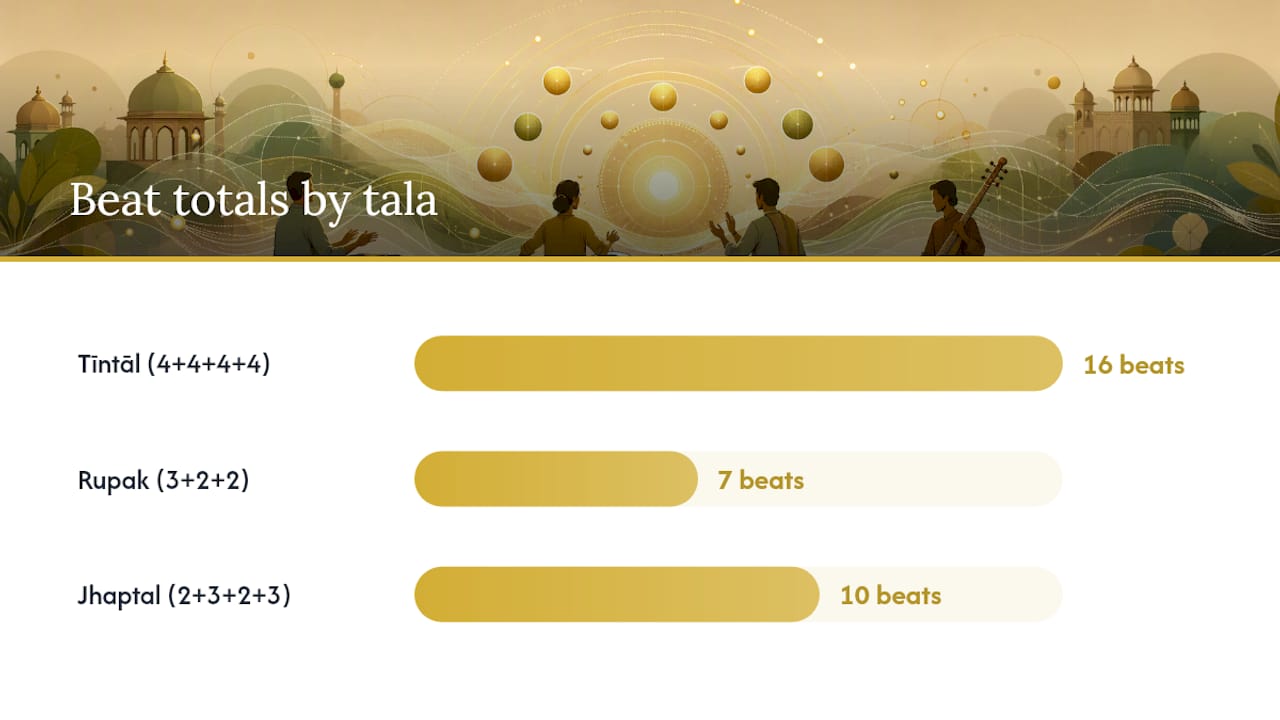
Tīntāl, sometimes spelled Tintal, is the most commonly encountered tala in North Indian classical music, and for good reason. It runs 16 beats, split into four vibhags of four (4+4+4+4), with a tali–tali–khali–tali pattern across those divisions. DigiTabla’s reference on Tintal lays out exactly this structure, and notes it’s the backbone of countless instrumental and vocal performances, which is why some musicians nickname it the “master tal.” Its symmetry makes it forgiving for beginners to count, while its khali on the third vibhag gives soloists a clear structural landmark to play against.
Not every Hindustani tala is that even. Rupak runs just 7 beats, grouped as 3+2+2, and it opens with khali rather than tali, an unusual choice that throws newcomers off until they internalize it. Jhaptal runs 10 beats, grouped 2+3+2+3, with tali–tali–khali–tali across its four vibhags. Both show how tala variety comes from asymmetric groupings, not just different beat totals.
Underneath any of these sits the theka, the fixed cycle of bols a tabla player uses to state the tala’s identity. Tintal’s theka runs “Dha Dhin Dhin Dha / Dha Dhin Dhin Dha / Dha Tin Tin Ta / Ta Dhin Dhin Dha,” and you can hear the khali vibhag immediately, because the stroke on “Ta” is deliberately softer and open, lacking the resonant bass of “Dha.”
When you sit down to listen for this, focus on three things in order:
- Find sam first. It’s usually where the soloist’s phrase lands hardest and the tabla resets its pattern.
- Track the claps. Tali beats tend to get slightly more rhythmic weight from every instrument, not just the drum.
- Notice the khali. It should feel like a breath, a lighter texture, right before the pattern builds back toward sam.
Tala in Carnatic Music: Suladi Talas, Jati, and Konnakol
Carnatic music counts tala with a different vocabulary built from three unit types. Anudrutam is a single beat. Drutam is two beats, counted as a clap followed by a wave. Laghu is variable, ranging from three to seven beats depending on something called jati, a numerical classifier applied to that particular tala.
Combine those units in fixed sequences and you get the suladi talas, the seven foundational cycles of the Carnatic system: Dhruva, Matya, Rupaka, Jhampa, Triputa, Ata, and Eka. Britannica’s entry on tala names all seven and identifies Adi tala, a variant of Triputa built on a laghu of eight, as the most widely used pattern in South Indian performance today. That same source notes talas across both traditions can range from 3 beats up to a sprawling 128, which gives you a sense of how much rhythmic real estate this system covers.
Where Carnatic training pulls ahead in accessibility is konnakol, the practice of vocalizing rhythmic syllables like “ta,” “di,” “gi,” and “na” to internalize a pattern before ever touching an instrument. It’s taught as a performance art in its own right, not just a teaching crutch, and Carnatic vocalists and percussionists often perform konnakol solos that display astonishing rhythmic complexity. CompMusic’s Carnatic tala examples offer recorded demonstrations if you want to hear konnakol applied to real cycles rather than just described.
For a first listen, seek out a recording of Adi tala under a familiar kriti (a composed piece). Try to count the eight beat laghu at the start, then the two drutams of two beats each that follow, for a total of eight.
Pro Tip: Recite “ta ka di mi” on repeat at a slow, even pace before attaching it to any tala. Getting that four syllable phrase locked into muscle memory makes counting laghu of any length far less intimidating.
How Tala Shapes Classical Dance
In Bharatanatyam and related classical dance forms, tala isn’t background music the dancer happens to move to. It’s the literal timing grid for footwork, called adavus, and for the narrative gesture work known as abhinaya. Wikipedia’s coverage of tala notes this coordinating function directly: the metrical structure syncs dance movement to the accompanying rhythm, beat for beat.
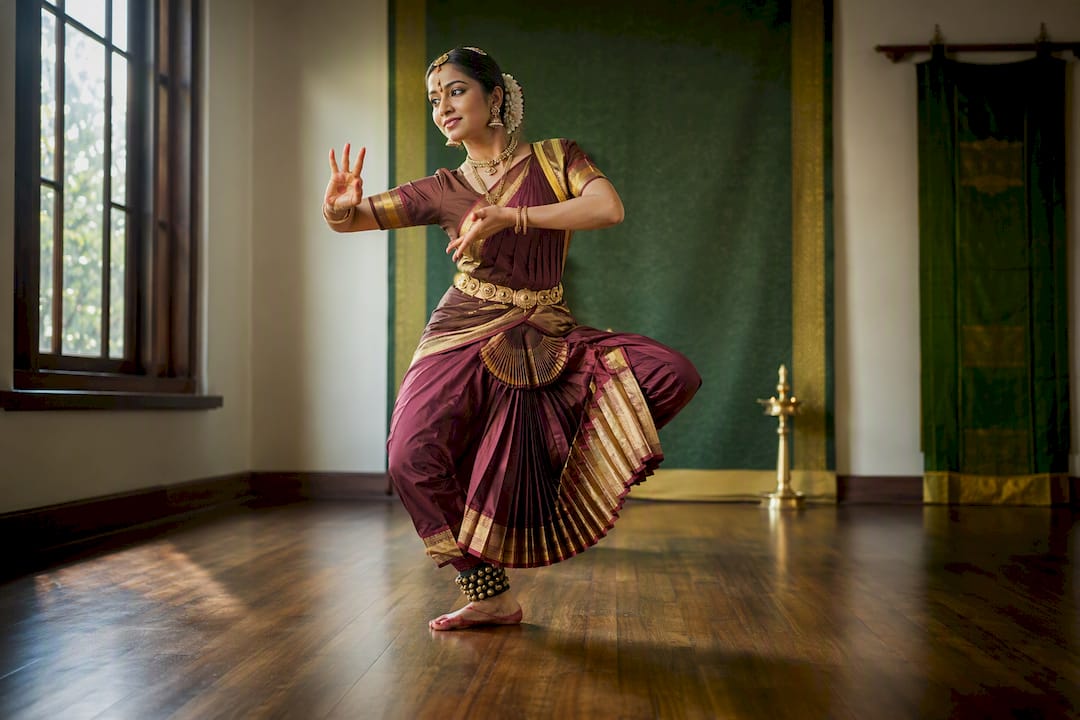
Adi tala shows up constantly in Bharatanatyam repertoire because its eight beat structure divides cleanly for footwork patterns that build in complexity across repetitions. Dancers often mark tali audibly with their own feet or a handheld cymbal called nattuvangam, played by the choreographer or a supporting musician standing beside them, while khali gets marked with a quieter gesture or a held pose.
A few things help dancers, and dance watchers, lock into the cycle:
- Watch the feet on sam specifically. A strong stamp or full weight shift there is rarely accidental.
- Listen for the nattuvangam syllables (the spoken jatis like “tat tat thai”) running alongside the dance, since they’re reciting the same rhythmic pattern the feet are executing.
- Practice counting the tala out loud while walking through adavus slowly, before adding speed.
Practicing Tala: Drills, Improvisation, and the Pull Back to Sam
Counting tala well starts embarrassingly slow, and that’s by design. Here’s a practice sequence worth building from scratch:
- Count without an instrument. Just clap tali and wave khali on a simple tala like Tintal, out loud, until the pattern feels automatic rather than calculated.
- Add konnakol or bols. Recite the syllables for the tala’s theka, matching your voice to where a tabla player’s hands would strike.
- Substitute a metronome loop for a drone or simple tabla theka. A plain metronome click can’t show you tali and khali. A recorded theka can, and it forces you to hear the accent pattern rather than just count numbers.
- Practice re-entry after distraction. Deliberately look away or think about something else for four beats, then find your way back to sam. This mimics what improvisation demands.
Accompanists use exactly this skill during a real performance. A tabla or mridangam player states the theka clearly at first, then signals divisions through subtle variations in the bols, giving the soloist constant reference points without breaking the flow.
The most striking use of tala happens in improvisation, where soloists intentionally play against the cycle. A musician might phrase a melodic idea in groupings of five across a 16 beat tala, creating a cross rhythm that sounds unmoored, almost like it’s drifting away from the pulse. Britannica’s account of tala practice describes this directly: performers use cyclic structure and internal stress patterns, then introduce displacements that only resolve at sam, generating exactly the tension and release that makes a tala performance thrilling rather than mechanical. That resolution, the instant everything snaps back into alignment on beat one, is often the loudest applause moment in an entire concert.
Pro Tip: If you’re new to spotting cross rhythms, don’t try to count the “wrong” pattern the soloist is playing. Just keep clapping the tala’s own tali and khali steadily. The moment of resolution will announce itself.
A Practical Listening Plan to Train Your Ear
Reading about tala only gets you so far. The gap closes fast once you start listening with a specific job in mind rather than just enjoying the music passively.
Here’s a listening progression that works whether you’re brand new or already play an instrument:
- Start with a clean Tintal performance, ideally a solo sitar or sarod piece where the tabla theka is audible and unhurried. Listen once just for sam.
- Move to a vocal Carnatic kriti in Adi tala. Listen for the laghu (eight beats) followed by two drutams, and try clapping along.
- Find a fast tabla solo (tabla tarang or a jhala section). These sections deliberately speed toward sam, and hearing the crowd’s reaction on arrival tells you exactly where the cycle resets.
- Try a Rupak tala vocal piece. Its 7 beat, khali-first structure will feel disorienting at first. That’s the point. It trains your ear away from assuming every tala starts with a clap.
A simple home exercise ties this together in four steps: identify sam by watching for where the performers visibly reset, clap along to mark each vibhag once you’ve found the grouping, try reciting basic konnakol syllables over a slow cycle, and finally loop a short section of a recording to repeat the exercise until the pattern feels obvious rather than effortful.
One detail from the research worth remembering: talas documented across Indian classical music span from just 3 beats to as many as 128, which means the listening skill you’re building here scales. Master a 16 beat cycle and a 7 beat one, and the underlying logic transfers even to cycles you’ve never encountered.
A tanpura drone playing steadily in the background, even a simple recorded one, gives your ear a fixed reference point while you practice clapping vibhags, which makes the counting noticeably easier than working against silence.
Practitioner Notes: Teaching Tala the Way It’s Actually Learned
Teaching tala to a new student is different from explaining it. Rajib Karmakar, an internationally performing sitarist and educator, builds lessons around a sequence that starts with clapping alone, no instrument, until a student’s hands find the tali and khali without thinking about them. Only then does konnakol enter the lesson, followed by the sitar itself.
One drill Rajib returns to often: have a student clap a 16 beat Tintal cycle while he deliberately plays a phrase that crosses the vibhag lines, landing his resolution one beat early or late before correcting on the next cycle. Students who can keep clapping steadily through that disorientation, without losing sam, have genuinely internalized the tala rather than just memorized its count.
A moment from performance sums up why this matters. During a fast jhala passage, when a soloist’s phrasing seems to drift entirely away from the beat, the audience’s applause at the exact instant everything resolves on sam is the clearest proof that tala isn’t background structure. It’s the whole point of the tension. Understanding how improvisation actually interacts with structure changes how you hear that moment forever.
Where Tala Came From and How It Changed Across Regions
Tala’s roots stretch back through centuries of Sanskrit musical treatises, where rhythmic theory developed alongside raga theory as twin pillars of a shared classical system. Over time, that shared root split into two distinct practices as North and South Indian music diverged, shaped by different court patronage, different instruments, and centuries of relative separation between regional traditions.
Hindustani music, influenced heavily by Persian and Central Asian court culture starting roughly in the medieval period, developed its tabla based theka system and named talas like Tintal, Rupak, and Jhaptal that emphasize symmetric or near symmetric groupings. Carnatic music, retaining a more continuous line back to older Sanskrit rhythmic theory, developed the anudrutam, drutam, and laghu framework with its jati based flexibility, producing the seven suladi talas as a more systematized, almost mathematical approach to cycle construction.
Regional variation didn’t stop at the Hindustani, Carnatic divide either. Folk and devotional traditions across the subcontinent, from Sufi qawwali rhythms to temple percussion ensembles, developed their own cyclic conventions that borrowed from classical tala theory without adopting it wholesale. Even within Hindustani music, gharanas (stylistic lineages centered on particular teaching families) sometimes favor certain talas or slight variations in theka phrasing, which is part of why two tabla players can render the “same” Tintal theka with audibly different character.
How Tala Compares to Western and Other Metrical Systems
A Western time signature like 4/4 tells you beats per measure and which beat gets stressed by convention, usually the first. Tala does something structurally different. It’s a repeating cycle with built in stress and release points, tali and khali, that are compositional features rather than performance defaults. There’s no direct equivalent to khali, a deliberately unstressed division marked by an actual physical gesture, in standard Western notation.
The asymmetry runs deeper too. A 4/4 measure repeats identically every time. A tala’s internal groupings, like Rupak’s 3+2+2 or Jhaptal’s 2+3+2+3, create a lopsided internal rhythm that a listener trained only on even Western meters can find genuinely disorienting on first exposure. Tala’s cyclical nature and lack of a precise Western equivalent comes specifically from this combination of asymmetric grouping and the deliberate use of “empty” beats as an artistic device, not an accident of counting.
Other global traditions share some kinship with tala’s logic. West African polyrhythmic drumming and certain Balkan folk meters (Bulgarian dance rhythms in 7 or 11, for instance) also build music around asymmetric, cyclic groupings rather than uniform measures. None of them map onto tala exactly, but the comparison is useful for Western trained musicians: if you’ve ever counted a Balkan 7 beat dance tune, you already have a head start on hearing Rupak.
Common Roadblocks Students Hit and How to Push Through Them
Almost every new tala student hits the same handful of walls, and knowing they’re normal helps more than any amount of extra counting.
The first wall is losing sam during improvisation sections, especially fast ones. The fix isn’t counting faster. It’s practicing the re-entry drill described earlier, deliberately losing the count on purpose during slow practice so re-finding sam becomes a trained reflex rather than a panic response.
The second wall is confusing khali with simply being lost. Because khali removes the clap, students sometimes assume they’ve missed a beat rather than recognizing an intentional wave. Practicing with a recording where you can see a performer’s hands, rather than audio alone, clears this up fast.
The third wall is asymmetric talas like Rupak feeling arbitrary. They’re not. Their groupings follow the same jati logic as Carnatic laghus, just applied within Hindustani conventions. Once a student sees the pattern as designed rather than random, the resistance usually drops.
The fourth wall, common among instrumentalists specifically, is treating tala as the tabla player’s job alone. Every melodic phrase should be composed and improvised with tala’s shape in mind, not layered on top of it as an afterthought.
Tala in Fusion, Film Scores, and Contemporary Music
Contemporary composers working across Indian classical and global genres treat tala as a flexible compositional tool rather than a rigid rulebook. A fusion arrangement might state Tintal’s 16 beat cycle clearly in the percussion while layering a Western drum kit playing straight 4/4 subdivisions underneath, letting listeners feel both systems simultaneously without either one canceling the other out.
Film and media composition leans on this same flexibility. A cue built around Adi tala’s eight beat structure can underscore a scene’s emotional pacing while still syncing to picture edits cut on Western time. Composers who understand both systems fluently, rather than treating tala as decorative “world music” texture, produce scores that feel structurally coherent rather than pasted together. Licensing and scoring work involving Indian classical elements increasingly asks for exactly this kind of fluency.
Jazz and electronic producers have also borrowed tala concepts, particularly the idea of odd, asymmetric groupings as a source of rhythmic interest, without necessarily adopting the full theka or bol vocabulary. The influence runs both directions too. Younger Indian classical musicians trained in both systems often bring polyrhythmic ideas from jazz back into their improvisation over traditional talas, creating cross rhythms that would have sounded unusual a generation ago but now register as an accepted extension of the tension and release logic tala has always built in.
Apps and Tools That Help You Practice Tala
A physical tabla or mridangam player is still the richest way to internalize tala, but a handful of digital tools fill the gap between lessons. Basic tala counting apps display the vibhag structure visually, showing tali and khali markers as the beat progresses, which helps when you’re practicing alone and need a visual anchor instead of a teacher’s hand gestures.
Loop based apps that let you slow down a recording without pitch distortion are especially useful for tala practice specifically, because slowing a fast jhala passage down to half speed reveals the underlying vibhag structure that’s nearly impossible to track at full tempo. Metronome apps with customizable accent patterns can approximate a tali/khali structure too, though they can’t replicate the qualitative texture difference a real drum stroke provides between a stressed and unstressed beat.
Recording yourself clapping along to a known tala and reviewing the playback is arguably still the most effective low-tech tool available, since it exposes exactly where your count drifts relative to the actual cycle. None of these tools replace guided instruction, but they make solo practice between lessons far more productive than counting blind.
Why Understanding Tala Changes How You Listen
Learning to hear sam, tali, and khali didn’t just teach me terminology. It changed what I notice in a performance entirely. The moment a soloist resolves a displaced phrase back onto beat one used to sound like a nice musical flourish to me. Now it sounds like the entire point of everything that came before it.
If you’ve made it this far, don’t stop at reading. Pull up a recording tonight and just clap along. Better yet, if you want that internalization to happen faster and with real feedback, consider structured lessons or a workshop built around exactly this kind of practice.
— Rajib
Learn Tala Directly Through Sitarrajib’s Lessons and Workshops
Reading about vibhags and tali patterns only gets you partway. Real progress happens when someone corrects your clap in real time, which is exactly what private instruction with Sitarrajib offers over solo app based practice: direct, personalized correction from a working performer rather than a generic drill sequence.
Rajib Karmakar teaches private sitar lessons that build tala counting into every session from the very first class, alongside konnakol coaching for students who want to internalize rhythm vocally before ever touching a string. Workshops cover tala fundamentals for groups, including listeners who don’t play an instrument but want to genuinely hear what’s happening in a performance. Event organizers and festival planners exploring how sitar fits into festival programming will also find tala literate performance a natural fit for culturally engaged audiences.
If you want guided practice rather than another article, reach out to book a private lesson or ask about upcoming workshop dates.
Sources
- tala | Indian Classical, Rhythmic Cycles, Percussion — Britannica
- Tintal — DigiTabla
- What is Tala? Beyond just Rhythm and Providing a Beat — Darbar