
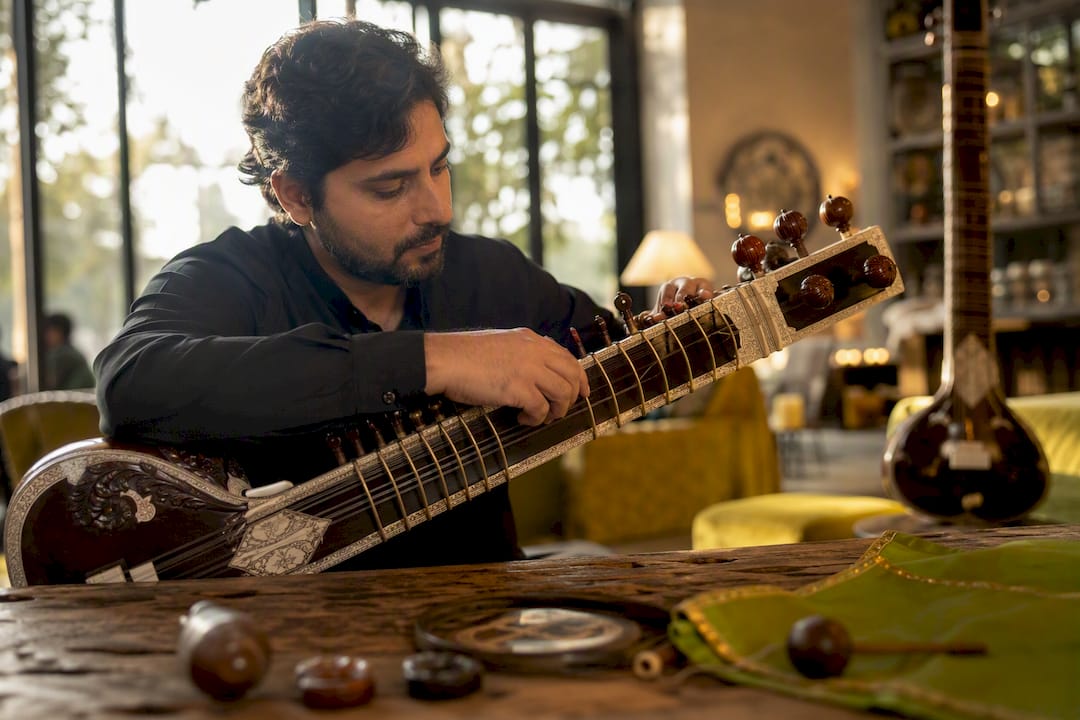
Yes, online sitar lessons work. Live one-on-one lessons and structured, level-based courses produce the fastest technical progress because they give you direct correction and a clear path from posture to raga. A trial lesson or a syllabus built around mizrab technique and meend is the right next step, and platforms like SITARRAJIB make that path concrete from day one.
TL;DR:
- Live one-on-one lessons are essential for precise technique correction, especially during the first year when hand position and mizrab stroke matter most.
- Structured syllabi typically outline clear milestones across beginner, intermediate, and advanced stages, focusing on posture, meend, improvisation, and performance skills.
- Weekly practice should range from 15 minutes for maintenance to over an hour for faster progress, with daily consistency key to developing fluency.
- Teacher credentials and a documented guru lineage, alongside sample lessons and detailed syllabus, are crucial for choosing a quality instructor.
- Online lessons work best with proper camera angles showing both hands, recording follow-ups, and regular milestone setting to maintain motivation and track improvement.
Table of Contents
- Which online sitar lesson format fits you?
- What do beginner, intermediate, and advanced courses cover?
- How do online sitar lessons actually run week to week?
- How much practice do you need, and how fast will you improve?
- What do online sitar lessons typically cost?
- How do you choose an online sitar teacher without guessing?
- What does SITARRAJIB’s online sitar program include?
- What separates a good sitar teacher’s style from a mediocre one?
- How do you stay engaged in an online sitar class?
- Which platforms offer online sitar lessons, and how do they differ?
- What common problems do online sitar students run into?
- Can you find community and peer support learning sitar online?
- Teacher’s perspective: what actually improves an online lesson
- Ready to book an online sitar lesson with SITARRAJIB?
- Sources
Which online sitar lesson format fits you?
Not every lesson format serves the same goal, and picking the wrong one wastes months. Live 1:1 sessions give you real-time correction on hand position and mizrab stroke, which matters most in your first year. Group classes cost less and build listening skills through shared talas, but they slow individual correction. Prerecorded courses work for theory and raga structure, though they cannot fix a wrist angle that’s slightly off. Hybrid formats, blending a weekly live session with recorded practice material, tend to give you the best of both without the price tag of daily 1:1 time.
- Live 1:1: best for technique correction, posture, and building a relationship with a teacher who tracks your specific weaknesses.
- Group lessons: better value, useful for rhythm and ensemble sense, weaker for individual finger correction.
- Prerecorded courses: good for revisiting raga theory and tala counting on your own schedule.
- Hybrid: a live session plus recorded lesson access, which is what most academy-style level-based courses now offer.
Most teachers who run structured programs will offer a trial lesson before you commit, along with a written syllabus outline so you know exactly what months one through six actually cover.
What do beginner, intermediate, and advanced courses cover?
A real syllabus reads like a map, not a mood board. Here’s what each stage typically demands, based on how academy-style progressive curricula sequence skills from posture through performance.
- Beginner (months 1 to 4): Sitting posture, tuning the instrument, basic mizrab stroke (da and ra), simple talas like Teentaal, and your first alankars (melodic patterns). Weekly milestone: play a clean five-note phrase without buzzing strings.
- Intermediate (months 5 to 12): Meend (string bending for pitch glide), improvisation frameworks built on a single raga, faster gats (fixed compositions), and exposure to three or four ragas beyond your first. Weekly milestone: complete a full gat in Teentaal without dropping tempo.
- Advanced (year 2 and beyond): Concert-length repertoire, advanced ornamentation layered over faster talas, complex tala cycles like Jhaptaal or Rupak, and preparation for either a live recital or a studio recording session. Weekly milestone: perform a 10 to 15 minute set with alap, jor, and gat sections.
Practice exercises shift accordingly. A beginner drills string-crossing patterns daily for a short focused period. An intermediate student works meend against a tanpura drone. An advanced student records a gat and listens back for timing drift, a habit borrowed directly from studio prep work. If you want a deeper look at how phrasing develops at the top end, the alap technique guide breaks down the opening movement most advanced students eventually perform.
How do online sitar lessons actually run week to week?
The mechanics are simpler than most beginners expect. You need a laptop or tablet, a stable internet connection, and a camera positioned to show both hands clearly, not just your face. Teachers running serious programs will ask for two angles when possible: one showing the left hand on the fretboard, one showing the right-hand mizrab stroke. A close camera on the mizrab hand can actually clarify finger position more precisely than a crowded in-person classroom, since the teacher can zoom in within an inch of your fingers instead of squinting across a room.
A typical lesson follows a simple rhythm: the teacher demonstrates a phrase, you play it back, they correct in real time, and you leave with a specific assignment for the week. Many teachers also record the session or upload a follow-up clip, so you can rewatch a tricky passage instead of relying on memory. Written notation often comes attached too, particularly for talas and gats that are easier to read than to recall by ear. The Indian music notation guide is worth bookmarking if you’re new to reading bols and sargam.
- Camera setup: two angles if possible, one for each hand.
- Lesson flow: demonstration, playback, correction, assignment.
- Follow-up materials: recordings, notation, and sometimes a written practice log.
- Scheduling: weekly slots booked around your timezone, with most academies offering evening options for students overseas.
Pro Tip: Record your own practice on the same device every week. Comparing this week’s clip to last week’s is the fastest way to see progress you’d otherwise miss day to day.
How much practice do you need, and how fast will you improve?
Progress on sitar is a function of practice quality more than raw hours, but you still need a baseline. A practical practice plan looks like this:
- 15 minutes a day (minimum): tuning, basic mizrab drills, and one tala cycle. Enough to maintain skills between lessons, not enough to advance quickly.
- 30 minutes a day: the above plus a short alankar routine and repetition of your current gat. This is the range most steady learners settle into.
- 60 minutes a day: full warm-up, technique drills, raga-specific improvisation practice, and recording review. This is where faster progress happens, especially for adults with prior musical training on another instrument.
Consistent daily riyaz paired with weekly lessons is the standard advice across teachers and platforms, and for good reason: sitar technique degrades quickly without daily string contact. Expect your first clean melody within about a month, basic raga fluency developing over several months, and performance-ready repertoire only after a year or more of consistent work. Prior musical training accelerates all of this, sometimes cutting timelines by a third, while inconsistent lesson frequency is the single biggest thing that slows students down.
What do online sitar lessons typically cost?
Pricing varies more by teacher experience than by platform. Hourly private lessons commonly range from budget rates for newer teachers to premium rates for senior performers with a strong lineage. Bundle pricing, buying eight or twelve lessons at once, usually knocks a meaningful percentage off the hourly rate. Subscription models, a flat monthly fee for weekly sessions plus recorded access, have become common at academy-style programs.
- Pay-as-you-go: flexible but usually the most expensive per lesson.
- Lesson bundles: better value, common on teaching marketplaces that let you book blocks of sessions.
- Monthly subscriptions: predictable cost, often includes recordings and community access.
Higher fees usually buy you more than just a bigger name. They tend to include performance coaching, recording-session guidance, and access to a teacher with a documented lineage rather than someone self-taught from videos. A quick way to judge value: compare what’s included, not just the hourly number. A $30 lesson with no recordings and no syllabus can cost you more time than a $50 lesson that hands you a clear roadmap. For a full local breakdown of typical rates, the sitar lesson cost guide covers specifics worth checking before you commit to a package.
How do you choose an online sitar teacher without guessing?
Vetting a teacher takes fifteen minutes if you know what to check. Skipping this step is how students end up stuck for six months with a teacher who can’t actually explain why their meend sounds flat.
- Check credentials and lineage. Ask who they trained under and for how long. A teacher with a documented guru lineage will answer this without hesitation.
- Request a sample lesson recording. Watching five minutes of an actual lesson tells you more than any bio page.
- Ask about the trial policy. Reputable teaching platforms and independent teachers alike commonly offer a free or discounted first session.
- Get syllabus specifics. Vague answers like “we’ll see how it goes” are a warning sign. You want month-by-month or level-by-level detail.
- Ask about recital or recording opportunities. Teachers who prepare students for real performance outcomes tend to structure lessons more rigorously.
- Confirm refund or cancellation terms before paying for a bundle.
Red flags to disqualify a teacher immediately: no verifiable lineage, refusal to provide any sample video, and no written syllabus of any kind.
Pro Tip: Ask two teachers the exact same syllabus question and compare the answers side by side. The difference in specificity usually tells you everything you need to know before you spend a dollar.
What does SITARRAJIB’s online sitar program include?
Rajib Karmakar teaches from a performance background, not just a classroom one, which shows up in how the syllabus is structured. Lessons are built around the same level-based progression outlined earlier: posture and mizrab fundamentals, then meend and improvisation, then concert and recording preparation for students heading toward a recital or a studio session.
- Structured, level-based syllabus with clear milestones at each stage.
- Lesson recordings provided so you can review technique between sessions.
- Recording-session prep drawn directly from studio work, useful if you ever plan to record your own playing.
- Performance coaching aimed at students preparing for a first recital, not just casual practice.
Because Rajib performs and records professionally, the recording guidance carries real production context, not just classroom theory. Students preparing for their own sessions can get a sense of what that looks like in the sitar recording techniques guide, which draws on the same studio approach used in lesson curriculum.
What separates a good sitar teacher’s style from a mediocre one?

Credentials matter, but teaching style is what determines whether those credentials translate into your progress. A teacher with a strong lineage who can’t break down why your mizrab stroke sounds harsh is less useful than a moderately credentialed teacher who catches the exact wrist angle causing the problem.
Look for teachers who explain the mechanics behind a correction rather than just demonstrating the fix and moving on. “Angle your wrist ten degrees lower” is more useful over time than “watch me and copy.” Teaching style also shows up in pacing: some teachers move fast and expect you to catch up between lessons, while others build in more repetition. Neither approach is wrong, but mismatched pacing is a common reason students quit within the first three months.
Lineage still matters for a specific reason: it usually indicates years of disciplined training under a senior musician, which shapes how a teacher hears and corrects subtle timing or pitch issues. A teacher who trained for a decade under a recognized guru will typically catch problems in your meend or gamak that a self-taught instructor might miss entirely. Ask directly who someone studied under, and for how long, before you commit to a course.
How do you stay engaged in an online sitar class?

Online lessons fail for the same reason online workouts fail: nobody’s standing over your shoulder between sessions. A few habits close that gap. Warm up with the same five-minute routine every single time, since consistency trains your fingers faster than variety does at the beginner stage. Record yourself weekly and actually watch the playback, comparing it to the previous week rather than to a professional recording, which only discourages you.
Set a single, specific goal for each week instead of a vague one. “Play the gat cleanly at a slightly faster tempo” beats “get better at gats.” Ask your teacher for a short assignment you can point to and say “I did this” by next lesson. Vague assignments produce vague practice.
Use the recorded lessons your teacher provides as targeted review tools, not passive rewatches. Pause on the exact moment a correction happens and mimic it in slow motion before attempting full speed. This single habit accounts for more of the difference between fast and slow learners than raw practice time does.
Which platforms offer online sitar lessons, and how do they differ?
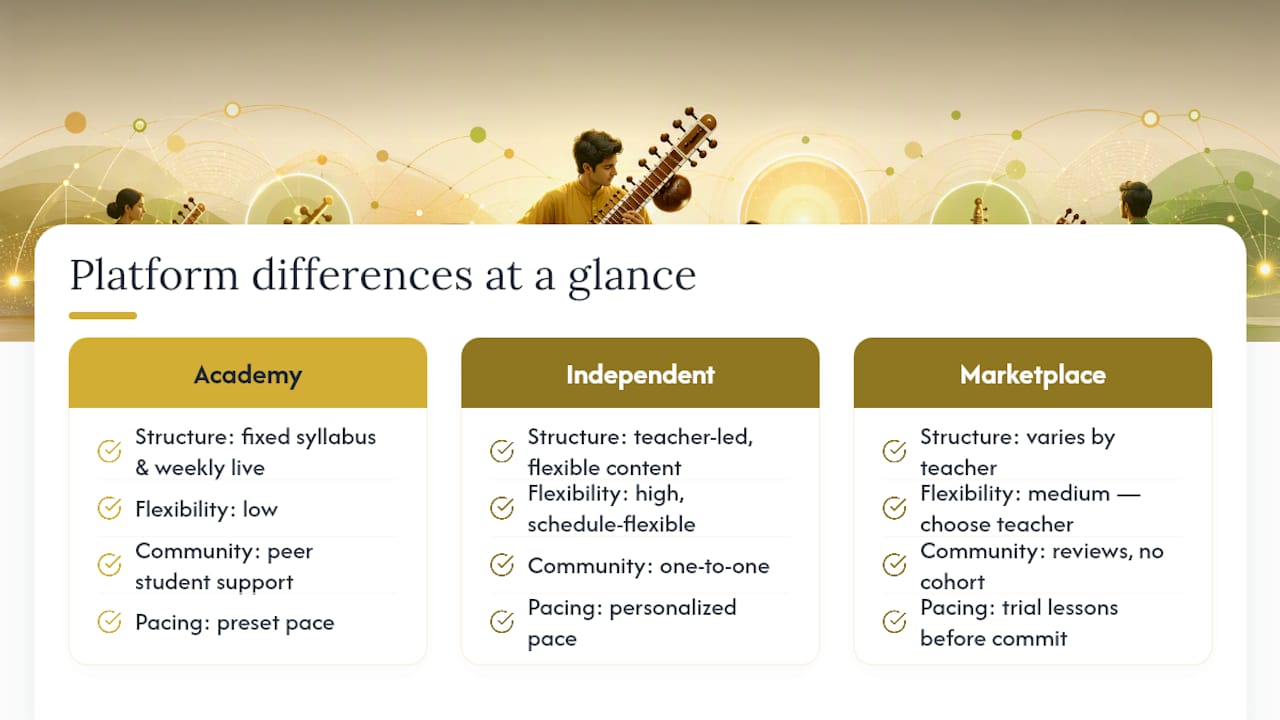
Academy-style programs, independent teacher websites, and general music-lesson marketplaces each solve a slightly different problem. Academy programs tend to offer the most structure: a fixed syllabus, weekly live sessions, recorded lesson access, and sometimes a student community for peer support. They suit students who want a clear path without having to assemble one themselves.
Independent teacher sites, run by individual performers, offer more personalized pacing and often more flexibility around scheduling and lesson content, since you’re working directly with one person rather than a curriculum committee. General marketplaces solve a different problem entirely: they let you compare multiple teacher profiles, read teacher-set rates, and book a trial lesson before committing, which is useful if you’re still deciding what kind of teacher or teaching style fits you.
None of these formats is universally better. A structured academy suits a student who wants zero decisions to make about what comes next. A marketplace suits a student who wants to shop around first. An independent performer-teacher, the model SITARRAJIB follows, suits a student who wants training grounded in actual concert and recording experience rather than a generic curriculum alone.
What common problems do online sitar students run into?
The most frequent complaint isn’t technology, it’s motivation drift around month three, once the novelty wears off and progress feels slower than expected. Fix this by setting weekly milestones instead of vague long-term goals, so you have something concrete to measure against every seven days.
Camera angle problems come second. Students often show their face clearly and their hands poorly, which defeats the entire purpose of live correction. Position your camera to show both hands before every lesson starts, not just when the teacher asks.
Timezone friction affects international students specifically. Booking a fixed weekly slot rather than rebooking ad hoc each week reduces the scheduling back and forth that causes missed lessons. Audio lag or poor connection quality is the third common issue. A wired connection over Wi-Fi, when possible, solves most of this instantly.
Finally, many students underestimate how much correction depends on sound quality. A cheap microphone can mask exactly the pitch and tone issues a teacher needs to hear. If your setup allows it, a basic external microphone improves lesson value more than almost any other single upgrade.
Can you find community and peer support learning sitar online?
Learning an instrument alone can feel isolating, and sitar’s steep early learning curve makes that worse if you never hear how other students are progressing. Several academy programs address this directly by running private student groups, often through WhatsApp or similar tools, where students share recordings, ask questions between lessons, and sometimes organize informal practice sessions together.
Peer feedback works differently than teacher feedback. A fellow beginner might not catch a technical flaw, but they’ll notice when a phrase sounds musical, which matters just as much. Group classes offer a built-in version of this, since you’re playing alongside others every week and absorbing their corrections along with your own.
If your course or teacher doesn’t offer a formal community space, ask directly. Most are happy to connect students informally, even if it’s not advertised on the course page. A short recital, even an informal one over video call with two or three other students, tends to accelerate confidence faster than months of solo practice ever could.
Teacher’s perspective: what actually improves an online lesson
Angle your camera so the mizrab hand is visible, not just your torso. Warm up the same way every session, five minutes, no shortcuts. Rewatch recorded lessons in slow motion and mimic the exact correction moment rather than skimming the whole clip. Before your first recital or recording, treat mistakes as information, not failure. The students who improve fastest are the ones who record themselves constantly and stop comparing week one to year three.
— Rajib
Ready to book an online sitar lesson with SITARRAJIB?
If you’ve read this far, you already know what separates a real lesson from a video subscription: live correction, a syllabus you can see, and a teacher who’s actually performed the repertoire they’re teaching. SITARRAJIB gives you all three, plus something most online programs skip entirely: recording-session coaching from someone who scores film and studio work professionally, not just teaches from a textbook.
A trial lesson with Rajib Karmakar covers a short technique assessment, a look at your current posture and mizrab stroke, and a walkthrough of what a level-appropriate syllabus would look like for you specifically. Pricing depends on lesson frequency and whether you choose single sessions or a bundle. If you’re aiming toward a recital, a recording, or just want structured progress without guessing what comes next, start by checking available dates and course details on the festival and lesson programming page and reach out to book your first session.
Sources
- Online Sitar Lessons: Learn From The Pioneer
- Learn to Play Sitar with Srijanee Banerjee (Darbar Academy)
- Sitar Lessons | Sitar Teachers & Tutors Online | Lessonface
- Online Sitar Classes near me | Sitar Lessons Online – ipassio