
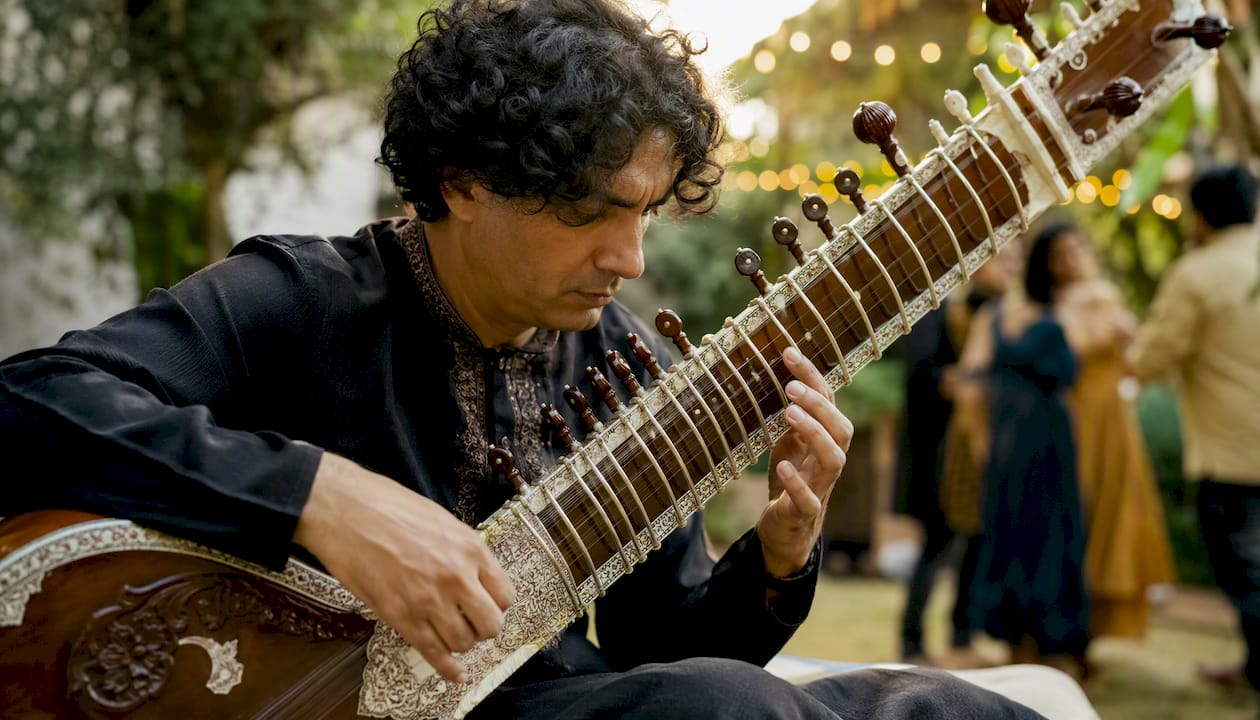
A multicultural entertainment act is a live performance or workshop that draws on two or more distinct cultural traditions, presented by practitioners with genuine ties to those traditions. You hire one when your event has a diversity or inclusion objective, marks a cultural celebration, serves a mixed-heritage audience, or needs programming that goes beyond standard entertainment to create real community connection. UNESCO’s 2003 Convention identifies performing arts and social practices as living expressions of intangible cultural heritage, which gives multicultural acts both artistic and educational weight. Artists like Rajib Karmakar (Sitarrajib) and projects like Andrea Ariel Dance Theatre’s Borderless show what this looks like in practice.
An act qualifies as multicultural when it includes most of these elements:
- Mixed traditions: two or more cultural forms in a single program or set
- Living practitioners: artists with authentic community ties, not surface-level costume
- Multilingual or participatory elements: audience interaction, translated program notes, or language-inclusive design
- Fusion or crossover formats: intentional blending of instruments, movement styles, or theatrical conventions
- Educational framing: context that helps audiences understand what they are witnessing
Key Takeaways
A multicultural entertainment act delivers the most value when it combines authentic cultural practice, respectful programming, and clear logistical planning from the first booking conversation.
| Point | Details |
|---|---|
| Definition | A multicultural act draws on two or more cultural traditions, presented by practitioners with genuine community ties. |
| Top principles | Prioritize authenticity and fair pay; always provide cultural context through program notes or MC framing. |
| Booking lead time | Standard lead times appropriate for event complexity: single acts require advance notice, longer for multiple acts or festivals. For example, 8–12 weeks is typical for a single act, with 16–20 weeks for larger or festival-scale bookings. |
| Evaluation checklist | Request a bio, video samples, rider, insurance certificate, and a statement of cultural practice before signing. |
| Sitarrajib | Rajib Karmakar offers live sitar performances, workshops, and fusion sets for corporate, festival, and educational events across the U.S. |
Table of Contents
- What types of multicultural performance formats can you book?
- Why do multicultural acts strengthen your event?
- How do you program multicultural acts respectfully?
- What logistics do you need to plan?
- How do you evaluate and brief an act?
- Sample program templates for common event formats
- Real examples organizers can learn from
- What legal and permissions issues should you know?
- A practitioner’s perspective on booking multicultural acts
- Sitarrajib brings multicultural programming to your event
- Sources
What types of multicultural performance formats can you book?
Formats vary widely, and the right choice depends on your event goals, venue, and audience size.
Traditional single-culture performance presents one cultural form with full artistic integrity, such as a classical Indian sitar recital or a West African drum ensemble. It works well when you want depth over breadth.
Fusion and crossover sets blend two or more traditions into a single performance. Fusion entertainment curated to your audience can increase engagement across demographic groups, though it requires careful production planning to avoid diluting cultural meaning. Sitarrajib’s cross-genre music fusion sets are a strong example of this approach.
Multidisciplinary multicultural theatre weaves music, dance, and narrative across cultural lines. Borderless by Andrea Ariel Dance Theatre (June 28–29, 2024) did exactly this, combining diverse choreographers and live musicians to explore identity and connection in a unified program.
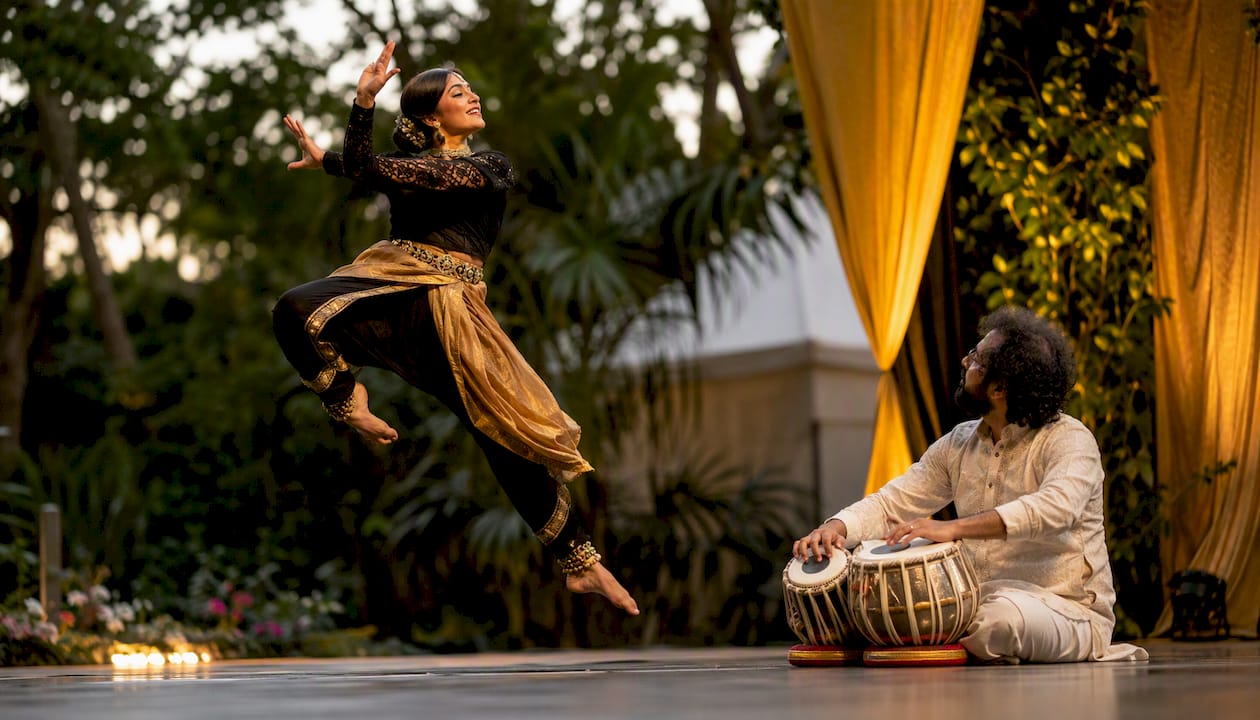
Participatory and audience-led works put the audience inside the performance. The Choreography offers multilingual audio instructions so participants collectively create the piece without needing a shared spoken language. This model suits corporate team events, school assemblies, and community festivals.
Workshop plus performance combos pair a short educational session with a live set. Asé Shakerz, a student African dance troupe, uses this model in campus multicultural programming to explore cultural preservation and legacy.
| Format | Best for | Audience size | Budget shape | Technical needs | Participation level | Community involvement |
|---|---|---|---|---|---|---|
| Traditional single-culture | Cultural galas, ceremonies | Small to medium | Flat fee per performance | Standard PA, instrument care | Performer-only | High: living tradition bearer |
| Fusion/crossover set | Corporate receptions, festivals | Medium to large | Flat fee or per-hour | Expanded backline, mixing board | Low to moderate | Moderate: curated blend |
| Multicultural theatre | Arts festivals, galas | Medium | Project fee | Full stage, lighting, rehearsal time | Moderate | High: multiple community partners |
| Participatory/audience-led | School assemblies, team events | Small to medium | Per-person or flat | Audio distribution, open floor space | Full participatory | Moderate: facilitator-led |
| Workshop + performance | Education, community outreach | Small to medium | Per-hour or half-day | Minimal: open space, basic PA | High | High: practitioner-led |
Why do multicultural acts strengthen your event?
Cultural practices reaffirm group identity, and when audiences witness living cultural memory through gestures, songs, or dance, they connect to something larger than the event itself. That is the core benefit. For planners, it maps to concrete outcomes:
- Audience engagement: participatory and fusion formats hold attention longer than passive entertainment
- Inclusivity signal: programming that reflects your audience’s backgrounds builds trust and belonging
- Education and awareness: acts with contextual framing teach without lecturing
- Brand and community relations: multicultural programming signals social commitment to sponsors, press, and community partners
- Unique experience value: attendees remember culturally specific performances more readily than generic entertainment
ROI signals worth tracking: post-event survey scores on “felt included,” social media mentions tagging the performer or cultural tradition, and dwell time near the performance area.
Citywide multicultural festivals like Harlem Welcomes the World show how mixed-format staging, combining workshops, short sets, and community-led activities, maximizes both reach and learning at scale.
How do you program multicultural acts respectfully?
The core principle: prioritize community authenticity and performer agency before anything else. Scholars describe multicultural performance as a social and political bridge that creates legitimized access between communities, but only when presented with contextual care.
Practical rules to follow:
- Consent and credit: confirm the artist has the right to perform and teach the tradition they represent; credit them fully in all materials
- Community partnership: where possible, involve local cultural organizations in curation, not just performance
- Fair pay: pay cultural artists at market rate; do not treat cultural programming as a discount category
- Contextualization: provide program notes or an MC introduction that explains the tradition’s origin and significance
- Language and accessibility: offer translated materials, captioning, or ASL interpretation where your audience needs it
- Venue inclusivity: confirm the space accommodates the cultural requirements of the act (prayer space, instrument storage, dietary needs)
Pro Tip: To verify authenticity, ask the artist for lineage documentation, community endorsements, and links to documented projects like Borderless. Workshop experience is a strong signal: artists who can teach a tradition usually have deeper roots in it than those who only perform it.
Community co-creation, where local cultural groups help shape the program, produces more resonant results than extractive programming, where an organizer simply hires a performer and moves on. Structure honoraria to reflect the full scope of work: performance, preparation, travel, and any educational materials the artist provides.
What logistics do you need to plan?
Start planning with sufficient lead time for your event scale, allowing several weeks to several months for booking single acts and larger multi-act or festival programs. Core items to lock in early: confirmed fee, signed contract, technical rider, hospitality, and travel or visa needs for international artists.
| Planning item | Details |
|---|---|
| Booking lead time | Standard lead times appropriate for event complexity: single acts require advance notice, longer for multiple acts or festivals |
| Fee models | Flat fee per performance, per-hour rate, per-person workshop fee, or project-based for bespoke composition |
| Budget tiers | Fees vary widely depending on artist scope, ensemble size, and event type; budget accordingly for community acts through professional touring artists |
| Core technical needs | PA system, monitor mix, stage space, instrument storage, blackout capability for theatre formats |
| Rider items | Backline spec, dedicated dressing room, specific microphone or DI requirements, hospitality (water, dietary needs), load-in window |
Fee drivers include artist pedigree, ensemble size, travel distance, bespoke composition requirements, and whether the booking includes a workshop component. A solo sitar artist with a workshop add-on will cost more than a straight performance, but the educational value often justifies the difference for school or corporate bookings.
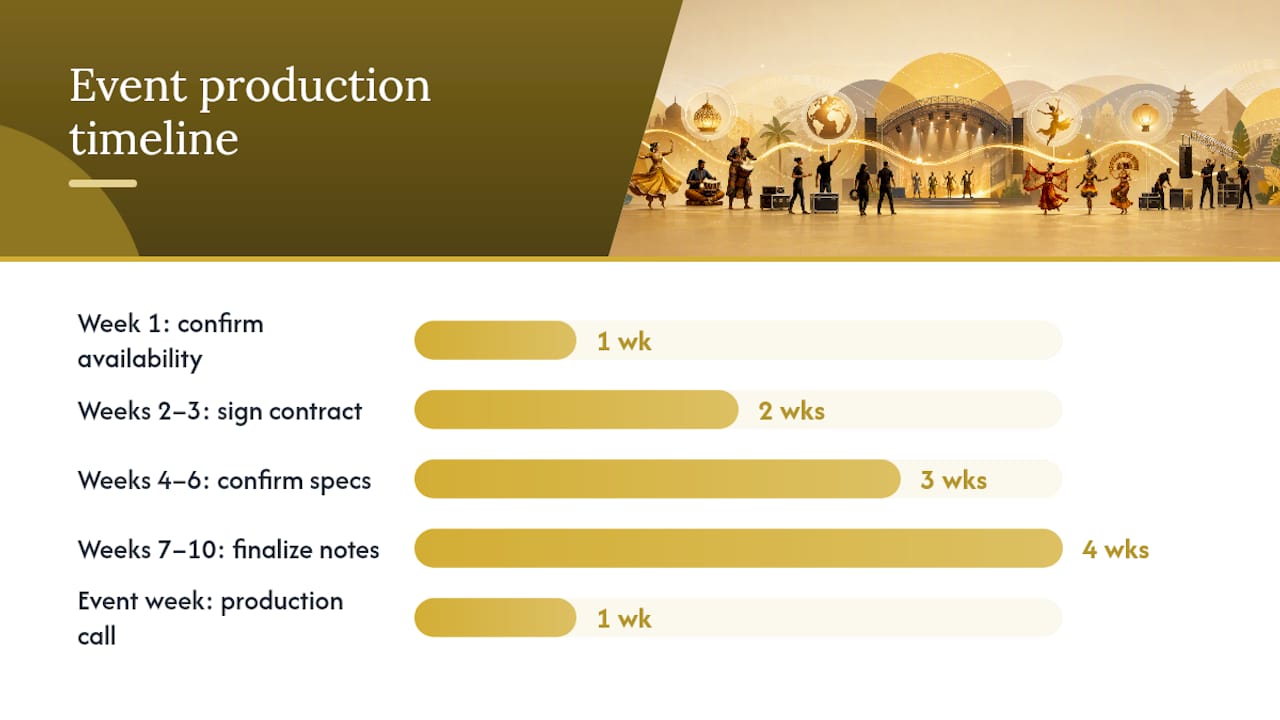
Timeline milestones to track:
- Week 1: confirm availability and negotiate fee
- Week 2–3: sign contract, collect rider and insurance certificate
- Week 4–6: share event brief, confirm technical specs with production team
- Week 7–10: finalize program notes, MC script, and accessibility materials
- Week of event: production call, load-in, soundcheck, rehearsal window
Note on budget: workshop-plus-performance combos often qualify for arts education grants or cultural programming funds, which can offset costs significantly.
How do you evaluate and brief an act?
Key evaluation criteria: artistic authenticity, production fit, accessibility, engagement style, and documented workshop capability.
Credentials and proof to request:
- Artist bio with lineage or training background
- Video samples (minimum two: one performance, one workshop or educational setting)
- Technical rider and insurance certificate
- References from comparable events
- Sample workshop outline if education is part of the brief
- Statement of cultural practice or community endorsement
Sample briefing template:
- Event overview: name, date, venue, expected attendance, event type
- Objectives: what you want the audience to feel, learn, or do
- Audience profile: age range, cultural backgrounds, accessibility needs
- Technical specs: stage size, PA setup, load-in time
- Honorarium: total fee, payment schedule, expense coverage
- Deliverables: performance length, workshop duration, program notes
- Timeline: soundcheck time, performance slot, load-out
- Contact points: production manager, day-of coordinator
Accessibility checklist:
- Captioning or live transcription available?
- ASL interpretation arranged?
- Program notes in multiple languages?
- MC introduction scripted to contextualize cultural content?
- Venue physically accessible for performers and audience?
Sample program templates for common event formats
Choose the template that matches your audience and event objective, then adjust timing to your venue’s constraints.
Gala (formal program, 200–500 guests):
- Pre-reception: 20-minute ambient cultural music set (no amplification needed)
- Opening program: 15-minute featured cultural performance with MC introduction
- Dinner: background fusion set, 45–60 minutes
- Transition buffer: 10 minutes between sets
Festival stage (outdoor or multi-stage, 500+ guests):
- Opening set: 25–30 minutes, single-culture or fusion act
- Artist talk or Q&A: 10 minutes
- Tech turnaround: 15–20 minutes before next act
- Workshop tent: 45-minute parallel session for smaller groups
Corporate reception (50–200 guests):
- Ambient fusion performance running 60–90 minutes as guests arrive and network
- No formal stage required; floor-level setup increases intimacy
- Brief MC introduction at the 30-minute mark to contextualize the music
School assembly (interactive, 30–150 students):
- 10-minute performance to open and capture attention
- 20-minute participatory workshop: students learn a rhythm, movement, or phrase
- 5-minute closing performance incorporating what students just learned
For any format, brief your MC with two to three sentences of cultural context per act. Audiences who understand what they are watching engage more deeply and are less likely to misread cultural cues.
Real examples organizers can learn from
Documented projects give you a reference point for scale, objectives, and outcomes.
Borderless (Austin, TX, June 2024): A large-scale collaborative multicultural dance-theatre program featuring diverse choreographers and ensembles. The key logistical note: multiple artistic partners require a longer rehearsal window and a clear curatorial lead. Lesson: assign one producer to manage cross-cultural coordination so artistic decisions stay coherent.
Asé Shakerz (campus multicultural programming): A student African dance troupe whose storyline centers on cultural preservation and legacy in a university setting. Logistical note: student troupes often need more technical support than professional ensembles. Lesson: budget extra time for soundcheck and confirm the troupe’s own technical requirements early.
The Choreography (participatory, multilingual): An audience-participation model where multilingual audio instructions make every attendee a performer. Logistical note: requires open floor space and audio distribution equipment. Lesson: participatory formats need clear facilitation and a pre-event briefing for front-of-house staff.
Sitarrajib (artist-led sitar performance and workshop, Los Angeles): Rajib Karmakar offers live sitar performances paired with cultural music workshops for corporate events, festivals, and educational programs. Logistical note: sitar requires a quiet stage environment and a dedicated DI or microphone setup. You can review performance videos and portfolio to evaluate fit before booking.
Multicultural performance works best when the organizer treats the artist as a cultural partner, not a vendor. The most successful bookings start with a conversation about objectives, not a quote request.
What legal and permissions issues should you know?
Most multicultural performance rights in the U.S. are managed through contracts, but a few areas need specific attention.
- Copyright for compositions and arrangements: confirm who owns the music being performed and whether any recordings made at your event require a separate license
- Moral rights and attribution: always credit artists fully in programs, social media, and recordings; some cultural practitioners consider uncredited use a serious breach
- Community permissions for sacred practices: certain dances, songs, or ceremonies require permission from community elders or cultural organizations before public presentation
- Recording and broadcast licenses: if you plan to stream or record the performance, get written consent and confirm any royalty obligations
- Insurance: require a certificate of liability insurance from the artist or their agency before the event date
Pro Tip: When an act involves sacred or ceremonially significant practices, ask the artist for a written statement of practice that confirms community authorization. This protects both the organizer and the artist. For complex cases involving Indigenous or First Nations traditions, consult a cultural IP attorney before contracting.
UNESCO’s intangible cultural heritage framework provides useful language for grant applications and event rationale, particularly when programming involves oral traditions, performing arts, or social practices that communities are actively safeguarding.
In U.S. jurisdiction, most performance rights are contract-based. When in doubt, ask for documented permissions and a written statement of cultural practice from the artist.
A practitioner’s perspective on booking multicultural acts
When an organizer contacts me about a multicultural booking, the first question I ask is: what do you want your audience to walk away feeling? The answer shapes everything, from the set length to whether a workshop makes sense.
A sitar performance works as ambient background, as a featured concert set, or as the anchor for a cultural education program. Each requires a different setup, a different briefing, and a different level of audience preparation. What does not change is the need for a quiet stage, a proper soundcheck window, and an MC introduction that gives the music context.
Dos and don’ts from an artist’s perspective:
- Do share the event brief and audience profile before the contract is signed
- Do provide a dedicated rehearsal or soundcheck window of at least 45 minutes
- Do include program notes that explain the cultural tradition being presented
- Don’t rush the cultural contextualization to save time; it is the difference between an audience that listens and one that connects
- Don’t assume a fusion set requires less preparation than a traditional one; blending traditions well takes more rehearsal, not less
Sitarrajib brings multicultural programming to your event
Sitarrajib offers live sitar performances, cultural music workshops, and curated fusion sets that fit a wide range of event formats, from corporate receptions and galas to school assemblies and festival stages. Each booking is led by Rajib Karmakar, an internationally recognized sitarist and educator based in Los Angeles.
For corporate planners, a sitar performance adds a distinctive cultural layer that generic entertainment cannot replicate. For festival bookers, Sitarrajib’s festival programming experience covers everything from stage logistics to workshop coordination. You can request a rider, view video samples, or get a quote directly at Sitarrajib.
Sources
- UNESCO — Intangible cultural heritage
- Social practices, rituals and festive events — UNESCO ICH
- BORDERLESS — Andrea Ariel Dance Theatre
- The Choreography — interactive performance (Koreografin)
- Asé Shakerz — Definition Theatre listing
- NYC Multicultural Festival — Harlem Welcomes the World
- Why fusion entertainment is the future of live events — Dennis Smith Entertainment
- Hemispheric Institute review essay (Citlali Martinez)