
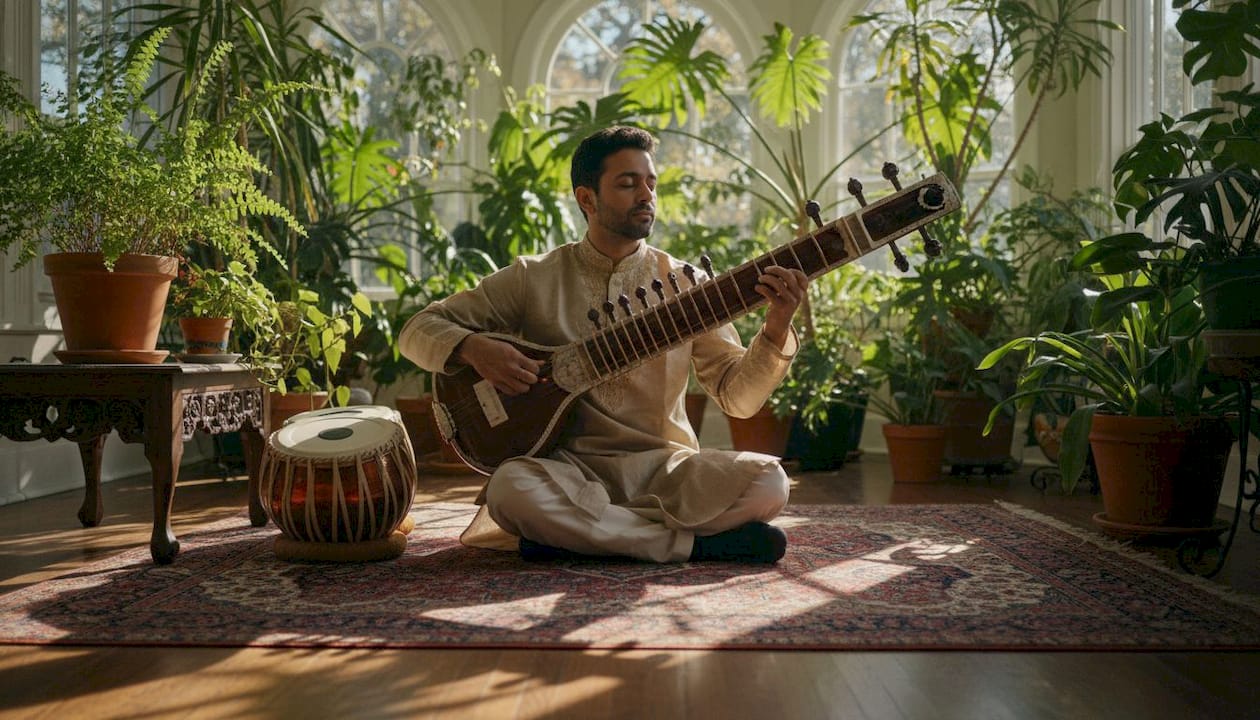
Improvisation in sitar is defined as the spontaneous creation of melodies within the strict grammatical rules of a raga, the melodic framework at the heart of Indian classical music. The formal term for this practice is manodharma sangeet, meaning “music of creative imagination.” Every sitar performance follows the Alap-Jod-Jhala structure, moving through phases of increasing rhythmic density before introducing percussion. The raga governs which notes you can use, how you approach them, and what emotional mood you must sustain. That combination of freedom and discipline is what makes sitar improvisation one of the most demanding and rewarding practices in world music.
What is improvisation in sitar, and how does it work?
Sitar improvisation is not free-form playing. It is a structured creative act where every phrase you invent must fit the raga’s rules: its specific notes, its characteristic phrases called pakad, and its emotional quality called rasa. Think of it as composing and performing at the same time, within a set of laws you have internalized over years of practice.
The raga provides the grammar. You provide the sentences. A raga like Yaman uses a raised fourth (tivra Ma) and carries a mood of longing and beauty. Every phrase you create in Yaman must honor that raised fourth and that emotional color. Violating those rules does not produce creative freedom. It produces a different raga, or no raga at all.
This is why understanding sitar improvisation requires you to first understand raga grammar. The Indian music notation system, based on swaras (the seven notes Sa Re Ga Ma Pa Dha Ni), gives each raga its identity. Mastering that system is the foundation on which all improvisation rests.
What are the main phases of sitar improvisation in performance?
A sitar recital follows a clear arc. The Alap-Jod-Jhala phase consumes 40–50% of total performance time and is played entirely without percussion. That is a significant portion of the concert dedicated to pure melodic exploration.
Phase I: Alap, Jod, and Jhala
The Alap opens the performance. It is slow, meditative, and completely free of rhythm. You introduce the raga note by note, phrase by phrase, letting the audience absorb its character. No tabla, no fixed beat. Just melody and silence.
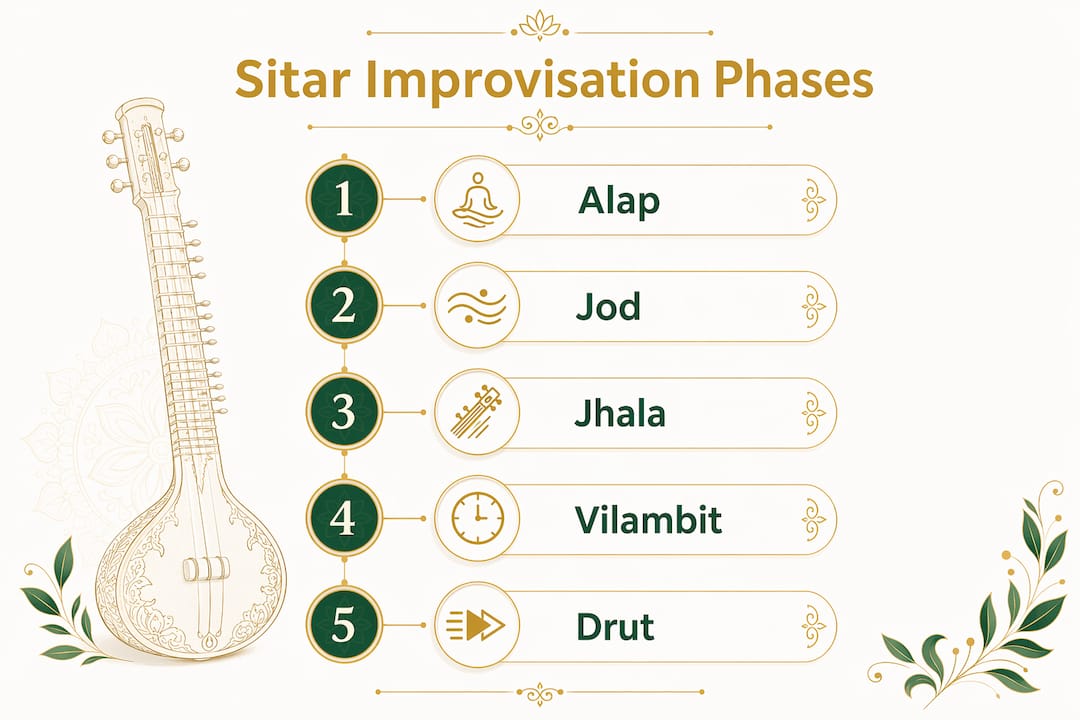
Jod follows. Here you add a rhythmic pulse by striking the chikari drone strings in a steady pattern. The tempo is still moderate, but the music gains momentum. Jhala is the climax of Phase I. It is fast, dense, and exhilarating, with rapid alternation between melody strings and drone strings creating a wall of sound.
Phase II and III: Compositions with percussion
After Jhala, the tabla player joins. Phase II introduces a slow-tempo composition called vilambit, played at 45–60 bpm. This gives you space to develop long, elaborate improvisations around the fixed composition. Phase III is the drut section, where the tempo exceeds 150 bpm and can reach over 300 bpm in the final passages. The improvisations here are shorter and more rhythmically intense.
| Phase | Name | Percussion | Tempo |
|---|---|---|---|
| I-A | Alap | None | Free (no fixed tempo) |
| I-B | Jod | None | Moderate pulse |
| I-C | Jhala | None | Fast |
| II | Vilambit composition | Tabla | 45–60 bpm |
| III | Drut composition | Tabla | 150–300+ bpm |
Pro Tip: Practice the mental shift between Jhala and vilambit deliberately. The jump from fast, percussion-free playing to slow, tabla-accompanied performance is one of the hardest transitions in a sitar recital.
Which techniques define how to improvise on sitar?
Sitar improvisation relies on a specific set of physical techniques called tantrakari, the string techniques unique to the instrument. Mastering these is what separates melodic ideas from actual musical expression.
The core techniques include:
- Mizrab stroke: The plectrum worn on the index finger delivers the primary attack. Controlling its angle and pressure shapes the tone of every note you improvise.
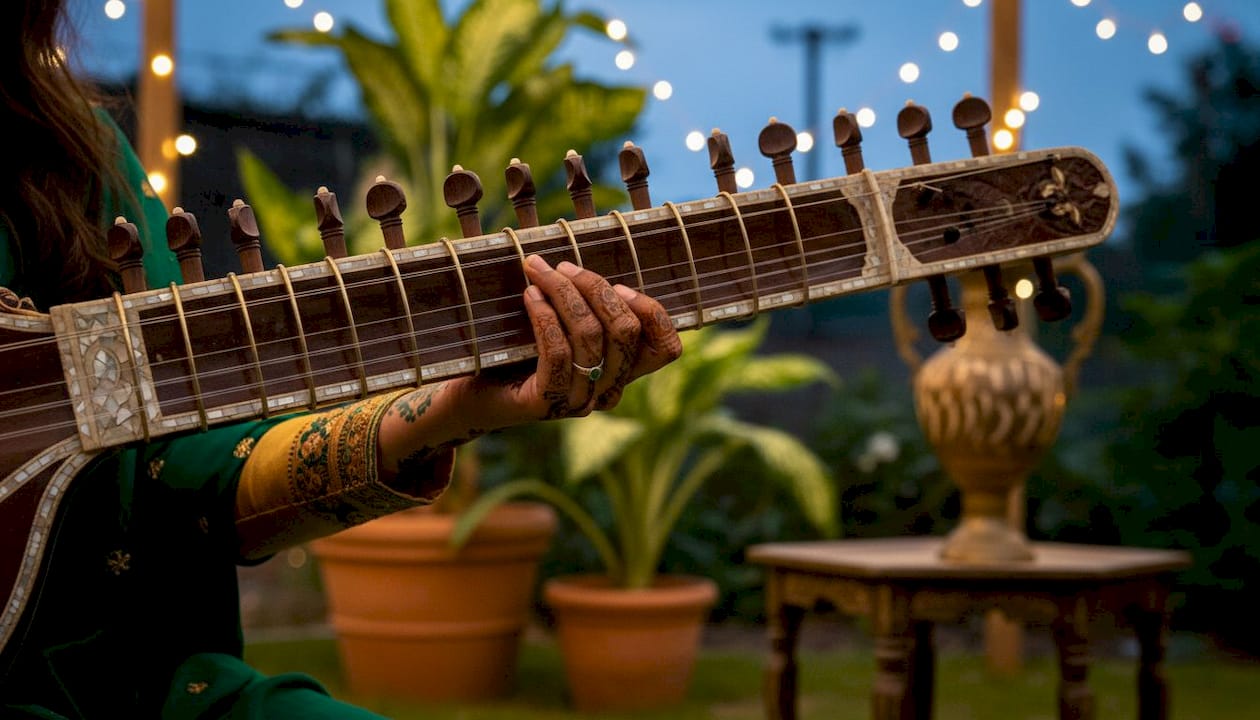
- Meend (glides): Meend requires pulling the string laterally across the fret to slide between pitches. It gives the sitar its characteristic vocal quality. Mastering meend means developing fingertip strength and specialized calluses, starting with small intervals before attempting wide glides.
- Krintan: A hammer-on and pull-off technique that produces rapid ornamental figures without repeated mizrab strokes. It adds a vocal, breath-like quality to phrases.
- Murki: A fast, tight ornament that decorates a single note with quick neighboring tones. Both krintan and murki add vocal phrasing to the sitar’s melodic lines.
- Sympathetic strings (taraf): The sitar has 11–13 sympathetic strings running beneath the main strings. They resonate with the notes you play, adding harmonic depth. Controlling their resonance is critical. Improper damping of taraf strings causes sonic muddiness during fast passages.
Rhythmic improvisation, called Layakari, adds another layer. Layakari involves doubling (dugun) and tripling (tigun) note durations within a fixed tala cycle, plus polyrhythmic patterns that create tension against the tabla’s beat. Modern artists extend this further with unconventional talas and polyrhythmic layering.
Pro Tip: When practicing Layakari, use a tanpura drone and a metronome simultaneously. The drone keeps you in the raga; the metronome keeps your rhythmic subdivisions honest.
How does sitar improvisation balance freedom and discipline?
The biggest misconception about sitar improvisation is that it is spontaneous in the way jazz free improvisation is spontaneous. It is not. True improvisation is a disciplined narrative within raga syntax. Even the most spontaneous phrase never violates the raga’s essential melodic rules.
Manodharma sangeet translates literally as “music of the mind’s imagination.” The concept acknowledges creative freedom while placing it firmly inside a grammatical structure. You are free to invent any phrase you like, as long as it belongs to the raga. That constraint is not a limitation. It is the source of the music’s coherence and emotional power.
“Improvisation on the sitar is cognitively one of the most complex forms of creative behavior in music. The musician must simultaneously generate melodies, coordinate with the ensemble, and execute precise fine-motor skills, all in real time.” — Roger E. Beaty, as cited by Darbar
That cognitive load is real. You are managing raga grammar, tala cycles, ensemble communication, and physical technique all at once. Experienced performers describe it as a meditative state where these processes become automatic through years of practice.
Raga Bhairav, for example, uses a flat second (komal Re) and a flat sixth (komal Dha). Every improvised phrase in Bhairav must navigate those flat notes in specific ways. Skipping them or using them incorrectly destroys the raga’s identity and its early-morning devotional mood. The discipline is not arbitrary. It carries centuries of emotional and cultural meaning.
What are the stylistic variations in sitar improvisation?
Sitar improvisation has not stayed static. It has evolved through distinct schools called gharanas and through the influence of individual masters who pushed the instrument’s possibilities.
Key developments in that evolution include:
- Maihar Gharana’s systematization: The Maihar Gharana shifted sitar playing from vocal imitation to a fully instrumental approach. It developed long meends, rhythmic structures, and tantrakari techniques specific to the sitar’s physical design.
- Ravi Shankar’s global influence: Ravi Shankar elevated sitar improvisation into a complete solo art form, bringing it to international concert stages and introducing it to audiences unfamiliar with Indian classical music.
- Nikhil Banerjee’s depth: Nikhil Banerjee was known for his meditative Alap and his ability to sustain emotional intensity across long improvisations. His approach emphasized raga grammar over technical display.
- Dhrupad to Khayal transition: Early sitar improvisation drew from the Dhrupad vocal tradition, which is austere and slow. The shift to Khayal style brought more ornamentation, faster compositions, and greater rhythmic variety.
- Contemporary innovations: Today’s sitarists explore cross-genre improvisation, incorporating elements from jazz, classical Western music, and electronic production while maintaining raga structure as the foundation.
The contrast between older and newer approaches is not a conflict. It reflects the living nature of the tradition. Each generation of players adds to the vocabulary without abandoning the grammar.
Key Takeaways
Sitar improvisation is a disciplined creative practice rooted in raga grammar, structured performance phases, and specific physical techniques that together produce expressive, spontaneous music.
| Point | Details |
|---|---|
| Raga grammar is non-negotiable | Every improvised phrase must follow the raga’s note rules, pakad, and emotional rasa. |
| Performance follows a fixed arc | The Alap-Jod-Jhala phase takes 40–50% of concert time before percussion enters. |
| Tantrakari techniques enable expression | Meend, krintan, and mizrab control are the physical tools that translate ideas into sound. |
| Layakari adds rhythmic depth | Doubling and tripling note durations within tala cycles creates the rhythmic tension audiences hear. |
| Gharana tradition shaped modern style | The Maihar Gharana and masters like Ravi Shankar moved sitar from vocal imitation to a full solo art form. |
What I’ve learned about improvisation that most guides won’t tell you
Most people who start learning sitar focus on scales and compositions. That makes sense. But the real shift happens when you stop thinking about what notes to play and start thinking about how to move between them. Meend is where that shift lives. A single glide from Ga to Pa in Raga Yaman, done with the right pressure and speed, carries more emotional weight than a dozen fast runs. That is not an opinion. It is something you feel the first time you get it right.
The sympathetic strings are another thing nobody warns you about adequately. In a quiet room, they sound beautiful. In a fast improvisation, they can turn your best phrases into mud. Learning to damp them with fret-hand pressure during rapid passages is a skill that takes months to develop. Most beginners ignore it until a teacher points it out.
The mental transition from Jhala to vilambit is genuinely hard. You are playing fast and free, then suddenly you have to lock into a slow tala with a tabla player. The Alap-Jod-Jhala phases require a complete mental reset, not just a tempo change. Practicing that transition deliberately, not just playing through it, is what separates performers who sound polished from those who sound like they are still warming up.
My advice for anyone learning how to improvise on sitar: spend more time on fewer ragas. Deep knowledge of Yaman or Bhairav will teach you more about improvisation than surface knowledge of twenty ragas. The raga’s personality becomes your vocabulary. You cannot improvise fluently in a language you barely speak.
Improvisation is a living tradition. Every performance adds something. Every master who came before you left phrases in the air that you can learn from and build on. That continuity is what makes this art form worth the years it takes to develop.
— Rajib
Sitar improvisation in action: what Sitarrajib offers
Rajib Karmakar performs and teaches sitar improvisation at a professional level, drawing on the Maihar Gharana tradition and years of international concert experience.
If you want to hear what structured improvisation sounds like in a real performance context, the live sitar recordings at Sitarrajib capture full raga performances from Alap through drut. For musicians interested in how sitar fits into live programming, the festival performance guide covers the practical side of presenting sitar improvisation to modern audiences. Private lessons and workshops are also available for players who want direct guidance on raga grammar, meend technique, and Layakari. Visit Sitarrajib to explore all available resources and performance options.
FAQ
What is the meaning of manodharma sangeet?
Manodharma sangeet means “music of creative imagination” and refers to improvisation within Indian classical music. It describes the practice of spontaneously creating phrases that follow raga grammar while expressing the performer’s individual creativity.
How long does the Alap phase last in a sitar recital?
The Alap-Jod-Jhala section typically occupies 40–50% of total performance time. The exact length depends on the performer and the concert context, but it is always the longest unaccompanied section of the recital.
What is the difference between Alap and Jod?
Alap is completely free of rhythm, while Jod introduces a steady pulse by striking the chikari drone strings. Both sections are performed without tabla accompaniment.
How do I start learning to improvise on sitar?
Start by mastering one raga deeply, learning its pakad, its note hierarchy, and its emotional character. Practice meend with small intervals before attempting wide glides, and use a metronome when working on Layakari to keep rhythmic subdivisions accurate.
What is Layakari in sitar improvisation?
Layakari is rhythmic improvisation within a fixed tala cycle. It includes techniques like doubling (dugun) and tripling (tigun) note durations, as well as polyrhythmic patterns that create tension and release against the tabla’s beat.