

A music production credit is the formal acknowledgment that a producer oversaw the creative and technical direction of a sound recording. It attaches to the master recording copyright, not the underlying composition, and it determines two things immediately: who gets recognized on a release and who can collect master-side royalties. Credits are the mechanism that connects contributors to royalty systems, including streaming income, performance payments, and sync fees.
Two quick points to keep in mind:
- Master-side income flows to the producer through points (a percentage of master revenue) or an upfront fee, collected through registries like SoundExchange and tracked via platforms like MusicBrainz.
- Songwriting/publishing income is separate. Producers who contribute beats or instrumentals compositionally may also qualify for songwriting royalties, collected through performing rights organizations (PROs) like ASCAP or BMI, and mechanical royalties through the MLC (Mechanical Licensing Collective).
Missing a production credit is not just a bruised ego situation. It can block you from royalty collection entirely.
Table of Contents
- What do master and composition credits actually cover?
- How does a production credit affect what you get paid?
- How do you document and register a production credit?
- What should producers negotiate to protect credits and payment?
- What session musicians and niche instrumentalists need to know
- Key Takeaways
- Why clear credits matter more than most producers realize
- Work with Sitarrajib for sessions, credits, and licensing support
- Useful registries and resources for U.S. producers
What do master and composition credits actually cover?
Producer credits attach to the master recording; songwriter credits attach to the composition. Each copyright generates different royalty streams with different longevity and ownership rules.
| Dimension | Master recording | Composition |
|---|---|---|
| Copyright owner | Label or artist (producer may share) | Songwriter(s) and publisher(s) |
| Royalty streams | Digital performance (SoundExchange), sync master fee, neighboring rights | Performance (ASCAP/BMI), mechanical (MLC), sync publishing fee |
| Primary U.S. registry | SoundExchange | PROs (ASCAP, BMI, SESAC) + MLC |
| Typical producer pay vehicle | Points (2–5% of master revenue) or flat fee | Publishing share (if producer co-wrote) |
| Recoupment risk | Yes, on label deals | Generally no, on publishing side |
SoundExchange handles digital performance royalties on the master side for U.S. sound recordings. The MLC handles mechanical royalties on the composition side for digital streams and downloads. PROs like ASCAP and BMI cover public performance royalties for the composition.
One distinction that trips people up: the master copyright can last longer in practical terms because it is often owned by a label or artist entity, while the composition copyright reverts to the author under U.S. copyright termination rights after 35 years. Ownership structure matters when you negotiate.
Recoupment note: On a label deal, producer points are often subject to recoupment, meaning the label recoups its advance from master royalties before the producer sees backend income. On an independent release, recoupment terms are negotiable or absent entirely.
How does a production credit affect what you get paid?
Producer compensation flows from three sources: upfront fees, backend points, and (when applicable) a publishing share.
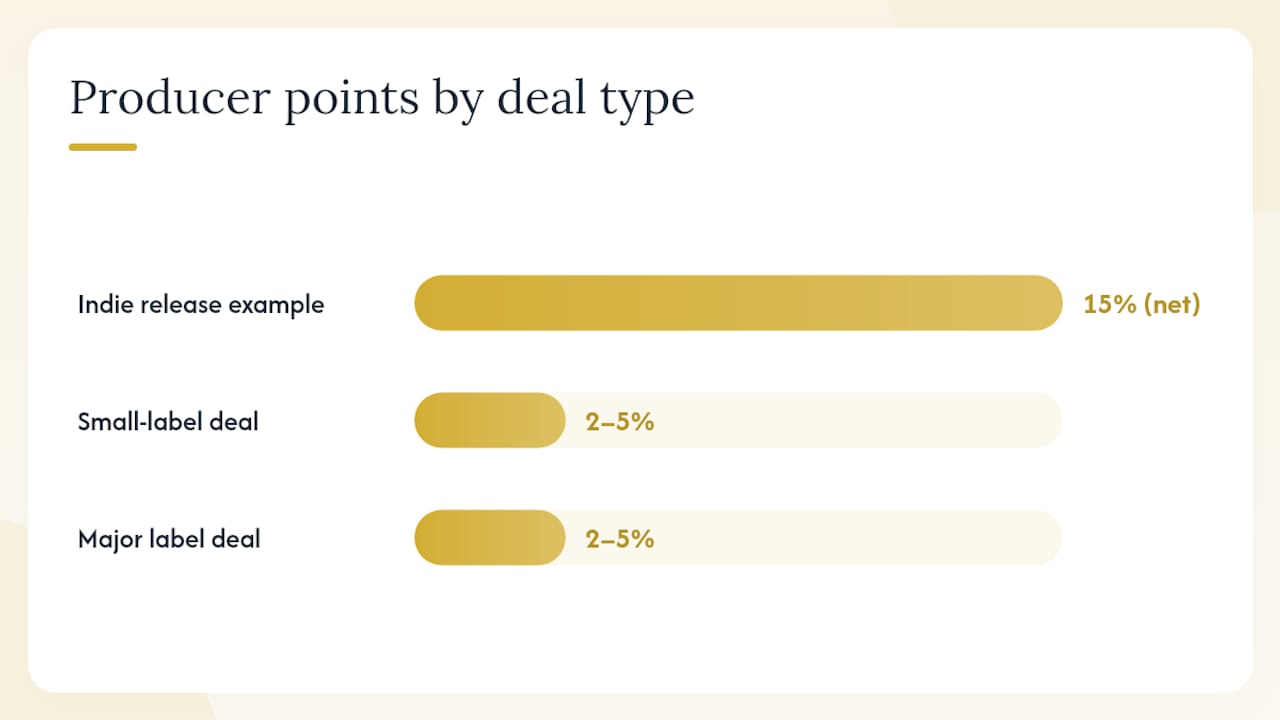
Points are the standard backend mechanism. One point equals 1% of the revenue attributed to the master recording, and industry norms place producer points at 2–5% of master royalties.
| Deal type | Typical producer points | Upfront fee range | Publishing share |
|---|---|---|---|
| Indie release (self-funded) | Varies widely, higher points are possible | Negotiable, often lower | Possible if producer co-wrote |
| Small label deal | 2–5 points | $500 per track | Rarely included |
| Major label deal | 2–5 points (after recoupment) | $5,000 per track | Occasionally, for top producers |
On a major label deal, the label recoups its recording advance from master royalties before the producer receives any backend income. A producer earning 3 points on a release with a $50,000 recording advance will not see backend income until the master generates enough revenue to cover that advance. A Letter of Direction (LOD) is often required to route label payments directly to the producer, and without one, the money may simply stay with the label.
Two quick scenarios:
New producer on an indie release: Takes a $500 flat fee and 15% of net master revenue. No recoupment clause. Registers with SoundExchange directly. Simpler deal, faster payment.
Established producer on a label release: Negotiates a $5,000 upfront fee plus 3 points. Signs an LOD directing the label to pay points to the producer’s designated account. Registers contribution with SoundExchange and confirms metadata with the distributor before release.
Publishing share: If you contributed a melodic hook, a chord progression, or lyrics, negotiate a co-writer credit alongside your producer credit. That opens up a separate royalty stream through ASCAP, BMI, or SESAC, plus mechanical royalties through the MLC. The two streams are additive, not exclusive.
How do you document and register a production credit?
Without a written agreement covering credit language and backend royalties, producers can lose backend income entirely. Documentation is not optional. Here is the step-by-step process:
- Supply accurate metadata to your distributor — Distributor portals (DistroKid, TuneCore, CD Baby, and similar) have fields for producer credits. Fill them in before the release goes live. Correcting metadata post-release is possible but slow, and some platforms cache old data for months.
- Create or update a MusicBrainz entry — MusicBrainz documents standard production credit types and recommends specific relationships for metadata entries. A MusicBrainz entry improves credit visibility across services that pull from its open database, including some streaming platforms and music apps.
Pre-release vs. post-release: Everything through step 7 should happen before the release date. Step 8 is a post-release verification. Catching errors early saves weeks of back-and-forth with distributors.
When preparing metadata for distribution, submitting your track through a platform like Intonality can help you confirm that credit fields are properly formatted before the release goes live.
What should producers negotiate to protect credits and payment?
Use this checklist before signing anything:
- Metadata obligations: — The artist or label must supply accurate producer credits to all distributors and registries within a specified timeframe (typically 30 days before release).
Points vs. upfront fee: Take a higher upfront fee when the release has uncertain commercial prospects or when the recoupment terms are vague. Points pay off on a hit; a flat fee pays off immediately regardless of performance. If the LOD and recoupment language are not clear in the contract, industry insiders recommend taking the higher upfront fee rather than relying on vague backend promises.
Pro Tip: Ask for a “credit audit” clause that gives you the right to review distributor and registry metadata 30 days after release. Most producers never request this, but it is the fastest way to catch missing credits before they become a long-term royalty problem.
What session musicians and niche instrumentalists need to know
Session players, including sitarists, oud players, and other niche instrumentalists, often contribute distinctive elements that shape a recording’s identity. The credit you receive depends entirely on what you contributed and what you negotiated before the session.
Three possible credit outcomes for a session instrumentalist:
- Performance credit (“Sitar performed by [Name]”): Standard for session work. Acknowledges your contribution in metadata and liner notes but does not grant master points or publishing royalties on its own.
- Producer or co-producer credit: Appropriate when you made arrangement decisions, suggested structural changes, or shaped the sonic direction of the track beyond simply playing your part.
- Co-writer credit: Warranted when you improvised a melodic phrase, created a distinctive hook, or contributed a compositional element that became part of the published work. This opens up PRO and MLC royalty streams.
Before any session, document the following:
- A written session agreement specifying your credit line, session fee, and any backend terms.
- A clear description of your contribution (performance only, arrangement input, compositional elements).
- Confirmation that your name will appear in distributor metadata and MusicBrainz under the correct relationship type.
- A clause stating that if your contribution is used in sync placements, your performance credit appears in the sync license documentation.
For producers working with a live sitarist or other niche instrumentalist, the benefits of live session sitar recording go beyond authenticity. A properly credited live session creates a documented contributor record that strengthens the release’s metadata and supports royalty claims across all platforms.
When the instrumentation is culturally specific, accurate metadata is especially important. Platforms that surface world music content rely on contributor data to route the recording to the right audience. Missing or generic credits reduce discoverability and can affect sync licensing opportunities, as music supervisors often search by instrumentation and contributor. For guidance on how Indian classical music fits into film and media licensing, the documentation steps are the same, but the stakes for accurate metadata are higher.
Key Takeaways
A music production credit attaches to the master recording, determines royalty eligibility, and must be documented in a signed agreement and accurate metadata before release to be enforceable.
| Point | Details |
|---|---|
| Production credit definition | Attaches to the master recording; grants recognition and access to master-side royalties. |
| Master vs. composition | Master income flows through SoundExchange and points; composition income flows through PROs, MLC, and publishing. |
| Typical producer pay | Points typically range from 2–5% of master revenue on label deals; indie deals vary widely. |
| Document everything | Get a signed agreement with exact credit wording, an LOD if a label is involved, and confirm metadata before release. |
| Sitarrajib sessions | Rajib Karmakar’s studio sessions include full credit documentation and metadata setup for producers and collaborators. |
Why clear credits matter more than most producers realize
Credits are treated as a formality until money is on the table. Then they become the only thing that matters.
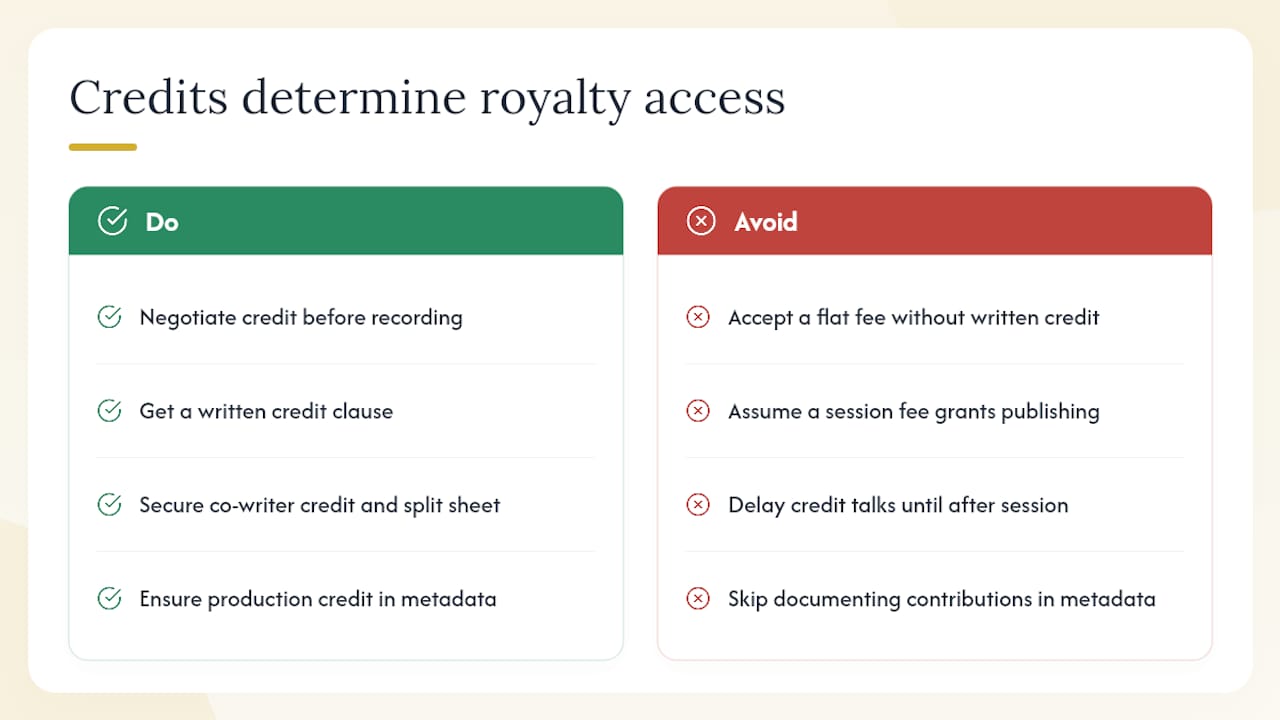
The part most guides skip is this: a production credit is not just about getting your name on a release. It is a legal designation that determines which royalty streams you can access. A producer who accepts a flat fee with no written credit clause has, in practical terms, waived their claim to backend income, because there is no documented basis for a royalty claim. The credit line in the metadata is the paper trail that connects your name to the master, and the master is what SoundExchange, sync licensors, and streaming platforms use to route payments.
Session musicians face a version of this problem that is even more overlooked. A sitarist who improvises a defining melodic phrase on a track has contributed something compositional. Without a co-writer credit and a split sheet, that contribution generates zero publishing royalties, even if the phrase becomes the most recognizable part of the song. The session fee covers the performance. The co-writer credit covers the composition. They are not the same thing, and one does not substitute for the other.
The practical takeaway: negotiate credit language before you play a single note or press record. The conversation is much easier before the session than after.
Work with Sitarrajib for sessions, credits, and licensing support
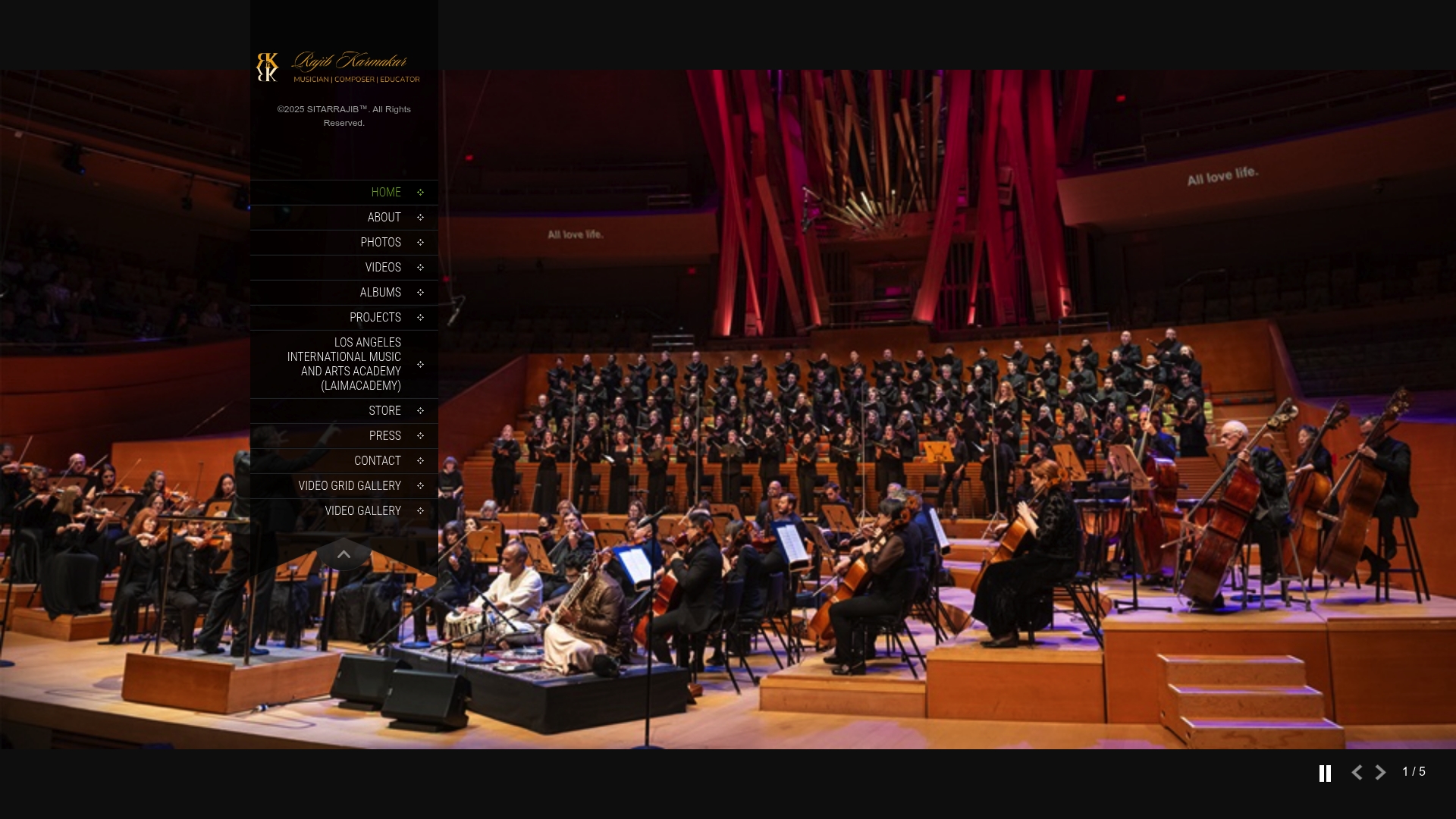
Sitarrajib offers studio session recordings with full credit documentation built into every project. Whether you need an authentic sitar performance for a film score, a media production, or a commercial release, each session includes a written agreement with exact credit wording, metadata preparation for distributor portals and MusicBrainz, and guidance on registering contributions with U.S. royalty organizations.
Available services include:
- Live session sitar recording — with producer-ready stems, ISRC-ready metadata, and credit documentation.
- Sync licensing support — for film, TV, and media placements, including master and composition credit setup.
If you are a producer or music supervisor who needs a properly documented session with a niche instrumentalist, book a live session recording with Sitarrajib and get the credits right from the start. For broader media production needs, the world music sounds guide covers how niche instrumentation fits into U.S. media projects with proper licensing and credit documentation.
Useful registries and resources for U.S. producers
Register your credits and collect your royalties through these primary U.S. organizations:
- Producer Credit – APRA AMCOS
- How Music Credits Work — From Song Credits to Royalty Payments | Credits.fm
- Producer Agreements: What to Include in Every Deal | Songkeeper
- Producer Credits vs. Songwriter Credits Explained | Songkeeper
- 5 Things to Look for in a Music Producer Agreement | Lawyer Drummer
- Music producer | Berklee
- Artist Relationship Guide for Artists – MusicBrainz
- How do producer royalties and points work? | MusicAdmin
- Song Credits Made Simple: A Guide for Artists
Missing metadata is not a minor inconvenience. Credits determine who is eligible for royalties and who receives payments from sync deals. A release with no producer credit in SoundExchange’s system means no digital performance royalties for that producer, regardless of what the contract says. Register before the release date, verify after, and keep copies of every signed agreement.